

Study in Italy for Indian Students
Public tuition is income-banded, so the fee on the university website is rarely the fee you pay. The visa now needs €10,179.85 in traceable funds.

Free check
Less than 2 minutes
Limited intake, 1:1 support
international students trusted us
tuition for qualifying students
English-taught programmes
Italian regions covered
Two things changed this year.
The money you must show for a student visa went from €6,947.33 to €10,179.85 a year, a rise of over 46%. And the tuition you actually pay at a public university has almost nothing to do with the fee printed on the university website. It depends on a document your family files using income from two years ago.
Both facts decide whether Italy works for you. Neither appears correctly on most pages ranking for this topic.
Which admission cycle are you actually applying for right now?
If you are reading this in late 2026, you are almost certainly planning for academic year 2027/28.
Master's and PhD applicants have no national cut-off, but the visa must be issued before teaching starts and universities set their own earlier dates. Working back from a late-September start, a file reaching VFS after early August is already tight.
Some universities run a February intake for selected master's programmes. It is a real option, though the choice is narrow and scholarship rounds rarely align with it.
Which universities in Italy are actually worth applying to?
Italy has around 65 universities in the QS rankings, split between public institutions, a small number of private universities, and separate AFAM academies for art, design and music. Public universities carry the low fees. Private ones carry the higher ones and, in design and business, some of the strongest industry links.
Politecnico di Milano became the first Italian university inside the QS global top 100, and moved to 87th in the 2027 edition.
The headline rank misleads here. Italian universities are specialists with a generalist's reputation. Sapienza and Bologna sit in the 120s and 130s overall, but Sapienza leads the world in classics and Politecnico di Milano sits inside the global top 10 for architecture and design. Check the subject table for your field before you use the overall rank to decide anything.
The courses Indian students actually take: engineering and computer science, data science and AI, management and finance, fashion and product design, architecture, food and agricultural science, and Medicine and Surgery. Design and fashion are where the private institutes, IED and Domus Academy among them, compete seriously with the public system.
Best cities: QS Best Student Cities 2026 places Milan and Rome in the mid-40s globally and Turin in the 60s. Milan is the strongest for jobs and the most expensive by a wide margin. Bologna, Padova and Pavia give you a similar public-university degree at roughly €400 a month less in rent. [Browse Italian universities by course and city →]
Why did the visa bank balance jump to €10,179.85?
MUR and MAECI publish a joint circular every two years setting procedures for non-EU students. The one covering 2026/27 and 2027/28 raised the minimum means of subsistence to €10,179.85 for the year, and separately expects you to cover a return airfare of roughly €500.
Two details matter more than the number.
Traceability. The circular asks consular officers to assess where the money came from, not only that it exists. A balance that appeared three weeks before your appointment, from a source you cannot document, reads as manufactured. Build it over four to six months.
Scholarships count only once awarded. A pending DSU application does not reduce the figure. An issued award letter does.
What counts as proof of funds
- Bank statements for the student or a direct sponsor, usually six months
- Sponsor affidavit with the sponsor's ITR, salary slips or business income proof
- Sanctioned education loan letter from a recognised bank
- An issued scholarship award letter
Italy does not use a blocked account like Germany. That flexibility is also the trap: with no fixed instrument, the burden of proving the money is genuine falls entirely on how you document it.
Is education in Italy really free, or is that a half-truth?
Half-truth, and the half nobody explains is the half that saves you money.
Public universities publish a tuition range, usually €900 to €4,000 a year. That is the ceiling, not the price. Italian law requires public institutions to set fees by family economic condition, measured by an indicator called ISEE. Students whose family income sits outside Italy file the equivalent version, the ISEE Parificato.
Your ISEE Parificato value drops you into a fee band. Most public universities set full exemption somewhere around €22,000 to €26,000 of assessed value, and many Indian middle-income families land under it. Below the threshold you pay only the regional student tax and stamp duty, usually €140 to €200 for the year.
Students who skip the ISEE Parificato are charged the top bracket by default. No exceptions, and most universities will not refund retroactively.
What your family in India needs to prepare
The assessment uses income and assets from two calendar years before the academic year. For 2027/28 that means calendar year 2025. Start collecting now:
- Family composition certificate listing every household member
- Income proof for each earning member for the reference year: ITR, Form 16, or a certificate from a competent authority
- Bank balances for all family members as at 31 December of the reference year
- Property documents with area in square metres, or a nil-property certificate
- MEA apostille plus sworn Italian translation of each document
The certificate is issued in Italy by an authorised CAF office, usually within two to three weeks. A few universities, Sapienza among them, do not accept ISEE Parificato from international students and use their own declaration instead. Confirm your university's rule before paying for translations.
What will a year in Italy actually cost you?
City choice moves your budget more than university choice does. A public university in Pavia and one in Milan may charge similar tuition after ISEE. The rent gap between them is around €4,000 a year.
The health cover figure has a trap in it. Voluntary SSN registration for students is a flat €700 per calendar year, raised from €149.77 in 2024, and it cannot be split or pro-rated. Register on arrival in September and you pay €700 for four months, then €700 again in January. Budget €1,400 for your first five months, or hold a compliant private policy for the first year and switch to the SSN in January.
Which scholarships are worth applying for, and when?
DSU regional scholarship (diritto allo studio). The most valuable award open to you and the one most students underestimate. Run by the region, not the university. Typically combines full tuition exemption, a stipend of roughly €5,000 to €7,000, subsidised housing and canteen access. Assessed on the same ISEE Parificato you filed for fees, plus merit for renewal.
The catch has a name: idoneo non beneficiario. You can qualify on income and merit, be placed on the ranking list, and still receive nothing because regional funding ran out above your rank. Regions differ enormously in how deep the funding reaches. Applying costs almost nothing. Treating the award as guaranteed money in your visa file is a mistake. [How the DSU ranking and payout actually works →]
MAECI, the Italian Government Scholarship. Around €900 a month for nine months, plus tuition exemption and health cover, awarded by the Ministry of Foreign Affairs. One annual round, usually opening in the first half of the year through the Study in Italy portal. You need admission, or an application in progress, to an eligible programme.
Invest Your Talent in Italy. For master's programmes in engineering, advanced technologies, architecture, design and economics, paired with an internship at an Italian company. Full tuition plus a stipend. Applications typically close in winter for the following autumn.
University merit scholarships. Politecnico di Milano, Bologna and Padova run their own schemes worth €2,000 up to full tuition plus a living allowance. Deadlines usually sit alongside the admission deadline, so applying late to the programme forfeits the scholarship automatically.
Do you need IELTS, or Italian, to get in?
For English-taught programmes, most universities ask for IELTS 6.0 to 6.5 or TOEFL iBT 80. Some accept PTE or Duolingo.
You can be admitted without IELTS in three situations, and only these three:
- Your previous degree was taught and examined in English and your institution issues a medium-of-instruction certificate
- The university runs its own English assessment or interview and accepts the result
- You are applying to an Italian-taught programme, where a different test applies
That third case catches people. Italian-taught degrees need CEFR B2 in Italian, and under the current circular universities are encouraged to test language ability before the visa stage, often remotely. B2 is roughly 500 to 600 hours of study. You cannot arrange it in the final month.
Short answer: for English-taught degrees, no Italian is needed for admission. You will need survival Italian to rent a flat, open a bank account and deal with the questura. A1 or A2 before departure pays for itself.
How does the application actually work, step by step?
- Shortlist programmes on Universitaly's course search and each university's own site. Confirm language of instruction and any entry test.
- Apply directly to each university through its portal, in its window. Universitaly is not the application. It is the government layer on top of it.
- Get your qualification recognised. See below.
- Receive the admission or eligibility letter.
- Complete pre-enrolment on Universitaly, selecting university, programme and the consulate where you will apply. The university validates it. The consulate then sees it.
- Book the visa appointment at VFS for the Embassy of Italy New Delhi or your jurisdictional consulate, and submit the Type D file.
- Travel, then finalise enrolment with original documents.
Validated pre-enrolment is not a visa. The consulate assesses your file independently, including the coherence of your academic path and your socio-economic profile. Under the current circular a refusal generally cannot be cured by refiling for the same academic year. There is no second attempt, which is why the first file has to be right.
Declaration of Value, CIMEA statement, or Diplo-Me?
Indian qualifications are not automatically recognised in Italy, and picking the wrong instrument costs a full cycle.
- Declaration of Value is issued by the Italian consulate in India. Traditional route, slower, needs HRD attestation and apostille first.
- CIMEA Statement of Comparability comes from Italy's ENIC-NARIC centre, is usually faster, and is accepted by a growing number of universities.
- Diplo-Me is CIMEA's digital route for eligible qualifications.
There is no universal rule. Your university's admission office decides which it accepts. Ask in writing before spending on attestation, and start the moment you receive an offer. The timeline runs in weeks.
Documents required for the Italy study visa
Passport valid for the full stay · visa application form · validated Universitaly pre-enrolment · admission letter · transcripts and certificates, apostilled and translated · Declaration of Value or CIMEA statement · language certificate · proof of funds meeting €10,179.85 plus repatriation · health insurance valid from arrival · proof of accommodation · photographs · a cover letter explaining your academic plan.
What actually gets Indian study visa files refused?
From reviewing files against the New Delhi checklist, refusals cluster into five patterns, and only one is about the amount of money.
Financial documents that do not survive a second look. Round-figure deposits, a balance that appeared inside a month, a sponsor whose declared income cannot support the sponsorship. The number matters less than the story behind it.
An academic path that does not hold together. A commerce graduate applying for a data engineering master's with nothing bridging the two. Officers assess coherence, and an unexplained switch reads as a visa route rather than a study plan. If your direction genuinely changed, the cover letter has to say so and evidence it.
Study gaps left unexplained. Italy sets no fixed gap limit, and gaps of several years are approved regularly. Unexplained ones are not. Employment letters, a diploma or a documented family reason all work. Silence does not.
Documents that contradict each other. A name spelled two ways across passport and transcripts. A bank statement address that does not match the affidavit. Accommodation dates that end before the course does. Easiest points to lose, most commonly lost.
Accommodation and insurance treated as formalities. A booking that expires in week three, or cover starting after your intended arrival, invalidates the file even when everything else is clean.
Does the entry route change by course?
For most subjects, no. You apply, you show grades and language, you are assessed.
Three exceptions matter. Medicine: Italy does not offer an MBBS. The qualification is a six-year single-cycle degree in Medicine and Surgery, and admission to English-taught programmes runs through the IMAT, sat once a year in September with a small reserved non-EU quota at each university. Italy replaced the entrance test for its Italian-taught medical courses with an open first semester and filtering exams, but that reform does not extend to the English-taught track. Engineering and science: many programmes use the TOLC or a university-run assessment, with deadlines earlier than general admissions. Design, fashion and architecture: portfolio-led, and public architecture programmes may add a test.
Two things that will cost you money in your first months
Apply for your permesso di soggiorno within eight working days of arrival, at a post office Sportello Amico using the provided kit. Missing that window puts your legal stay at risk regardless of a valid visa. Budget €120 to €150 in fees and stamps.
File your ISEE Parificato and your regional DSU application on time. In most regions both deadlines fall between September and October, weeks after you land, while you are still finding accommodation. Missing the DSU deadline forfeits the scholarship for the entire year and is the most expensive administrative mistake a new student in Italy can make.
Can you work during your degree, and stay after it?
During studies, a student residence permit allows part-time work of up to 20 hours a week, capped at 1,040 hours a year. Student roles pay roughly €7 to €10 an hour, giving €500 to €700 a month before tax. That covers rent in a small city. It does not fund a degree, and no visa officer will accept it as part of your financial plan.
After graduation, you convert your student permit into a permesso per attesa occupazione, valid for 12 months while you look for work. The figure is 12 months, not 6. Once employed, you convert again to lavoro subordinato.
For permanent residence, you need five continuous years of legal residence, an A2 Italian test, a clean record and stable income of around €7,000 a year. The rule people miss: years on a student permit generally count as half. A two-year master's contributes about one year toward the five. Plan for seven to eight years from arrival, not five.
Is Italy a good, and safe, choice for Indian students?
Good, with conditions. Public tuition after ISEE is among the lowest in Europe. Degrees are ECTS-based and recognised across the EU. English-taught options now run well beyond medicine and business. Around 5,200 Indian students were admitted in 2025.
On safety, Italy has low violent crime and normal urban petty crime in Rome, Milan and Naples, mostly pickpocketing near stations and tourist sites. Standard precautions cover it. Bologna, Padova and Pavia rank consistently among Europe's safer student cities.
Italy is probably the wrong choice if:
- You need part-time work to fund the degree. The hours cap and wage levels make the arithmetic fail.
- You want a fast, high-salary graduate outcome. Italian graduate salaries sit below Germany, the Netherlands and Ireland, and hiring outside Milan usually expects working Italian.
- You want a short path to permanent residence. The half-count rule makes Italy slower than most EU alternatives.
- Your family cannot document income and assets for the reference year. Without a clean ISEE Parificato you pay top-bracket fees and forfeit DSU, which removes most of Italy's cost advantage.
- You cannot show €10,179.85 with a traceable origin.
If none of those apply, the cost-to-quality ratio is hard to beat in Europe.
Frequently asked questions
How much money do I need in my bank account for an Italy student visa?
€10,179.85 for the academic year, plus roughly €500 for return travel, under the circular governing 2026/27 and 2027/28. Guides citing €6,000 or €6,947 are out of date.
Can I study in Italy without IELTS?
Yes, if your previous degree was taught in English and your institution issues a medium-of-instruction certificate, or if the university runs its own English assessment. Italian-taught programmes require B2 Italian instead.
Is study in Italy free for Indian students?
Not automatically. Public tuition is income-banded, and an ISEE Parificato below your university's exemption threshold can reduce it to the regional tax of roughly €140 to €200. Skip the filing and you are charged the top bracket.
Which are the best public universities in Italy for international students?
By overall QS position, Politecnico di Milano, Sapienza and Bologna lead, with Padova and Politecnico di Torino close behind. By subject, the order changes completely, so check the subject table for your field.
How much study gap is acceptable for Italy?
There is no fixed limit. Gaps of several years are approved when documented with employment records, a diploma or a stated family reason. Undocumented gaps are the problem, not long ones.
How long can I stay in Italy after finishing my degree?
12 months on a permesso per attesa occupazione while job-hunting, convertible to a work permit on employment.
Do I need Italian to study in Italy?
Not for English-taught degrees. You will need basic Italian for daily life and administration, and B2 for any Italian-taught programme.
Declaration of Value or CIMEA statement?
Whichever your university accepts. Many now prefer the CIMEA Statement of Comparability because it is faster. Confirm in writing with the admission office before starting attestation.
Your next step
If you are targeting September 2027, two things to start this month: the document trail for your ISEE Parificato, using calendar year 2025 income, and the six-month bank record behind the €10,179.85. Both take longer than the university application itself, and both are what a refused file usually turns on.
Send us your marksheets, your target field and your family's 2025 income documents. We will tell you which fee bracket you realistically land in, whether DSU is worth applying for in that region, and what your file is missing. No cost for the assessment.
Reviewed against the MUR/MAECI circular on enrolment of non-EU students for AY 2026/27 and 2027/28, and the Embassy of Italy New Delhi study-visa checklist. Last updated 5 September 2026.
Where they're studying now
Students who started exactly where you are
English-taught programmes, €0 tuition for qualifying students, and the DSU grant landing in their account every year. The funding mechanics are identical at every Italian public university: the same ISEE Parificato, the same regional bando, the same ranking. Only the authority and the dates change.




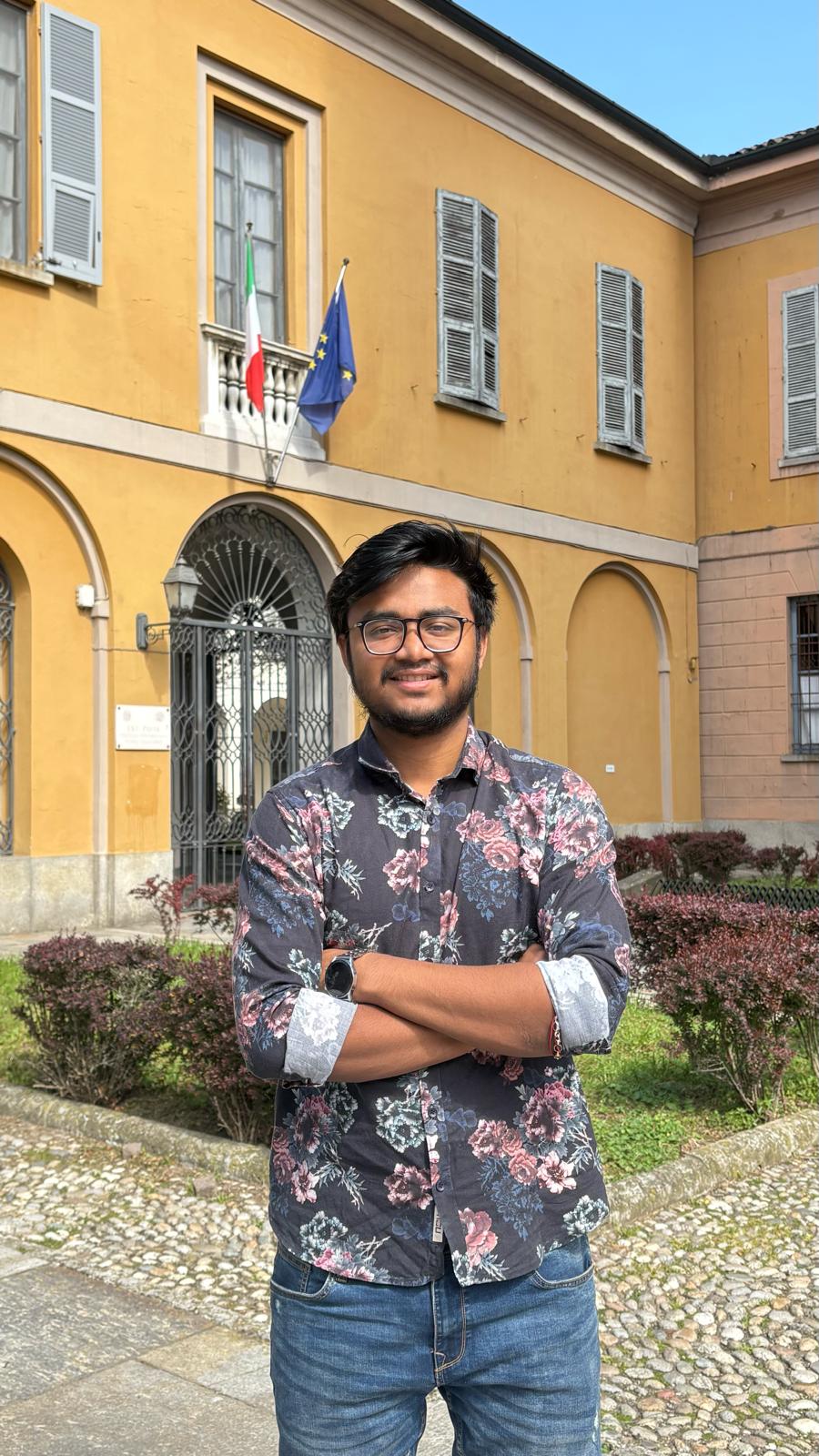

They began right where you are

