

Master in Tropical and Subtropical Agriculture at University of Florence
Two-year English-taught LM-69 master's at the University of Florence on sustainable crop, soil and water management and rural development in tropical and subtropical regions, with a thesis that can include field work abroad.
Master
2 years
Florence
English
University of Florence



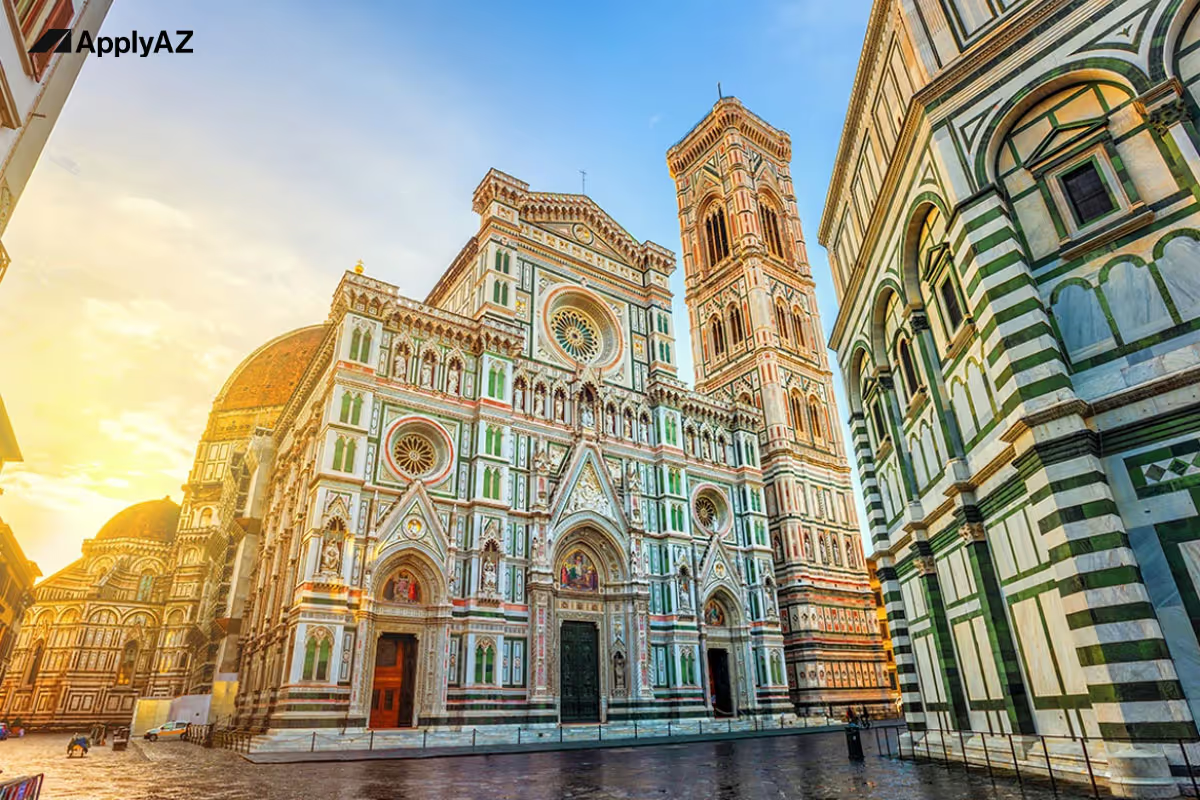
Tropical and Subtropical Agriculture is a two-year, 120 ECTS master's degree (class LM-69) taught in English at the University of Florence's School of Agriculture. It trains agronomists for sustainable farming, land and water management and rural development in the Global South. Fees follow ISEE, so it can be tuition-free for eligible students.
Entry requirements
- A bachelor's degree in agricultural or forestry sciences (Italian class L-25) gives direct access; degrees in biology, environmental sciences, geology or civil and environmental engineering are checked exam by exam.
- At least 36 ECTS in listed subject areas such as maths, physics, chemistry, botany, agronomy, crop and animal sciences, agricultural economics or sociology.
- English at B2 level, shown by at least 3 ECTS of English in your bachelor's or a certificate from a recognised body; some visa offices also ask for IELTS or similar.
- An individual interview to assess your preparation.
- An admission clearance (nulla osta) from the Admission Board, requested through DreamApply with a self-declaration of your exams and English level.
About the programme
Tropical and Subtropical Agriculture is a two-year master's degree (laurea magistrale, class LM-69, agricultural sciences and technologies) run by the Department of Agricultural, Food, Environmental and Forestry Science and Technology (DAGRI) at the University of Florence's School of Agriculture. It is taught in English, in person in Florence, with open access. The course was previously also called Natural Resources Management for Tropical Rural Development.
Its focus is sustainable agriculture, forestry and animal sciences, land and water management and rural development, with small and medium farms in the Global South as the main area of work. Florence's ties with tropical agriculture go back to 1904, and a degree in the field has run at the university since 1980. It suits graduates in agriculture, forestry, biology or environmental sciences.
What you will study
The first year builds core knowledge of tropical cropping systems, soils, water and rural project design. Students can also earn free credits through French, Spanish or Portuguese language skills. Units in the 2026/27 study plan include:
- Climate Smart Agronomy and Land Management (12 ECTS)
- Sustainable Water Resources Management (9 ECTS)
- Tropical Tree Crops (6 ECTS)
- Tropical and Subtropical Plant and Soil Ecology (6 ECTS)
- Pests and Diseases of Tropical Crops (6 ECTS)
- Plant Genetics and Breeding (6 ECTS)
- Project Planning for Sustainable Rural Development (6 ECTS)
- Optional French, Spanish or Portuguese (B2) writing (6 ECTS)
How the programme is taught
The degree runs at 60 credits a year, and students who reach 120 credits early may graduate before the end of the second year. The thesis is worth 21 credits and can include field or laboratory work, preferably with experience in tropical or subtropical countries; international students can also carry out their experiments in Italy. The thesis is written in English and defended orally before a commission. Erasmus+ mobility is also available.
Career paths
The course trains technical experts, researchers, project designers and coordinators in tropical agriculture, international cooperation for rural development, environmental management and the international marketing of crop, livestock and forestry products. Potential employers named by the course include:
- companies producing and marketing agricultural and livestock products in tropical and subtropical areas
- non-governmental organisations working in development and cooperation
- national and international institutions for land and water management and agricultural cooperation
- institutions responsible for food safety in international trade
- research institutions working on agriculture and the rural environment
Fees and scholarships
UniFi links tuition to ISEE. For 2026/27, students resident abroad get an automatic figurative ISEE based on the World Bank income group of their country, from €25,500 for low-income countries to €75,500 for high-income ones. If you come from a developing country you pay only the €140 regional tax and €16 stamp duty. DSU Toscana scholarship winners and eligible students pay stamp duty only, so this programme can be tuition-free for eligible students.
How to apply from outside the EU
Graduates from abroad request the admission clearance (nulla osta) on DreamApply, uploading an application for assessment, a self-declaration of exams taken and a self-declaration of B2 English. The Admission Board usually replies within 30 days and also holds an individual interview; missing credits can be made up through single courses. The application fee is €20.
For 2026/27, non-EU candidates had two rounds: 10 December 2025 to 6 February 2026 (results by mid-March) and 16 February to 17 April 2026 (results by mid-May). Admitted students pre-enrol on Universitaly by 31 July and apply for a type D study visa.
How ApplyAZ helps
If this programme fits your goals, ApplyAZ can include it in a shortlist of 20 to 30 English-taught programmes at Italian public universities. We write your CV and a tailored statement of purpose, submit your applications and Universitaly pre-enrolment, file your DSU scholarship application and prepare your visa file, with a named person on each stage. The university decides admission, the region decides the scholarship and the consulate decides the visa. See how ApplyAZ works or check your eligibility.
Questions and answers
Is Tropical and Subtropical Agriculture taught in English?
Yes. Teaching and the thesis are in English, and you need B2 English, shown by 3 ECTS of English in your bachelor's or a recognised certificate. Some visa offices also ask for IELTS or similar.
Which bachelor's degrees are accepted?
Agricultural or forestry sciences give direct access. Biology, environmental sciences, geology or civil and environmental engineering graduates are checked exam by exam, and everyone needs at least 36 ECTS in listed subject areas.
Is there an entrance test?
No written test. The Admission Board reviews your exams and English level and holds an individual interview before granting the admission clearance.
When can I apply for 2027/28?
The 2027/28 rounds are not published yet. For 2026/27, non-EU candidates applied on DreamApply from 10 December 2025 to 6 February 2026 or from 16 February to 17 April 2026.
How much are the fees?
Fees depend on ISEE. Students resident abroad get a figurative ISEE by their country's income group, students from developing countries pay only €156 in taxes, and DSU Toscana scholarship winners pay only stamp duty.
What careers does it lead to?
Roles as technical experts, researchers and project coordinators in agribusiness, NGOs, international cooperation, food safety institutions and agricultural research, especially in tropical and subtropical regions.
Similar programmes
More programmes in this city

They began right where you are

