

Master in Geoengineering at University of Florence
Two-year English-taught LM-35 master's at the University of Florence that joins civil and environmental engineering with geology to reduce geo-hydrological risk from floods, landslides and subsidence, with separate paths for engineers and geologists.
Master
2 years
Florence
English
University of Florence



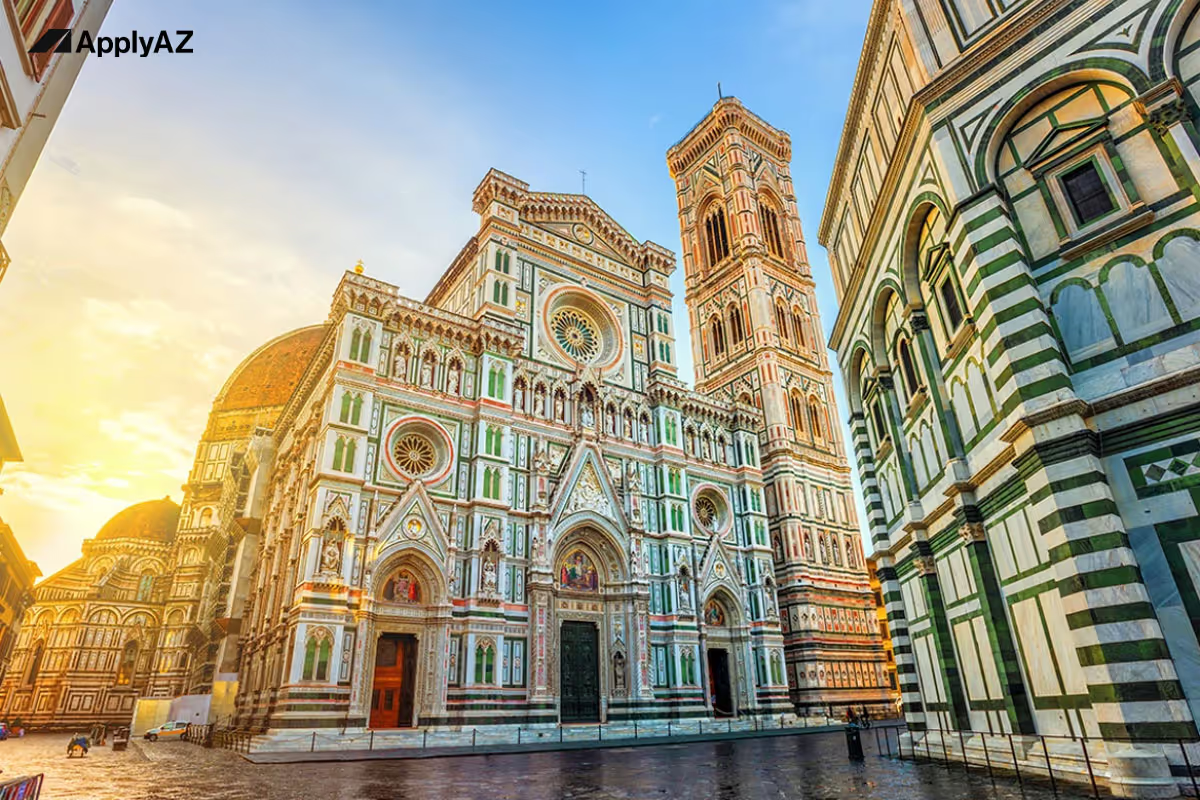
Geoengineering is a two-year, 120 ECTS master's degree (class LM-35) taught entirely in English at the University of Florence. It trains specialists who monitor, design and manage works that reduce flood and landslide risk. Fees follow ISEE, so it can be tuition-free for eligible students.
Entry requirements
- A first-level (bachelor's) degree from Italy or abroad, with minimum credits in set groups of subjects; for foreign degrees the Teaching Committee decides and may ask for an interview or extra credits.
- English at B2 level or higher, shown by an English-taught bachelor's, at least 3 ECTS of English at that level, or a recognised certificate obtained in the last five years.
- A graduation grade of 90/110 or more, or the equivalent for foreign degrees, meets the personal preparation requirement; otherwise you have an interview with the committee.
- An admission clearance (nulla osta) from the Teaching Committee before you can enrol.
- A declaration of value or a CIMEA statement for your foreign degree.
About the programme
Geoengineering is a two-year international master's degree (laurea magistrale, class LM-35, environmental and land engineering) run by the Department of Civil and Environmental Engineering (DICEA) of the University of Florence. The whole programme is taught in English, in person in Florence, and access is open, with no cap on places.
It trains specialists who monitor, design and manage systems and works that reduce geo-hydrological risk: floods, landslides, subsidence, sinkholes and slope and basin dynamics. The course is built within the UNESCO Chair on Prevention and Sustainable Management of Geo-Hydrological Hazards at UniFi, and suits graduates in civil or environmental engineering, geology or related sciences.
What you will study
The degree integrates structural mechanics, geotechnics, hydrology, hydraulics, geology and engineering geology with numerical methods, statistics and geomatics. It is a single track split into two paths that differ by up to 18 ECTS: the path for engineers makes up for gaps in geology, and the path for geologists makes up for gaps in engineering. First-year units in the 2026/27 study plan include:
- Fluvial Hydraulics and Flood Risk (15 ECTS)
- Computational Methods (12 ECTS)
- Engineering Geology (9 ECTS)
- Engineering Geomorphology and Geology II (6 ECTS each)
- Path units chosen by background, such as Geology I, Applied Geophysics, Geomatics, Continuum Mechanics and Fluvial Hydraulics
How the programme is taught
Of the 120 ECTS, 90 come from taught subjects (60 in the first year and 30 in the second), 12 from activities you choose freely, 6 from a training internship and 12 from the final exam. Internships take place at companies and public bodies, and some courses include individual or group design projects under a professor's guidance. Laboratory work, technical visits and external activities require the School of Engineering's health and safety training. UniFi also lists double degree agreements for Geoengineering with partner universities in Tirana, Novi Sad and Skopje.
Career paths
The course aims to train technicians with an engineering profile applied to geological and hydraulic problems, able to plan, design and manage complex systems at territorial scale. According to its educational goals, graduates are prepared to:
- develop territorial survey methods and analyse data at different scales
- assess geo-hydrological risk and environmental impacts, including through models
- design protection against landslides and floods
- monitor, control and manage land and the environment with sustainability criteria
- restore and conserve highly built-up territorial systems
Fees and scholarships
Geoengineering follows the standard UniFi fee rules for 2026/27: a €140 regional tax, €16 stamp duty and a contribution linked to ISEE. If you live abroad, the university assigns a figurative ISEE from your country's World Bank income group, between €25,500 and €75,500. Students from developing countries pay only the two taxes, while DSU Toscana scholarship winners and eligible candidates pay stamp duty only, so the degree can be tuition-free for eligible students.
How to apply from outside the EU
You first need an admission clearance (nulla osta) from the Geoengineering Teaching Committee, which checks your credits, English and grade; the course advises requesting it at least 30 days before the deadline. Graduates from abroad apply on Apply Unifi (DreamApply) with a €20 non-refundable fee and a declaration of value or CIMEA statement.
For 2026/27, non-EU applicants living abroad had two rounds: 10 December 2025 to 6 February 2026, and 16 February to 17 April 2026. Once admitted, you pre-enrol on Universitaly by 31 July and apply for a type D study visa.
How ApplyAZ helps
If this programme fits your goals, ApplyAZ can include it in a shortlist of 20 to 30 English-taught programmes at Italian public universities. We write your CV and a tailored statement of purpose, submit your applications and Universitaly pre-enrolment, file your DSU scholarship application and prepare your visa file, with a named person on each stage. The university decides admission, the region decides the scholarship and the consulate decides the visa. See how ApplyAZ works or check your eligibility.
Questions and answers
Is Geoengineering taught in English?
Yes. All teaching is in English. You need English at B2 level, shown by an English-taught bachelor's, 3 ECTS of English at that level or a certificate obtained in the last five years.
Which bachelor's degrees are accepted?
Civil or environmental engineering, geology and related degrees, with minimum credits in set subject groups. Engineers follow a path with extra geology and geologists a path with extra engineering. The Teaching Committee assesses foreign degrees.
Is there an entrance test?
No. A graduation grade of 90/110 or the foreign equivalent meets the personal preparation requirement. Otherwise, or when the committee sees fit, you have an interview before it decides.
When can I apply for 2027/28?
The 2027/28 rounds are not published yet. For 2026/27, non-EU applicants living abroad applied on Apply Unifi from 10 December 2025 to 6 February 2026 or from 16 February to 17 April 2026, with a €20 fee.
How much are the fees?
Fees depend on ISEE. Students resident abroad get a figurative ISEE by their country's income group, and DSU Toscana scholarship winners or eligible students pay only the €16 stamp duty.
What careers does it lead to?
Work in geo-hydrological risk and environmental impact assessment, territorial monitoring and the design of flood and landslide protection, building on an internship with a company or public body.
Similar programmes
More programmes in this city

They began right where you are

