

Master in Security and Human Rights at University of Tuscia
Two-year English-taught LM-90 master's in Viterbo on security, migration, data protection and sustainability, with options in Security and Human Mobility or Security, Technology and Sustainability.
Master
2 years
Viterbo
English
University of Tuscia


Security and Human Rights is a two-year master's degree (class LM-90, European studies) taught entirely in English at the University of Tuscia in Viterbo. It looks at security and freedom through migration, technology and sustainability, with two specialist options in year two. Fees follow family income, so it can be tuition-free for eligible students.
Entry requirements
- A first-level (bachelor's) degree of 180 credits, or an equivalent foreign qualification.
- English at least at B2 level (CEFR).
- An interview in English that checks your entry requirements; international students first submit the 2026/27 admission form.
- Degree certificate and transcript, plus a declaration of value, a CIMEA statement of comparability or an ARDI statement for enrolment.
About the programme
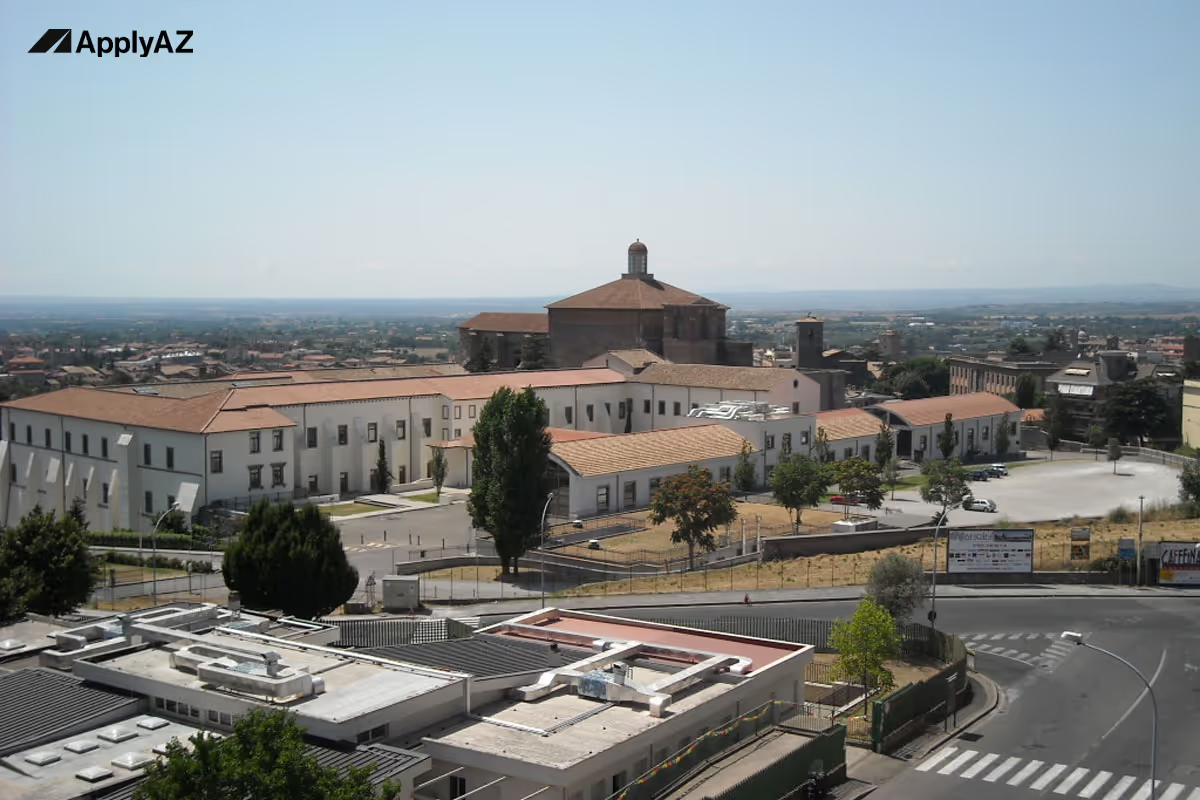
Security and Human Rights is a two-year master's degree in class LM-90 (European studies), delivered entirely in English at the University of Tuscia's Santa Maria in Gradi site in Viterbo. It revisits the old tension between security and freedom through three present-day challenges: migration, technology and sustainability.
The approach is multidisciplinary, drawing on law, political science, sociology, history, philosophy and economics. It suits graduates in law, political science, international relations or the social sciences who want to work on borders, data governance or the green transition.
What you will study
The first year builds a shared base on security. In the second year you choose Option A, Security and Human Mobility, or Option B, Security, Technology and Sustainability. Units in the 2026/27 study plan include:
- Security and Individual Liberties in Comparative Perspective and International Political Sociology of Security
- Liberty and Security in Historical and Philosophical Perspectives, and The Global Governance of International Security (9 ECTS each)
- Criminal Law and Global Threats, and Human Rights and Security in EU Criminal Investigations
- Option A: Human Mobility and the European Border Regime, The External Dimension of EU Migration and Asylum Policies, and EU Asylum Law: Implementation Challenges
- Option B: Cybersecurity and Data Protection, Artificial Intelligence and Automated Decision-Making, and Green Transition and Climate Change Law
- Digital Evidence and Human Rights, and Bioethics, AI Ethics, and Environmental Sustainability
- A stage, summer training school, Erasmus traineeship or workshops (8 ECTS), and a final exam (10 ECTS)
How the programme is taught
Teaching is officially blended but centred on the classroom: a limited share of teaching is online, mainly so that scholars from foreign universities can take part, and in-person classes can also be followed remotely in equipped rooms. The Italian course page stresses that in-person teaching remains central. The plan also includes conferences and seminars, and language skills.
Career paths
The course trains experts in security, migration management and the reception of migrants, and circular economy and sustainability. The university expects graduates to compete for senior roles in private and public bodies at national, EU and international level.
Graduates can continue with second-level university masters or a PhD, including the university's PhD in European and Global Markets Law: Crises, Rights, Regulation.
Fees and scholarships
The course page notes scholarships for international and Italian students. Beyond that, Unitus fees depend on income: for 2026/27, non-EU students with income or assets abroad declare them through the ISEEUP, and those who do not pay a fixed fee by country of origin. With a Lazio DiSCo regional scholarship, the degree can be tuition-free for eligible students.
How to apply from outside the EU
International applicants complete the course's 2026/27 admission form and then have an oral interview in English, which checks the entry requirements. The course coordinator issues the admission letter.
With that letter you pre-enrol on Universitaly and upload your degree, transcript and a declaration of value, CIMEA or ARDI statement. After the International Student Office validates your pre-enrolment, you apply for a type D study visa; for 2026/27 the consulate deadline is 30 November 2026.
How ApplyAZ helps
If this programme fits your goals, ApplyAZ can include it in a shortlist of 20 to 30 English-taught programmes at Italian public universities. We write your CV and a tailored statement of purpose, submit your applications and Universitaly pre-enrolment, file your DSU scholarship application and prepare your visa file, with a named person on each stage. The university decides admission, the region decides the scholarship and the consulate decides the visa. See how ApplyAZ works or check your eligibility.
Questions and answers
Is Security and Human Rights taught in English?
Yes. The course is delivered entirely in English, and applicants need English at least at B2 level (CEFR), which is checked during the admission interview.
Can I follow the course online?
The course is officially blended. A limited share of teaching is online and in-person classes can be followed remotely, but the university says in-person teaching remains central, and it is taught in Viterbo.
What are the two options?
After a common first year, you choose Security and Human Mobility, focused on borders, migration and asylum law, or Security, Technology and Sustainability, focused on cybersecurity, AI and climate law.
Is there an entrance test?
There is no written test. International applicants submit the admission form and then have an interview in English that checks the degree and language requirements.
Which bachelor's degree do I need?
A first-level degree of 180 credits or an equivalent foreign qualification. The admission interview in English checks that your background meets the access requirements.
How much does it cost?
Fees depend on income declared through the ISEEUP for 2026/27; without it a fixed fee by country of origin applies. Lazio DiSCo and course scholarships are open to eligible students.
Similar programmes
More programmes in this city

They began right where you are

