

Master in Science and Technologies for Agriculture and Mountain Areas at University of Tuscia
Two-year English-taught interclass master's (LM-69/LM-73) at the University of Tuscia's Rieti centre, with curricula in Digital Agriculture and Mountain Areas Management built around sensors, data and precision farming.
Master
2 years
Viterbo
English
University of Tuscia


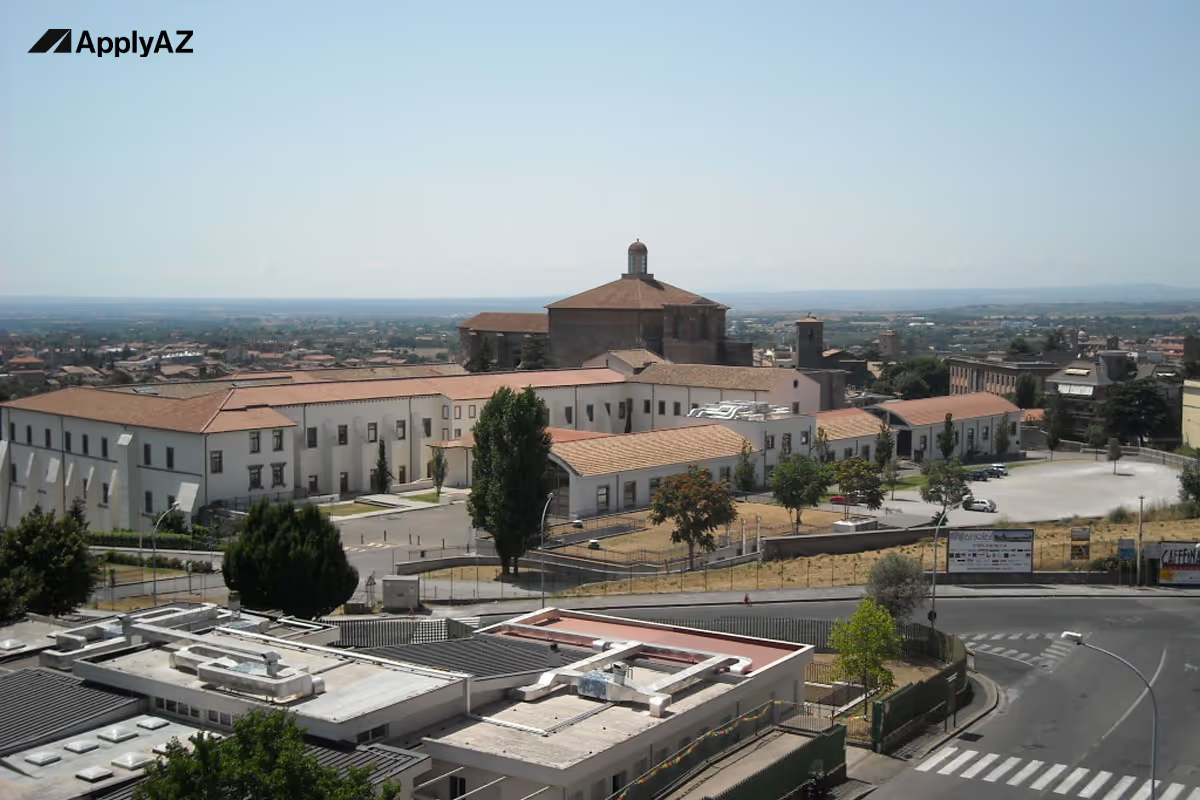
Science and Technologies for Agriculture and Mountain Areas (STAM) is a two-year interclass master's degree (LM-69/LM-73) taught in English by the University of Tuscia at its Rieti university centre. It trains specialists in digital and precision agriculture and mountain land management. Fees follow family income, so it can be tuition-free for eligible students.
Entry requirements
- A bachelor's degree, or an equivalent foreign qualification of at least three years, in agriculture, forestry, natural sciences or a related field.
- At least 24 credits in your bachelor's: 12 in physics, mathematics, informatics, statistics, chemistry or information systems, and 12 in agriculture, forestry, botany or plant physiology.
- English at B2 level, shown by IELTS, TOEFL, Cambridge First, PTE Academic or a similar certificate, or by a statement that your previous degree was taught in English.
- An oral admission interview; the course coordinator issues an admission letter to successful applicants.
- Degree certificate and transcript, plus a declaration of value, a CIMEA statement of comparability or an ARDI statement, which you can submit on arrival in Viterbo.
About the programme
Science and Technologies for Agriculture and Mountain Areas (STAM) is a two-year international master's degree taught entirely in English by the Department of Agriculture and Forest Sciences (DAFNE) of the University of Tuscia. Classes take place at the university centre in Rieti, in the hills of northern Lazio.
It is an interclass degree in LM-69 (Agricultural Science and Technology) and LM-73 (Forest and Environmental Science and Technology), so it joins farming and forestry rather than treating them apart. The aim is to train agronomists and foresters who work as data specialists for agriculture: people who can bring sensors, software, predictive models and precision farming into real farms, forests and mountain land. It suits graduates in agriculture, forestry or natural sciences who want a digital, applied profile.
What you will study
Everyone takes a set of common courses, then picks one of two curricula. The official course description lists:
- Common courses: agricultural economics and policy, land survey and mapping, and applied soil science
- Statistical analysis of environmental data
- Food processing in marginal areas, water and energy resource management, and applied phytopathology and entomology
- Digital Agriculture curriculum: precision agronomy, digital applications in agriculture, precision livestock farming and digital genetics technologies
- Sensors and mechatronics, and machinery for precision agriculture
- Mountain Areas Management curriculum: ecosystem monitoring under climate change, conservation and restoration of mountain forests, and digital wildlife monitoring
- Quantitative ecology research methods, and sustainable forest planning and operations
How the programme is taught
According to the department, practical work runs through the degree: laboratory exercises, fieldwork, interdisciplinary projects, internships with companies and international exchange opportunities. The course is linked to two missions of Italy's National Recovery and Resilience Plan (PNRR): the green transition and digital transformation.
Career paths
The university describes roles in research and development for agricultural, agri-food, livestock and forestry companies, in firms that build technology for farms and forests, and in public bodies that plan and monitor land. After the Italian state examination, graduates can register as agronomists or foresters, and a PhD is another route.
- Manager or precision-technology consultant in agricultural and agri-food companies
- Officer in regional or national agencies, or in organisations such as FAO, the World Bank and the European Union
- Specialist in digital and mechatronic solutions at makers of farm machinery and sensors
- Adviser on innovation, sustainability, risk analysis and environmental impact
- Researcher or trainer in digital and sustainable agriculture
Fees and scholarships
Unitus sets fees by income. For 2026/27, students with income and assets abroad declare them through the ISEEUP (the equivalent of the ISEE parificato); anyone who does not, or whose ISEEUP cannot be calculated, pays a fixed fee set by country of origin in the university's fee regulations. Lazio DiSCo, the regional agency for the right to study, runs income-based scholarships, so this degree can be tuition-free for eligible students.
How to apply from outside the EU
Admission to STAM goes through an oral interview, booked online from the course page. You first submit the programme's online application, and the course coordinator sends an official admission letter if you are accepted. You need English at B2.
With the letter, you pre-enrol on Universitaly and upload your degree, transcript and recognition documents; for 2026/27, visa applications must reach the consulate by 30 November 2026. You then apply for a type D study visa and complete enrolment in person at the International Students desk.
How ApplyAZ helps
If this programme fits your goals, ApplyAZ can include it in a shortlist of 20 to 30 English-taught programmes at Italian public universities. We write your CV and a tailored statement of purpose, submit your applications and Universitaly pre-enrolment, file your DSU scholarship application and prepare your visa file, with a named person on each stage. The university decides admission, the region decides the scholarship and the consulate decides the visa. See how ApplyAZ works or check your eligibility.
Questions and answers
Is STAM taught in English?
Yes. English is the official language of the degree, and applicants need English at B2 level, shown by a certificate such as IELTS or TOEFL, or by a statement that their bachelor's was taught in English.
Where is the programme taught?
At the University of Tuscia's university centre in Rieti, run by the Department of Agriculture and Forest Sciences. Enrolment and international student services are handled in Viterbo.
Which bachelor's degrees are accepted?
You need at least 24 credits: 12 in physics, mathematics, informatics, statistics, chemistry or information systems, and 12 in agriculture, forestry, botany or plant physiology. Agriculture, forestry and natural sciences graduates usually meet this.
Is there an entrance test?
There is no written test. Admission is by an oral interview that you book online, after submitting the programme's application form. Successful applicants receive an admission letter from the course coordinator.
What are the two curricula?
Digital Agriculture covers precision agronomy, precision livestock farming, sensors and machinery. Mountain Areas Management covers mountain forest conservation, ecosystem monitoring, digital wildlife monitoring and sustainable forest planning.
How much does it cost?
Fees depend on income declared through the ISEEUP; without it a fixed fee by country applies (2026/27 rules). Lazio DiSCo offers income-based regional scholarships to eligible students.
Similar programmes
More programmes in this city

They began right where you are

