

Master in Circular Economy at University of Tuscia
Two-year English-taught LM-76 master's at the University of Tuscia's Civitavecchia campus on the economics of reuse, secondary raw materials, sustainable value chains and industrial symbiosis.
Master
2 years
Viterbo
English
University of Tuscia


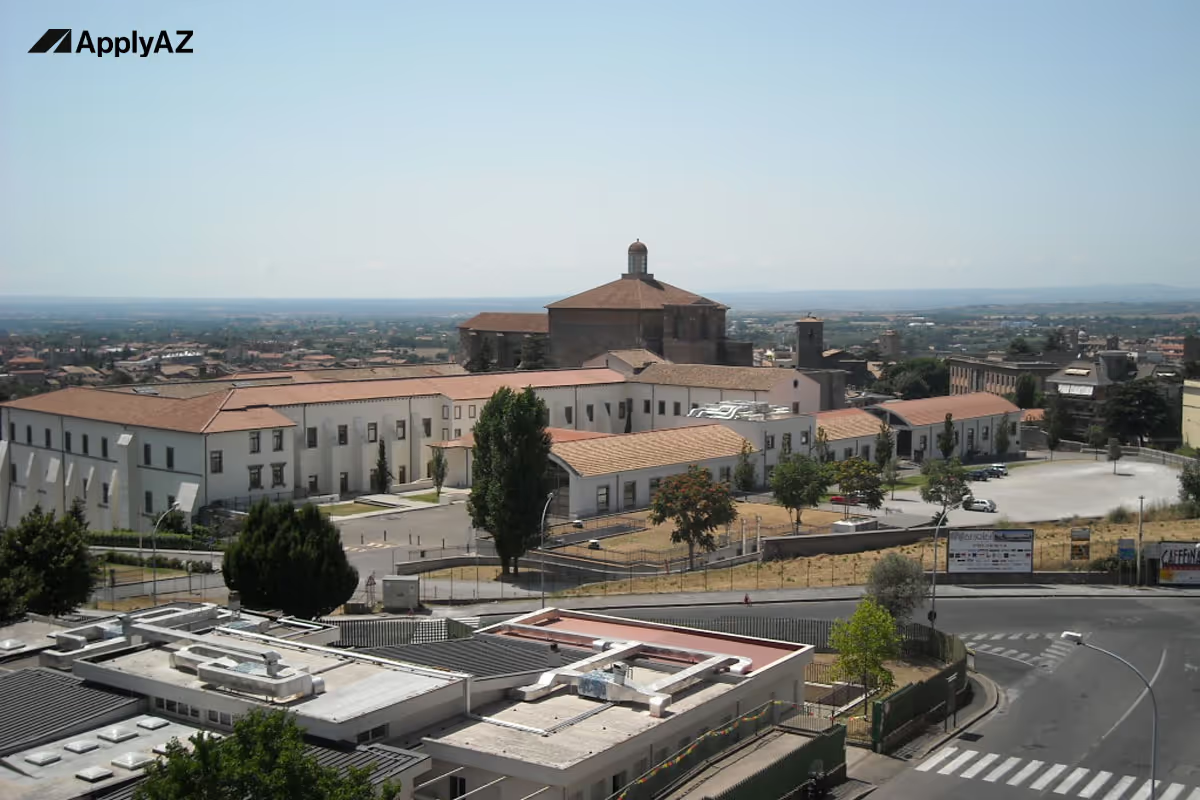
Circular Economy is a two-year master's degree (class LM-76) taught in English by the University of Tuscia's DEIM department at its Civitavecchia campus. It covers the economics, technology, law and management of reuse, waste and sustainable value chains. Fees follow family income, so it can be tuition-free for eligible students.
Entry requirements
- A bachelor's degree, or an equivalent foreign qualification of at least three years; the course checks curricular requirements before enrolment.
- English at B2 level, shown by IELTS, TOEFL, Cambridge First, PTE Academic or a similar certificate, or by a statement that your previous degree was taught in English.
- An online application for international students followed by an oral interview; admitted students receive an admission letter from the course coordinator.
- Degree certificate and transcript, plus a declaration of value, a CIMEA statement of comparability or an ARDI statement, which can be provided on arrival.
About the programme
Circular Economy is a two-year master's degree in class LM-76 (economics for the environment and culture), taught in English by the Department of Economics, Engineering, Society and Business Organization (DEIM) of the University of Tuscia. Classes are held at the university's campus in Civitavecchia, the port city on the coast of northern Lazio.
The course gives you tools to work where economic and environmental sustainability meet: getting more value from natural resources, using secondary raw materials, managing value chains sustainably and building industrial symbiosis between firms. It suits graduates in economics, business, agriculture or environmental subjects who want to work on the shift to circular production.
What you will study
Students follow a common path in circular economics before choosing electives. Units in the 2026/27 study plan include:
- Consumer Behavior in the Circular Economy and Sustainable Economics: Development and History (8 ECTS each)
- Micro and Macroeconomics of the Circular Economy, and Econometric Perspectives on Circular Economy
- Bioeconomy and Agri-food System, and Sustainable Agriculture and Waste Reuse
- Technology Innovation for a Circular Economy, and Lifecycle Design and Assessment
- Resources, Waste and Environmental Management, and Sustainable Industrial Logistics and Digitalization
- Environmental Law, International Law of the Sea and Management of Port Activities
- Corporate Social and Environmental Responsibility, Sustainable Finance, and Communication and Social Processes for a Circular Economy
- Further training activities and a final dissertation (12 ECTS)
How the programme is taught
Teaching mixes economics, statistics, technology, law and management, reflecting how circular projects work in practice. The Civitavecchia setting shows in units on the law of the sea and port management. For international students, the university's English catalogue lists the course with no video lectures, so plan on attending in person.
Career paths
The department expects graduates to take on new roles that follow market trends towards sustainability, in companies, public bodies and consultancies that need people who can link technological innovation with productive reconversion and sustainable development. The degree also gives access to the Italian state exam for the Register of Auditors.
For research, the department points to its PhD in Economics, Management and Quantitative Methods.
Fees and scholarships
The University of Tuscia charges fees according to income. For 2026/27, international students declare income and assets held abroad through the ISEEUP; students who do not submit it, or whose ISEEUP cannot be calculated, pay a fixed fee linked to their country of origin. Lazio DiSCo, the regional right-to-study agency, offers scholarships, so this master's can be tuition-free for eligible students.
How to apply from outside the EU
Start with the 2026/27 international student application linked from the course page, then book the oral interview. If you are admitted, the course coordinator issues an admission letter.
You then pre-enrol on Universitaly, where the International Student Office checks applications in order of submission, and upload your degree, transcript and recognition documents. With the validated pre-enrolment you apply for a type D study visa; for 2026/27 applications must reach the consulate by 30 November 2026.
How ApplyAZ helps
If this programme fits your goals, ApplyAZ can include it in a shortlist of 20 to 30 English-taught programmes at Italian public universities. We write your CV and a tailored statement of purpose, submit your applications and Universitaly pre-enrolment, file your DSU scholarship application and prepare your visa file, with a named person on each stage. The university decides admission, the region decides the scholarship and the consulate decides the visa. See how ApplyAZ works or check your eligibility.
Questions and answers
Is Circular Economy taught in English?
Yes. The course is taught in English, and the university asks for English at B2 level, shown by a certificate such as IELTS or TOEFL, or by a statement that your bachelor's was taught in English.
Where is the course taught?
At the University of Tuscia's campus in Civitavecchia, on the coast of northern Lazio, run by the Department of Economics, Engineering, Society and Business Organization (DEIM).
Is there an entrance test?
There is no written test. International applicants fill in the online application and book an oral interview; admitted students receive an admission letter from the course coordinator.
What subjects are in the study plan?
Units include consumer behaviour, micro and macroeconomics and econometrics of the circular economy, bioeconomy, lifecycle design and assessment, waste management, environmental law and sustainable finance, plus a 12 ECTS dissertation.
What can I do after graduating?
Graduates can work on sustainability and circular projects in companies, public bodies and consultancies. The degree gives access to the Italian state exam for the Register of Auditors, and a PhD is possible.
How much does it cost?
Fees follow income declared through the ISEEUP under the 2026/27 rules; without it, a fixed fee by country of origin applies. Eligible students can apply for a Lazio DiSCo scholarship.
Similar programmes
More programmes in this city

They began right where you are

