

Master in Forestry and Environmental Sciences at University of Tuscia
Two-year English-taught LM-73 master's in Viterbo on sustainable forest and natural resource management, with a Forests and Environment curriculum and the multi-university MEDfOR curriculum. Entry needs chemistry, botany and silviculture credits, English at B2 and an interview.
Master
2 years
Viterbo
English
University of Tuscia


Forestry and Environmental Sciences is a two-year, 120 ECTS master's degree (class LM-73) taught in English at the University of Tuscia in Viterbo. Entry needs a bachelor's with at least 5 ECTS each in chemistry, plant biology and silviculture, English at B2 and an admission interview. Non-EU applicants also need an average above 28/30. Fees follow family income, so it can be tuition-free for eligible students.
Entry requirements
Detailed entry requirements
Tuscia's Forestry and Environmental Sciences master asks for a bachelor's with at least 5 ECTS in each of chemistry, plant biology and silviculture, English at B2 and a positive admission interview. Non-EU applicants must also be born after 31 December 1997, hold a degree issued in 2022 or later and have an average above the Italian 28/30. Reviewed 8 October 2026. [1]
Degree and credit requirements
You need a university undergraduate degree with at least 5 ECTS in each of these subject areas: [1]
- Chemistry (sectors CHIM/03 and CHIM/06)
- Plant biology or botany (sectors BIO/01 to BIO/03)
- Silviculture (sector AGR/05)
For foreign degrees, the university applies an equivalence criterion. The multi-university MEDfOR curriculum has its own admission and enrolment procedure through the MEDfOR consortium. [1]
Extra requirements for non-EU applicants
The programme page adds four conditions for international applicants from outside the EU: [1]
- You were born after 31 December 1997.
- Your bachelor's degree or post-secondary qualification was issued by a foreign university or recognised higher institution in 2022 or later.
- Your bachelor's grade point average is above the equivalent of 28/30 on the Italian scale, calculated with the official formula of the Italian Ministry of Education.
- You are not currently enrolled in a first-cycle, single-cycle or second-cycle degree at Tuscia or any other Italian university.
What this means for your transcript
As a guide, based on the rules above:
- Usually a fit: a B.Sc. in Forestry that includes silviculture, botany and chemistry, with a very strong average and a degree issued in 2022 or later.
- Check carefully: a B.Sc. in Agriculture, Botany, Environmental Science or Life Sciences. These often cover chemistry and plant biology but may not include a silviculture course worth 5 ECTS. Any related degree with an average close to the 28/30 line also needs checking, because marks are converted with the ministry formula, which we check for you.
- Often short: a B.Tech or B.E. in engineering, a BCA, B.Com, BBA or BA. These rarely include plant biology or silviculture.
English
You need English at B2. The programme lists TOEFL above 87, IELTS above 5.5, City and Guilds (Pitman) IESOL B2 Communicator or higher, Cambridge ESOL First (FCE) or higher, Trinity College London ISE II and British Institute ESOL B2. The commission can assess other certificates at admission. [1]
Without a certificate, you take an additional English test as part of the admission interview. [1] For Universitaly pre-enrolment, Tuscia also accepts a certificate showing your previous university studies were taught in English. [3]
Admission interview
There is no written entrance test. Your preparation is assessed in an admission interview on three areas: [1]
- Forest ecology and silviculture: environmental factors in stand growth, the role of forests against climate change, coppice silviculture and stand regeneration in canopy gaps.
- Forest economy: valuing small forest properties, stumpage value and forest ecosystem services.
- Zoology: the meaning of biodiversity, eukaryotes and prokaryotes, and the effects of invasive alien species on native communities.
2026/27 dates
The 2026/27 procedure on the programme page does not set a fixed application deadline for non-EU applicants, who apply through the course form. For 2026/27, enrolment on the student platform closes on 2 November 2026, and visa applications must be submitted by 30 November 2026. The 2027/28 calendar is not yet published. [1][3]
Documents and non-EU steps
In 2025/26 the international application form asked for your passport, bachelor's degree certificate and B2 English certificate for pre-admission, followed by an oral interview. [2] Admitted students receive an official admission letter from the course coordinator and then pre-enrol on Universitaly. [3]
For a master's, Tuscia's 2026/27 Universitaly list includes your school-leaving diploma and bachelor's degree with an apostille or legalisation (or a CIMEA Statement of Verification) and an Italian translation unless issued in English, your transcript, a Declaration of Value or CIMEA Statement of Comparability (or an ARDI Statement of Correspondence where it applies), your English or English-medium certificate and your admission letter. A legalised Diploma Supplement can replace some of these. [3]
Pre-enrolment is often possible before the Declaration of Value or CIMEA statement arrives, but one is needed to complete enrolment in Viterbo. You book your visa appointment once Tuscia validates your pre-enrolment. [3]
Sources and verification
Checked by the ApplyAZ admissions team against the university's official documents listed below. Entry rules can change with each new call, and we re-check them before every application.
- University of Tuscia, Department for Innovation in Biological, Agro-Food and Forest Systems (DIBAF). Forestry and Environmental Sciences (LM-73) programme page: admission requirements, interview topics and admission procedure, academic year 2026/27. Reviewed 8 October 2026.
- University of Tuscia. Annex A: international master's degree courses fully taught in English, with pre-admission and interview procedure, academic year 2025/26. Reviewed 8 October 2026.
- University of Tuscia. How to enrol: steps for non-EU students, covering language, admission letter, Universitaly pre-enrolment, documents, visa and fees, academic year 2026/27. Reviewed 8 October 2026.
About the programme
Forestry and Environmental Sciences (SFA) is a two-year master's degree in class LM-73 (forest and environmental science and technology), taught in English by the Department for Innovation in Biological, Agro-Food and Forest Systems (DIBAF) at the University of Tuscia.
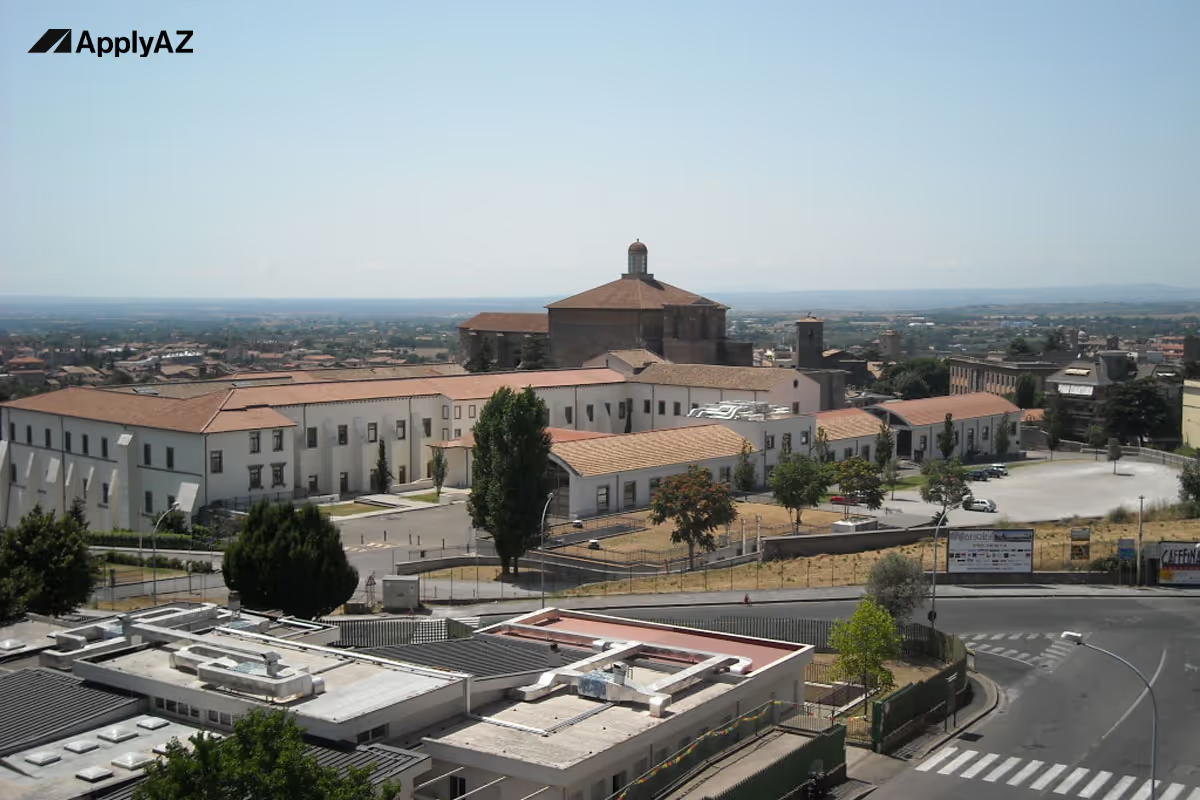
Teaching takes place at the Riello campus in Viterbo, where the department runs its laboratories and field practicals.
The degree is built for students who want a professional career in forest and natural resource management. It links how forest ecosystems work with environmental quality, and it was designed together with other Italian and European universities.
What you will study
There are two curricula. Forests and Environment is the main path and is taught entirely in Viterbo.
MEDfOR, on Mediterranean forestry and natural resource management, is a multi-university track leading to a multiple degree: the first year runs in Lisbon, Lleida or Padova and the second at a partner in another country. Students who spent their first year in Lisbon or Lleida can take the second year in Viterbo, with 30 ECTS of courses and a 30 ECTS dissertation. [1] Subjects named in the official course structure include:
- Forest biology: forest biotechnology, forest genetics, forest ecophysiology and vertebrates of forest ecosystems
- Soil quality monitoring and advanced forest pathology
- Forest management: forest economics and policy, forest management planning, silviculture and forest tree cropping
- Remote sensing and modelling in forestry
- Urban environments: phytoremediation and air quality, soil pollution, urban forestry and urban hydrology
- Applied hydrology for soil conservation and wood products
- A traineeship and a final dissertation (20 to 26 ECTS)
How the programme is taught
The thesis is central: you design your own case study with a supervisor, normally over up to five months of full-time fieldwork, analysis and writing, and defend it publicly. [1]
A 4-credit traineeship (100 hours) takes place in a research laboratory, company or public administration. Forests and Environment students can also apply for Erasmus+ mobility for study or traineeships in Europe.
Career paths
According to the department, graduates move into public bodies, private companies and academic institutions in the EU and beyond, and the degree gives a research base for a PhD or a second-level university master.
- Forest manager or forest surveyor
- Founder or specialist in a start-up mapping forests and natural resources with remote sensing
- Ecological consultant
- Government official in forestry, natural resources and environmental protection (MEDfOR profile)
Fees and scholarships
Fees at Unitus depend on income. International students with income or assets outside Italy declare them through the ISEEUP procedure for 2026/27; if they do not, a fixed fee by country of origin applies.
Lazio DiSCo, the regional agency for the right to study, awards scholarships to students with limited means, so the degree can be tuition-free for eligible students.
How to apply from outside the EU
For 2026/27 the course sets its own rules for non-EU applicants: you must be born after 31 December 1997, hold a bachelor's issued in 2022 or later with an average above the Italian 28/30, and not be enrolled at Tuscia or any other Italian university. [1]
Eligible candidates apply through the online form on the course page, then sit an admission interview. Admitted students receive an admission letter from the course coordinator. [1][3]
Once you are admitted, we complete your Universitaly pre-enrolment with your degree, transcript, English certificate and admission letter. A declaration of value or CIMEA statement is needed to complete enrolment in Viterbo, and you apply for a study visa once Tuscia validates your pre-enrolment. For 2026/27, enrolment closes on 2 November 2026 and visa applications are due by 30 November 2026. The 2027/28 calendar is not yet published. [1][3] MEDfOR has a separate admission procedure through the consortium.
How ApplyAZ helps
ApplyAZ is an Italy-based consultancy that works only with public universities. We can include this programme in a shortlist of 20 to 30 English-taught programmes that fit your profile, so your plan never rests on a single application.
For eligible students who start with us, a named person owns each stage, from A to Z:
- We check your transcript against Tuscia's entry rules for this programme.
- We write your CV and a tailored statement of purpose.
- We prepare and submit your course application form, admission interview and Universitaly pre-enrolment.
- We help you declare your family income for reduced fees and file your DiSCo Lazio scholarship application at the right time and in the right format.
- We prepare your visa file.
With operations in all 20 Italian regions, we follow each region's scholarship rules and deadlines as they change. The university decides admission, the region decides the scholarship and the consulate decides the visa, so no one can promise an outcome. You pay in milestones, and every service you pay for is either delivered or its fee is refunded (terms apply).
Programmes at Italian public universities can be tuition-free for eligible students. Check if you are eligible and book a one-to-one consultation session with one of our Italy experts, or see how ApplyAZ works.
Questions and answers
What bachelor's degree do I need for Forestry and Environmental Sciences at Tuscia?
A university undergraduate degree with at least 5 ECTS in each of chemistry, plant biology or botany, and silviculture. Foreign degrees are assessed with an equivalence criterion. Non-EU applicants also need an average above the Italian 28/30 and a degree issued in 2022 or later. [1]
Is there an entrance exam?
There is no written test. You have an admission interview on forest ecology and silviculture, forest economy and zoology, with topics such as stand regeneration in canopy gaps, stumpage value and biodiversity. [1]
What English level is required? Do I need IELTS?
English at B2. Accepted certificates include IELTS above 5.5, TOEFL above 87, Cambridge First and Trinity ISE II, and the commission can assess others. Without a certificate, your English is tested as part of the admission interview. [1]
When is the deadline for non-EU students?
The 2026/27 programme page sets no fixed application date for non-EU applicants, who apply through the course form. For 2026/27, enrolment closes on 2 November 2026 and visa applications are due by 30 November 2026. The 2027/28 calendar is not yet published. [1][3]
Are there extra rules for non-EU applicants?
Yes. You must be born after 31 December 1997, hold a bachelor's issued in 2022 or later with an average above the equivalent of 28/30, and not be enrolled at Tuscia or any other Italian university. [1]
I have a B.Sc. in Agriculture or Botany. Can I apply?
Possibly. These degrees often cover the chemistry and plant biology credits, but you also need at least 5 ECTS in silviculture and a very strong average. A B.Sc. in Forestry is more likely to cover all three areas. We check your transcript against each one. [1]
What is MEDfOR?
MEDfOR is a multi-university curriculum on Mediterranean forestry leading to a multiple degree. The first year runs in Lisbon, Lleida or Padova. Students who start in Lisbon or Lleida can take the second year in Viterbo. It has its own admission procedure. [1]
Can someone handle my whole application to Forestry and Environmental Sciences at Tuscia?
Yes. ApplyAZ, an Italy-based consultancy that works only with public universities, checks your transcript against Tuscia's rules for this programme, handles the application and Universitaly pre-enrolment, helps you file the DiSCo Lazio scholarship application at the right time and in the right format, and prepares your visa file, for eligible students. Start by checking your eligibility.
I'm applying from India. What is the route into Forestry and Environmental Sciences?
An Indian B.Sc. in Forestry, or a B.Sc. in Agriculture or Botany with chemistry, can fit if your transcript shows at least 5 ECTS in each of chemistry, plant biology and silviculture. Non-EU applicants also need an average above the Italian 28/30, a degree issued in 2022 or later and English at B2. The steps are the course application form, the admission interview and Universitaly pre-enrolment. [1] Indian students apply for the type D study visa at the Italian embassy or consulate that covers their state, such as New Delhi, Mumbai or Bengaluru.
Is the route different from Pakistan, Bangladesh or Sri Lanka?
No. The academic rules for Forestry and Environmental Sciences are the same whatever your nationality. Applicants from Pakistan, Bangladesh and Sri Lanka follow the same steps as India: course application form, admission interview, admission letter and Universitaly pre-enrolment, then a type D study visa from the Italian mission for their country of residence. Read our guide for students in Dhaka.
I live in the UAE, Saudi Arabia, Qatar, Kuwait, Oman or Bahrain. Where do I apply for the visa?
At the Italian embassy or consulate responsible for the country where you legally live, after Universitaly pre-enrolment. The academic rules for Forestry and Environmental Sciences are the same whatever your nationality, and Gulf residents follow the same steps: course application form, admission interview, admission letter and Universitaly pre-enrolment. Read our guides for Dubai, Riyadh and Doha.
I'm applying from the UK, US, Canada, Singapore or Malaysia. Is anything different?
The academic rules are identical. Non-EU applicants who live abroad, including citizens of these countries, follow the same route: course application form, admission interview, admission letter and Universitaly pre-enrolment, then a type D study visa. Read our guides for London, New York, Singapore and Kuala Lumpur.
More English-taught programmes at this university
Other public universities in this city

They began right where you are

