

Master in Physics at University of Messina
Two-year LM-17-R physics master at the University of Messina with the English-taught Materials Physics and Devices curriculum, aimed at materials, photonics and nanoscale devices. Entry needs a physics degree or set credits plus English at B2.
Master
2 years
Messina
Multiple
University of Messina


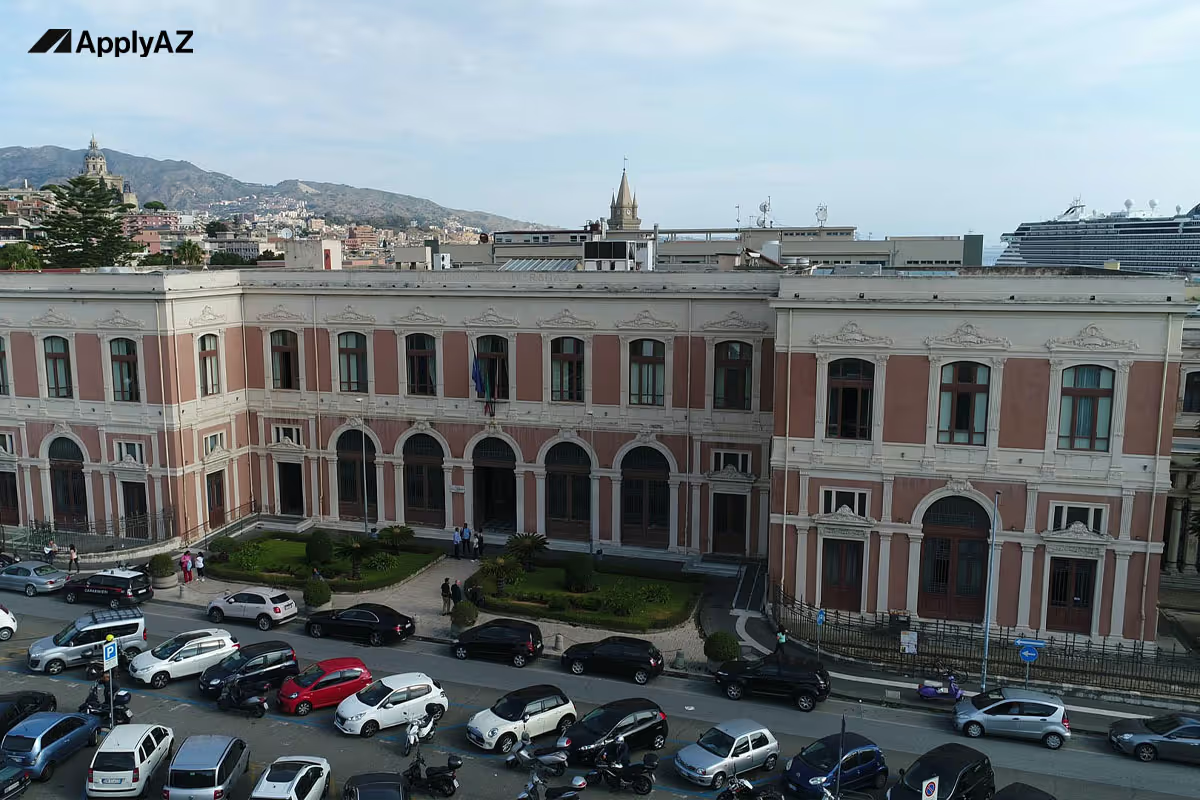
Physics is a two-year, 120 ECTS master's degree (class LM-17-R) at the University of Messina, with an English-taught curriculum, Materials Physics and Devices. Entry needs a degree in class L-30, or 25 credits in maths or computing and 45 in physics, plus English at B2. A final mark of 95 out of 110 passes the preparation check. International fees follow country groups.
Entry requirements
Detailed entry requirements
Messina's Physics master, whose Materials Physics and Devices curriculum is taught in English, has open access: you need a degree in class L-30 or set credits in maths and physics, and a committee checks your preparation before enrolment, which a final mark of at least 95 out of 110 and English at B2 pass. Reviewed 8 October 2026. [1]
Degree and credit requirements
You need one of the following. [1]
- Direct access: a degree in class L-30 (physical sciences and technologies), or in class 25 under the older Italian system, or a foreign qualification recognised as suitable for direct access to the master's.
- Credit route: any other first-level degree or three-year university diploma, Italian or a foreign qualification recognised as suitable, with at least 25 CFU in mathematics and computing (sectors MATH-*, INFO-01/A and IINF-05/A) and at least 45 CFU in physics (sectors PHYS-*).
These rules come from the course regulations that apply from the 2025/26 cohort. [1] Visa applicants must also show at least 15 years of education in total. [2]
Final mark and preparation check
Before enrolment, a committee appointed by the course council checks the personal preparation of applicants who meet the degree rule. The check counts as passed with a bachelor's final mark of at least 95 out of 110 and English at B2. [1]
If the check shows gaps, the course council, on the committee's proposal, sets an integrated path within the master's. You still graduate with 120 CFU and no extra activities. Access is open, with no cap on places and no entrance test. [1]
What this means for your transcript
Italian CFU and the credits on a foreign transcript are not the same unit, and the committee looks at the subjects you studied, not just your total. As a guide, based on the rule above:
- Usually a fit: a B.Sc. with physics as the main subject, such as a B.Sc. (Honours) in Physics, that also includes mathematics courses.
- Check carefully: a B.Sc. with physics as one of three subjects, such as physics, chemistry and maths, which often covers the 25 maths credits but can fall short of 45 credits in physics. A B.Tech or B.E. in Engineering Physics, Electronics or Electrical Engineering usually covers the maths but may not reach 45 credits in physics.
- Often short: a BCA, B.Com, BBA or BA, or a B.Tech in Computer Science, which usually lacks the physics block.
Your final mark matters too. The regulations do not say how a foreign mark converts to the 95 out of 110 benchmark, so we check it against your transcript.
English
English at CEFR level B2, shown by passing university exams or qualifying tests, or by certificates recognised at European or international level. [1] Visa applicants to English-taught programmes upload an international English certificate at B2. [2] UniME accepts: [6]
- IELTS 5.5 or higher, valid for two years from the test date
- TOEFL iBT 72 or higher, valid for two years from the test date
- Cambridge B2 First or higher
- PTE General Level 3, or PTE Academic 59
Native speakers from listed countries, including the UK, the USA, Canada, Australia, Ireland and New Zealand, are exempt, as are holders of a degree taught entirely in English at a university in one of those countries, or of an IB Diploma taught entirely in English. English-medium study in other countries is not on the exemption list. [6]
2027/28 application calls for visa applicants
UniME has published three calls for non-EU applicants who need a visa for 2027/28: [2]
- Early Bird: 1 to 20 December 2026, only for applicants who already hold final academic documents and a declaration of value or CIMEA statement of comparability.
- Second call: 2 February to 19 March 2027.
- Third call: 8 April to 8 May 2027. UniME may close it early depending on the number of applications.
The application fee is €40 and covers up to two applications. For 2026/27 the Universitaly deadline was 15 September 2026, and the 2027/28 Universitaly date is not yet published. [2]
Documents and non-EU steps
For a master's, UniME asks for: [2]
- your school-leaving diploma, after at least 12 years of study
- your bachelor's diploma or an official provisional certificate, showing at least 15 years of education in total
- your transcript of records
- an English certificate for English-taught programmes
- a passport valid for at least 18 months
Translated documents must come with the original-language version, and documents must be in English or officially translated into Italian. A departmental commission assesses your pre-evaluation on the UniME Application Portal against the entry requirements, and no further documents can be uploaded once it is submitted. After a positive evaluation you receive an admission letter, register on Universitaly and apply for a type D study visa. Enrolment is confirmed only with a valid study visa issued for the University of Messina and an administrative check of your admission documents. [2]
Sources and verification
Checked by the ApplyAZ admissions team against the university's official documents listed below. Entry rules can change with each new call, and we re-check them before every application.
- University of Messina, Department of Mathematical and Computer Sciences, Physical Sciences and Earth Sciences. Teaching regulations of the Master's degree in Physics (class LM-17), applying from the 2025/26 cohort. Reviewed 8 October 2026.
- University of Messina, International Office. Application and admission for international applicants, academic year 2027/28. Reviewed 8 October 2026.
- University of Messina, International Office. Fees and fundings for international students, effective from academic year 2025/26. Reviewed 8 October 2026.
- University of Messina, Physics master's degree programme page (degree class LM-17-R, teaching languages, access and duration), undated. Reviewed 8 October 2026.
- University of Messina, International Office. English-taught programmes list, undated. Reviewed 8 October 2026.
- University of Messina, International Office. English language requirements, published December 2025. Reviewed 8 October 2026.
About the programme
The Physics master's degree (laurea magistrale, class LM-17-R) is a two-year, 120 ECTS course run by the Department of Mathematics, Computer Science, Physics and Earth Science of the University of Messina. It has two curricula: Materials Physics and Devices, taught in English, and Fisica, a flexible curriculum with options in matter, nuclear and particle, and applied physics. Access is open, with no cap on places. [1][4][5]
The course gives a deep knowledge of the main physical theories and of scientific method. [1] The Materials Physics and Devices curriculum is aimed at technological applications and entry into industry, covering materials, photonics and nanoscale devices. It suits physics graduates who want to work in research and development or go on to a PhD.
What you will study
In the 2026/27 plan the first year combines advanced quantum physics and condensed matter with two laboratory courses and computational physics. The second year moves to devices and nanotechnology, and most of it is given over to the thesis (36 ECTS for preparation and defence).
- Advanced quantum physics and Condensed matter physics
- Laboratory and data analysis (12 ECTS) and Spectroscopy laboratory
- Computational physics
- Quantum optics and technologies
- Biomaterials and Advanced chemistry
- Micro-opto electronic devices, Nanophysics and nanotechnologies and Spintronics
- Thesis: preparation (30 ECTS) and defence (6 ECTS)
Career paths
The official professional profile is a physicist, with advanced laboratory and computational skills, the ability to lead research independently and to communicate technical work in English. Sectors named by the university include: [1]
- research and development in high-tech industries, especially electronics, optics and quantum technologies
- transfer of research results to business and industry
- radiation protection, diagnostics and environmental monitoring
- computing applications and modelling in industry, economics and finance
- PhD programmes and specialisation schools such as medical physics
Fees and scholarships
Since 2025/26, UniME has set international student fees by country group. You pay €156 a year in Group A, €256 in Group B (countries like India), €356 in Group C and €506 in Group D; every amount includes the €156 regional tax. [3] ERSU Messina, the regional right to study body, runs an income-based scholarship call each year with accommodation and meals, and eligible students can apply. See the fees page.
How to apply from outside the EU
Your physics or related degree, your final mark and a B2 English level are what count here. [1] We apply on the UniME Application Portal, and the €40 fee covers up to two applications. For 2027/28 the calls for visa applicants run from 1 to 20 December 2026 (Early Bird, with final documents and a declaration of value or CIMEA statement of comparability), from 2 February to 19 March 2027 and from 8 April to 8 May 2027. UniME may close the third call early depending on the number of applications. [2]
Admitted students receive a letter explaining Universitaly registration, which is needed for the type D study visa. Enrolment is confirmed only with a valid study visa issued for the University of Messina. [2] See the application and admission page.
How ApplyAZ helps
ApplyAZ is an Italy-based consultancy that works only with public universities. We can include this programme in a shortlist of 20 to 30 English-taught programmes that fit your profile, so your plan never rests on a single application.
For eligible students who start with us, a named person owns each stage, from A to Z:
- We check your transcript against Messina's entry rules for this programme.
- We write your CV and a tailored statement of purpose.
- We prepare and submit your pre-evaluation application on the UniME portal and Universitaly pre-enrolment.
- We help you declare your family income for reduced fees and file your regional DSU scholarship application at the right time and in the right format.
- We prepare your visa file.
With operations in all 20 Italian regions, we follow each region's scholarship rules and deadlines as they change. The university decides admission, the region decides the scholarship and the consulate decides the visa, so no one can promise an outcome. You pay in milestones, and every service you pay for is either delivered or its fee is refunded (terms apply).
Programmes at Italian public universities can be tuition-free for eligible students. Check if you are eligible and book a one-to-one consultation session with one of our Italy experts, or see how ApplyAZ works.
Questions and answers
Which bachelor's degrees qualify for the Physics master at Messina?
A degree in class L-30 (physical sciences and technologies), or a foreign qualification recognised as suitable, gives direct access. Any other first-level degree qualifies if it includes at least 25 credits in maths or computing and at least 45 credits in physics. [1]
Is there a minimum grade?
The preparation check counts as passed with a bachelor's final mark of at least 95 out of 110 and English at B2. If the committee finds gaps, the course council sets an integrated path within the 120 credits, with no extra activities. [1]
Is there an entrance exam?
No. Access is open, with no written test. Before enrolment, a committee checks your degree, credits, final mark and English. Visa applicants are first assessed through a pre-evaluation on the UniME Application Portal. [1][2]
What English level do I need? Do I need IELTS?
English at CEFR B2. UniME accepts IELTS 5.5, TOEFL iBT 72, Cambridge B2 First, PTE General Level 3 or PTE Academic 59. Native speakers from listed countries, and holders of a degree taught entirely in English in those countries, are exempt. [1][6]
When are the 2027/28 deadlines for non-EU students?
Visa applicants can apply in the Early Bird call from 1 to 20 December 2026, if they already hold final documents and a declaration of value or CIMEA statement, then from 2 February to 19 March 2027, or from 8 April to 8 May 2027. [2]
Which curriculum is taught in English?
Materials Physics and Devices is the English-taught curriculum, and UniME lists it among its English-taught master's degrees. The other curriculum, Fisica, is separate. The programme site gives English and Italian as teaching languages. [1][4][5]
I have a B.Sc. in physics, chemistry and maths. Can I apply?
Possibly. A three-subject B.Sc. often covers the 25 maths credits but can fall short of 45 credits in physics, unless it has direct access as a recognised physics degree. We check your transcript against both credit blocks and the 95 out of 110 benchmark. [1]
What careers does it lead to?
The graduate profile is a physicist. The regulations name research and development in high-tech industry, especially electronics, optics and quantum technologies, technology transfer, radiation protection, diagnostics and environmental monitoring, modelling in industry and finance, and access to PhD and medical physics programmes. [1]
Can someone handle my whole application to Physics at Messina?
Yes. ApplyAZ, an Italy-based consultancy that works only with public universities, checks your transcript against Messina's rules for this programme, handles the application and Universitaly pre-enrolment, helps you file the regional DSU scholarship application at the right time and in the right format, and prepares your visa file, for eligible students. Start by checking your eligibility.
I'm applying from India. What is the route into Physics?
An Indian B.Sc. with physics as the main subject, or another bachelor's such as a B.Tech, can meet the rule if your transcript shows at least 25 credits in maths or computing and 45 in physics. A final mark of at least 95 out of 110 and English at B2 pass the preparation check. The steps are the UniME pre-evaluation application, an admission letter and Universitaly pre-enrolment. [1][2] Indian students apply for the type D study visa at the Italian embassy or consulate that covers their state, such as New Delhi, Mumbai or Bengaluru.
Is the route different from Pakistan, Bangladesh or Sri Lanka?
No. The academic rules for Physics are the same whatever your nationality. Applicants from Pakistan, Bangladesh and Sri Lanka follow the same steps as India: UniME pre-evaluation application, admission letter and Universitaly pre-enrolment, then a type D study visa from the Italian mission for their country of residence. Read our guide for students in Dhaka.
I live in the UAE, Saudi Arabia, Qatar, Kuwait, Oman or Bahrain. Where do I apply for the visa?
At the Italian embassy or consulate responsible for the country where you legally live, after Universitaly pre-enrolment. The academic rules for Physics are the same whatever your nationality, and Gulf residents follow the same steps: UniME pre-evaluation application, admission letter and Universitaly pre-enrolment. Read our guides for Dubai, Riyadh and Doha.
I'm applying from the UK, US, Canada, Singapore or Malaysia. Is anything different?
The academic rules are identical. Non-EU applicants who live abroad, including citizens of these countries, follow the same route: UniME pre-evaluation application, admission letter and Universitaly pre-enrolment, then a type D study visa. Read our guides for London, New York, Singapore and Kuala Lumpur.
More English-taught programmes at this university
Other public universities in this city

They began right where you are

