

Master in Languages for Communication in International Enterprises and Organizations at University of Modena and Reggio Emilia
English-taught LM-38 master's in Modena combining two foreign languages from English, French, German and Spanish with translation, international economics, business law and digital communication. 20 places for non-EU applicants.
Master
2 years
Modena
English
University of Modena and Reggio Emilia



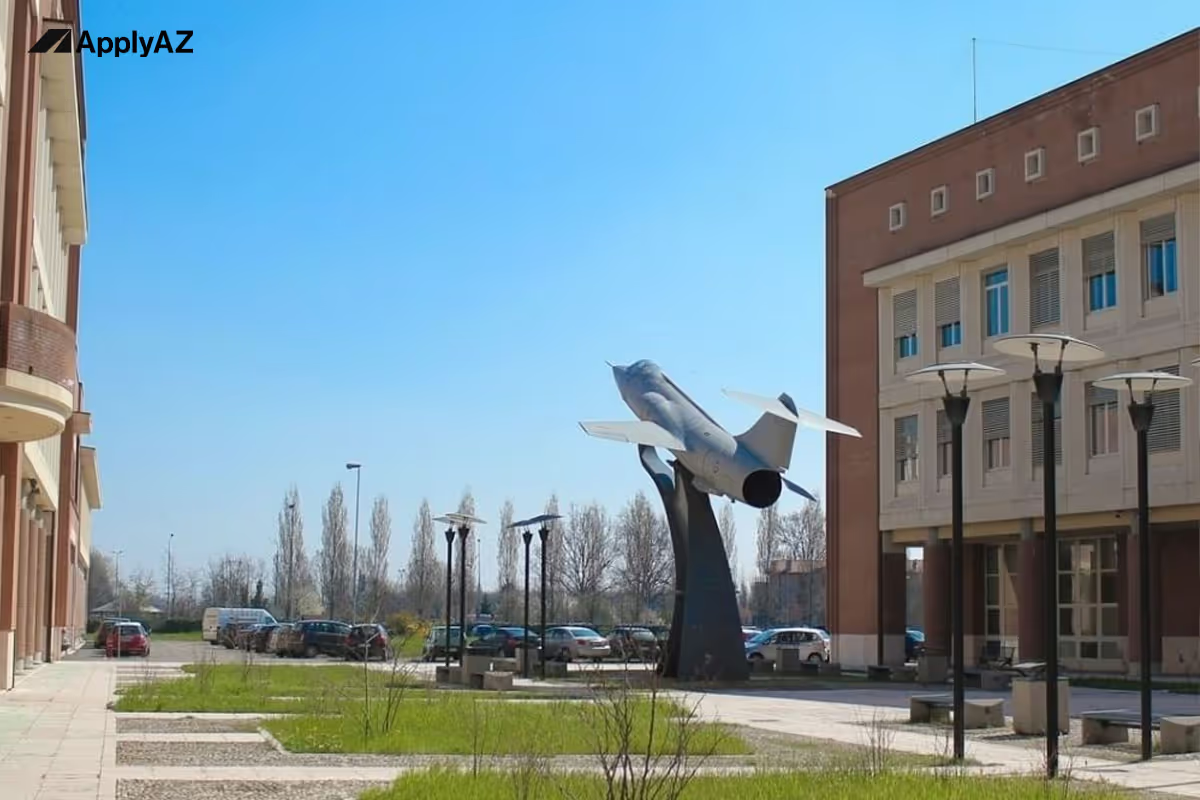
Languages for Communication in International Enterprises and Organizations is a two-year, 120 ECTS master's degree (LM-38) taught in English at the University of Modena and Reggio Emilia. You study two of English, French, German or Spanish with business, law and digital communication. Fees depend on income, and it can be tuition-free for eligible students.
Entry requirements
- A bachelor's degree in languages, communication, economics or a related class (Italian classes L-11, L-12, L-15, L-16, L-18, L-20, L-36, L-37) or a recognised foreign equivalent.
- At least 20 credits in foreign language subjects and 34 in listed linguistic, literary, humanities, economics or law subjects; foreign graduates need exams in languages such as French, English, Spanish or German.
- English at B2 level at least, shown by an international certificate or a statement from your university, unless clear from your transcript.
- Non-EU applicants living abroad prove their two study languages by documents or an interview with a department lecturer.
- Limited places: 20 for non-EU candidates living abroad.
About the programme
Languages for Communication in International Enterprises and Organizations (LACOM, in Italian Lingue per la comunicazione nell'impresa e nelle organizzazioni internazionali) is a two-year master's degree in class LM-38, modern languages for international communication and cooperation. It is worth 120 ECTS and run by the Department of Linguistic and Cultural Studies of the University of Modena and Reggio Emilia (Unimore) in Modena. The whole course is taught in English, and access is limited by a set number of places.
The degree suits graduates in languages, communication, economics or related fields who want to reach an advanced level in two foreign languages and use them in companies, public bodies and international organisations that deal with culturally and linguistically varied markets.
What you will study
The course aims for C1 to C2 command of at least two foreign languages, linguistic analysis applied to spoken and written business communication, a grounding in economics and law, and digital communication skills. Course units in the current plan include:
- Intercultural Communication and Language Variation in two of English, French, German or Spanish (12 ECTS each)
- Specialised Communication and Translation in your chosen languages (9 ECTS each)
- Introduction to International Economics (9 ECTS)
- Comparative Business Law, International Commercial Law, and Introduction to European and International Law
- Professional Communication and Digital Discourse, and Digital Humanities
- Marketing and Digital Communication, and Internationalization Strategies
- Economic Development and Sustainability, and (Digital) Communication and Human Rights
How the programme is taught
The plan includes 8 credits of other activities, such as a work placement or further language study, and a final dissertation. Options in the plan also include advanced Chinese or Russian and Italian as a Foreign Language.
Career paths
The official course profile describes two main roles for graduates:
- Writers and translators of internal and external business communication, translating specialised texts and mediating spoken exchanges with foreign partners, for international companies and organisations, publishers, advertising and tourism agencies, translation agencies and public administrations
- Public relations specialists who build business relationships with foreign partners, prepare presentations of company activity and assess proposals for European project funding
Fees and scholarships
At Unimore, tuition follows family income. When a non-EU student's income and assets are all abroad, the university sets a notional Country ISEE from per-capita income at purchasing power parity; for 2026/27 the €0 to €30,000 band paid €380 plus fixed items in year one. Students eligible for an ER.GO scholarship are fully exempt from the all-inclusive fee, so the course can be tuition-free for eligible students.
How to apply from outside the EU
The course sets 20 places for non-EU candidates living abroad. For 2026/27 they applied online through a dedicated call from 10 January to 10 March 2026 and paid a non-refundable €20 fee. You prove your two study languages with documents or at an interview, in person or online, with a department language lecturer, and results are published anonymously as the committee works through files.
After admission you pre-enrol on Universitaly and apply for a type D study visa. The 2027/28 call is still to come.
How ApplyAZ helps
If this programme fits your goals, ApplyAZ can include it in a shortlist of 20 to 30 English-taught programmes at Italian public universities. We write your CV and a tailored statement of purpose, submit your applications and Universitaly pre-enrolment, file your DSU scholarship application and prepare your visa file, with a named person on each stage. The university decides admission, the region decides the scholarship and the consulate decides the visa. See how ApplyAZ works or check your eligibility.
Questions and answers
Is this degree taught in English?
Yes. The whole course is delivered in English, whichever two foreign languages you choose to study, so every applicant must show English at B2 level at least.
Which languages can I study?
You study two foreign languages chosen from English, French, German and Spanish. Advanced Chinese or Russian and Italian as a Foreign Language also appear among the options in the study plan.
Is there an entrance test?
Yes, in a form that depends on your status. Non-EU applicants living abroad prove their two study languages with documents or an interview, in person or online, with a department language lecturer. Other candidates sit a written test in each language.
How many places are there for non-EU students?
Access is limited. The course sets 20 places for non-EU candidates living abroad and 150 for Italian, EU and Italy-resident candidates.
When is the deadline for non-EU applicants?
For 2026/27 the call for non-EU students living abroad ran from 10 January to 10 March 2026, with a 20 euro fee, and results were published as the committee assessed files. The 2027/28 call is not out yet.
How much are the fees?
Fees depend on family income. In 2026/27, non-EU students with income only abroad in the lowest Country ISEE band paid 380 euros plus fixed items in year one, and ER.GO-eligible students are exempt from the all-inclusive fee.
Similar programmes
More programmes in this city

They began right where you are

