

Master in Economics and Development at University of Florence
Two-year English-taught economics master's at the University of Florence with curricula in Development Economics and Economics, coding labs in R and Stata, and double degree options with Göttingen, Bamberg and Rennes.
Master
2 years
Florence
English
University of Florence



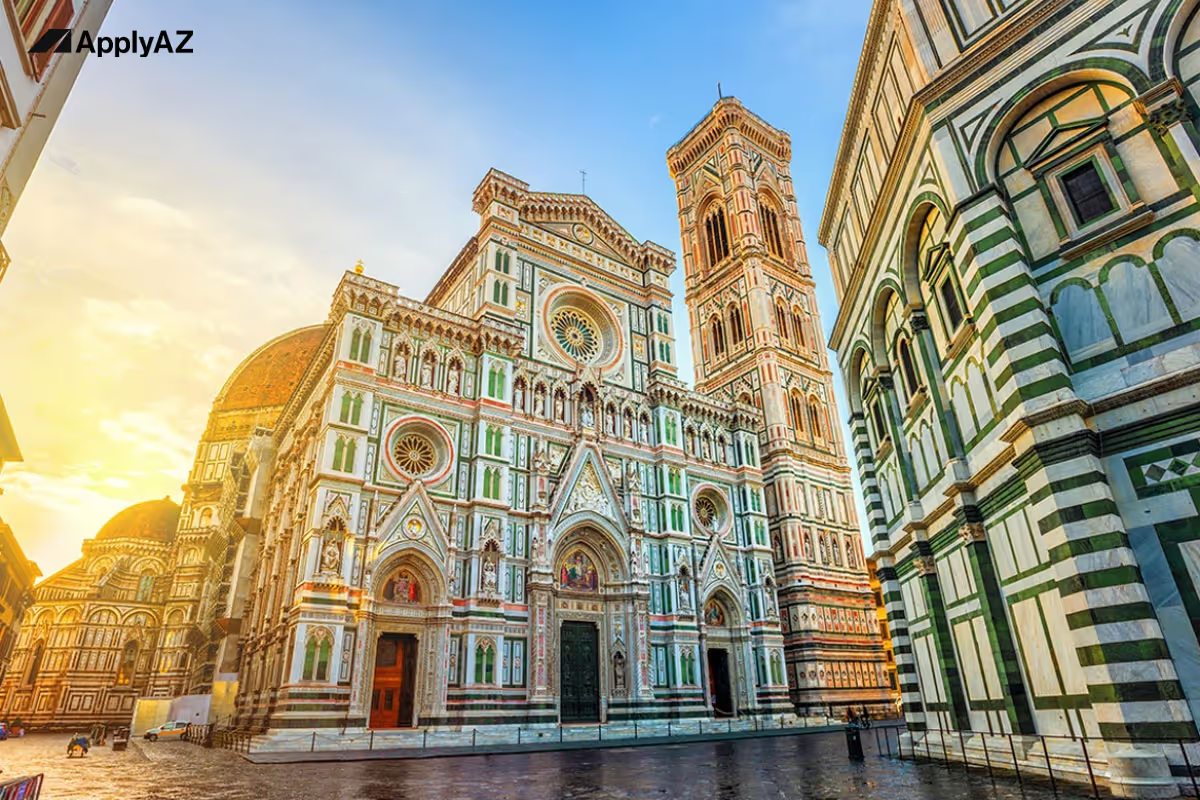
Economics and Development is a two-year, 120 ECTS master's (class LM-56) taught entirely in English at the University of Florence, with curricula in Development Economics and Economics. Fees follow ISEE, and DSU Toscana scholarship winners pay only stamp duty, so it can be tuition-free for eligible students.
Entry requirements
- A completed bachelor's degree whose grade allows you to continue to graduate studies in your country; applications for degrees not yet awarded are not considered.
- At least 18 ECTS in economics, 6 in mathematics and 6 in statistics, plus 18 more in business, economics, law, mathematics, political science or statistics. Missing credits must be earned by passing exams before admission.
- English at B2 level, shown by Cambridge First, TOEFL, IELTS or similar, or by a bachelor's taught entirely in English.
- Applicants below the grade requirement can still apply and may be interviewed by the Admission Committee.
- At least one reference (a letter from a university professor is strongly recommended), plus a declaration of value or CIMEA statement for your degree.
About the programme
Economics and Development is a two-year master's degree in class LM-56 (economics) at the University of Florence, worth 120 ECTS and taught entirely in English. It belongs to the School of Economics and Management and is run by the Department of Economics and Management, with teachers from statistics, law and political science. Lectures are in person in Florence, with classes on the Novoli campus, and access is open, with no cap on places.
The programme is international: in 2025/26 more than 56% of enrolled students were not Italian. Students can also join shared courses with Syracuse University in Florence. It suits graduates with a solid base in economics, maths and statistics who want to work as economists or go on to a PhD.
What you will study
You choose between a curriculum in Development Economics and a curriculum in Economics, the latter split into an Economics track and a Behavioural Economics track. The first year lays foundations; in the second year you shape your path through electives. Units in the 2026/27 plan include:
- Development Microeconomics and Development Macroeconomics (9 ECTS each)
- Game Theory and Microeconomics, Advanced Macroeconomics and Mathematics for Economics (9 ECTS each)
- Statistical Inference, Human Development and International Cooperation and Health and Education Economics
- Corporate Governance and Finance for Development or Corporate Governance and Financial Markets (12 ECTS)
- R, Stata and mathematical methods labs, plus an Econometrics Lab
- Electives such as Agriculture, Development and Poverty; Labour Economics and Gender; Applied Microeconometrics; Behavioural Economics
- International Trade and a 21 ECTS final thesis
How the programme is taught
Introductory maths and statistics courses run in September, and every first-year student is assigned an academic mentor. Each January and June some instructors offer research assistant positions worth 6 ECTS, and an internship can count as an elective. Erasmus+ allows a semester abroad.
In February of the first year you can apply for a double degree: with the University of Göttingen for Development Economics, or with the University of Bamberg or the University of Rennes for Economics, spending the second year and writing the thesis there. For 2026/27 entrants the programme will also award four €400 prizes to the top first-year students.
Career paths
The Development Economics curriculum prepares professional development economists for national and international agencies, civil service posts, NGOs and private companies with interests in developing countries. The Economics tracks lead to economist roles in private consultancies, business, finance, central banking, national and international organisations and governments. Both curricula are also a route into PhD programmes, and a professor advises students applying for one.
Fees and scholarships
UniFi sets fees by ISEE. For 2026/27, students resident abroad are given a figurative ISEE according to their country's World Bank income group, between €25,500 and €75,500. Students from developing countries pay only the €140 regional tax and €16 stamp duty. Winners and eligible candidates of the DSU Toscana scholarship pay only stamp duty, which means the degree can be tuition-free for eligible students.
How to apply from outside the EU
The Admission Committee checks your grade, credits and English. It can grant clearance (nulla osta), ask for an interview, extra exams or a B2 test, or reject the application. You apply on Apply Unifi (DreamApply) with a €20 non-refundable fee, one reference and a declaration of value or CIMEA statement.
For 2026/27, non-EU applicants living abroad had two rounds: 10 December 2025 to 6 February 2026 and 16 February to 17 April 2026. Admitted students then pre-enrol on Universitaly by 31 July and apply for a type D study visa.
How ApplyAZ helps
If this programme fits your goals, ApplyAZ can include it in a shortlist of 20 to 30 English-taught programmes at Italian public universities. We write your CV and a tailored statement of purpose, submit your applications and Universitaly pre-enrolment, file your DSU scholarship application and prepare your visa file, with a named person on each stage. The university decides admission, the region decides the scholarship and the consulate decides the visa. See how ApplyAZ works or check your eligibility.
Questions and answers
Is Economics and Development taught in English?
Yes. The whole programme is taught in English, and you need English at B2 level, shown by a certificate such as Cambridge First, TOEFL or IELTS, or by a bachelor's taught entirely in English.
Which bachelor's background do I need?
You need at least 18 ECTS in economics, 6 in mathematics, 6 in statistics and 18 more in business, economics, law, maths, political science or statistics. Missing credits must be made up with exams.
Is there an entrance test?
No written test. The Admission Committee reviews your file; if your grade or background falls short, it may ask for an interview, extra exams or a B2 English test.
Can I earn a double degree?
Yes. First-year students can apply in February for a double degree with Göttingen (Development Economics) or with Bamberg or Rennes (Economics), spending the second year abroad.
When can I apply for 2027/28?
The 2027/28 rounds are not published yet. For 2026/27, non-EU applicants living abroad could apply on Apply Unifi until 6 February or 17 April 2026, with a €20 fee.
How much are the fees?
Fees depend on ISEE. Students resident abroad get a figurative ISEE by their country's income group, and DSU Toscana scholarship winners and eligible students pay only the €16 stamp duty.
Similar programmes
More programmes in this city

They began right where you are

