

Master in Cybersecurity at University of Pisa
Two-year English-taught LM-66 master's in Pisa from the Information Engineering and Computer Science departments, covering system, network, hardware and AI security. Non-EU entry needs a 75% CGPA, 54 subject credits, B2 English and an interview.
Master
2 years
Pisa
English
University of Pisa



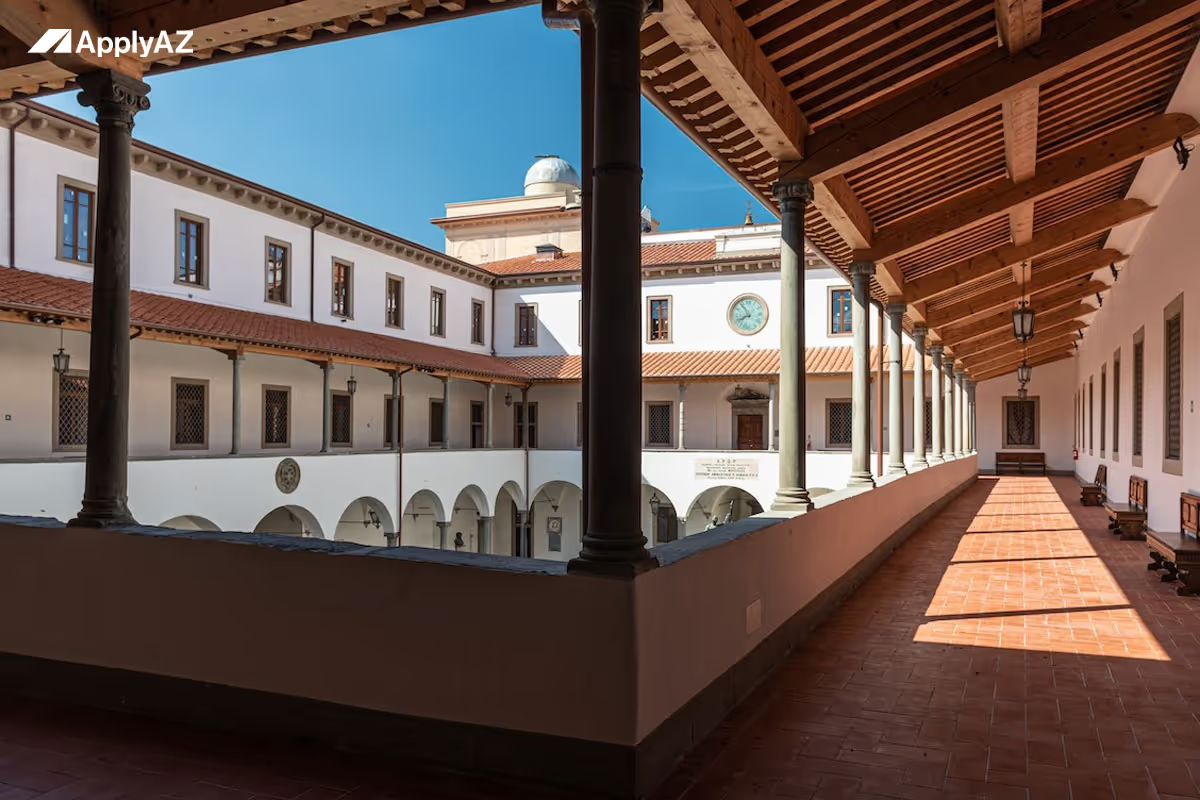
Cybersecurity is a two-year, 120 ECTS master's degree (class LM-66) taught in English at the University of Pisa by its Information Engineering and Computer Science departments. Non-EU entry needs a three-year computing degree, a CGPA of at least 75%, English at B2 and a successful video interview. Fees follow your country's income group or family income, so it can be tuition-free for eligible students.
Entry requirements
Detailed entry requirements
The Cybersecurity master asks for a bachelor's of at least three years in computing or a related field, equivalent to Italian class L-8 or L-31 or with 18 credits in maths or physics and 36 in computing, a CGPA of at least 75%, English at B2, and success in a document review and video interview. Reviewed 8 October 2026. [1]
Degree and credit requirement
You need a Bachelor of Science or equivalent first-cycle degree obtained abroad after at least three years of study, in Computer Science, Computer Engineering or another field with a suitable background in both mathematics and computer science or computer engineering. Qualifications from non-EU countries are verified and recognised by the Italian diplomatic authorities. [1]
Your degree must be equivalent to an Italian degree in class L-8 (Information Engineering) or L-31 (Computer Science), or include: [1][2]
- At least 18 credits in mathematics or physics (sectors MAT and FIS).
- At least 36 credits in information technology: electronics, telecommunications, computer engineering or computer science (sectors ING-INF/01, ING-INF/03, ING-INF/05 and INF/01).
The degree course board assesses whether the credits from a foreign qualification are adequate. [2]
Minimum grades
A CGPA of at least 75% of the maximum grade is strictly required, for example 3 on a 4-point scale or 15 out of 20. It must be calculated on all exams, electives included, over every year of your bachelor's, and backed by your official documents. [1]
No institution-specific grade-to-percentage conversion is used, and any application below 75% is excluded automatically. [1]
What this means for your transcript
As a guide, based on the rules above:
- Usually a fit: a B.Tech or B.E. in Computer Science, IT, or Electronics and Communication, or a B.Sc. in Computer Science, with a CGPA of at least 75% of the maximum.
- Check carefully: a BCA or B.Sc. IT, which usually covers the 36 computing credits but can fall short on the 18 maths or physics credits, and a B.Sc. in Mathematics or Physics or a B.Tech in Electrical Engineering, which can lack the 36 credits in computing, electronics or telecoms.
- Often short: a B.Com, BBA or BA, or a B.Tech in Civil or Mechanical Engineering, as these rarely reach 36 credits in those computing sectors.
Your grades matter as much as your subjects. On a 10-point scale, 75% of the maximum is a CGPA of 7.5, and a lower average is excluded whatever your subjects. [1]
English
English at CEFR level B2 is required. In the application you declare your English level, stating how long you studied and which certificate you hold. The call does not list accepted tests or minimum scores, and the interview also assesses your English. [1]
The programme's FAQ says you can apply without an official certificate and do not need one, or an internal exam, after admission. The Italian consulate may still ask for a certificate for the visa, so we check this for your file. [3]
Selection
An Evaluation Committee of Information Engineering and Computer Science professors assesses your background and education, your potential and your aptitude for an interdisciplinary programme. [1]
- Document review: scored out of 60. Below 42 points you are rejected; 42 or more puts you on the interview shortlist.
- Video interview: scored out of 40, covering your motivation, expectations, technical skills and English. You show the ID used in your application, and missing your slot means exclusion. At least 28 points makes you eligible for admission, and eligible applicants are ranked.
The programme's FAQ says applications are assessed mainly on your bachelor's CGPA and the international standing of your university. It reports around 1,500 applications a year, and the 2026/27 call aimed to admit an average of 40 non-EU applicants. Results appear only on the application portal at the end of the procedure, and a decision cannot be reviewed within the same call. [1][3]
2026/27 deadlines
The 2026/27 second-round call for non-EU citizens living abroad ran from 25 February to 15 March 2026, 12:00 GMT, a strict deadline. Interviews were scheduled from 20 March to 10 April 2026, admission notices were sent by 20 April 2026, and rejections were published on the portal by 6 May 2026. [1]
The programme usually publishes one call around late December or early January and a second in March or April, with no third round. It expects the next call in December 2026 or January 2027. [3]
Documents and non-EU steps
You apply online on the University of Pisa's portal for English-taught master's degrees, with a €30 fee for each application and at most two applications. The fee applies only to holders of a foreign qualification. You upload, as PDFs: [1]
- A declaration of your English, with the length of your studies and the certificate you hold.
- Certification of your degree showing its legal length of at least three years, with your degree certificate and transcripts translated into English or Italian.
- A valid passport.
- A full CV covering your education.
Reference letters and other certificates are optional. Applications missing a required document are invalid and cannot be completed after the deadline. [1]
The programme's FAQ adds that a declaration of value from the Italian embassy or a CIMEA statement of comparability is needed to show that your degree corresponds to an Italian bachelor's. Final-year students can apply with their transcripts. [3]
Admitted applicants confirm by email, receive a formal admission letter for Universitaly pre-enrolment, apply for the type D study visa and then enrol in Pisa. Pre-enrolment and the visa can take several weeks. [1]
Sources and verification
Checked by the ApplyAZ admissions team against the university's official documents listed below. Entry rules can change with each new call, and we re-check them before every application.
- University of Pisa, Departments of Information Engineering and Computer Science. Call for applications for non-EU citizens not resident in Italy, Master's Degree in Cybersecurity (LM-66), academic year 2026/27, second round. Reviewed 8 October 2026.
- University of Pisa, Cybersecurity programme page (degree class, teaching language, admission requirements, 2026/27 study plan and career opportunities). Reviewed 8 October 2026.
- University of Pisa, Master's Degree in Cybersecurity website. Call for applications for non-EU citizens and frequently asked questions, undated. Reviewed 8 October 2026.
- University of Pisa, Master's Degree in Cybersecurity website. Admission and course structure, and notes on the Group A course choice, course structure valid from 2024/25. Reviewed 8 October 2026.
- University of Pisa. Tuition fees for degree courses, academic year 2026/27. Reviewed 8 October 2026.
About the programme
Cybersecurity is a two-year master's degree (laurea magistrale, class LM-66, computer systems security) worth 120 ECTS, taught entirely in English in Pisa. It is offered jointly by the University of Pisa's Department of Information Engineering and Department of Computer Science, and answers the growing need for specialists with deep scientific and technological expertise in security. Access is open, but non-EU applicants living abroad compete in a separate, selective call. [1][2]
The course gives a solid grounding in the foundations, methods and technologies of the field, so that graduates can deal with security problems in very different application areas and contribute to research. It suits graduates in computer science or computer engineering with a strong academic record.
What you will study
The first year covers the core of the discipline plus a 12 ECTS bridging unit chosen according to your background: Computer Science and Computer Engineering graduates take Electronics and communication technologies, while Electronics and Telecommunications graduates take Systems and languages for informatics. The second year adds AI-based security, a choice of advanced units and a substantial thesis. [4]
The 2026/27 study plan includes: [2]
- Foundations of cybersecurity and Data and system security (9 ECTS each)
- Hardware and embedded security
- Language-based technology for security
- Organisational sciences and information technology law (12 ECTS)
- Artificial intelligence for cybersecurity
- Two of Network security, System and network hacking, Dependable and secure systems, or Software engineering
- Electives such as Biometric systems and Electromagnetic security, and a 24 ECTS thesis
Career paths
According to the University of Pisa, graduates work in public or private organisations that need specialised staff for their security needs, or in companies developing new cybersecurity solutions. Research careers are also open, in universities and in public or private research organisations working on security. Typical settings include: [2]
- Security teams in companies and public bodies
- Vendors building security products and services
- University and industrial research groups
Fees and scholarships
The programme says scholarship and fee options for international students change each year and are set out in each call. For 2026/27, the University of Pisa set a maximum of €2,900 a year for students with income abroad. You are automatically given a flat rate by your country's income group (€290, €580, €1,160 or €2,900), plus a €140 regional tax and a €16 stamp duty for new students, or you can ask for a fee based on an ISEEU parificato. [3][5]
DSU Toscana scholarship winners are fully exempt from tuition, so the course can be tuition-free for eligible students. The 2026/27 call also lists MAECI government scholarships, the Invest Your Talent in Italy scholarship, which this programme takes part in and which students from selected countries apply for separately, and an Academic Excellence Award for the best first-year student. [1][5]
How to apply from outside the EU
Non-EU applicants living abroad apply only through the programme's own call on the University of Pisa's portal for English-taught master's degrees, with a €30 fee per application. The programme usually publishes one call around late December or early January and a second in March or April, with no third round. The 2026/27 second-round call ran from 25 February to 15 March 2026, and the programme expects the next call in December 2026 or January 2027. [1][3]
Selection is competitive: the programme reports around 1,500 applications a year, and the 2026/27 call aimed to admit an average of 40 non-EU applicants after a document review and a video interview. Admitted students confirm by email, receive a formal admission letter, pre-enrol on Universitaly and apply for a type D study visa. [1][3]
How ApplyAZ helps
ApplyAZ is an Italy-based consultancy that works only with public universities. We can include this programme in a shortlist of 20 to 30 English-taught programmes that fit your profile, so your plan never rests on a single application.
For eligible students who start with us, a named person owns each stage, from A to Z:
- We check your transcript against Pisa's entry rules for this programme.
- We write your CV and a tailored statement of purpose.
- We prepare and submit your online application on the English-taught master's portal and Universitaly pre-enrolment.
- We help you declare your family income for reduced fees and file your DSU Toscana scholarship application at the right time and in the right format.
- We prepare your visa file.
With operations in all 20 Italian regions, we follow each region's scholarship rules and deadlines as they change. The university decides admission, the region decides the scholarship and the consulate decides the visa, so no one can promise an outcome. You pay in milestones, and every service you pay for is either delivered or its fee is refunded (terms apply).
Programmes at Italian public universities can be tuition-free for eligible students. Check if you are eligible and book a one-to-one consultation session with one of our Italy experts, or see how ApplyAZ works.
Questions and answers
What bachelor's degree do I need for the Cybersecurity master at Pisa?
A bachelor's of at least three years in Computer Science, Computer Engineering or another field with a suitable background in maths and computing. Unless it matches Italian class L-8 or L-31, it needs at least 18 credits in maths or physics and 36 in computing, electronics or telecoms. [1]
What CGPA do I need?
At least 75% of the maximum grade, for example 3 on a 4-point scale or 15 out of 20, calculated on all exams across every year. No university-specific percentage conversion is used, and applications below 75% are excluded automatically. [1]
Is there an entrance exam or interview?
There is no written test. The committee scores your documents out of 60, and applicants with 42 or more are invited to a video interview scored out of 40. You need at least 28 in the interview to be eligible for admission. [1]
What English level is required? Do I need IELTS?
English at B2. You declare your level and any certificate in the application, and the programme's FAQ says you can apply without an official certificate. The Italian consulate may still ask for one for the visa, so we check this for your file. [1][3]
When is the deadline for non-EU students?
For 2026/27, the second-round call ran from 25 February to 15 March 2026 (12:00 GMT). The programme usually opens one call in late December or early January and a second in March or April, and expects the next call in December 2026 or January 2027. [1][3]
Can I apply before I graduate?
Yes. The programme's FAQ says your exam transcripts are enough for the evaluation. If you are admitted, you may need your degree certificate for the visa, and you need it to complete enrolment in Pisa. [3]
I have a BCA or a B.Sc. in Mathematics. Can I apply?
Possibly. A BCA often covers the 36 computing credits but can fall short on the 18 maths or physics credits, while a maths degree has the maths but often lacks computing. Either way, you also need a CGPA of at least 75% of the maximum. [1]
How competitive is admission?
Very. The programme reports around 1,500 applications a year, and the 2026/27 call aimed to admit an average of 40 non-EU applicants. The FAQ says selection rests mainly on your bachelor's CGPA and the international standing of your university. [1][3]
Can someone handle my whole application to Cybersecurity at Pisa?
Yes. ApplyAZ, an Italy-based consultancy that works only with public universities, checks your transcript against Pisa's rules for this programme, handles the application and Universitaly pre-enrolment, helps you file the DSU Toscana scholarship application at the right time and in the right format, and prepares your visa file, for eligible students. Start by checking your eligibility.
I'm applying from India. What is the route into Cybersecurity?
A recognised Indian bachelor's, such as a B.Tech or B.E. in Computer Science, IT or Electronics, can meet the rule if it has 18 credits in maths or physics and 36 in computing, electronics or telecoms, and your CGPA is at least 75% of the maximum. You also need English at B2. The steps are the online application, a video interview if shortlisted, the admission letter and Universitaly pre-enrolment. [1] Indian students apply for the type D study visa at the Italian embassy or consulate that covers their state, such as New Delhi, Mumbai or Bengaluru.
Is the route different from Pakistan, Bangladesh or Sri Lanka?
No. The academic rules for Cybersecurity are the same whatever your nationality. Applicants from Pakistan, Bangladesh and Sri Lanka follow the same steps as India: online application in the non-EU call, a video interview if shortlisted, the admission letter and Universitaly pre-enrolment, then a type D study visa from the Italian mission for their country of residence. Read our guide for students in Dhaka.
I live in the UAE, Saudi Arabia, Qatar, Kuwait, Oman or Bahrain. Where do I apply for the visa?
At the Italian embassy or consulate responsible for the country where you legally live, after Universitaly pre-enrolment. The academic rules for Cybersecurity are the same whatever your nationality, and Gulf residents follow the same steps: online application in the non-EU call, a video interview if shortlisted, the admission letter and Universitaly pre-enrolment. Read our guides for Dubai, Riyadh and Doha.
I'm applying from the UK, US, Canada, Singapore or Malaysia. Is anything different?
The academic rules are identical. Non-EU applicants who live abroad, including citizens of these countries, follow the same route: online application in the non-EU call, a video interview if shortlisted, the admission letter and Universitaly pre-enrolment, then a type D study visa. Read our guides for London, New York, Singapore and Kuala Lumpur.
More English-taught programmes at this university
Other public universities in this city

They began right where you are

