

Master in Bionics Engineering at University of Pisa
Two-year English-taught LM-21 master's in Pisa, run by the University of Pisa with Scuola Superiore Sant'Anna, with Biorobotics and Neural Engineering curricula and 15 places for non-EU applicants.
Master
2 years
Pisa
English
University of Pisa



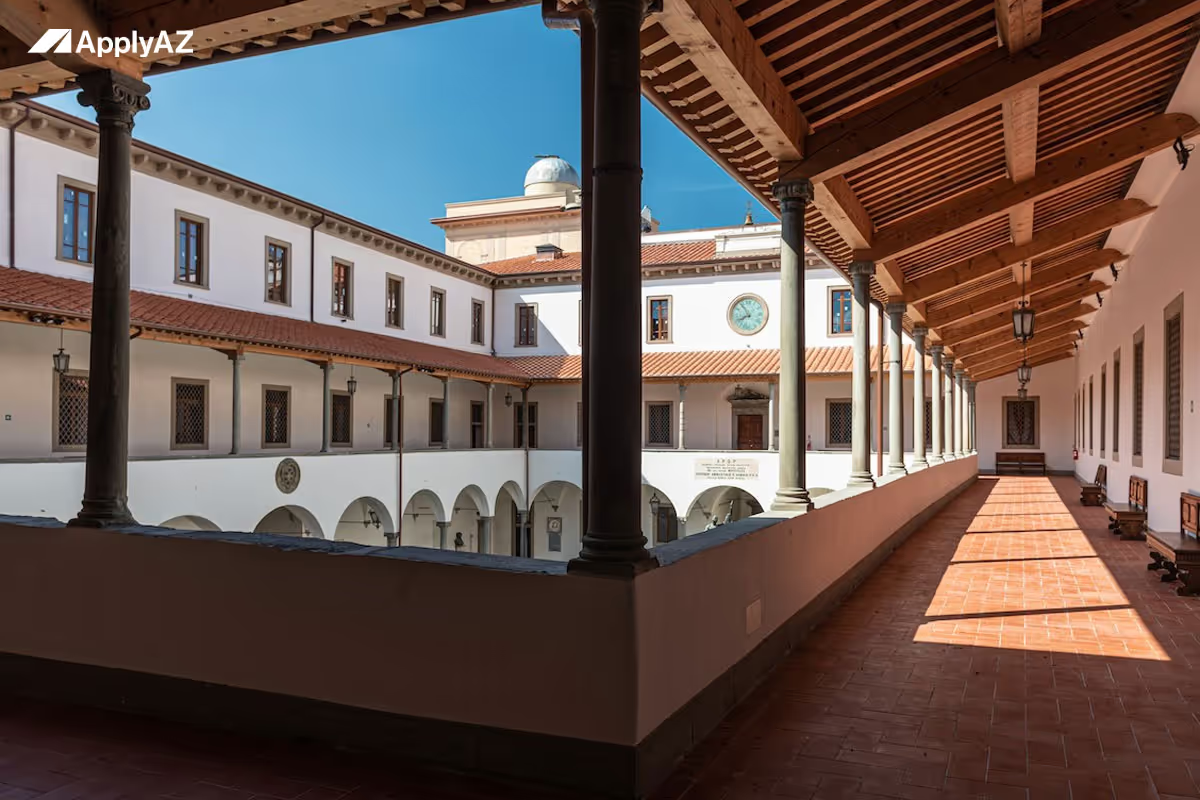
Bionics Engineering is a two-year, 120 ECTS master's degree (class LM-21, Biomedical Engineering) taught in English in Pisa, run jointly by the University of Pisa and Scuola Superiore Sant'Anna. Entry is limited to 30 students a year, 15 of them non-EU, and it can be tuition-free for eligible students.
Entry requirements
- A bachelor's or master's degree in bioengineering or biomedical engineering, or a degree in another discipline that meets the minimum credit requirements in the call.
- Those minimums include at least 42 ECTS in mathematics, physics and chemistry, plus set credits in bioengineering, information and industrial engineering subjects, for a total of 90 ECTS.
- English at B2 level of the European framework.
- Selection on qualifications and an interview, with a short summary of your bachelor's thesis (maximum five pages) using the official template.
- Non-EU applicants who have not yet graduated can apply if they complete the degree by July of the admission year.
About the programme
Bionics Engineering is a two-year master's degree (laurea magistrale, class LM-21, Biomedical Engineering) worth 120 ECTS and taught in English in Pisa. It is offered jointly by the University of Pisa and Scuola Superiore Sant'Anna, and managed by UniPi's Department of Information Engineering together with Sant'Anna's BioRobotics Institute. The course started in September 2015.
Bionics brings together advanced robotics and bioengineering with life sciences such as medicine and neuroscience, to create biomimetic machines, neuroprostheses and patient-centred healthcare and assistive technologies. Entry is limited to 30 students a year, so it suits engineering graduates with strong maths, physics and bioengineering foundations who want a research-oriented degree.
What you will study
After a shared first-year core you follow one of two curricula: Biorobotics, focused on robotic models of humans and animals and robots for surgery and rehabilitation, or Neural Engineering, focused on neuroprostheses, sensory systems and robots that interact with people. Units in the 2026/27 plan include:
- Analysis of Bionic and Robotic Systems and Bioinspired Computational Methods (12 ECTS each)
- Neuroanatomy and Cognitive Neuroscience, and Statistical Signal Processing
- Bioinspired and Soft Robotics, or Applied Brain Science
- Wearable Robotics, Rehabilitation and Assistive Technologies, and Advanced Interventional and Therapeutic Technologies (Biorobotics)
- Neural Prostheses, Bionic Senses, Neural Signal Processing and Measurement Techniques, and Human-Computer Interaction and Affective Computing (Neural Engineering)
- Electives such as Neuromorphic Engineering and Advanced Materials for Bionics
- Lab training (3 ECTS) and a final dissertation (15 ECTS)
Career paths
The University of Pisa describes three main outlets for graduates:
- Industrial design and development of neuroprosthetic and biorobotic platforms
- Public and private healthcare
- Research institutions working on biorobotics and neural engineering
The programme also aims to help graduates turn scientific insights into market opportunities, and the research focus is a natural base for a PhD.
Fees and scholarships
Admitted students enrol through the University of Pisa, whose 2026/27 rules set a maximum of €2,900 a year for students whose family lives abroad. Non-EU students fall automatically into a lower band by their country's World Bank income group (€290, €580 or €1,160) or can ask for an ISEEU parificato calculation. DSU Toscana scholarships include a fee exemption, so the degree can be tuition-free for eligible students.
How to apply from outside the EU
Selection is run by Scuola Superiore Sant'Anna on its online portal, through an assessment of qualifications followed by an interview, with 15 places reserved for non-EU candidates living abroad. For 2026/27 the non-EU deadline was 16 February 2026 at 11:00 CEST, and final-year students could apply if they graduated by July 2026.
Once admitted, you pre-enrol on Universitaly, apply for a type D study visa and complete enrolment with the University of Pisa. The 2027/28 call is not out yet.
How ApplyAZ helps
If this programme fits your goals, ApplyAZ can include it in a shortlist of 20 to 30 English-taught programmes at Italian public universities. We write your CV and a tailored statement of purpose, submit your applications and Universitaly pre-enrolment, file your DSU scholarship application and prepare your visa file, with a named person on each stage. The university decides admission, the region decides the scholarship and the consulate decides the visa. See how ApplyAZ works or check your eligibility.
Questions and answers
Is Bionics Engineering taught in English?
Yes. The whole master's is taught in English, and applicants need at least B2 level of the European framework.
Who runs the programme?
It is offered jointly by the University of Pisa and Scuola Superiore Sant'Anna, managed by UniPi's Department of Information Engineering and Sant'Anna's BioRobotics Institute. Sant'Anna handles the selection and students enrol through the University of Pisa.
How many places are there for non-EU students?
Entry is limited to 30 students a year: 15 places for non-EU candidates living abroad and 15 for EU candidates and non-EU candidates resident in Italy.
How are applicants selected?
Through an assessment of qualifications and an interview. You need a degree in bioengineering or biomedical engineering, or another degree meeting the minimum credits in the call, and you submit a short summary of your bachelor's thesis.
When is the deadline for 2027/28?
The 2027/28 call has not been published. For 2026/27 the non-EU deadline was 16 February 2026 at 11:00 CEST, and the EU deadline was 27 July 2026.
How much are the fees?
Under the University of Pisa's 2026/27 rules, fees are capped at €2,900 a year, with lower flat bands by country income group or an ISEEU parificato amount. DSU Toscana scholarships include a fee exemption for eligible students.
Similar programmes
More programmes in this city

They began right where you are

