

Bachelor in Heritage Innovation Engineering at University of Messina
Three-year English-taught bachelor (L-23) at the University of Messina on the recovery of historic buildings: materials, digital survey and modelling, structural design, restoration, urban regeneration and smart building sensing.
Bachelor
3 years
Messina
English
University of Messina


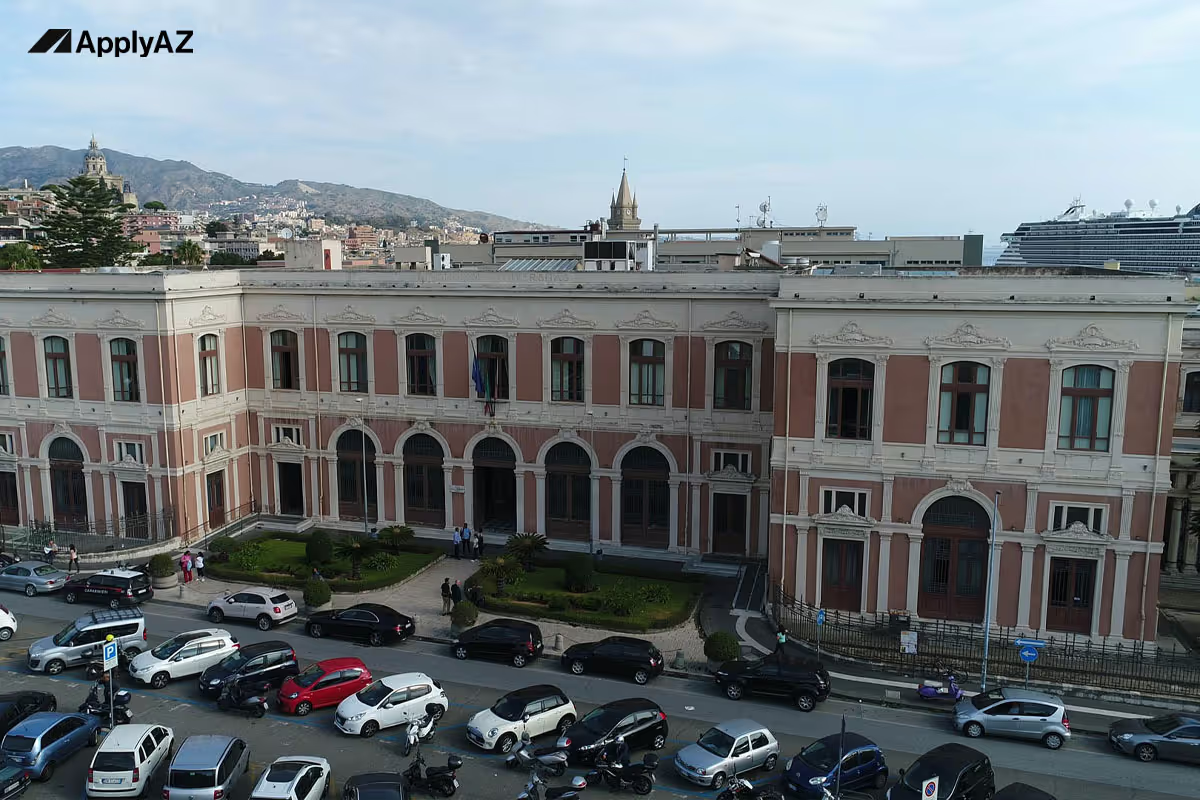
Heritage Innovation Engineering is a three-year, 180 ECTS bachelor's degree (class L-23) taught in English by the Department of Engineering of the University of Messina. It applies digital tools, BIM and sustainable technologies to historic buildings. International fees follow country groups, and it can be tuition-free for eligible students.
Entry requirements
- A secondary school qualification from 12 years of schooling, equivalent to the Italian diploma, meeting the university's entry criteria by country.
- English at CEFR level B2, shown by a certificate accepted by UniME.
- Open access: there is no cap on places and no competitive entrance exam.
- A basic knowledge check through a CISIA test or equivalent; if you do not pass, you receive additional learning requirements (OFA) to clear in the first year.
- For the Early Bird call, final school documents and a declaration of value or CIMEA statement of comparability.
About the programme
Heritage Innovation Engineering is a three-year bachelor's degree (laurea, class L-23, building science and technology) worth 180 ECTS. The Department of Engineering of the University of Messina teaches it entirely in English on its Messina campus, with open access.
The degree trains technical specialists for the recovery of historic buildings and the regeneration of urban areas. It joins the building sciences with digital tools such as BIM and augmented reality, and puts environmental, social and economic sustainability, energy efficiency and heritage conservation at the centre. It suits school leavers who like architecture and engineering and want a hands-on technical role.
What you will study
The first year builds the basics in mathematics, physics, materials and architectural drawing. The second year adds structures, geotechnics and building physics, and the third turns to restoration, design and digital modelling. Each year includes an elective, and the degree ends with a 6 ECTS final project.
- Architectural drawing and digital representation (12 ECTS) and History of modern and contemporary architecture (9 ECTS)
- Knowledge of modern materials (12 ECTS) and Physics and elements of diagnostics for cultural heritage (9 ECTS)
- Structural mechanics (9 ECTS) and Fundamentals of geotechnical engineering (6 ECTS)
- Sustainable technologies (12 ECTS) and Tools for building design: from LCA to 5RS (6 ECTS)
- Digital technologies for surveying and modelling (9 ECTS) and Structural design by digital technologies (6 ECTS)
- Architectural restoration (12 ECTS), Urban regeneration (9 ECTS) and Integrated sensing for smart building (9 ECTS)
How the programme is taught
Lectures run alongside laboratory work, and internships of 3 ECTS in the second and third years take place with professional or industrial firms, research institutions or public bodies. Students can also join national and international mobility schemes such as Erasmus.
Career paths
The department describes graduates as technical specialists in heritage building recovery and urban regeneration, able to support the design and building of projects and to work within EU and international rules. Typical roles include:
- collaborator on design and construction projects
- site technician and works supervisor
- energy performance specialist
- technical officer in a public administration
- technical director in a building company or urban planning technician
- safety coordinator on construction sites
Fees and scholarships
Since 2025/26 UniME sets fees for international students by country group rather than by family income. The yearly total, which includes the €156 regional tax, is €156, €256, €356 or €506; countries like India sit in the €256 group. The ERSU Messina scholarship, awarded mainly on family income, comes with a tuition fee waiver, a cash award, housing and meals, so this programme can be tuition-free for eligible students.
How to apply from outside the EU
You need 12 years of schooling and a B2 English certificate. Applications go through the UniME application portal, with a €40 fee covering up to two applications. For 2027/28, visa applicants can use the Early Bird call from 1 to 20 December 2026 (final documents plus a declaration of value or CIMEA statement needed), then 2 February to 19 March or 8 April to 8 May 2027.
After a positive evaluation, the admission letter explains Universitaly registration and the type D study visa. See the application and admission page.
How ApplyAZ helps
If this programme fits your goals, ApplyAZ can include it in a shortlist of 20 to 30 English-taught programmes at Italian public universities. We write your CV and a tailored statement of purpose, submit your applications and Universitaly pre-enrolment, file your DSU scholarship application and prepare your visa file, with a named person on each stage. The university decides admission, the region decides the scholarship and the consulate decides the visa. See how ApplyAZ works or check your eligibility.
Questions and answers
Is Heritage Innovation Engineering taught in English?
Yes. UniME lists it among its English-taught bachelor's degrees and the course page gives English as the only language. Applicants need English at CEFR level B2.
Is there an entrance exam?
No competitive exam: access is open. Students take a CISIA knowledge check or equivalent, and anyone who does not pass receives additional learning requirements (OFA) to complete in the first year.
What school background do I need?
A secondary school qualification from 12 years of schooling that is equivalent to the Italian diploma. UniME publishes entry criteria by country, and a foundation course exists for students with fewer years of schooling.
When can I apply for 2027/28?
Visa applicants apply on the UniME portal in the calls of 1 to 20 December 2026, 2 February to 19 March 2027 or 8 April to 8 May 2027. The €40 fee covers up to two applications.
How much are the fees?
International students pay a yearly amount set by country group: €156, €256, €356 or €506, including the €156 regional tax. ERSU Messina scholarship winners also receive a tuition fee waiver, and ERSU decides awards.
What jobs can graduates do?
Graduates support the design and construction of projects, supervise building sites, assess energy performance, work as technical officers in public bodies or building companies, and act as safety coordinators, mainly on historic buildings and urban regeneration.
Similar programmes
More programmes in this city

They began right where you are

