

Master in Physics at University of Ferrara
Two-year English-taught LM-17 physics master's at the University of Ferrara, with optional units in astrophysics, cosmology, medical, nuclear and solid state physics, a 35 ECTS research project and a double degree with Université Paris-Saclay.
Master
2 years
Ferrara
English
University of Ferrara


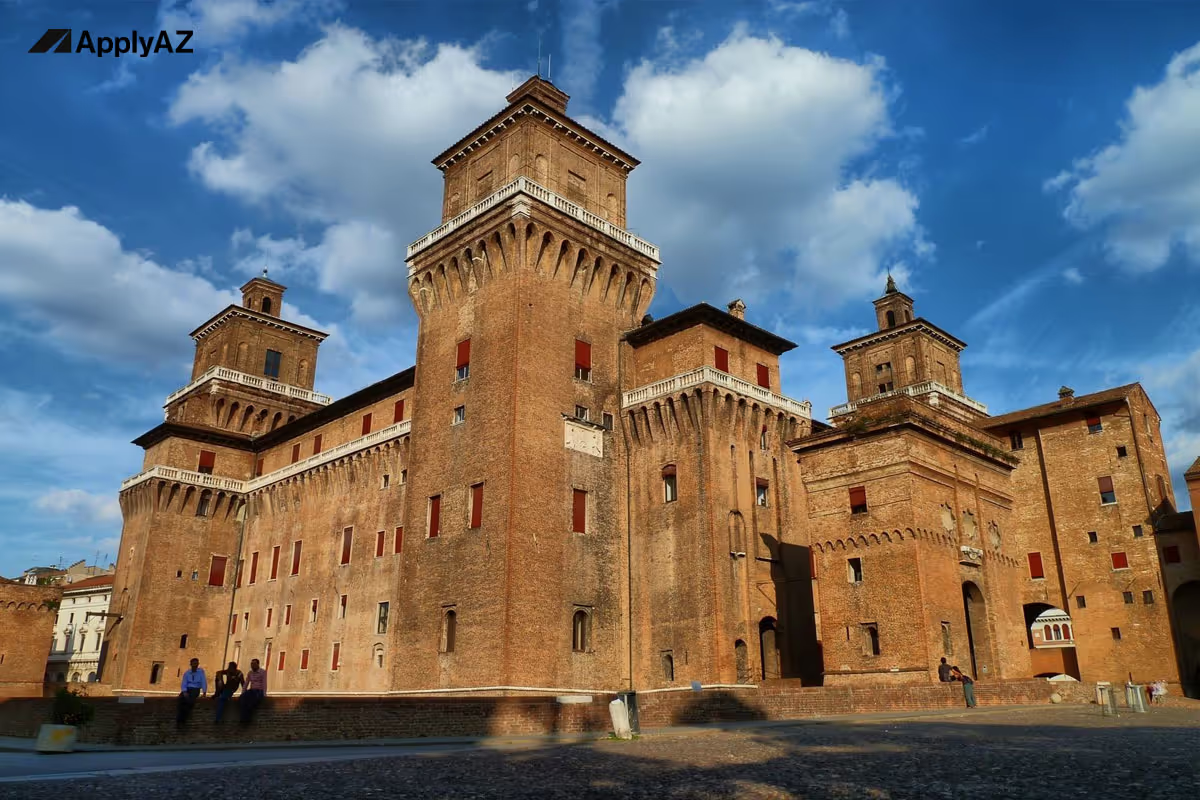
The Master in Physics at the University of Ferrara is a two-year, 120 ECTS laurea magistrale (LM-17) taught in English in Ferrara, with optional units from astrophysics to medical physics and a Paris-Saclay double degree. Fees follow family income, so it can be tuition-free for eligible students.
Entry requirements
Detailed entry requirements
Ferrara’s English Physics master requires a suitable three-year university qualification, an eligible physics curriculum and English B2. The 2026/27 regulation provides a precise 85-credit alternative for other degrees and an individual scientific/English interview after curricular clearance. Previously successful international early assessment and double-degree selection have specific exemptions. [1, 2]
Physics degree route and suitability of foreign awards
Italian L-30 Physical Sciences/Technologies or former class 25 satisfies the curricular degree-class route. Other Italian awards, three-year university diplomas and suitable recognised foreign qualifications are assessed under the alternative subject-credit route or for content correspondence. English B2 and adequate scientific preparation remain required after the degree-class check. A physics-sounding degree title or foreign certificate does not establish automatic admission. [1]
Other degrees: minimum 85 credits with exact subject allocations
- 20 total credits in mathematics/computing: MAT/01–/08, INF/01 or ING-INF/05. [1]
- 5 credits in chemistry: CHIM/01–/03 or CHIM/06. [1]
- 60 physics credits in FIS/01–/08, including 9 in FIS/02 theoretical physics/mathematical models and 51 collectively in FIS/01, /03, /04, /05 and /07. The specified 9+51 distribution matters within the 60 total. [1]
- Foreign or former-system examinations are mapped to equivalent content by the competent academic body. Missing curricular credits must be acquired before the personal-preparation interview; an interview cannot simply erase the deficit. [1]
Scientific and linguistic preparation interview
The commission checks the documentary curriculum first, then interviews eligible candidates to establish actual scientific and written/spoken English preparation. The regulation does not publish a universal bachelor’s GPA cutoff or a numerical IELTS/TOEFL threshold. B2 is the language level; the assessment must also establish the ability to understand English lectures/texts and work on scientific writing. A generic language certificate is not a substitute for scientific assessment. [1]
Prepare mathematical analysis, geometry/algebra and basic chemistry; classical mechanics, thermodynamics, electromagnetism and optics; experimental methods and electronics; classical/modern physics, special relativity, non-relativistic quantum mechanics, astrophysics and statistical mechanics. Computing/numerical tools and the ability to frame and solve a physics problem are also listed. The commission decides admissibility and an appropriate study pathway avoiding repetition of equivalent examinations already passed. [1]
Recognised prior assessments and 2026 interview calendar
Candidates found suitable under the double-degree selection are also suitable for master’s admission. Non-EU international applicants who have already passed the specifically organised early curricular/preparation assessment are exempt from repeating the ordinary personal-preparation assessment. These exemptions require the actual favourable selection decision, not merely interest in a double degree or an international application. [1]
The published 2026 calendar lists interviews on 27 January, 24 February, 31 March, 21 April, 26 May, 27 July and 29 September, followed by 20 October and 21 December, 09:30–10:30. As of 6 October, the latter two appointments are future listed sessions for eligible applicants. The programme’s 30 April overseas application deadline remains separate. Follow the course’s appointment instructions after the admission request. [2]
International application: two submissions and the closed 2026 window
For non-EU applicants abroad needing a study visa, submit the academic application in Apply.Unife and pay the non-refundable €20 application fee, and also submit Universitaly pre-enrolment for Ferrara for academic year 2026/27. The central page says only candidates completing both procedures are evaluated. Admission is an academic decision; it does not itself issue a visa. [3]
This programme was one of three English masters with the specific 12 January–30 April 2026 window. That window is closed as of 6 October. The later June/July dates for other Ferrara degrees must not be used for this course. A subsequent interview date does not reopen the overseas application. The central page describes a separate later route for qualifying Italian/EU/EU-equivalent applicants with foreign records; it does not automatically reopen this programme’s closed international selection. No 2027/28 dates are established by these documents. [2, 3]
Foreign qualification and document checklist
Provide the school-leaving qualification from a normally at least 12-year school system, the qualifying bachelor’s award and its full examination transcript. Ferrara requires the applicable legalisation and official Italian translation of the school and bachelor’s records. Supply university-stamped course syllabi or a Diploma Supplement in Italian or English, together with the required language evidence. These documents establish both qualification validity and subject preparation; a CV alone cannot establish the credit matrix. [4]
A Declaration of Value or CIMEA comparability/verification is required only if Ferrara requests it. Supply any country-specific academic-access evidence applicable to your qualification. Present the original academic records and translations to the Incoming office on arrival. The document page permits specified missing-document completion by 31 January only after academic and linguistic clearance; that administrative allowance does not waive the qualifying degree, required credits or English. [4]
Sources and verification
- University of Ferrara, Physics LM-17 Teaching Regulation, academic year 2026/27, article 4; publication date not stated in document; reviewed 6 October 2026.
- University of Ferrara Physics, Admission and Enrollment, 2026 interview calendar; publication date not stated; reviewed 6 October 2026.
- University of Ferrara, Enrol to a degree course, updated 25 May 2026, academic year 2026/27; reviewed 6 October 2026.
- University of Ferrara, Documents and qualifications for university admission, updated 18 December 2025; reviewed 6 October 2026.
About the programme
The Master in Physics is a two-year laurea magistrale (class LM-17) worth 120 ECTS and taught fully in English by the Department of Physics and Earth Sciences of the University of Ferrara. Teaching is face to face at the Scientific-Technological Campus in Ferrara, and students work in close contact with the department's research groups.
It is the natural next step after a bachelor's in physics. The course aims at a deep and flexible understanding of modern physics, theoretical and experimental, with room to lean towards fundamental research or applied physics.
What you will study
Everyone takes six first-year courses that extend bachelor-level physics, then builds the rest of the plan from optional units in astrophysics, cosmology, medical physics, archaeometry, nuclear and subnuclear physics, solid state physics and technology, and theoretical and computational physics. Units in the 2026/27 plan include:
- Quantum Mechanics, Statistical Physics and Mathematical Methods of Physics
- Fundamentals of Particle Physics, Nuclear Physics and Experimental Particle Physics
- General Relativity and Gravitational Waves, Observational Cosmology and Experimental High Energy Astrophysics
- Solid State Physics, Magnetic Materials and the Laboratory for Solid State Technologies
- Physics of Medical Imaging, Ionizing Radiation Physics and Computational Methods for Medical Physics
- Physics and Technology of Solar Energy, Environmental Radioactivity and Artificial Intelligence
- A traineeship (3 ECTS), a research project (35 ECTS) and a dissertation (10 ECTS)
How the programme is taught
The second year is built around research: the research project and final dissertation together carry 45 ECTS, so most students spend much of the year inside a research group. A double degree with Université Paris-Saclay (formerly Paris-Sud) is open to all students: after a selection, a limited number spend one year in Ferrara and one in France, choosing among several French master's tracks, and graduate with degrees from both universities.
Career paths
The university describes three main routes. In private companies, graduates take R&D roles that call for modelling and designing complex systems and handling new technologies. In research, the thesis gives a first real research experience and prepares for a PhD. The degree also opens the way to teaching in secondary schools and, after further study, at university.
Fees and scholarships
Unife sets fees on family income (an ISEE, or an income document for income earned abroad) and on credits earned. For 2026/27 the yearly amount ranged from €156 to about €2,250, paid in four instalments. Students with an ISEE up to €27,000 and those found eligible for the ER.GO regional scholarship are listed for a total exemption, so this programme can be tuition-free for eligible students. ER.GO also handles student housing.
How to apply from outside the EU
Physics checks every applicant's background through an admission interview with an evaluation committee, held online on set dates through the year. We apply on apply.unife.it (a one-time €20 fee) and also pre-enrol you on Universitaly for Ferrara, or your file is not assessed.
For 2026/27 the window for this master's ran from 12 January to 30 April 2026, and late applications were rejected. Keep the originals of your legalised diplomas and translations for arrival. Unife asks for a declaration of value or CIMEA statement only on request. Admitted students then apply for a type D study visa.
How ApplyAZ helps
If this programme fits your goals, ApplyAZ can include it in a shortlist of 20 to 30 English-taught programmes at Italian public universities. We write your CV and a tailored statement of purpose, submit your applications and Universitaly pre-enrolment, help you file your DSU scholarship application at the right time and in the right format, and prepare your visa file, with a named person on each stage. The university decides admission, the region decides the scholarship and the consulate decides the visa. See how ApplyAZ works or check your eligibility.
Questions and answers
Can I apply with a non-physics degree?
Yes, if it is a suitable qualification and the commission recognises the exact alternative mathematics/computing, chemistry and physics credit requirements. [1]
How many alternative-route credits are required?
At least 85: 20 mathematics/computing, 5 chemistry and 60 physics, with the prescribed 9-credit theoretical and 51-credit other-physics split. [1]
Can missing credits be recovered after interview?
The regulation requires curricular additions before the personal-preparation assessment. [1]
Is the interview only an English test?
No. It checks both scientific preparation and English, after curricular eligibility has been established. [1]
Must successful early international candidates repeat it?
Candidates who passed the specifically organised international early assessment are exempt from the subsequent ordinary preparation assessment. [1]
Does the October interview reopen overseas applications?
No. The 2026/27 overseas application window ended 30 April. Interview appointments and application deadlines are separate. [2, 3]
More English-taught programmes at this university
Other public universities in this city

They began right where you are

