

Master in Local Development at University of Padua
English-taught master in Padua on local development and development cooperation, combining economics, sociology, geography, statistics, pedagogy and anthropology, with a second-year research internship and a mobility window at the University of Graz.
Master
2 years
Padua
English
University of Padua


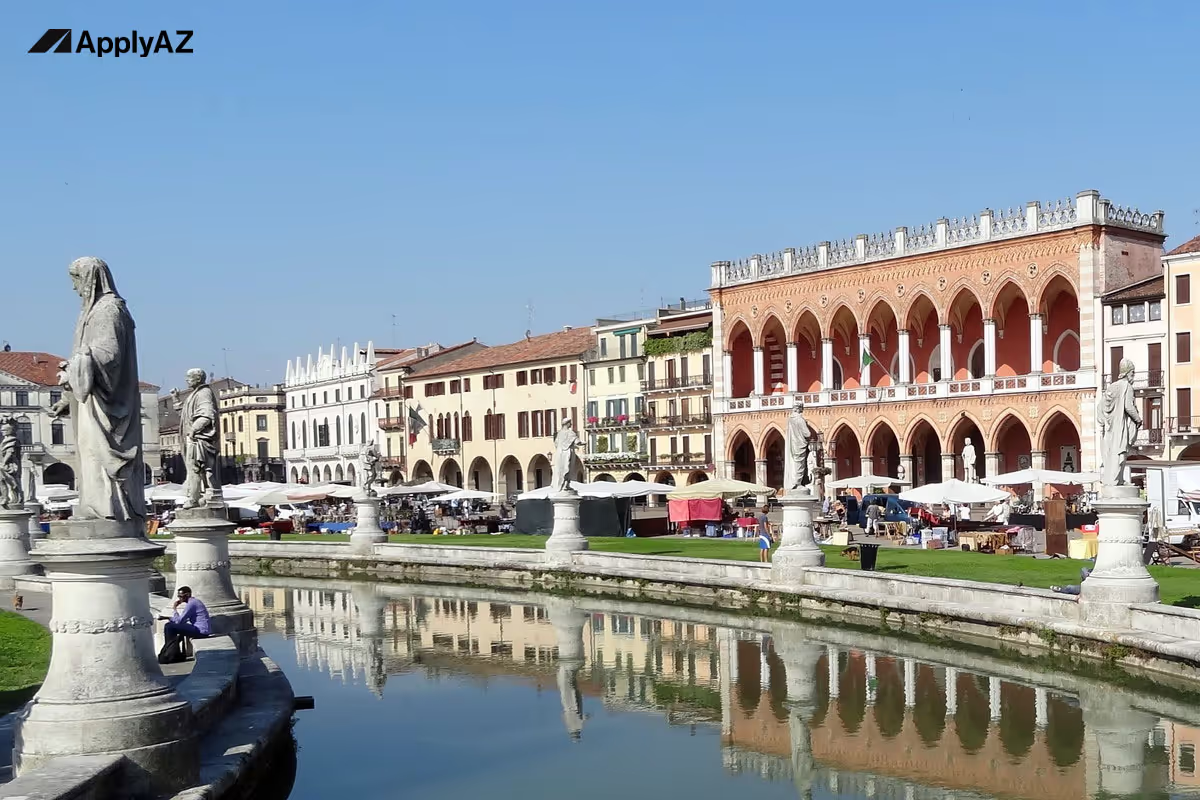
Local Development is a two-year, 120 ECTS master's degree (class LM-81-R) taught entirely in English at the University of Padua, training professionals to design, monitor and evaluate local development programmes. Non-EU students with family abroad pay a fixed €2,790 a year (2026/27), waived for regional scholarship winners.
Entry requirements
- A bachelor's degree of at least three years (or equivalent) with proven skills in at least one of: development studies, geography, urban and regional planning, environmental and sustainability studies, tourism and regional development, sociology, anthropology, public policy, political science, international relations and diplomacy, economics, management or intercultural communication.
- A final grade that meets the country-based requirements the university publishes (95/110 for Italian qualifications).
- English at B2 level of the CEFR, shown by a certificate on the university's accepted list unless an exemption applies.
- No entrance test: the selection committee assesses your application and may invite you to an interview through the application platform.
About the programme
Local Development is a two-year, 120 ECTS master's degree in class LM-81-R (Sciences for Development Cooperation), delivered entirely in English in Padua. It belongs to the School of Human and Social Sciences and Cultural Heritage, is run by the Department of Historical and Geographic Sciences and the Ancient World, and has open admission with requirements.
The degree gives a thorough understanding of the social, organisational, economic, territorial and institutional forms and dynamics that shape local development in different geographical contexts. It suits graduates in geography, development studies, planning, the social sciences or economics who want to work on development projects and cooperation, in a class that the university describes as multicultural and multilingual.
What you will study
Teaching is multidisciplinary. It covers the methods used to formulate, implement, monitor and evaluate local development programmes, and how to promote sustainability processes. The study plan draws on these disciplinary areas:
- Economics
- Sociology
- Political science
- Statistics
- Historical and geographical studies
- Socio-pedagogical studies
- Anthropology
How the programme is taught
In the second year an internship lets you carry out research that can become the starting point of your final dissertation. International partnerships and mobility agreements support the degree's international profile: since 2025/26 students can join an Arqus mobility window at the University of Graz, taking pre-selected courses in Sustainability and Innovation Management or in Climate Change and Transformation Science.
Career paths
Graduates work as local development and development cooperation professionals in different social and geographical contexts. The university names these roles and settings:
- Managerial roles in the design, monitoring and evaluation of projects
- Development cooperation agencies
- Governmental organisations at local, national and international level
- Non-governmental organisations
- Trade and citizenship associations, and enterprises
Fees and scholarships
Local Development is in fee Group A, like all degrees of its School. For 2026/27, non-EU students whose household is not resident in Italy pay a fixed €2,790 a year, or €930 as citizens of countries on the ministry's list of particularly poor countries. An ISEE parificato changes only the regional tax. Veneto regional scholarship winners pay nothing towards the fee, which means zero euro tuition for eligible students, and international applicants are considered for merit fee waivers. See the fees page.
How to apply from outside the EU
Apply on apply.unipd.it; the selection committee may call you for an online interview. Upload your transcript, degree certificate, CV, motivation letter and English certificate and pay €60; no legalised documents are required to apply. Non-EU applicants living abroad can use Call One (15 September to 15 November 2026) or Call Two (1 December 2026 to 1 March 2027).
Admitted students pay a non-refundable €208 fee to accept, complete Universitaly pre-enrolment and apply for a type D study visa. Your degree and transcript must be legalised, apostilled or verified by CIMEA by 31 August 2027. The year starts on 1 October 2027.
How ApplyAZ helps
If this programme fits your goals, ApplyAZ can include it in a shortlist of 20 to 30 English-taught programmes at Italian public universities. We write your CV and a tailored statement of purpose, submit your applications and Universitaly pre-enrolment, file your DSU scholarship application and prepare your visa file, with a named person on each stage. The university decides admission, the region decides the scholarship and the consulate decides the visa. See how ApplyAZ works or check your eligibility.
Questions and answers
Is the Master in Local Development taught in English?
Yes, the degree is delivered entirely in English in Padua. You need English at B2 level of the CEFR, shown by a certificate on the university's accepted list unless an exemption applies.
Which bachelor's degrees are accepted?
A degree of at least three years with proven skills in a field such as development studies, geography, planning, sustainability, tourism, sociology, anthropology, public policy, political science, international relations, economics, management or intercultural communication.
Is there an entrance test?
No. The selection committee assesses your application and may invite you to an interview through the application platform.
Does the programme include an internship or study abroad?
Yes. A second-year internship lets you do research that can lead into your final dissertation, and since 2025/26 students can join an Arqus mobility window at the University of Graz.
When can I apply for 2027/28?
Non-EU applicants living abroad apply on apply.unipd.it from 15 September to 15 November 2026 or from 1 December 2026 to 1 March 2027. The fee is €60 and classes start on 1 October 2027.
How much are the fees?
For 2026/27, non-EU students with family abroad pay a fixed €2,790 a year, or €930 if they are citizens of a country on the ministry's list of particularly poor countries. Veneto regional scholarship winners are exempt.
Similar programmes
More programmes in this city

They began right where you are

