

Master in Chemistry at University of Pavia
Two-year chemistry master at the University of Pavia with an English-taught Bio- and Nanomaterials curriculum in functional polymers, biosensors, nanomaterial characterisation and computational chemistry, ending with a 39 ECTS experimental thesis.
Master
2 years
Pavia
Multiple
University of Pavia



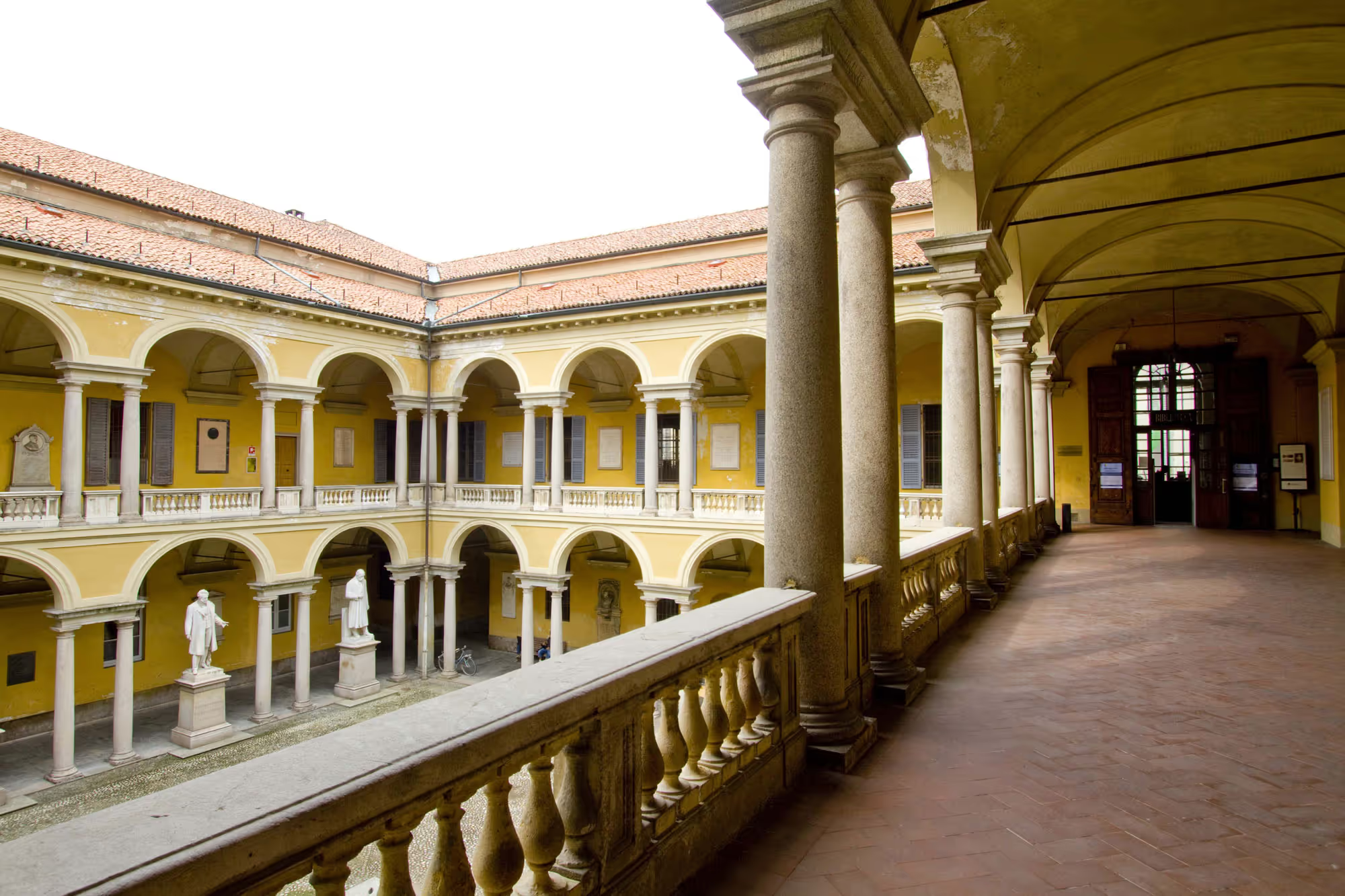
The Master in Chemistry at the University of Pavia is a two-year, 120 ECTS degree (class LM-54-R) whose Bio- and Nanomaterials curriculum is taught entirely in English. It covers polymers, biosensors, nanomaterials and computational chemistry, with a 39 ECTS experimental thesis. Non-EU students pay a flat rate by country or an income-based fee.
Entry requirements
- A bachelor's degree in chemistry (class L-27 or equivalent), or another degree with at least 60 credits in chemistry, with at least 15 each in analytical, physical, general and inorganic, and organic chemistry.
- At least 24 credits of chemistry laboratory courses.
- English at B2 level, or a university English course worth at least 3 ECTS; graduates of universities in Australia, Canada, Ireland, New Zealand, the UK or the USA, or of degrees fully taught in English, need no certificate.
- A committee assesses your background and holds an oral interview in English; chemistry graduates with a mark of at least 92/110 are exempt from the admission test.
- An application on apply.unipv.eu for the Bio- and Nanomaterials curriculum, with the official course descriptions from your university and the €35 fee.
About the programme
Chemistry (Chimica) is a two-year master's degree in class LM-54-R, run by the Department of Chemistry at the University of Pavia. The degree is officially bilingual: four of its five curricula are taught in Italian, while the Bio- and Nanomaterials curriculum is delivered entirely in English and is the route open to students who do not speak Italian. It is worth 120 ECTS, taught on campus in Pavia, with open access.
The Bio- and Nanomaterials curriculum combines polymer science, materials characterisation and biomedical applications of chemistry. It suits chemistry graduates, or graduates with a strong chemistry and laboratory record, who want to work on functional, bio-based and nanostructured materials in research or industry.
What you will study
In the Bio- and Nanomaterials curriculum the first year pairs a core course, Chemistry for Bio- and Nanomaterials, with two laboratory courses and a set of choices in analytical, physical, inorganic and computational chemistry. The second year adds two related electives, such as Nanomedicine in Regenerative Medicine, Additive Manufacturing of Living Materials or Sustainable Materials for Circular Economy, and the thesis. Units in the 2026/27 study plan include:
- Laboratory for Bio- and Functional Polymers
- Laboratory for Bio- and Nanomaterials
- Artificial Intelligence for Drug Design and Beyond
- Introduction to Molecular Computational Chemistry
- Chemosensors and Biosensors
- Characterization of Bio- and Nanomaterials
- Microspectroscopy Applied to Bio- and Nanomaterials
- Supramolecular Devices
How the programme is taught
The two first-year laboratory courses account for 18 ECTS and 216 hours of bench work. The experimental thesis carries 39 ECTS in the second year and is supervised by a University of Pavia faculty member; it can be written and defended in English, with an abstract in Italian. Placements in Italy or abroad are possible on request, and the regulations provide an LM+ scheme in which the thesis can be linked to a training placement with a host company.
Study periods abroad normally last 3 to 10 months. Students with a foreign degree include a 3 ECTS Italian language course in the second year unless they can show Italian proficiency.
Career paths
The university's professional profile is the senior chemist, able to organise research and development and to direct basic and applied research laboratories in public or private facilities. Graduates work in:
- Basic and applied research in public or private laboratories
- Quality analysis and control laboratories
- Management of national and international chemistry projects
- Education and science communication, including publishing and museums
- Teaching in schools and universities
- PhD programmes in chemistry, biochemistry, biotechnology, pharmaceutical or materials science
Fees and scholarships
Chemistry counts as a science-area degree. For 2026/27, non-EU students who do not present family financial documents pay a flat rate by citizenship: €390 a year in bracket 1, which includes countries like India, Bangladesh and Sri Lanka, €1,520 in bracket 2 and €4,550 in bracket 3. Documenting family income and assets instead gives an equivalent ISEE; up to €32,000 the all-inclusive fee is zero, which means zero euro tuition for eligible students apart from regional tax and €16 stamp duty. The EDiSU Pavia scholarship requires this route.
How to apply from outside the EU
On apply.unipv.eu the Bio- and Nanomaterials curriculum has its own entry, separate from the Italian-taught curricula. Upload your passport, degree certificate, a transcript with course workloads, the official course descriptions from your university and proof of English, and pay the €35 fee. The committee reviews your chemistry credits and interviews you in English. For 2026/27 the first call ran from 12 to 20 November 2025, with later calls open to applicants abroad only while non-EU seats remained; the 2027/28 calendar was pending in September 2026.
Admitted students complete the Universitaly pre-enrolment and apply for a type D study visa, which the consulate decides.
How ApplyAZ helps
If this programme fits your goals, ApplyAZ can include it in a shortlist of 20 to 30 English-taught programmes at Italian public universities. We write your CV and a tailored statement of purpose, submit your applications and Universitaly pre-enrolment, file your DSU scholarship application and prepare your visa file, with a named person on each stage. The university decides admission, the region decides the scholarship and the consulate decides the visa. See how ApplyAZ works or check your eligibility.
Questions and answers
Is the Master in Chemistry taught in English?
Only one curriculum is. Bio- and Nanomaterials is delivered entirely in English; the other four curricula are taught in Italian. International students who do not speak Italian apply for the Bio- and Nanomaterials curriculum.
What will I study in the Bio- and Nanomaterials curriculum?
Functional and bio-based polymers, nanomaterials and their characterisation, biosensors, microspectroscopy and computational chemistry, with two laboratory courses in the first year and a 39 ECTS experimental thesis.
What background do I need?
A chemistry bachelor's degree, or another degree with at least 60 chemistry credits, 15 each in analytical, physical, general and inorganic, and organic chemistry, and at least 24 credits of laboratory courses.
Is there an entrance test?
A committee reviews your background and holds an oral interview in English. Chemistry graduates with a final mark of at least 92/110 are exempt from the admission test.
How much are the fees?
For 2026/27, non-EU students pay a flat rate by citizenship, from €390 a year in bracket 1, or an income-based fee that is zero with an equivalent ISEE up to €32,000. EDiSU Pavia runs the regional scholarship.
What careers does the degree lead to?
The university's profile is the senior chemist: research and development in public or private laboratories, quality control, chemistry project management, science communication, teaching, or a PhD in chemistry, biotechnology or materials science.
Similar programmes
More programmes in this city

They began right where you are

