

Master in Industrial Nanobiotechnologies for Pharmaceuticals at University of Pavia
English-taught master at the University of Pavia on nanotechnology in pharmaceutical biotechnology, with a 12 ECTS traineeship, a 30 ECTS experimental thesis and two second-year tracks: Nanomedicines and Medicinal Tissue Engineering.
Master
2 years
Pavia
English
University of Pavia



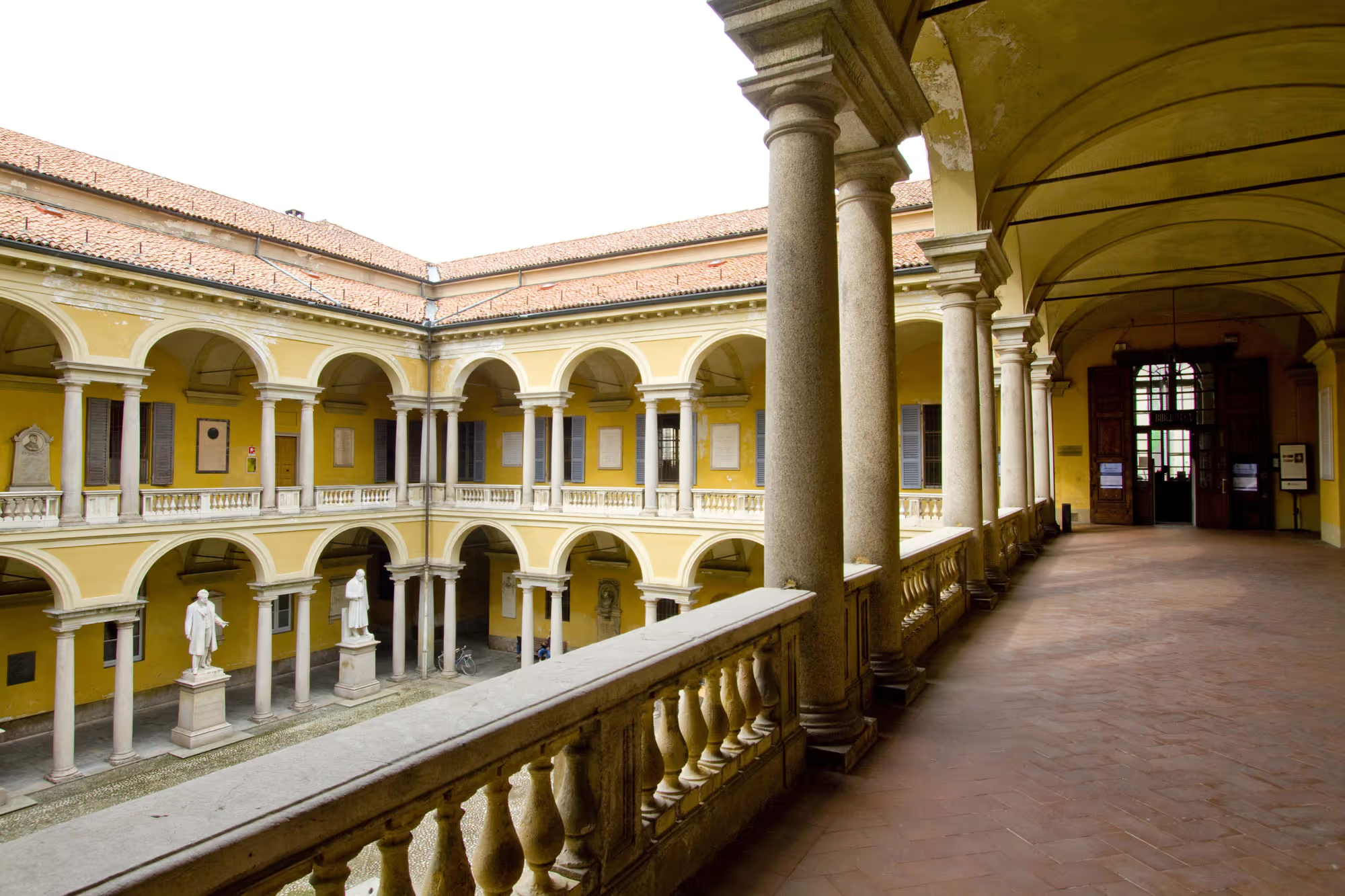
The Master in Industrial Nanobiotechnologies for Pharmaceuticals is a two-year, 120 ECTS degree (class LM-8-R) taught entirely in English at the University of Pavia's Department of Drug Sciences. It trains specialists in nanomedicines, drug delivery and tissue engineering for industry. Non-EU students pay a flat rate by country or an income-based fee.
Entry requirements
- A bachelor's degree of at least three years. Degrees in biotechnology, biological sciences, chemistry or pharmacy meet the curricular requirements; other graduates need at least 10 credits in mathematics, physics, computer science or statistics, 6 in chemistry and 6 in biology.
- Documented laboratory experience beyond the practical classes in your transcript, such as an experimental thesis, post-degree lab work or experience in a pharmaceutical company.
- English at B2 level of the CEFR (for example Cambridge B2 First, IELTS Academic or TOEFL iBT), submitted with the application; graduates of universities in Australia, Canada, Ireland, New Zealand, the UK or the USA are exempt.
- An interview in English with a faculty committee that assesses your preparation.
- An online application on apply.unipv.eu with a Europass CV, transcript, diploma, motivation letter and the €35 fee.
About the programme
Industrial Nanobiotechnologies for Pharmaceuticals (INBP) is a two-year master's degree in class LM-8-R, industrial biotechnology, run by the Department of Drug Sciences at the University of Pavia. It is a full-time degree taught entirely in English on campus in Pavia, worth 120 ECTS, with non-restricted access and a limited quota of seats for non-EU applicants who need a visa.
The degree aims to train specialists for research, manufacture and quality control where nanotechnology meets industrial pharmaceutical biotechnology. Graduates learn to design nanostructured systems for diagnosis and therapy, formulate nanobiotechnological medicines and medical devices, develop biopharmaceuticals at industrial scale and apply the regulations that govern these products. It suits graduates in biotechnology, biology, chemistry or pharmacy who already have hands-on laboratory experience.
What you will study
The first year is shared by all students and builds the pharmaceutical and biological base, with a short refresher in analytical chemistry, biology or organic chemistry chosen to fill gaps in your background. In the second year you follow one of two tracks: Nanomedicines or Medicinal Tissue Engineering. Units in the 2026/27 regulations include:
- Preformulation and Pharmaceutical Technology
- Traditional and Innovative Dosage Forms
- Immunology, Biotechnological Drugs and Vaccines
- Statistics Applied to Pharmaceutical Sciences
- Nanotechnology-Based Medicines (Nanomedicines track)
- Industrialization Processes and Methodologies (Nanomedicines track)
- Biomaterials and Bioconjugates for Tissue Repair and Regeneration (Medicinal Tissue Engineering track)
- Pharmacological and Biomechanical Aspects (Medicinal Tissue Engineering track)
How the programme is taught
A 12 ECTS traineeship in the first year introduces you to research work, normally in the laboratories of the Department of Drug Sciences; external placements are possible with the department's approval. The traineeship must be completed before the thesis, which is worth 30 ECTS: an original experimental project developed with a supervisor and defended in public. Students with a foreign degree also take a 3 ECTS course in Italian for foreign students.
Study periods of 3 to 12 months abroad are possible through Erasmus or bilateral agreements. The degree is also linked to NANOMED, the joint programme Nanomedicine for Drug Delivery with the universities of Angers, Patras and Paris Cité: students selected for NANOMED spend part of their studies in Pavia and can also obtain the INBP degree.
Career paths
The university describes graduates as pharmaceutical nanotechnologists able to work across research, production and regulation. The roles it lists include:
- Researcher in pharmaceutical and biomedical companies
- Project manager or executive in biotechnology firms
- Research and development consultant
- Regulatory affairs specialist
- Industrial production of nanoparticle systems and tissue engineering products
- Trainer in the public and private sectors
Fees and scholarships
INBP counts as a science-area degree for fees. Non-EU students who do not submit family financial documents pay a flat rate by citizenship: for 2026/27, €390 a year in bracket 1 (countries like India, Nepal and Pakistan), €1,520 in bracket 2 and €4,550 in bracket 3. The alternative is an income-based fee from an equivalent ISEE: up to €32,000 the all-inclusive fee is zero, giving zero euro tuition for eligible students; regional tax and €16 stamp duty remain. This route is also needed for the EDiSU Pavia scholarship.
How to apply from outside the EU
For this degree your English certificate must be uploaded with the application on apply.unipv.eu, together with your passport, a Europass CV in English, your transcript and diploma and a motivation letter; late certificates are not accepted. The fee is €35 per programme. A committee checks your background and interviews candidates in English. For 2026/27 the first call ran from 12 to 20 November 2025, and later calls stayed open to applicants abroad only while non-EU seats remained; 2027/28 dates were not out by September 2026.
After admission you complete the Universitaly pre-enrolment and request a type D study visa, which the consulate decides. At enrolment your degree must be legalised, apostilled or verified by CIMEA.
How ApplyAZ helps
If this programme fits your goals, ApplyAZ can include it in a shortlist of 20 to 30 English-taught programmes at Italian public universities. We write your CV and a tailored statement of purpose, submit your applications and Universitaly pre-enrolment, file your DSU scholarship application and prepare your visa file, with a named person on each stage. The university decides admission, the region decides the scholarship and the consulate decides the visa. See how ApplyAZ works or check your eligibility.
Questions and answers
Is the Master in Industrial Nanobiotechnologies for Pharmaceuticals taught in English?
Yes. The whole degree is taught in English on campus in Pavia. You need English at B2 level, shown by a certificate uploaded with your application, unless your bachelor's degree is from a university in Australia, Canada, Ireland, New Zealand, the UK or the USA.
What bachelor's degree do I need?
A degree of at least three years. Biotechnology, biology, chemistry and pharmacy fit directly; other graduates need at least 10 credits in mathematics, physics, computer science or statistics, plus 6 in chemistry and 6 in biology. You also need documented laboratory experience.
Is there an entrance test?
There is no written test. A faculty committee reviews your file and holds an interview in English to assess your preparation.
Which tracks can I choose?
After a shared first year you choose Nanomedicines, focused on nanotechnology-based medicines and industrial scale-up, or Medicinal Tissue Engineering, focused on biomaterials, bioconjugates and the regulation of tissue products.
How much are the fees?
For 2026/27, non-EU students pay a flat rate by citizenship, from €390 a year in bracket 1 to €4,550 in bracket 3 for science degrees, or an income-based fee that is zero with an equivalent ISEE up to €32,000. EDiSU Pavia offers regional scholarships.
What jobs can graduates do?
The university lists research roles in pharmaceutical and biomedical companies, project management in biotechnology firms, research and development consulting, regulatory affairs, industrial production of nanoparticle and tissue engineering products, and training roles.
Similar programmes
More programmes in this city

They began right where you are

