

Master in Food Safety and Food Risk Management at University of Parma
Two-year English-taught LM-70 joint master's led by the University of Parma with Bologna, Cattolica (Piacenza), Modena and Reggio Emilia and Ferrara: first year in Parma, second-year curriculum at a partner university.
Master
2 years
Parma
English
University of Parma


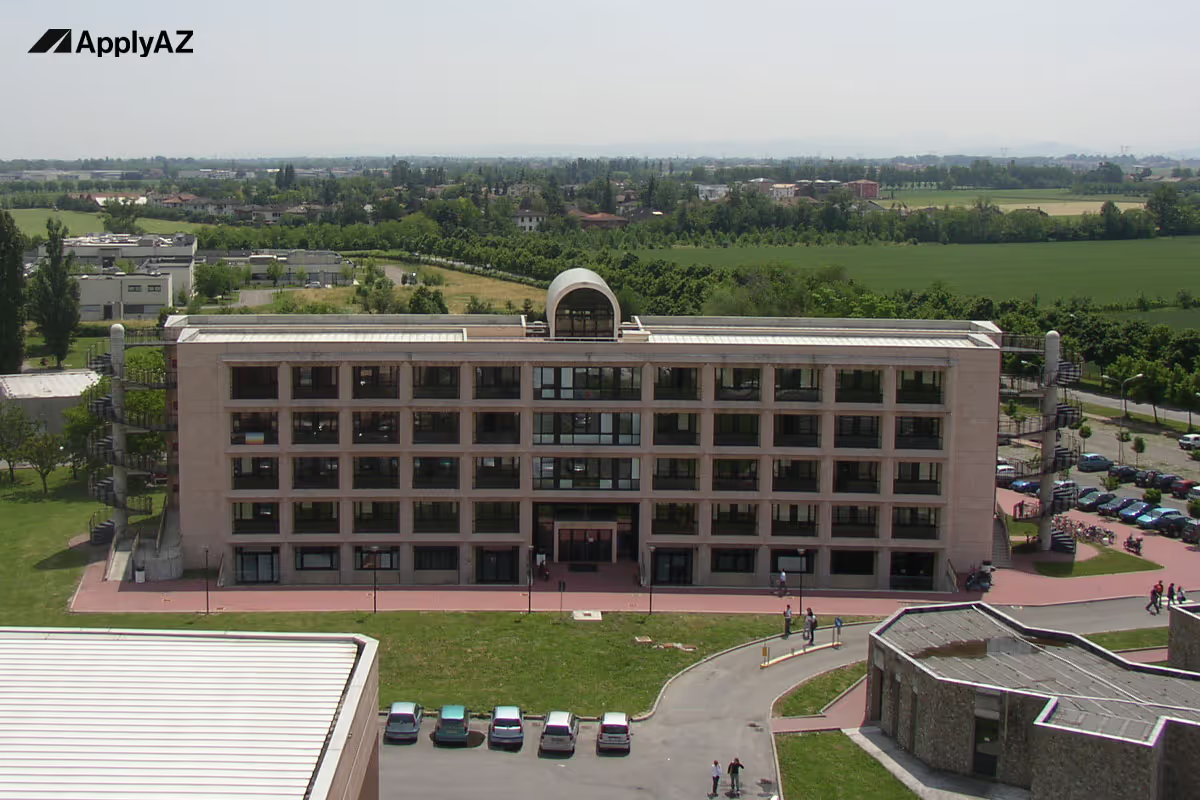
Food Safety and Food Risk Management is a two-year, 120 ECTS master's (LM-70) taught in English, run by the University of Parma with four other Emilia-Romagna universities. Year one is in Parma and year two at a partner. Fees depend on family income, so it can be tuition-free for eligible students.
Entry requirements
Detailed entry requirements
Parma’s Food Safety and Food Risk Management master requires a suitable first-cycle degree, foundational food-science preparation and English B2. The current 2026/27 portal requires both curricular and personal-preparation verification. The detailed degree and 60-credit framework below comes from the official 2023/24 regulation. [1, 2]
Required prior academic preparation
The current portal specifies adequate bachelor-level food technology, food microbiology, food chemistry, primary production and human nutrition. It requires the commission to establish both a suitable curriculum and adequate personal preparation before enrolment. Italian qualifications satisfying the named conditions are handled through the prescribed route; foreign or other records receive individual commission review. No universal numerical GPA floor appears in the current course portal. [1]
Named degree classes in the detailed official regulation
The 2023/24 article 4 names L-25 Agricultural/Forestry Sciences and Technology, L-26 Agri-Food Science/Technology and L-38 Animal Production Sciences, with former classes 20 and 40. These are curricular routes with English evidence still required. A foreign qualification is assessed for content equivalence, especially where the awarding system does not use ECTS. The current portal does not turn every similarly titled overseas degree into automatic admission. [1, 2]
Other degrees: 60 course credits and at least five courses
The detailed regulation permits other bachelor’s fields with at least 60 ECTS in its specified relevant sectors. Those credits must come from taught courses, not internships/stages or thesis projects, and must involve at least five different relevant courses. An examination-by-examination transcript and course descriptions are needed, and we map your course content against these sectors; a total credit count without relevant content is insufficient. [2]
The indexed relevant-sector list includes the specified physics disciplines and, among others, veterinary infectious diseases/parasitology/pharmacology (VET/05-/07), thermal/environmental engineering (ING-IND/10-/11), agri-food/business law (IUS/03-/04) and statistics (SECS-S/01-/02). These are examples rather than the whole matrix. The admission commission decides which prior courses count under the complete applicable list, and we map your courses against it before you apply. The older framework does not set a new selection date, and foreign qualifications are still reviewed. [2]
English B2: specific portal scores and accepted exemptions
The current portal lists Cambridge FCE/CAE, IELTS at least 5.5 and TOEFL at least 69, along with the named recognised certifying bodies. Native-English applicants and holders of a prior English-taught qualification may use the stated exemption; the latter must supply an official university letter confirming the teaching language. The older regulation also recognises a documented B2 academic English examination and a formally English-taught bachelor’s degree. [1, 2]
The portal describes Parma’s individual English B2 course, code 1005844, and CLA preparation as a possible route to achieving the level. Purchasing or studying that course is not itself a B2 pass or an academic acceptance. We work from the course-specific assessed evidence and commission instructions. These scores are specific to this programme; Parma’s Data Science master sets a different TOEFL score. [1]
Selection status as of 6 October 2026
The admissions portal marks both 2026/27 Food Safety international application periods ended. The central second-intake notice specifically included this programme for 4-26 June 2026; not every Parma master's programme had that extra round. The next call sets the 2027/28 dates. The central ordinary enrolment route for EU/equivalent applicants is separate from the international portal. [1, 4, 5]
Application file, language of documents and fees
We apply through the university’s admissions portal for the relevant international intake and upload your degree, academic record and course-specific evidence. The portal accepts academic records in English or Italian; official translations and verified copies are needed where necessary. The application fee is €30, covering up to three course requests within the call, rather than three automatic admissions. The fixed €156 administration charge is paid at final enrolment, separately from income-dependent tuition. [1]
Final enrolment with a foreign award requires original school and bachelor’s records with the prescribed diplomatic legalisation/Apostille, translations into Italian or English and the full university Transcript of Records. Any university-access examination certificate required in the awarding country is also needed. A Declaration of Value or CIMEA comparability is required under the university’s stated procedure; ARDI is accepted only under its specific country/document conditions, not as a universal replacement. Originals are delivered to the Welcome Point/student administration. [3]
Immigration and final enrolment are separate from selection
Visa applicants must complete the applicable Universitaly pre-enrolment and consular study-visa process after academic acceptance. For final registration, provide the passport, visa, residence permit/application receipt and official Italian tax code as applicable; self-generated online tax codes are not accepted. These English programmes do not require Italian B2 for admission, although the portal requires the course’s Italian-language assessment during the degree before graduation. [1, 3]
The central foreign-student page gives 31 October 2026 as the usual final enrolment date. Later-arriving visa holders may be considered through 31 January 2027, subject to programme-specific deadlines and the university checking teaching progress and practical feasibility. This is a conditional administrative provision for admission and enrolment, not a new overseas selection round, and late entry rests on the university's decision. EU/equivalent applicants use the separately published ordinary procedure rather than borrowing the closed visa-intake dates. [3, 4]
Sources and verification
- University of Parma Admissions Portal, Food Safety and Food Risk Management, course 5124/GEN/2026, academic year 2026/27; publication date not stated; reviewed 6 October 2026.
- University of Parma, Food Safety and Food Risk Management Educational Regulation, academic year 2023/24, article 4; publication date not stated; official indexed admission sections reviewed; reviewed 6 October 2026.
- University of Parma, Complete the enrolment, updated 25 August 2026, academic year 2026/27; reviewed 6 October 2026.
- University of Parma, Master’s degree courses in English, updated 3 June 2026; current 2026/27 programme portal; reviewed 6 October 2026.
- University of Parma, Second intake opens for admission to six English-taught master’s programmes, 4 June 2026, updated 16 June; reviewed 6 October 2026.
About the programme
Food Safety and Food Risk Management is a two-year laurea magistrale in class LM-70 (food science and technology) worth 120 ECTS and taught fully in English. It is a regional joint degree of five universities: Parma, which is the administrative seat, Bologna, Università Cattolica del Sacro Cuore (Piacenza campus), Modena and Reggio Emilia, and Ferrara. At Parma it belongs to the Department of Food and Drug.
The course trains experts in assessing and managing food risks across the supply chain, with a solid grasp of European food law. Parma sits in Italy's food valley and hosts the European Food Safety Authority (EFSA). The degree suits graduates in food science, food technology and related fields.
What you will study
All first-year teaching takes place in Parma. Core units include:
- Risk assessment of chemical compounds (9 ECTS)
- Food technology and food microbiology (12 ECTS)
- Food allergens: molecular approaches and regulatory aspects (9 ECTS)
- Biological hazards in food (6 ECTS) and exposure assessment and risk/benefit evaluation (6 ECTS)
- Hazard identification in primary production, covering plant health and animal welfare (12 ECTS)
- Food law and ethics, including food law and international policies (9 ECTS)
At the start of the second year you choose one of four curricula, each offered at a partner:
- Risk Mitigation at Università Cattolica (Piacenza), with Parma
- Agri-Food Safety at Modena and Reggio Emilia
- Risk Management at Bologna
- Food Safety and Product Design at Ferrara
How the programme is taught
The second year includes a 20-credit internship, which can be done at an outside organisation, in a university lab or through international mobility, and a 4-credit final dissertation. Thesis work is supervised jointly by the universities and food companies, government bodies or EU institutions. Graduates receive a joint degree from all five universities. Attendance is not compulsory.
Career paths
Graduates take on responsibility for safety in food companies, from primary production and sourcing of raw materials to process control, new product development, marketing and distribution in Europe and beyond. They can also design and monitor risk management strategies and food safety plans. Other routes include:
- Control bodies and national and international food safety organisations, including EFSA
- Research and development in companies, universities and research institutes
- Training and scientific communication
- The Italian register of Food Technologists, after the state exam
Fees and scholarships
Because Parma is the administrative seat, you enrol there and pay its fees. For 2026/27 that meant €156 at enrolment, then a personalised contribution of up to about €2,000 a year linked to family finances, merit and years enrolled, from which eligible students could be exempt. International students with foreign income apply for the reduction and for regional scholarships through ER.GO. The course can be tuition-free for eligible students.
How to apply from outside the EU
We apply through the university’s course-specific admissions portal against the detailed eligibility rules above. The 2026/27 international selection is closed. Academic admission, foreign-record validation, Universitaly, visa and final registration are separate stages. If you are already admitted, we follow the applicable enrolment instructions with you. [1, 3, 4]
How ApplyAZ helps
ApplyAZ is an Italy-based consultancy that works only with public universities. We can include this programme in a shortlist of 20 to 30 English-taught programmes that fit your profile, so your plan never rests on a single application.
For eligible students who start with us, a named person owns each stage, from A to Z:
- We check your transcript against Parma's entry rules for this programme.
- We write your CV and a tailored statement of purpose.
- We prepare and submit your application through the University of Parma admissions portal and Universitaly pre-enrolment.
- We help you declare your family income for reduced fees and file your ER.GO Emilia-Romagna scholarship application at the right time and in the right format.
- We prepare your visa file.
With operations in all 20 Italian regions, we follow each region's scholarship rules and deadlines as they change. The university decides admission, the region decides the scholarship and the consulate decides the visa, so no one can promise an outcome. You pay in milestones, and every service you pay for is either delivered or its fee is refunded (terms apply).
Programmes at Italian public universities can be tuition-free for eligible students. Check if you are eligible and book a one-to-one consultation session with one of our Italy experts, or see how ApplyAZ works.
Questions and answers
What academic background is needed?
A suitable first degree with food technology, microbiology, chemistry, primary-production and nutrition foundations, assessed under the course’s curricular and preparation rules. [1]
Can another bachelor’s field be considered?
The detailed 2023/24 regulation describes a 60-ECTS relevant-course route involving at least five courses. The commission must confirm the applicable mapping and current eligibility. [2]
Can my thesis fill the 60-credit total?
The detailed regulation excludes internship/stage and thesis credits from that curricular total. [2]
What English scores does the portal list?
English B2, with examples Cambridge FCE/CAE, IELTS 5.5+ or TOEFL 69+. [1]
Can an English-taught degree replace a certificate?
The current portal permits that route with an official former-university letter confirming English instruction. [1]
Was there a second international intake?
Yes, 4-26 June 2026 for this programme. It has ended; final enrolment provisions do not reopen it. [5]
Can someone handle my whole application to Food Safety and Food Risk Management at Parma?
Yes. ApplyAZ, an Italy-based consultancy that works only with public universities, checks your transcript against Parma's rules for this programme, handles the application and Universitaly pre-enrolment, helps you file the ER.GO Emilia-Romagna scholarship application at the right time and in the right format, and prepares your visa file, for eligible students. Start by checking your eligibility.
I'm applying from India. What is the route into Food Safety and Food Risk Management?
Indian applicants need a bachelor's degree with foundations in food technology, food microbiology, food chemistry, primary production and human nutrition [1]. Under the 2023/24 regulation, other degrees need at least 60 ECTS across five relevant courses, excluding internship and thesis credits [2]. English B2 is required, for example IELTS 5.5 or TOEFL 69 [1]. We map your transcript, apply through the portal and handle Universitaly pre-enrolment. Indian students apply for the type D study visa at the Italian embassy or consulate that covers their state, such as New Delhi, Mumbai or Bengaluru.
Is the route different from Pakistan, Bangladesh or Sri Lanka?
No. The academic rules for Food Safety and Food Risk Management are the same whatever your nationality. Applicants from Pakistan, Bangladesh and Sri Lanka follow the same steps as India: online application through the admissions portal, academic acceptance and Universitaly pre-enrolment, then a type D study visa from the Italian mission for their country of residence. Read our guide for students in Dhaka.
I live in the UAE, Saudi Arabia, Qatar, Kuwait, Oman or Bahrain. Where do I apply for the visa?
At the Italian embassy or consulate responsible for the country where you legally live, after Universitaly pre-enrolment. The academic rules for Food Safety and Food Risk Management are the same whatever your nationality, and Gulf residents follow the same steps: online application through the admissions portal, academic acceptance and Universitaly pre-enrolment. Read our guides for Dubai, Riyadh and Doha.
I'm applying from the UK, US, Canada, Singapore or Malaysia. Is anything different?
The academic rules are identical. Non-EU applicants who live abroad, including citizens of these countries, follow the same route: online application through the admissions portal, academic acceptance and Universitaly pre-enrolment, then a type D study visa. Read our guides for London, New York, Singapore and Kuala Lumpur.
More English-taught programmes at this university
Other public universities in this city

They began right where you are

