

Master in Data Science for Management at University of Parma
Two-year English-taught LM-Data master at the University of Parma's Department of Economics and Management, training data analysts and data scientists in statistics, programming, machine learning, credit risk and data protection.
Master
2 years
Parma
English
University of Parma


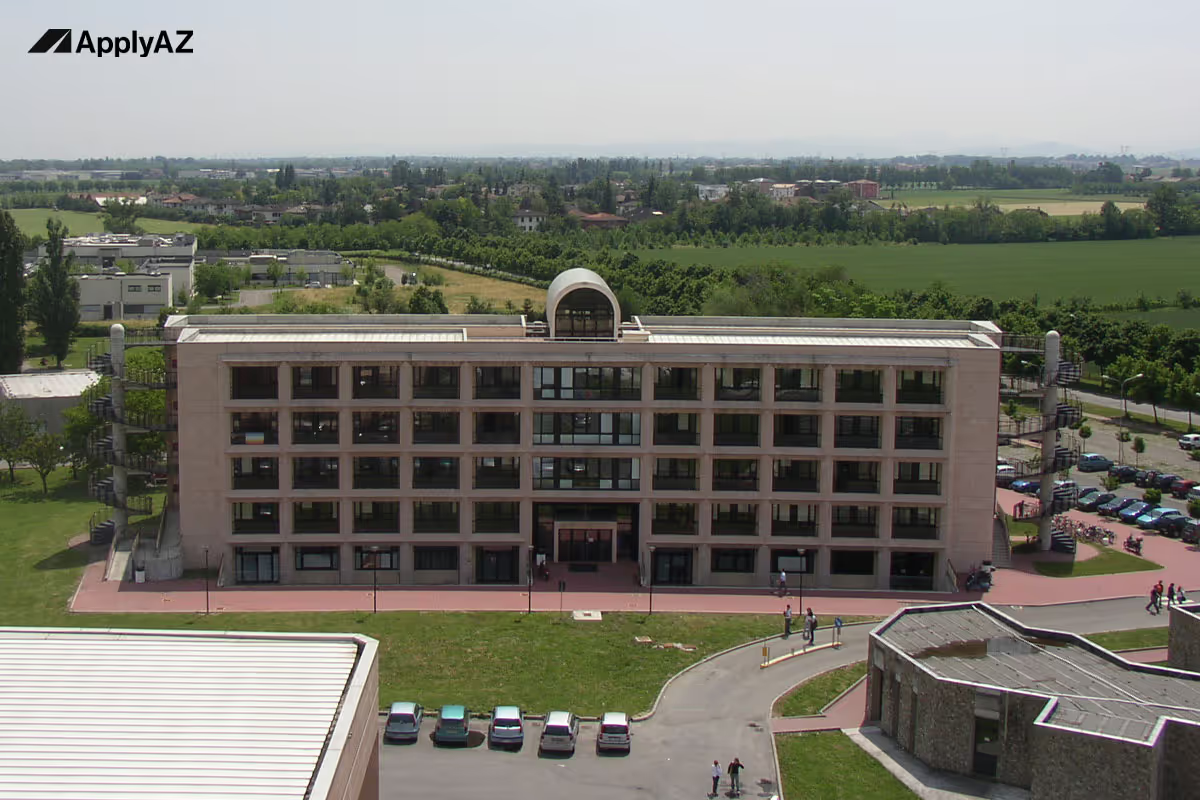
Data Science for Management is a two-year, 120 ECTS master (class LM-Data) taught entirely in English at the University of Parma. It blends statistics, programming and machine learning with finance, accounting and data law. Fees follow family income, so it can be tuition-free for eligible students.
Entry requirements
- A degree (or current enrolment) in computer science, mathematics, statistics, engineering, physics, economics, finance, business analytics, information systems or chemistry, obtained by September of the intake year.
- A final grade of at least 75% of the maximum, or a GPA of 3.0 or higher.
- An online admission test in English: 20 multiple-choice questions in 30 minutes on statistics, machine learning, data analysis, programming and business aspects of data science.
- English at B2 (IELTS 5.5, TOEFL iBT 60, Cambridge FCE or BEC Vantage, Trinity ISE II or TOEIC); graduates of an English-taught degree are exempt.
- Degree certificate and transcript in English or Italian, with originals delivered in person at enrolment.
About the programme
Data Science for Management is a two-year master's degree in the new class LM-Data, worth 120 ECTS and taught entirely in English in Parma. It is run by the Department of Economics and Management and started in 2025/26.
The course trains specialists who use mathematical, statistical and IT methods to manage, process and analyse data in companies, public administrations and research bodies. It suits graduates in quantitative subjects, from computer science and statistics to engineering, economics and finance, who want to move into analytics roles.
What you will study
The first year covers programming, data management, statistics and optimisation alongside digital management and accounting. The second year adds cybersecurity, machine learning and quantitative finance. Units in the 2026/27 plan include:
- Programming Fundamentals and Structural and Non-structural Data Management (15 CFU)
- Introduction to Data Science and Statistical Modelling
- Optimisation Fundamentals
- Digital Management for Data Science
- Emerging Technologies for Accounting and Accountability
- Sensitive Data Treatment
- Cybersecurity and Blockchain, and Artificial Intelligence and Machine Learning
- Credit Risk Management and Computational Methods for Finance
How the programme is taught
Many exams include practical work on real data, so you practise with software, write reports and present results, as data analysts do. The course encourages study periods abroad and includes internships, mainly in companies working in data science. The plan ends with 12 credits of electives, 6 credits of internships or seminars and a 9-credit thesis.
Career paths
The university names two main profiles. Data analysts combine and explore large, often unstructured data sources to support strategic decisions. Data scientists are more technical and build probabilistic and predictive models and new algorithms to improve business processes. Graduates can work in:
- Services and public administration, building data-based online and mobile services
- Companies, leading information systems projects and data-driven decision making
- Scientific and technological research, supporting data processing and modelling
Fees and scholarships
Tuition at Parma depends on your family's financial situation. For 2026/27 the contribution ranges from zero to a maximum of €2,000 a year, plus a one-time €156 administration fee at enrolment. Students with foreign income ask ER.GO, the regional right-to-study agency, for the reduction and can enter its scholarship call, so the course can be tuition-free for eligible students.
How to apply from outside the EU
Selection has two steps. First, your degree subject and grades must meet the threshold; then you sit a 30-minute online test in English. For 2026/27 the test was held on 10 April 2026, and those who passed received a letter of acceptance.
Visa applicants use Parma's portal, apply.unipr.it, with a €30 fee; the 2026/27 window ran from 15 January to 6 April 2026. After acceptance you pre-enrol, complete Universitaly pre-enrolment and apply for a type D study visa, bringing a declaration of value or CIMEA statement to enrolment.
How ApplyAZ helps
If this programme fits your goals, ApplyAZ can include it in a shortlist of 20 to 30 English-taught programmes at Italian public universities. We write your CV and a tailored statement of purpose, submit your applications and Universitaly pre-enrolment, file your DSU scholarship application and prepare your visa file, with a named person on each stage. The university decides admission, the region decides the scholarship and the consulate decides the visa. See how ApplyAZ works or check your eligibility.
Questions and answers
Is Data Science for Management taught in English?
Yes. The course is taught entirely in English. Italian is not required for admission, but students must pass an Italian language test before graduating.
Which bachelor's degrees are accepted?
Computer science, mathematics, statistics, engineering, physics, economics, finance, business analytics, information systems or chemistry, with a final grade of at least 75% of the maximum or a GPA of 3.0.
Is there an entrance test?
Yes. Eligible applicants take a 30-minute online test in English with 20 multiple-choice questions on statistics, machine learning, data analysis, programming and business aspects of data science.
What English level do I need?
B2, shown by IELTS 5.5, TOEFL iBT 60, Cambridge FCE or BEC Vantage, Trinity ISE II or TOEIC. Graduates of an English-taught degree are exempt.
When can I apply for 2027/28?
The 2027/28 call is not out yet. For 2026/27 visa applicants applied on apply.unipr.it from 15 January to 6 April 2026, and the online test was on 10 April.
What jobs does it lead to?
Graduates work as data analysts or data scientists in companies, public administrations and research bodies, handling large data sets, predictive models and data-driven decisions.
Similar programmes
More programmes in this city

They began right where you are

