

Master in Applied Economics at University of Padua
English-taught economics master in Padua with three curricula: digital economics, economic data analytics, and environmental economics and green finance, built on microeconomics, data analytics and machine learning.
Master
2 years
Padua
English
University of Padua



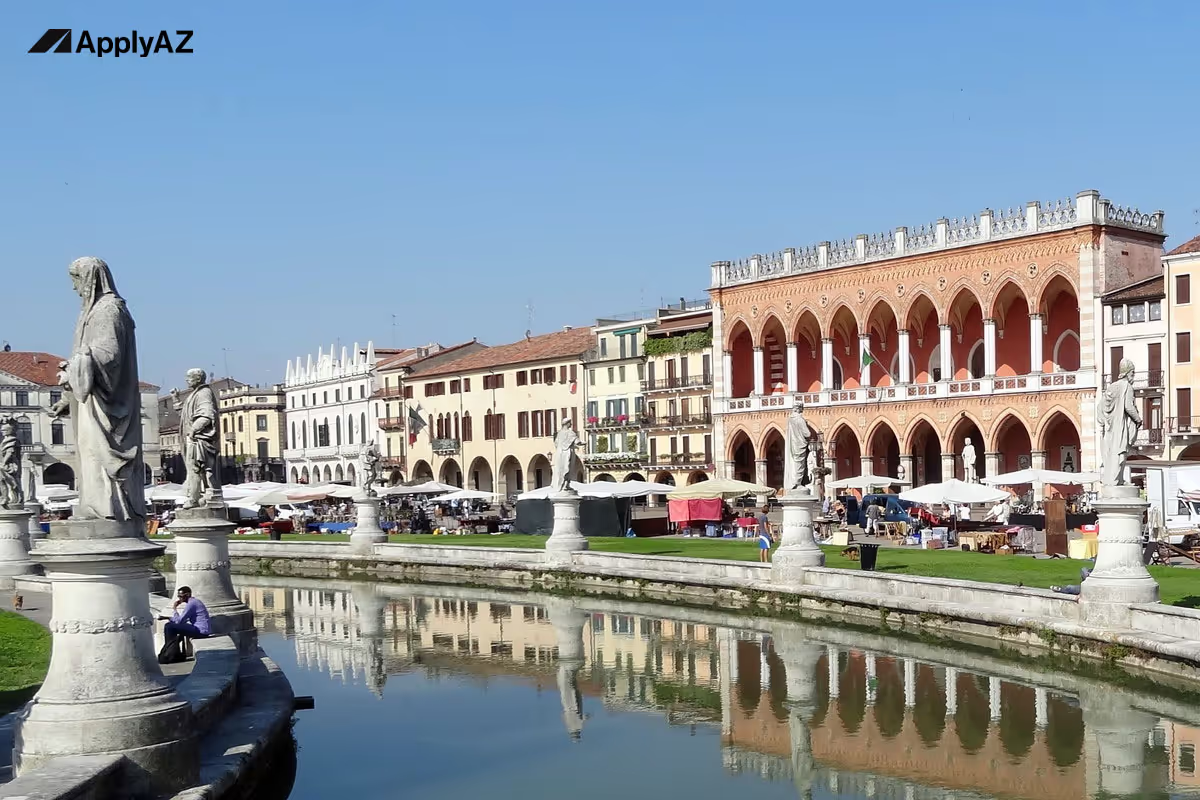
Applied Economics is a two-year, 120 ECTS master's degree (class LM-56-R) taught in English at the University of Padua, with curricula in Digital Economics, Economic Data Analytics, and Environmental Economics and Green Finance. Non-EU students with family abroad pay a fixed €2,790 a year (2026/27), waived for regional scholarship winners.
Entry requirements
- A bachelor's degree of at least three years (or equivalent) in economics, with proven competence in economics, econometrics and mathematics; accounting skills count in your favour.
- A final grade that meets the university's minimum for your country.
- English at B2 level of the CEFR; a C level certificate is a preferential element.
- A CV, motivation letter and letters of reference; GRE or GMAT scores are strongly encouraged but not mandatory.
- No entrance test: the academic committee assesses your file and may hold an online interview.
About the programme
Applied Economics is a two-year master's degree in class LM-56-R (Economics), taught in English in Padua by the Department of Economics and Management within the School of Economics and Political Science. It is worth 120 ECTS and has open admission with requirements.
The degree gives a solid grounding in the tools of economic analysis that companies, governments and non-profit organisations use to handle the digital and green transitions. It covers how markets and digital platforms work, how economic data are applied and how to analyse the ecological transition, combining theoretical courses with applied, research-oriented teaching. It suits economics graduates with a quantitative bent who want analytical roles.
What you will study
You choose one of three curricula: Digital Economics, Economic Data Analytics, or Environmental Economics and Green Finance. The admissions portal lists these subject areas:
- Microeconomics (all curricula)
- Data Analytics (all curricula)
- Machine Learning (Digital Economics and Economic Data Analytics)
- Digital Markets and Platforms, Industrial Organisation, Market Mechanisms and Regulatory Policies (Digital Economics)
- Macroeconomics, Policy Evaluation and Forecasting (Economic Data Analytics)
- Finance, and Sustainability Management and Reporting (Environmental Economics and Green Finance)
- Environmental Decision-Making (Environmental Economics and Green Finance)
Digital Economics also includes management, linking economic analysis to how firms compete and are regulated on digital markets.
Career paths
The programme prepares analysts, researchers and managers for public institutions and for profit and non-profit companies and organisations. The fields it names are:
- Digital economy
- Economic data analysis
- Environmental economics
- Green finance
Fees and scholarships
Degrees of the School of Economics and Political Science are in fee Group A. For 2026/27, non-EU students whose household lives abroad pay a fixed €2,790 a year, or €930 if they hold citizenship of a country on the ministry's list of particularly poor countries. An ISEE parificato changes only the regional tax. Veneto regional scholarship winners do not pay the fee, which means zero euro tuition for eligible students, and international applicants living abroad are considered for merit fee waivers. See the fees page.
How to apply from outside the EU
Apply on apply.unipd.it with your transcript, degree certificate, CV, motivation letter, English certificate and reference letters; a GRE or GMAT score is strongly encouraged, and the academic committee may invite you to an online interview. The fee is €60. For 2027/28, non-EU applicants living abroad can apply from 15 September to 15 November 2026 or from 1 December 2026 to 1 March 2027.
After admission you pay €208 to accept, complete the Universitaly pre-enrolment and apply for a type D study visa. Your degree and transcript must be legalised, apostilled or verified by CIMEA by 31 August 2027.
How ApplyAZ helps
If this programme fits your goals, ApplyAZ can include it in a shortlist of 20 to 30 English-taught programmes at Italian public universities. We write your CV and a tailored statement of purpose, submit your applications and Universitaly pre-enrolment, file your DSU scholarship application and prepare your visa file, with a named person on each stage. The university decides admission, the region decides the scholarship and the consulate decides the visa. See how ApplyAZ works or check your eligibility.
Questions and answers
Is the Master in Applied Economics taught in English?
Yes. The degree is taught in English in Padua. You need English at B2 level of the CEFR, and a C level certificate counts in your favour in the selection.
Which curricula can I choose?
Three: Digital Economics, Economic Data Analytics, and Environmental Economics and Green Finance. All build on microeconomics and data analytics, and the first two add machine learning.
Do I need the GRE or GMAT?
No, but scores are strongly encouraged. The committee also looks at your English level, CV, motivation letter and reference letters, and may hold an online interview.
What bachelor's background is required?
A degree of at least three years in economics, with proven competence in economics, econometrics and mathematics. Accounting skills are viewed favourably, and your grade must meet the minimum for your country.
When are the 2027/28 application windows?
Non-EU applicants living abroad can apply on apply.unipd.it from 15 September to 15 November 2026 or from 1 December 2026 to 1 March 2027. The fee is €60.
How much are the fees?
For 2026/27, non-EU students with family abroad pay a fixed €2,790 a year, or €930 if from a country on the ministry's list of particularly poor countries. Regional scholarship winners are exempt.
Similar programmes
More programmes in this city

They began right where you are

