

Bachelor in Management & Business Analytics at University of Udine
Three-year English-taught L-18 bachelor's at the University of Udine that joins business administration with statistics, coding and business analytics, preparing analysts and managers for digital transformation roles.
Bachelor
3 years
Udine
English
University of Udine



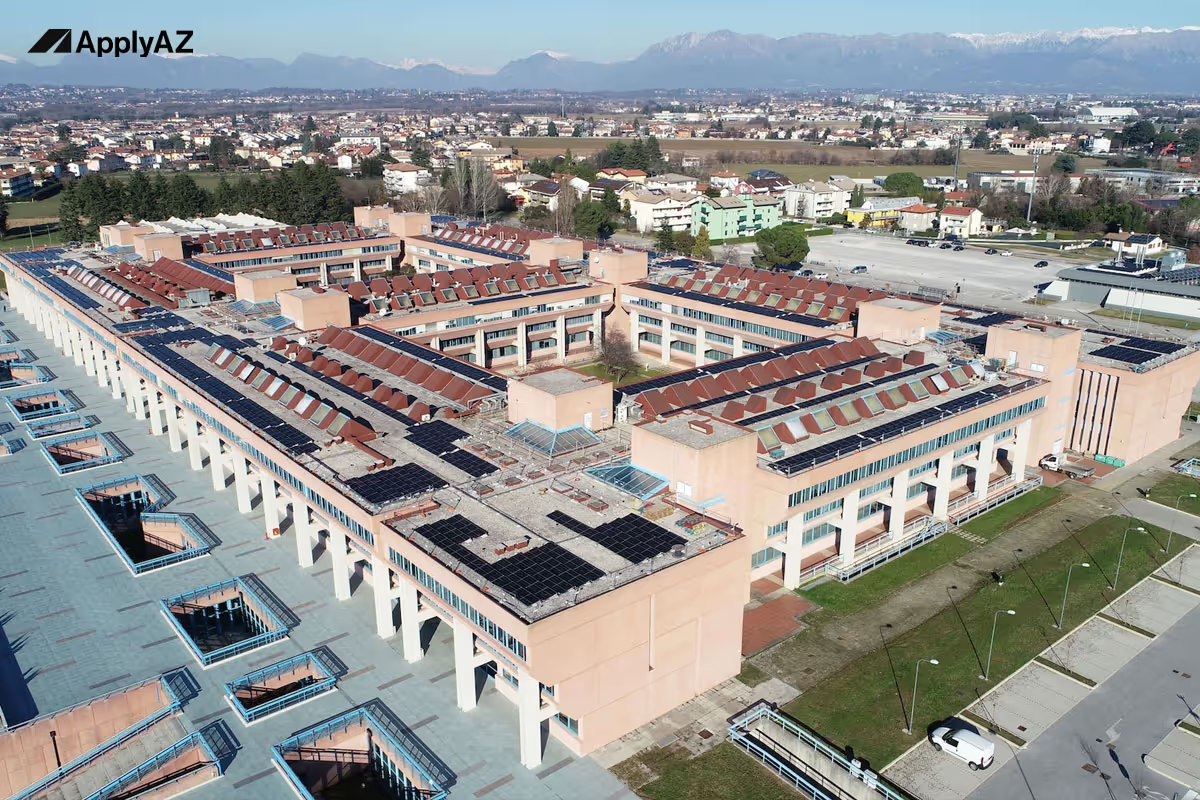
Management & Business Analytics is a three-year, 180 ECTS bachelor's degree (class L-18) taught in English at the University of Udine, combining business administration with statistics, coding and data skills. Tuition is set by family income, so it can be tuition-free for eligible students.
Entry requirements
Detailed entry requirements
Udine’s Management & Business Analytics bachelor requires a suitable school-leaving qualification and English B2. The 2026/27 Economics Study Prospectus provides 100 places, including 30 reserved overseas non-EU places, allocated chronologically. Foreign qualification pre-evaluation, the English requirement and the non-selective initial-preparation assessment are separate checks. [1-4]
School qualification and foundational knowledge
Hold a recognised secondary school diploma or suitable foreign final qualification. Foreign school records must normally follow at least 12 years of education, permit comparable first-cycle university study in the home system and include any national entrance/final test needed there. Shorter school systems require the qualification-completion measures under the ministerial rules rather than automatic acceptance. A school diploma must be both academically suitable and formally verifiable. [1, 3, 4]
The course expects solid general education, English B2 and basic mathematics/computing. No universal school GPA cutoff is published for this bachelor in these notices. GPA thresholds in the same international documents apply to other master’s degrees, not to this bachelor. [2-4]
Limited places, chronological allocation and waitlist
The 2026/27 prospectus sets 100 places, 30 reserved for non-EU foreign students resident abroad. Places are accepted in chronological enrolment order until filled. CEnT-S scores determine any remedial obligations, not a merit-ranked competition for these places. If places filled before the deadline, students could request the official waitlist, also ordered chronologically, and be contacted if a place became available. Neither the quota nor a waitlist request secures admission. [1]
English B2: evidence, age and notice exceptions
The course page generally prohibits admission without B2 certification. The more detailed international notice recognises certificates showing the achieved level and obtained within the last five years, including Cambridge, Trinity, IELTS, TOEFL, PTE/Pearson, Oxford, LanguageCert, Gatehouse and the listed Aptis routes. It also provides exemptions for native-English applicants and applicants who completed an English-taught school programme, such as the stated IB/multilingual-school cases. [2, 3]
The international notice permits pre-evaluation while awaiting the English exam/certificate, but language clearance remains necessary for final enrolment. It permits the competent committee to assess English through an online interview where B2 documentation is absent. These notice-specific routes depend on the university’s decision. The course page’s general certificate rule sits alongside the documented exceptions, and none of them allows enrolment without B2 competence. No universal test score equivalent is stated here. [3]
CEnT-S by 30 November: combined six-point threshold
CEnT-S replaces the former English TOLC-E for this course in 2026. The prospectus requires the initial-preparation test by 30 November 2026; it may be taken or repeated after enrolment within that deadline. Additional Learning Requirements, OFA, apply if the combined Mathematics plus Reasoning on Texts and Data score is below six points. This is six across the two sections together, not six in each section or six across the whole test. [1, 2]
Complete any OFA within year one by passing the prescribed recovery test or one of Mathematics for Business, Statistics for Business or Microeconomics. Failure blocks year-two examinations. CISIA’s free MOOCs support preparation but are not themselves a passed remedial assessment. [1, 2]
Foreign school pre-evaluation: two resident-category windows
Foreign-qualification applicants use the MBA Elix-Forms pre-evaluation, providing the final/provisional school qualification, B2/equivalent evidence, CV and motivation letter, and paying the non-refundable €20 fee. Only complete paid applications are evaluated. The academic committee schedules an online selection interview within 30 working days of submission, then communicates the outcome electronically. Favourable pre-evaluation precedes the final enrolment/visa steps. [3, 4]
The non-EU-resident window was 1 February to 31 May 2026; the EU-resident foreign-qualification window was 1 February to 10 September. Both are now closed. Overseas visa applicants then had to submit Universitaly pre-enrolment by 30 June 2026, with passport, photograph, final/provisional school and language evidence. Academic acceptance does not issue a visa or permit changing the selected programme after arrival under this notice. [3, 4]
Foreign award verification and final enrolment file
The international notice accepts the prescribed Declaration of Value or CIMEA statements. For eligible Lisbon Convention qualifications, ARDI correspondence still requires the CIMEA Verification Statement; ARDI alone is not the whole verification route. This validates the qualification and does not replace the programme’s academic suitability decision. [3, 4]
Final enrolment in Esse3 requires an identity document, official tax code, photograph, signed registration application, first-instalment PagoPA receipt, parental authorisation for minors and residence-permit evidence where applicable. The mandatory documents must be uploaded within the course deadlines and the prescribed 30-day limit after Esse3 registration; otherwise the position is cancelled. Student administration confirms perfected enrolment after checking the file. [1]
Current dates and exceptional late enrolment
Ordinary enrolment ran 9 July to 5 October 2026, closing at noon. It is now closed. If places remain, the Rector may approve a justified late request until 15 January 2027 at noon, using the required €16-stamped application. This is discretionary, not an unconditional open round, and does not extend the closed overseas pre-evaluation/Universitaly deadlines. The website’s English line mistakenly says October 2025; the 2026/27 prospectus confirms 5 October 2026. [1, 2]
Sources and verification
- University of Udine, Economics Study Prospectus 2026/27, bachelor’s admission provisions pp. 2-4; publication date not stated; reviewed 6 October 2026.
- University of Udine MBA, Knowledge and Admission Requirements, 2026 enrolment calendar; publication date not stated; reviewed 6 October 2026.
- University of Udine, Additional Notice to Study Prospectus 2026/27, applicants resident in non-EU countries, sections 1, 3, 4; reviewed 6 October 2026.
- University of Udine, Additional Notice to Study Prospectus 2026/27, applicants resident in EU countries, section 1; reviewed 6 October 2026.
About the programme
Management & Business Analytics is a three-year bachelor's degree (laurea, class L-18, business administration) worth 180 ECTS and taught in English at the University of Udine. It is run by the Department of Economics and Statistics (DIES), teaching is in person in Udine, and it is the only bachelor's degree the university teaches entirely in English.
The course joins core business knowledge with IT and digital skills, so that graduates can make data-driven decisions in companies that are going digital. It suits school leavers with a solid general education, English at B2 level and a basic grounding in maths and computing who want a business career with a strong data side.
What you will study
The first year builds the foundations in economics, accounting, quantitative methods and coding. Later years apply them to business processes and digital transformation across functions such as administration and control, finance, marketing, organisation, human resources and production. The compulsory first-year units in the 2026/27 plan are:
- Accounting & Business Administration (9 ECTS)
- Mathematics for Business (9 ECTS)
- Statistics for Business (9 ECTS)
- Microeconomics (9 ECTS)
- Introduction to Coding (9 ECTS)
- Business Organization & Business History (12 ECTS)
- Personal Development Seminars (3 ECTS)
How the programme is taught
Classes follow the conventional in-person format, all in English. Your starting level in maths and reasoning is checked with the CISIA CEnT-S test. If you score under 6 points in those two sections you receive additional learning requirements (OFA), which you clear in the first year by passing the TOLC OFA recovery test or one of the quantitative exams; free CISIA online courses support this. Until they are cleared you cannot sit second-year exams.
Career paths
The degree trains managers who act as a bridge between business specialists and IT specialists in digital transformation projects. Graduates can work in industrial, commercial and service companies, in public bodies, in accountancy and management consulting firms, or start their own business. Roles named by the university include:
- Junior business and data analyst
- Marketing and business analytics specialist
- Junior digital manager and assistant chief digital officer
- Business developer and innovation manager
- Project manager for digital transformation
- People management and HR specialist
Fees and scholarships
Uniud sets tuition by family income. International students present an ISEE parificato, which is used both to calculate fee reductions and to apply to ARDiS, the Friuli Venezia Giulia regional agency for the right to higher education, for scholarships and housing. Low-income students who meet the income and merit rules can be fully exempt, so this degree can be tuition-free for eligible students. We check the current Uniud fee rules before you enrol.
How to apply from outside the EU
We follow the programme-specific qualification, language, assessment and deadline rules set out in the entry requirements. Academic suitability, foreign-document recognition, Universitaly, visa and final registration are separate checks. We use the current official course procedure and the right applicant category for your case. [1, 2]
How ApplyAZ helps
ApplyAZ is an Italy-based consultancy that works only with public universities. We can include this programme in a shortlist of 20 to 30 English-taught programmes that fit your profile, so your plan never rests on a single application.
For eligible students who start with us, a named person owns each stage, from A to Z:
- We check your school results against Udine's entry rules for this programme.
- We write your CV and a tailored statement of purpose.
- We prepare and submit your Elix-Forms pre-evaluation, Universitaly pre-enrolment and Esse3 enrolment.
- We help you declare your family income for reduced fees and file your regional DSU scholarship application at the right time and in the right format.
- We prepare your visa file.
With operations in all 20 Italian regions, we follow each region's scholarship rules and deadlines as they change. The university decides admission, the region decides the scholarship and the consulate decides the visa, so no one can promise an outcome. You pay in milestones, and every service you pay for is either delivered or its fee is refunded (terms apply).
Programmes at Italian public universities can be tuition-free for eligible students. Check if you are eligible and book a one-to-one consultation session with one of our Italy experts, or see how ApplyAZ works.
Questions and answers
Are places allocated by CEnT-S score?
No. The 2026/27 places are allocated chronologically. The test determines initial-preparation gaps and OFA. [1]
Is six points needed in each section?
No. Six points is the combined Mathematics and Reasoning on Texts and Data threshold. [1, 2]
Can I take CEnT-S after enrolling?
Yes, within the prospectus’s 30 November 2026 test deadline. [1]
How do I clear an OFA?
Within year one, pass the prescribed recovery test or Mathematics for Business, Statistics for Business or Microeconomics. Otherwise year-two exams are blocked. [1]
Can I pre-apply while awaiting my English certificate?
The international notice allows that, with language clearance still required for final enrolment and its stated committee/exemption routes. [3]
Is January an automatic extended deadline?
No. Late enrolment requires available places and the Rector’s approval for serious justified reasons, and does not reopen the overseas application. [1]
Can someone handle my whole application to Management & Business Analytics at Udine?
Yes. ApplyAZ, an Italy-based consultancy that works only with public universities, checks your school results against Udine's rules for this programme, handles the application and Universitaly pre-enrolment, helps you file the regional DSU scholarship application at the right time and in the right format, and prepares your visa file, for eligible students. Start by checking your eligibility.
I'm applying from India. What is the route into Management & Business Analytics?
You need a school-leaving qualification, such as your Class 12 certificate, that follows at least 12 years of education and gives access to comparable university study in India, plus English B2 [1, 3, 4]. Places are allocated in chronological order, and the CEnT-S checks maths and reasoning without ranking you [1]. The steps are the Elix-Forms pre-evaluation with an online interview, Universitaly pre-enrolment and the CEnT-S [3, 4]. Indian students apply for the type D study visa at the Italian embassy or consulate that covers their state, such as New Delhi, Mumbai or Bengaluru.
Is the route different from Pakistan, Bangladesh or Sri Lanka?
No. The academic rules for Management & Business Analytics are the same whatever your nationality. Applicants from Pakistan, Bangladesh and Sri Lanka follow the same steps as India: Elix-Forms pre-evaluation with an online interview, Universitaly pre-enrolment and the CEnT-S test, then a type D study visa from the Italian mission for their country of residence. Read our guide for students in Dhaka.
I live in the UAE, Saudi Arabia, Qatar, Kuwait, Oman or Bahrain. Where do I apply for the visa?
At the Italian embassy or consulate responsible for the country where you legally live, after Universitaly pre-enrolment. The academic rules for Management & Business Analytics are the same whatever your nationality, and Gulf residents follow the same steps: Elix-Forms pre-evaluation with an online interview, Universitaly pre-enrolment and the CEnT-S test. Read our guides for Dubai, Riyadh and Doha.
I'm applying from the UK, US, Canada, Singapore or Malaysia. Is anything different?
The academic rules are identical. Non-EU applicants who live abroad, including citizens of these countries, follow the same route: Elix-Forms pre-evaluation with an online interview, Universitaly pre-enrolment and the CEnT-S test, then a type D study visa. Read our guides for London, New York, Singapore and Kuala Lumpur.
More English-taught programmes at this university
Other public universities in this city

They began right where you are

