

Bachelor in Comparative, European and International Legal Studies at University of Trento
Three-year law bachelor (L-14) taught entirely in English by the University of Trento's Faculty of Law. It studies law through comparative, European and international lenses, adds a second European language and includes an internship.
Bachelor
3 years
Trento
English
University of Trento



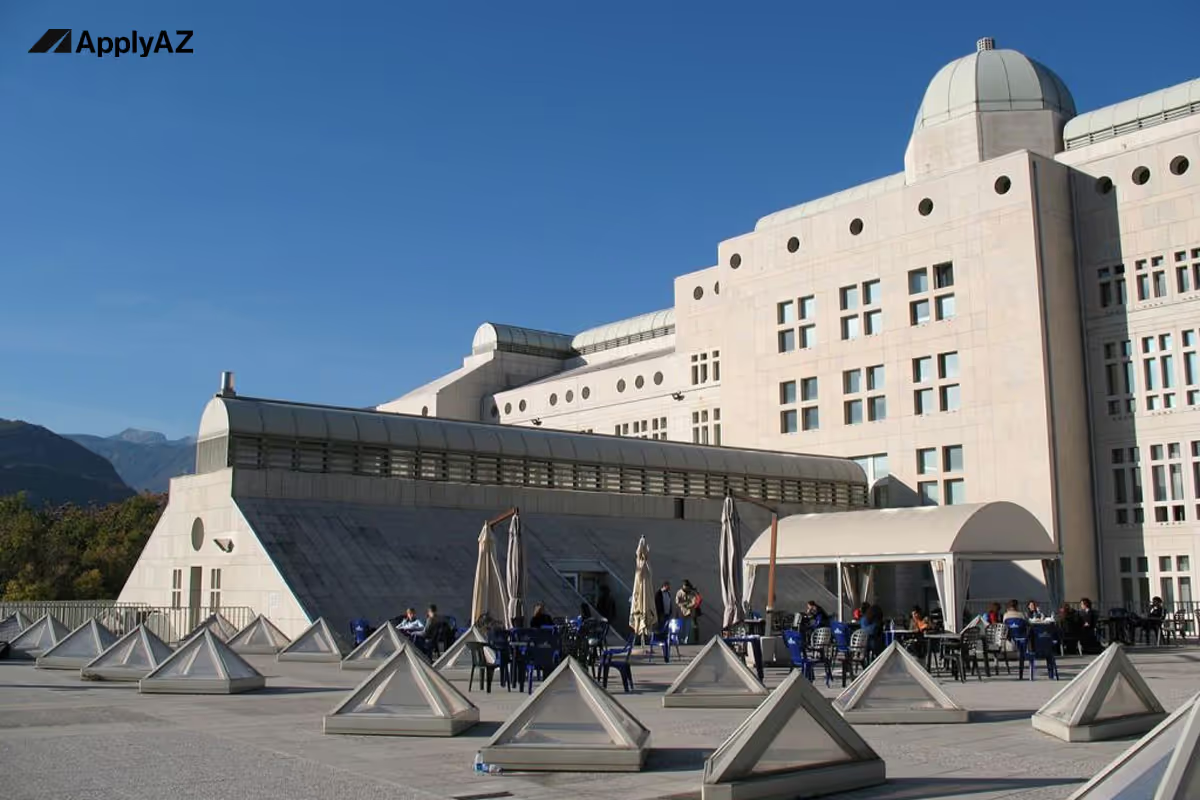
Comparative, European and International Legal Studies (CEILS) is a three-year, 180 ECTS bachelor's degree (class L-14) taught in English by the Faculty of Law of the University of Trento. Entry needs a school diploma after 12 years of schooling, English at B2 and at least 11 out of 60 in UniTrento's admission test. First-year fees for non-EU students follow the test score, so it can be tuition-free for eligible students.
Entry requirements
Detailed entry requirements
Trento's CEILS bachelor asks for a secondary school diploma after at least 12 years of schooling that gives access to university, English at B2 and at least 11 out of 60 in UniTrento's admission test, with places ranked by test score and non-EU applicants limited to the first session. Reviewed 8 October 2026. [1]
School-leaving requirement
You need a secondary school diploma, already obtained or obtained by 31 July 2026 for the 2026/27 intake. A foreign diploma must: [1]
- come after at least 12 years of schooling. With fewer years, you can reach the threshold by the routes set in the Italian ministry's rules for foreign qualifications.
- follow at least the last two years of study in that school system.
- give access to a similar university course in the country that issued it. Technical or vocational diplomas that do not give university access there are not valid.
- come with proof that you passed the national university entrance exam, where your country requires one for university access, such as the Gaokao in China or Selectividad in Spain.
Non-EU applicants must also be 18 by 30 September 2026. The call sets no minimum school grade or required subjects: places are ranked by your admission test score. Foreign diplomas are checked only after admission and pre-enrolment, and UniTrento can ask for CIMEA statements of verification or comparability. [1]
What this means for your school results
As a guide, based on the rule above:
- Usually a fit: Indian Class 12 (CBSE, ISC or a state board Higher Secondary certificate), Pakistani HSSC, Bangladeshi HSC, Sri Lankan GCE A levels or British A levels, which complete at least 12 years of schooling and give access to university in the issuing country.
- Check carefully: vocational or technical diplomas, a diploma earned after only one year in a school system, and qualifications from countries that require a national university entrance exam.
- Often short: a certificate after only 10 or 11 years of schooling, such as Class 10, SSC or O levels on their own.
Your school stream does not decide entry. The admission test covers reading comprehension, general knowledge, logic and basic IT rather than law, so science, commerce and humanities students all compete on the same test. [1]
English
You need English at CEFR level B2. You can declare it in one of four ways: [1]
- a certificate on the list recognised by UniTrento's language centre (provisional results of a passed exam are accepted when you apply);
- a statement from your secondary school that its official language of instruction was English;
- declaring that you are a native English speaker;
- self-certifying that you are a citizen or resident of a country where English is the official language.
UniTrento checks the requirement after enrolment. If the check is negative, you must prove B2 with an international certificate or an exam at the university language centre before you sit your course exams. [1] During the degree you then reach English at C1. [3]
Admission test and ranking
Admission depends on passing UniTrento's admission test, taken entirely in English: 60 multiple-choice questions in 60 minutes. [1]
- 30 questions on reading and text comprehension
- 20 questions on general knowledge with an international focus
- 5 questions on logical reasoning and 5 on basic computer skills
Each correct answer scores 1 point, a blank 0 and a wrong answer minus 0.33. The ranking follows your score within the available places, with a minimum of 11 out of 60, and the younger candidate goes first in a tie. For non-EU applicants, a selection committee converts the score to a mark out of 100, which sets your first-year fee. [1]
In the first session the test is online only, from home, with a technical check a week before. For 2026/27 the check was on 16 March 2026. [1]
2026/27 deadlines
Non-EU applicants living abroad can use only the first session. For 2026/27: [1]
- First session (all applicants): applications by 6 March 2026, online test on 23 March 2026 at 2:30 p.m. (UTC+1), rankings by 2 April 2026.
- Second session (EU and equivalent applicants only): applications from 9 April to 4 May 2026, test in person in Trento on 14 May 2026, rankings by 20 May 2026.
Non-EU places still unassigned on 30 June 2026 went to EU and equivalent applicants. Admitted non-EU students had to obtain their study visa by 30 September 2026. The next call sets the 2027/28 dates. [1]
Places, documents and non-EU steps
For 2026/27 the call offered 60 places in the first session (50 for EU and equivalent applicants, 10 for non-EU applicants living abroad) and 25 EU places in the second session. [1]
Non-EU applicants must register under the Non-EU competition, or they are excluded. With the application you upload: [1]
- your school-leaving diploma, or, if you have not finished school yet, your transcript of grades for the last two years;
- an official translation into Italian or English if the documents are not in English, French, German or Spanish;
- if you had fewer than 12 years of schooling, or your country has a national university entrance exam, the extra documents that prove you meet the rule.
If admitted, you pre-enrol at UniTrento, then complete Universitaly pre-enrolment with the Italian mission in your country, which is compulsory for the visa. Enrolment is finalised once these steps and the requirements are checked. [1]
Sources and verification
Checked by the ApplyAZ admissions team against the university's official documents listed below. Entry rules can change with each new call, and we re-check them before every application.
- University of Trento. Call for admission, Bachelor's degree in Comparative, European and International Legal Studies (class L-14 R), academic year 2026/27. Reviewed 8 October 2026.
- University of Trento, Faculty of Law. Comparative, European and International Legal Studies programme overview and study plan. Reviewed 8 October 2026.
- University of Trento, Faculty of Law. Comparative, European and International Legal Studies language proficiency page, undated. Reviewed 8 October 2026.
About the programme
Comparative, European and International Legal Studies (CEILS) is a three-year bachelor's degree (laurea, class L-14 Scienze dei servizi giuridici) worth 180 ECTS and taught entirely in English by the Faculty of Law of the University of Trento. Instead of training you in one national legal system, it takes a comparative, international and transnational approach to law.
It suits school leavers who want a legal education with an international outlook and expect to work across legal systems and languages. Alongside English, every student adds a second foreign language at B1 or higher (French, German, Spanish or Italian), and Italian is compulsory for students who are not Italian nationals. [3] Places are limited: for 2026/27 there were 75 places for EU and equivalent applicants and 10 for non-EU applicants living abroad, all in the first session. [1]
What you will study
The first year builds the comparative foundations of law, the second adds international law, legal history and economics, and the third moves to procedure, business and labour law before a written dissertation. Units in the official study plan include:
- Comparative Constitutional Law, Comparative Legal Systems and European Private Law (9 ECTS each)
- European Union Law and Philosophy of Law (9 ECTS each), with Roman Foundations of European Law and Informatics and the Law
- International Law and History of the Western Legal Tradition (9 ECTS each), plus Introduction to Economics
- International and Supranational Protection of Fundamental Rights, Comparative Private Law and Criminal Law
- Administrative Law, Business and Company Law, and Employment and Labour Law
- Civil Litigation in Comparative Perspective and Criminal Procedure from a Comparative and International Perspective
- Electives such as European Transport Law, International Tax Law, Public Governance of Data and Platforms, Competition Law and Conflict of Laws
- A written dissertation (6 ECTS) in the third year
How the programme is taught
You reach English at C1 during the degree through a 6-credit first-year unit, and take your second language to at least B1. The second year includes a 3-credit internship. Classes are mixed, taught by international and Italian academics with many visiting professors, and students are encouraged to go abroad during the degree. [2][3]
For study after the bachelor, the faculty has agreements with law schools abroad, including the University of Glasgow, the University of Liverpool, Utrecht University and the University of Strathclyde.
Career paths
The degree is designed for the international market of legal professions. The university names roles as legal officials or linguistic legal experts in industry, services and trade, in public organisations and in non-profit organisations that need people who understand several legal systems and can work with legal sources in more than one language. You can also continue to a master's degree in Italy or abroad.
Fees and scholarships
CEILS follows UniTrento's merit-based fee scheme for non-EU students living abroad. Your admission test score is converted to a mark out of 100 and sets your first-year fee. A higher score means a lower fee, and 90 or more brings a full exemption. [1]
Top-ranked non-EU applicants with at least 70/100 can also be awarded a UniTrento scholarship, depending on how many are available for the programme. Scholarship holders are exempt from fees, and the scholarship, a partial contribution to living costs in Italy, is paid only once you arrive. With a high score or a scholarship, the first year can be tuition-free for eligible students. Admitted non-EU students are offered a place in housing run by Opera Universitaria, the provincial body for the right to study, and EU and equivalent students pay fees based on ISEE. [1]
How to apply from outside the EU
Non-EU applicants living abroad can use only the first session, because of the time needed for pre-enrolment and the visa. For 2026/27 they applied on the UniTrento portal under the Non-EU competition by 6 March 2026 and sat the online test from home on 23 March 2026. Rankings came out by 2 April 2026. [1]
Admitted students pre-enrol at UniTrento, then complete Universitaly pre-enrolment with the Italian mission and apply for a type D study visa, which for 2026/27 had to be obtained by 30 September 2026. The next call sets the 2027/28 dates. [1]
How ApplyAZ helps
ApplyAZ is an Italy-based consultancy that works only with public universities. We can include this programme in a shortlist of 20 to 30 English-taught programmes that fit your profile, so your plan never rests on a single application.
For eligible students who start with us, a named person owns each stage, from A to Z:
- We check your school results against Trento's entry rules for this programme.
- We write your CV and a tailored statement of purpose.
- We prepare and submit your Non-EU application and test registration, UniTrento pre-enrolment and Universitaly pre-enrolment.
- We help you declare your family income for reduced fees and file your regional DSU scholarship application at the right time and in the right format.
- We prepare your visa file.
With operations in all 20 Italian regions, we follow each region's scholarship rules and deadlines as they change. The university decides admission, the region decides the scholarship and the consulate decides the visa, so no one can promise an outcome. You pay in milestones, and every service you pay for is either delivered or its fee is refunded (terms apply).
Programmes at Italian public universities can be tuition-free for eligible students. Check if you are eligible and book a one-to-one consultation session with one of our Italy experts, or see how ApplyAZ works.
Questions and answers
What school qualification do I need for CEILS at Trento?
A secondary school diploma after at least 12 years of schooling that gives access to university in your country, obtained by 31 July for the 2026/27 intake. There is no minimum school grade: places are ranked by your admission test score. Non-EU applicants must also be 18 by 30 September. [1]
Is there an entrance test?
Yes. The UniTrento test has 60 multiple-choice questions in English, answered in 60 minutes: 30 on reading comprehension, 20 on general knowledge with an international focus, 5 on logic and 5 on basic IT. Wrong answers cost 0.33 points, and the minimum score is 11 out of 60. [1]
What English level is required? Do I need IELTS?
English at B2. You can show it with a certificate on the university language centre's list, a school statement that your studies were taught in English, native speaker status, or citizenship or residence in a country where English is official. UniTrento checks it after enrolment, and we check which proof fits your file. [1]
When is the deadline for non-EU students?
Non-EU applicants can use only the first session. For 2026/27, applications closed on 6 March 2026, the online test was on 23 March and rankings came out by 2 April. The next call sets the 2027/28 dates. [1]
How many places are there for non-EU students?
For 2026/27 the call offered 10 places for non-EU applicants living abroad, all in the first session, and 75 for EU and equivalent applicants across two sessions. Non-EU places still unassigned on 30 June went to EU applicants. [1]
I have Indian Class 12 in the Science or Commerce stream. Can I apply?
Usually, yes. The rule asks for 12 years of schooling and a diploma that gives access to university in your country, which Class 12 from CBSE, ISC or a state board normally meets. Your stream does not matter: the call sets no required subjects, and places go by the admission test. [1]
How do tuition fees work for non-EU students?
Your first-year fee depends on your test score converted to 100. A higher score means a lower fee, and 90 or more gives a full exemption, so the programme can be tuition-free for eligible students. [1]
What can I do after the degree?
The university names roles as legal officials or linguistic legal experts in industry, services, trade, public bodies and non-profit organisations. You can also go on to a master's in law, economics, political science, international relations or sociology, and the faculty has agreements with several law schools abroad. [2]
Can someone handle my whole application to CEILS at Trento?
Yes. ApplyAZ, an Italy-based consultancy that works only with public universities, checks your school results against Trento's rules for this programme, handles the application and Universitaly pre-enrolment, helps you file the regional DSU scholarship application at the right time and in the right format, and prepares your visa file, for eligible students. Start by checking your eligibility.
I'm applying from India. What is the route into CEILS?
Indian Class 12 from CBSE, ISC or a state board completes 12 years of schooling, which matches the school rule, and you also need English at B2 and at least 11 out of 60 in the admission test. The steps are the Non-EU application by the first-session deadline, the online test, UniTrento pre-enrolment and Universitaly pre-enrolment. [1] Indian students apply for the type D study visa at the Italian embassy or consulate that covers their state, such as New Delhi, Mumbai or Bengaluru.
Is the route different from Pakistan, Bangladesh or Sri Lanka?
No. The academic rules for CEILS are the same whatever your nationality. Applicants from Pakistan, Bangladesh and Sri Lanka follow the same steps as India: Non-EU online application, admission test, UniTrento pre-enrolment and Universitaly pre-enrolment, then a type D study visa from the Italian mission for their country of residence. Read our guide for students in Dhaka.
I live in the UAE, Saudi Arabia, Qatar, Kuwait, Oman or Bahrain. Where do I apply for the visa?
At the Italian embassy or consulate responsible for the country where you legally live, after Universitaly pre-enrolment. The academic rules for CEILS are the same whatever your nationality, and Gulf residents follow the same steps: Non-EU online application, admission test, UniTrento pre-enrolment and Universitaly pre-enrolment. Read our guides for Dubai, Riyadh and Doha.
I studied or live in London, New York, Toronto, Vancouver, Singapore or Kuala Lumpur. What is the route?
The academic rules for CEILS are the same whatever your nationality, and your school results are assessed like any other foreign qualification. Non-EU applicants who live abroad follow the same route: Non-EU online application, admission test, UniTrento pre-enrolment and Universitaly pre-enrolment, then a type D study visa from the Italian mission for where they live. Read our guides for students in London, New York, Toronto, Vancouver, Singapore and Kuala Lumpur.
More English-taught programmes at this university
Other public universities in this city

They began right where you are

