

Bachelor in Civil and Environmental Engineering for Sustainable Development at Mediterranea University of Reggio Calabria
Three-year civil engineering bachelor (L-7, 180 ECTS) in Reggio Calabria with an English curriculum, Civil Engineering, covering structures, hydraulics, geotechnics, roads and transport.
Bachelor
3 years
Reggio Calabria
Multiple
Mediterranea University of Reggio Calabria



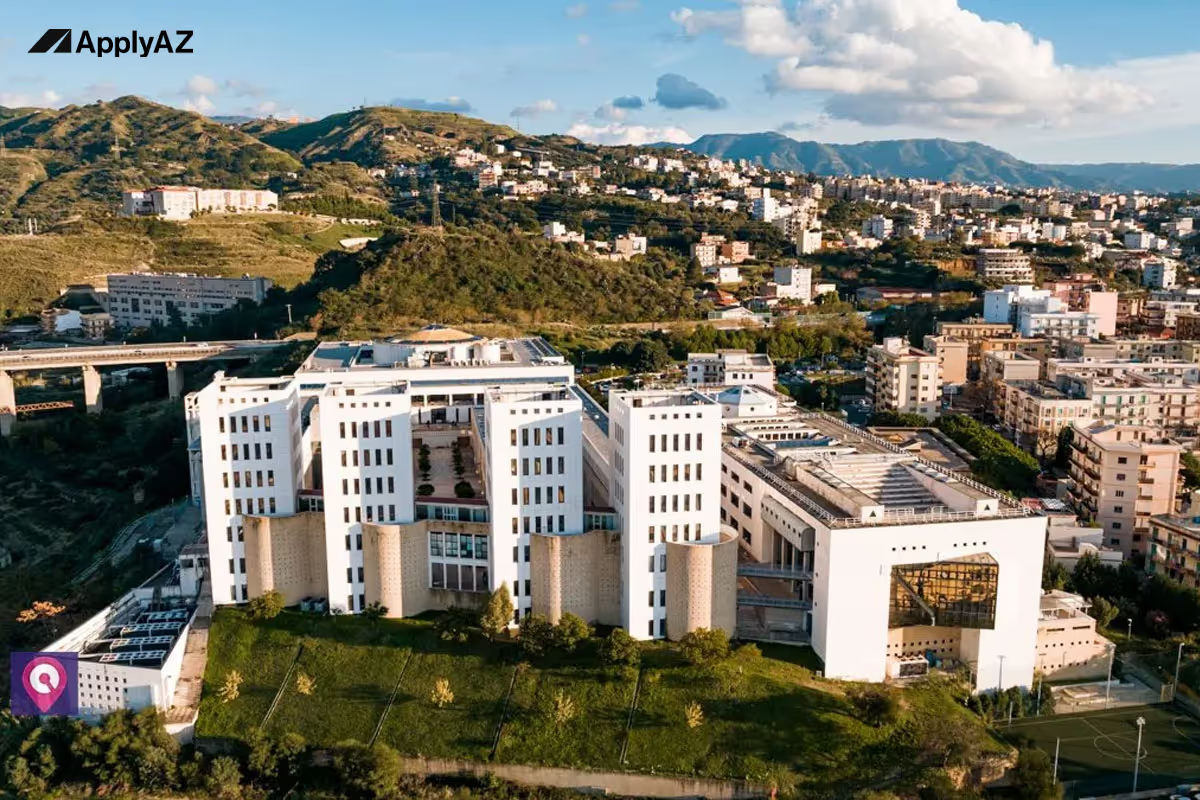
The Bachelor in Civil and Environmental Engineering for Sustainable Development (L-7) at Mediterranea University of Reggio Calabria is a three-year, 180 ECTS degree with an English curriculum, Civil Engineering. For 2026/27, non-EU students pay a yearly contribution set by country group.
Entry requirements
Detailed entry requirements
The 2026/27 regulation for Civil and Environmental Engineering for Sustainable Development separates the school qualification, compulsory initial-preparation assessment, language conditions and first-year remedial obligations. It includes the English Civil Engineering curriculum alongside Italian curricula.
Qualification and starting preparation
- An upper secondary school diploma or a foreign qualification recognised as suitable is required. The recognition of an overseas qualification is a university decision, not something established simply by translating the title.
- Students must participate in the department’s entry assessment. Expected preparation includes basic mathematics and physics, logical reasoning, and the ability to communicate effectively in Italian as described in the regulation.
Compulsory assessment and OFA
- The assessment can be organised through CISIA or through an equivalent test accepted by the department or university. It covers logical reasoning, verbal comprehension, mathematics and physical/chemical sciences.
- The minimum score is set in the department’s Manifesto degli Studi. The regulation itself does not give a numerical universal pass mark. A score below the applicable minimum leads to additional educational obligations, OFA.
- OFA can be cleared through the prescribed remedial activities and final assessment, or by passing the corresponding curriculum examination. They must be completed within the first year.
- The regulation does not treat the compulsory preparation test or the OFA rule as automatic competitive rejection; only the applicable admission notice could set that result.
English and Italian conditions
- The English Civil Engineering curriculum requires B2 English certification at matriculation, with equivalent qualifications admitted as specified in the regulation. This is a curriculum-specific English requirement.
- Article 3 also states a certified B2 Italian condition for foreign students, assessed through CISIA ITA-L2, with exemption through a recognised B2-or-higher Italian certificate. We confirm how the provision applies to your chosen curriculum and category.
- We fix your curriculum before checking language evidence. An English-language curriculum title does not by itself establish exemption from every other language provision in the governing regulation.
Academic-year scope and international procedure
- These are the teaching regulation’s 2026/27 provisions. Annual foreign-student entry and recognition procedures still apply, and test sessions, the numerical assessment threshold and document deadlines require the corresponding annual notice.
- An older catalogue entry or an undated webpage snapshot does not replace the current regulation and its annual implementation instructions.
Sources and verification
- Mediterranea University of Reggio Calabria. Civil and Environmental Engineering for Sustainable Development (L-7 R): teaching regulation, Articles 3-4. 2026/27 regulation; reviewed 6 October 2026.
About the programme
Civil and Environmental Engineering for Sustainable Development (Ingegneria civile e ambientale per lo sviluppo sostenibile) is a three-year, 180 ECTS laurea in class L-7 at the Mediterranea University of Reggio Calabria. It is run by the Department of Civil, Energy, Environmental and Materials Engineering (DICEAM) in Reggio Calabria.
The degree is listed as taught in English and Italian. Its Civil Engineering curriculum is offered in English and covers the typical disciplines of civil engineering, and it is the university's only English-taught degree. It suits school leavers with a strong base in mathematics and physics.
What you will study
The first year builds foundations in mathematics, physics, chemistry and drawing, the second year moves to structures, hydraulics and transport, and the third year to geotechnics, roads and construction. Course units in the Civil Engineering curriculum include:
- Mathematical Analysis, Geometry and Algebra, Physics and Chemistry
- Structural Engineering and Rational Mechanics
- Hydraulics, and Marine Structures and Hydrology
- Materials Science and Technology
- Transport Technique and Economy, and Traffic Control
- Geotechnics and Road Constructions
- Construction Techniques and Logistics Systems Engineering
- Topography and Statistical Methods for Engineering
How the programme is taught
The plan includes an English Language unit in the first year, elective credits chosen from the department's offer and a final project. The department notes that students may choose electives taught in another language.
Career paths
The official profile is a civil and environmental engineer for sustainable development, working on the design and site management of civil works, utilities and infrastructure, environmental monitoring, waste and wastewater management, and natural hazard risk reduction. Typical employers:
- Engineering practices and design firms
- Construction companies
- Agencies that manage civil infrastructure
- Public planning and urban systems departments
- Environmental consultancies
Graduates can continue to a master's degree in civil, building, safety or environmental engineering.
Fees and scholarships
For 2026/27, Mediterranea charges non-EU students with a visa a flat yearly contribution by country group, with the lowest band for group A. The university also publishes a yearly right-to-study competition for scholarships and other benefits.
How to apply from outside the EU
Non-EU applicants living abroad pre-enrol only through Universitaly, with one application for one course and university per year. You need a declaration of value or CIMEA statement of comparability and a B2 certificate for each teaching language; the university offers the CISIA ITA-L2 online test for Italian.
After the type D visa, you register on Esse3 and apply for your residence permit within 8 working days of arrival.
How ApplyAZ helps
ApplyAZ is an Italy-based consultancy that works only with public universities. We can include this programme in a shortlist of 20 to 30 English-taught programmes that fit your profile, so your plan never rests on a single application.
For eligible students who start with us, a named person owns each stage, from A to Z:
- We check your school results against Mediterranea's entry rules for this programme.
- We write your CV and a tailored statement of purpose.
- We prepare and submit your Universitaly pre-enrolment and entry assessment registration.
- We help you declare your family income for reduced fees and file your regional DSU scholarship application at the right time and in the right format.
- We prepare your visa file.
With operations in all 20 Italian regions, we follow each region's scholarship rules and deadlines as they change. The university decides admission, the region decides the scholarship and the consulate decides the visa, so no one can promise an outcome. You pay in milestones, and every service you pay for is either delivered or its fee is refunded (terms apply).
Programmes at Italian public universities can be tuition-free for eligible students. Check if you are eligible and book a one-to-one consultation session with one of our Italy experts, or see how ApplyAZ works.
Questions and answers
What school qualification is required?
An upper secondary school diploma, or a foreign qualification the university recognises as suitable. Recognition is a university decision, so a translated title alone does not establish it. Non-EU applicants abroad also need a declaration of value or a CIMEA statement of comparability.
Is the initial test compulsory?
Yes. Every student takes the department's entry assessment, through CISIA or an equivalent test the department or university accepts. It covers logical reasoning, verbal comprehension, mathematics and physical and chemical sciences.
What happens below the minimum score?
You are assigned additional educational obligations, known as OFA. The minimum score is set each year in the department's Manifesto degli Studi; the regulation itself gives no universal pass mark.
When must OFA be completed?
Within the first year. You clear OFA through the prescribed remedial activities and final assessment, or by passing the corresponding curriculum examination.
Does the English curriculum require B2 English?
Yes. The English Civil Engineering curriculum requires B2 English certification at matriculation, with equivalent qualifications admitted as specified in the 2026/27 regulation.
Does the regulation mention Italian for foreign students?
Yes. Article 3 states a certified B2 Italian condition for foreign students, assessed through the CISIA ITA-L2 test, with exemption for a recognised B2 or higher Italian certificate. We confirm how it applies to your curriculum and applicant category.
Can someone handle my whole application to Civil and Environmental Engineering for Sustainable Development at Mediterranea?
Yes. ApplyAZ, an Italy-based consultancy that works only with public universities, checks your school results against Mediterranea's rules for this programme, handles the application and Universitaly pre-enrolment, helps you file the regional DSU scholarship application at the right time and in the right format, and prepares your visa file, for eligible students. Start by checking your eligibility.
I'm applying from India. What is the route into Civil and Environmental Engineering for Sustainable Development?
Your Class 12 certificate must be recognised by the university as a suitable school-leaving qualification, with a declaration of value or CIMEA statement of comparability. Everyone takes the compulsory CISIA or equivalent entry assessment in mathematics, physics and reasoning, and a score below the minimum adds first-year OFA. The English curriculum needs B2 English at matriculation, and Article 3 also sets a B2 Italian condition for foreign students. Indian students apply for the type D study visa at the Italian embassy or consulate that covers their state, such as New Delhi, Mumbai or Bengaluru.
Is the route different from Pakistan, Bangladesh or Sri Lanka?
No. The academic rules for Civil and Environmental Engineering for Sustainable Development are the same whatever your nationality. Applicants from Pakistan, Bangladesh and Sri Lanka follow the same steps as India: Universitaly pre-enrolment, a declaration of value or CIMEA statement and the compulsory entry assessment, then a type D study visa from the Italian mission for their country of residence. Read our guide for students in Dhaka.
I live in the UAE, Saudi Arabia, Qatar, Kuwait, Oman or Bahrain. Where do I apply for the visa?
At the Italian embassy or consulate responsible for the country where you legally live, after Universitaly pre-enrolment. The academic rules for Civil and Environmental Engineering for Sustainable Development are the same whatever your nationality, and Gulf residents follow the same steps: Universitaly pre-enrolment, a declaration of value or CIMEA statement and the compulsory entry assessment. Read our guides for Dubai, Riyadh and Doha.
I studied or live in London, New York, Toronto, Vancouver, Singapore or Kuala Lumpur. What is the route?
The academic rules for Civil and Environmental Engineering for Sustainable Development are the same whatever your nationality, and your school results are assessed like any other foreign qualification. Non-EU applicants who live abroad follow the same route: Universitaly pre-enrolment, a declaration of value or CIMEA statement and the compulsory entry assessment, then a type D study visa from the Italian mission for where they live. Read our guides for students in London, New York, Toronto, Vancouver, Singapore and Kuala Lumpur.
More English-taught programmes at this university
Other public universities in this city

They began right where you are

