

Bachelor in Artificial Intelligence at University of Pavia
Three-year English-taught AI bachelor run by the University of Pavia with two Milan universities, mixing computer science, maths, physics, psychology and law, with four third-year tracks from marketing analytics to quantum information.
Bachelor
3 years
Pavia
English
University of Pavia



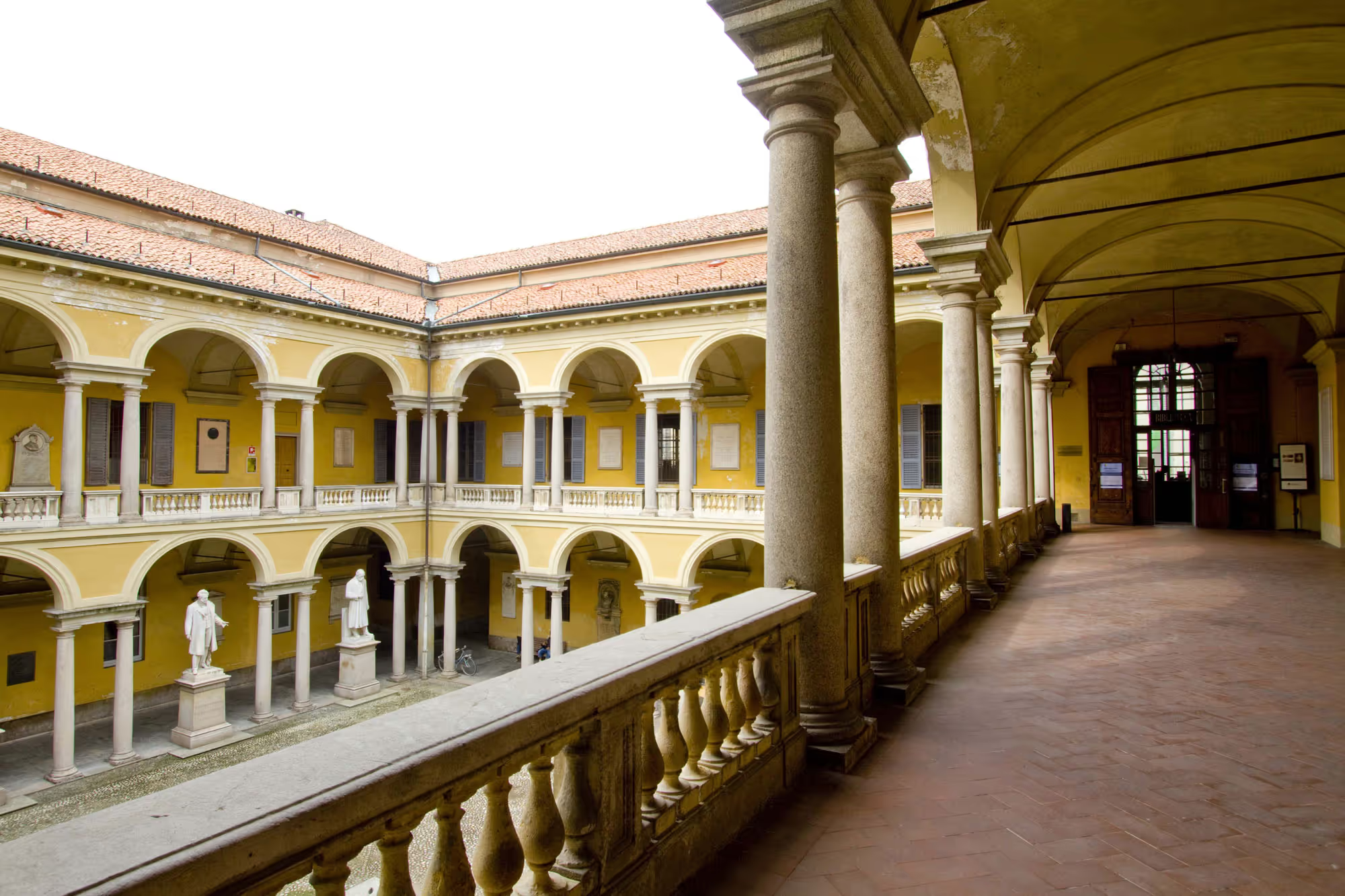
The Bachelor in Artificial Intelligence is a three-year, 180 ECTS degree (class L-31-R) taught in English by the University of Pavia with the University of Milan and Milano-Bicocca, with lessons in Pavia and Milan. Seats are limited, and non-EU applicants abroad are ranked on SAT scores. Fees are a flat rate by country or income-based.
Entry requirements
- A secondary school diploma awarded after at least 12 years of schooling. With 11 years you also need a foundation year, a completed first year at university or a related non-university course in AI.
- Proof of your national university entrance exam if your country requires one.
- English at B2 level of the CEFR.
- For non-EU applicants living abroad, an SAT score of at least 979/1600 (2026/27 call), sent by the College Board to the university's code 62940. Seats are allocated in score order.
- An online application on apply.unipv.eu with the €35 fee and, for enrolment, a declaration of value or CIMEA statement of comparability.
About the programme
Artificial Intelligence is a three-year bachelor's degree in class L-31-R, worth 180 ECTS and taught entirely in English. The University of Pavia is the administrative seat, so you apply and enrol there, but the degree is run jointly with the University of Milan (La Statale) and the University of Milano-Bicocca. Pavia's Department of Mathematics "Felice Casorati" coordinates it, and access is restricted to a fixed number of seats.
Lessons move between the cities. In Pavia you spend the second semester of year 1 and the first semester of year 2; the other semesters, including all of year 3, are shared between Milano Statale and Milano-Bicocca, and students get discounted train passes between Pavia and Milan. The degree suits school leavers who are comfortable with mathematics and want to study AI from several angles: computing, physics, cognition and law.
What you will study
The first two years are common to all students and aim to give the theoretical foundations, techniques and methods of artificial intelligence. In the third year you choose one of four tracks: data analysis, communication and marketing; industrial systems and healthcare; brain, cognition and society; or physics for AI, covering environment, health and quantum information. Compulsory units on the university's course page include:
- Computer Programming, Algorithms and Data Structures
- Knowledge Representation and Reasoning
- Theoretical and Computational Linear Algebra
- Machine Learning, Artificial Neural Networks and Deep Learning
- Probability and Statistical Inference
- Ethics, Law and AI
- Text Mining and Natural Language Processing
- Brain Modelling and Statistical Modelling (year 3)
How the programme is taught
The second semester of year 3 is the practical part. You can take a 9 ECTS internship (225 hours), three short laboratory courses, or a 6 ECTS internship (150 hours) plus one laboratory. The ten laboratories include machine learning and neural signals and brain-inspired systems. Year 3 also leaves 12 ECTS of free choice, Italian language can count towards the elective credits, and the degree closes with a 3 ECTS final exam.
Career paths
The degree site describes graduates as data and information analysts, decision support operators, system developers and designers of smart devices. Each third-year track leads towards a different field:
- Marketing and business analytics based on big data and customer insight
- Industrial automation and healthcare, including telemedicine platforms and wearable exoskeletons
- Cognitive science and human-computer interaction
- Environmental monitoring, physics research and quantum information technology
Fees and scholarships
The degree is in Pavia's science fee area. With a study visa you can choose the 2026/27 flat rate by citizenship: €390 a year in bracket 1, which covers countries like India, Nigeria and Pakistan, or €1,520 and €4,550 in brackets 2 and 3. Or you pay by equivalent ISEE: up to €32,000 the all-inclusive fee is zero, so there is zero euro tuition for eligible students, with only the regional tax and €16 stamp duty left. The ISEE route also opens the EDiSU Pavia regional scholarship.
How to apply from outside the EU
This degree has its own call rather than the general calendar. For 2026/27, non-EU applicants living abroad applied on apply.unipv.eu from 28 April to 18 May 2026 for 45 seats, plus 5 for the Marco Polo programme, uploading the SAT score sheet, diploma, transcript and passport and paying €35. Only scores of 979/1600 or more competed, and the ranking came out on 28 May.
Admitted students then completed Universitaly pre-enrolment by 31 August 2026 and applied for a type D study visa, which the consulate decides. The 2027/28 call was not yet published in September 2026.
How ApplyAZ helps
If this programme fits your goals, ApplyAZ can include it in a shortlist of 20 to 30 English-taught programmes at Italian public universities. We write your CV and a tailored statement of purpose, submit your applications and Universitaly pre-enrolment, file your DSU scholarship application and prepare your visa file, with a named person on each stage. The university decides admission, the region decides the scholarship and the consulate decides the visa. See how ApplyAZ works or check your eligibility.
Questions and answers
Is the Bachelor in Artificial Intelligence taught in English?
Yes. The whole degree is taught in English and you need English at B2 level of the CEFR. You enrol at the University of Pavia, which runs the degree with the University of Milan and Milano-Bicocca.
Which entrance test do non-EU students take?
Non-EU applicants living abroad take the SAT. For 2026/27 the minimum score was 979/1600 and seats were allocated in score order. EU applicants use the CISIA CEnT-S or the TOLC-I in English instead.
How many places are there for non-EU students?
For 2026/27 there were 45 seats for non-EU applicants living abroad and 5 for Marco Polo students. Access is restricted, so reaching the minimum SAT score does not by itself give you a seat.
Where are classes held?
In both cities. The second semester of year 1 and the first semester of year 2 are in Pavia; the other semesters, including all of year 3, are shared between Milano Statale and Milano-Bicocca. Students get discounted train passes.
How much are the fees?
Non-EU students with a study visa pay a flat rate by citizenship, from €390 a year for 2026/27, or an income-based fee. With an equivalent ISEE up to €32,000 the all-inclusive fee is zero, and EDiSU Pavia offers regional scholarships.
What jobs can graduates do?
The degree site names data and information analysts, decision support operators, system developers and smart device designers, in fields from marketing analytics to industrial automation, healthcare, cognitive science and quantum technology.
Similar programmes
More programmes in this city

They began right where you are

