

Master in Law, Economics and Governance at University of Bologna
Two-year English-taught interclass master's in Bologna (LM-56 R and LM/SC-GIUR R) combining corporate law, economics, regulation and governance. Open access: entry needs a related degree, a 60/100 committee score and English at B2.
Master
2 years
Bologna
English
University of Bologna



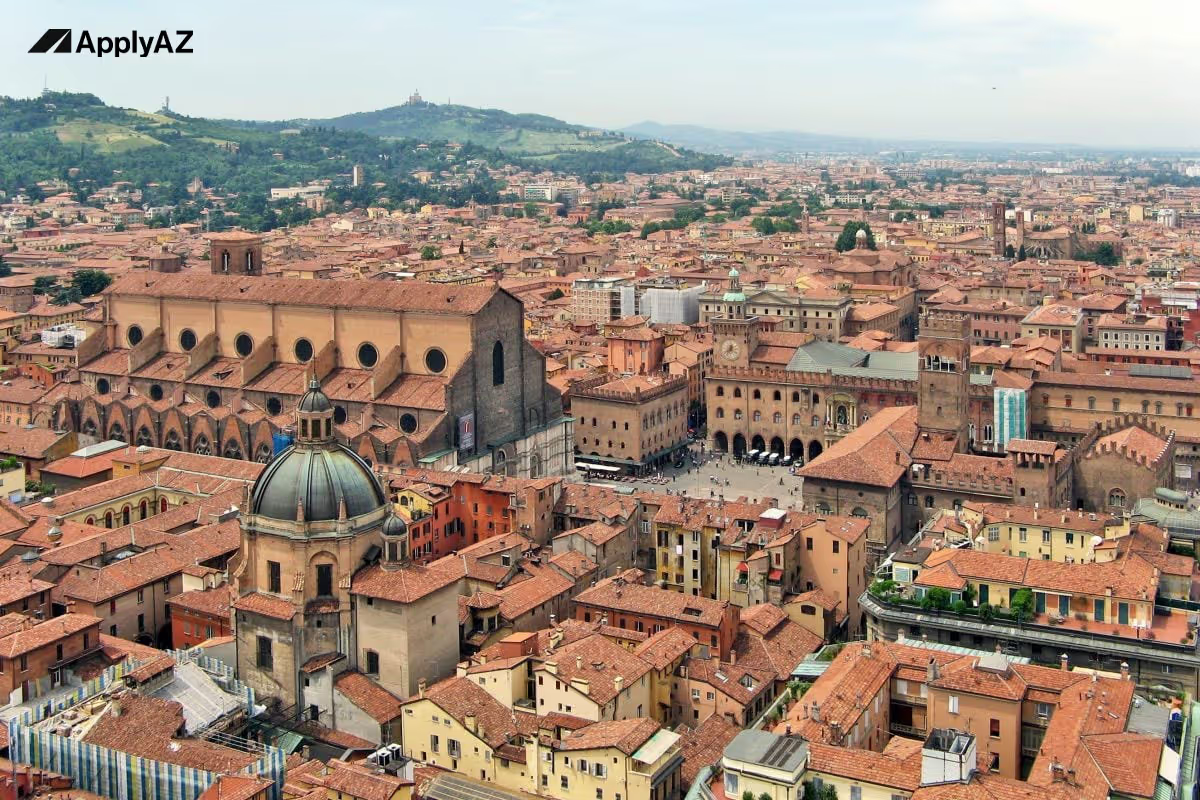
Law, Economics and Governance (LEGo) is a two-year, 120 ECTS interclass master's degree (classes LM-56 R and LM/SC-GIUR R) taught in English at the University of Bologna. Entry needs a first degree in law, economics, business, political science or statistics, or 42 credits in those subjects, a committee score of at least 60/100 and English at B2. Fees follow family income, so it can be tuition-free for eligible students.
Entry requirements
Detailed entry requirements
Bologna's Law, Economics and Governance master asks for a first degree in law, administration, business, economics, political science, peace studies or statistics, or any degree with at least 42 credits in listed law, economics and statistics subjects, English at B2 and a committee score of at least 60/100. Reviewed 8 October 2026. [1]
Degree requirement
You need a first-cycle degree or three-year university diploma, or a degree obtained abroad that is recognised as suitable under Italian law and gives access to a similar programme in the country where it was issued. It must be in one of these Italian degree classes, or an older Italian equivalent: [1]
- L-14 Legal services and LMG/01 Law
- L-16 Administration and L-18 Business administration
- L-33 Economics and L-41 Statistics
- L-36 Political science and international relations and L-37 Peace studies
A degree in any other class also qualifies if it includes at least 42 ECTS in the listed subject groups: [1]
- Law: private, comparative private, agrarian, commercial, economic, maritime, labour, constitutional, public, administrative, tax, international and EU law, civil and criminal procedure, criminal law, philosophy of law and comparative public law (IUS/01 to 10, 12 to 17, 20 and 21).
- Economics and business: political economy, economic policy, public finance, econometrics, applied economics, business economics, management, corporate finance, business organisation and financial intermediaries (SECS-P/01 to 03 and 05 to 11).
- Statistics: statistics, economic and social statistics, and mathematical methods for economics and finance (SECS-S/01, 03, 05 and 06).
- Sociology: sociology of economic processes and labour, and sociology of law (SPS/09 and SPS/12).
For degrees obtained abroad, the committee assesses how consistent your previous studies are with the programme. If you do not meet all the curricular requirements, you cannot register. [1]
What this means for your transcript
The rule is set by subject area, and the committee then scores how well your studies fit the programme. As a guide, based on the rule above:
- Usually a fit: a B.Com or BBA, a BA or B.Sc. in Economics, a BA in Political Science, a B.Sc. in Statistics, or an LL.B. or BA LL.B., since law, business, economics, political science and statistics are listed areas.
- Check carefully: a BA in Sociology, Public Administration or Development Studies, or a B.Sc. in Mathematics, where the committee looks at how many law, economics, business or statistics courses your transcript shows.
- Often short: a B.Tech, B.E., BCA or a B.Sc. in a natural or life science, unless your transcript includes at least 42 credits' worth of law, economics, business or statistics courses.
English
English at CEFR level B2 or higher, proven at the application stage in one of these ways: [1]
- a TOEFL, IELTS, Cambridge English or Trinity College London certificate with a score corresponding to at least B2, issued no more than three years before the application deadline
- a B2 certificate from a university language centre, issued no more than three years before the deadline
- a bachelor's or master's degree taught entirely in English, with a document stating this clearly
- a university English exam passed at B2, with the level shown in the exam title, syllabus or a declaration from the course instructor
- native speaker status, declared on the programme's form
- a B2 result in the Oxford Online Placement Test at the University of Bologna
The notice does not list minimum scores for each test. In the application, you select which document should be used to assess your English. [1]
Committee assessment
There is no entrance test and no cap on places. A committee from the Department of Sociology and Business Law scores your documents out of 100: [1]
- Academic merit: up to 50 points, based on your degree grade, or your weighted average if you have not yet graduated, and the quality of your education.
- Fit with the programme: up to 35 points for how consistent your academic curriculum is with the programme's educational objectives.
- CV: up to 15 points for extra academic qualifications, up to three each of relevant work experiences, internships, publications and training courses, up to two exchanges such as Erasmus, English certificates above B2, other language certificates at B2 or above, and IT certificates.
You need at least 60/100 to be admitted. A lower score means you cannot reapply in a later intake of the same year. [1]
2026/27 deadlines
- Intake 1 (including non-EU applicants): applications from 2 March to 21 April 2026 at 1:00 p.m., results from 13 May 2026.
- Intake 2 (including non-EU applicants): applications from 14 May to 18 June 2026 at 1:00 p.m., results from 15 July 2026.
- Intake 3 (EU and equivalent candidates only): applications from 19 August to 3 September 2026 at 1:00 p.m., results from 14 September 2026.
Matriculation ran from 22 July to 19 November 2026, with a late fee from 30 October 2026. You could apply and enrol before graduating, but the degree had to be obtained by 31 December 2026, otherwise registration is cancelled. Missing documents could be added until the closing date of your intake. The next notice sets the 2027/28 dates. [1]
Documents and non-EU steps
Applications are made on Studenti Online and must include: [1]
- your qualification: for foreign degrees, a copy translated into Italian or English with the transcript of records and Diploma Supplement where available, or your transcript if you have not yet graduated
- a valid identity document, or your passport if the ID has no English translation
- a self-certification of B2 English with your chosen proof
- a CV in English, ideally on the programme's LEGo CV form
- certificates of any extra academic qualifications, with their exam lists or transcripts
A residence permit, if you hold one, and one reference letter can be added, but the letter is not evaluated. Missing or partly uploaded mandatory documents mean the application is not considered. Non-EU applicants living abroad must also pre-enrol on Universitaly and request a study visa. At matriculation, the qualification must be translated, with authenticity and value verified where required, uploaded with your visa and shown in original at the International Student Administration Office. For 2026/27, careers had to be activated by 26 February 2027. [1]
Sources and verification
Checked by the ApplyAZ admissions team against the university's official documents listed below. Entry rules can change with each new call, and we re-check them before every application.
- University of Bologna, Department of Sociology and Business Law. Admission notice to the Second Cycle Degree Programme in Law, Economics and Governance, academic year 2026/27, English version. Reviewed 8 October 2026.
- University of Bologna, Second Cycle Degree Programme in Law, Economics and Governance, programme website: home page, How to enrol page and course structure diagram for students enrolled in 2026/27. Reviewed 8 October 2026.
- University of Bologna. Maximum all-inclusive contribution by degree programme, and fee pages on amounts, exemptions and the reduced fixed fee for non-OECD citizens, academic year 2026/27. Reviewed 8 October 2026.
About the programme
Law, Economics and Governance, known as LEGo, is a two-year second cycle degree (laurea magistrale) taught entirely in English in Bologna. It is an interclass degree: it belongs to class LM-56-R, Economics, and to the law class LM/SC-GIUR-R, and your choice of class does not change the study plan. It is worth 120 ECTS and is run by the Department of Sociology and Business Law (SDE), with Maria Rita Tagliaventi as director. Access is open, with no cap on enrolments for 2026/27, but every applicant must meet the entry requirements and pass a committee assessment. [1][2]
The university describes the aim as advanced skills in law, economics and governance strategies to lead organisations and businesses in a global context. It suits graduates in law, economics, business or political science who want to work where legal rules and economic decisions meet. [1][2]
What you will study
LEGo trains professionals who combine expertise in law and economics. For students enrolling in 2026/27, the first year opens with non-credit crash courses in the principles of economics and of law, then covers: [2]
- International Law and Markets (6 CFU)
- Law and Economics of Corporate Governance (6 CFU)
- Corporate Law and Financial Transactions (12 CFU): comparative corporate law and the law and practice of financial transactions
- Statistics and Organizational Management (6 CFU each)
- a 12 CFU choice between Industry Dynamics and Market Behavior, and Innovation Economics and Policy, which includes the economic policy of artificial intelligence
The second year covers International Economics, Business and Corporate Strategy, Principles of Accounting and Finance and European SMEs Law, plus a choice between Regulation of Innovation and AI and Internet Regulation, and one elective such as International Taxation Law or Agrifood Regulation. It ends with a dissertation project management unit and an 18 CFU final examination. Free-choice credits can include a 9 CFU internship, Python for business, and French, German or Spanish. International students also take a compulsory Italian language course, unless prior study or a certificate exempts them. Units can change between intakes, so we check the 2027/28 plan before you apply. [2]
Career paths
The university positions graduates to lead organisations and businesses that operate across borders, using law, economics and governance together. Internships, including internships abroad to prepare the final examination, are built into the study plan. A laurea magistrale also gives access to PhD programmes. [2]
Fees and scholarships
Bologna's fees follow family income (ISEE), and this degree sits in a higher fee band than the second-cycle standard. [1][3] For first-year students with an ISEE of €27,000 or less, this programme can be tuition-free for eligible students. International students whose family income and assets are only abroad cannot submit an ISEE and use a separate documentation route. Citizens of non-OECD countries in that position may instead choose a reduced flat fee. [3] ER.GO, the Emilia-Romagna right-to-study body, runs scholarships, residence places and other benefits through its own yearly call, separate from admission. [1]
How to apply from outside the EU
Because access is open, LEGo has no quota of places for non-EU applicants. For 2026/27, non-EU applicants living abroad could apply on Studenti Online in intake 1, from 2 March to 21 April 2026, or intake 2, from 14 May to 18 June 2026. Intake 3 was only for EU and equivalent candidates. Applicants who score below 60/100 cannot reapply in a later intake. The 2027/28 notice is not yet published. [1]
Admitted non-EU applicants living abroad then complete Universitaly pre-enrolment and apply for a study visa, which needs proof of financial means; we check the current figure for your intake. For 2026/27, matriculation ran from 22 July to 19 November 2026, with a late fee from 30 October. Students pay the first instalment, upload the translated qualification with its authenticity and value verified where required and the study visa, then show the originals at the International Student Administration Office in Bologna. Careers had to be activated by 26 February 2027. [1][2]
How ApplyAZ helps
ApplyAZ is an Italy-based consultancy that works only with public universities. We can include this programme in a shortlist of 20 to 30 English-taught programmes that fit your profile, so your plan never rests on a single application.
For eligible students who start with us, a named person owns each stage, from A to Z:
- We check your transcript against Bologna's entry rules for this programme.
- We write your CV and a tailored statement of purpose.
- We prepare and submit your Studenti Online application with your transcript, English CV and B2 English proof, and Universitaly pre-enrolment.
- We help you declare your family income for reduced fees and file your ER.GO Emilia-Romagna scholarship application at the right time and in the right format.
- We prepare your visa file.
With operations in all 20 Italian regions, we follow each region's scholarship rules and deadlines as they change. The university decides admission, the region decides the scholarship and the consulate decides the visa, so no one can promise an outcome. You pay in milestones, and every service you pay for is either delivered or its fee is refunded (terms apply).
Programmes at Italian public universities can be tuition-free for eligible students. Check if you are eligible and book a one-to-one consultation session with one of our Italy experts, or see how ApplyAZ works.
Questions and answers
What bachelor's degree do I need for Bologna's Law, Economics and Governance master?
A first degree in law, legal services, administration, business, economics, political science, peace studies or statistics, or any degree with at least 42 credits in the listed law, economics, business, statistics or sociology subjects. For foreign degrees, the committee assesses how well your studies fit the programme. [1]
Is there an entrance exam or a limit on places?
No test and no cap on enrolments. A committee scores your application out of 100: up to 50 points for academic merit, 35 for how well your studies fit the programme and 15 for your CV. You need at least 60 to be admitted. [1]
What English level is required? Do I need IELTS?
English at CEFR B2. The 2026/27 notice accepts TOEFL, IELTS, Cambridge or Trinity certificates at a B2-equivalent score, no older than three years, without listing exact scores. A degree taught entirely in English or a university English exam passed at B2 also counts. [1]
When is the deadline for non-EU students?
For 2026/27, non-EU applicants living abroad could apply in intake 1, which closed on 21 April 2026, or intake 2, which closed on 18 June 2026, both at 1:00 p.m. Intake 3 was for EU and equivalent candidates only. The 2027/28 dates are not yet published. [1]
Can I apply before I graduate?
Yes. You can apply and enrol before graduating, but for 2026/27 the degree had to be obtained by 31 December 2026, otherwise registration is cancelled. Missing documents could be added until your intake closed. [1]
I have a B.Tech or a BCA. Can I apply?
Only if your transcript includes at least 42 credits in the listed law, economics, business, statistics or sociology subjects, which engineering and computing degrees often lack. If you meet that rule, the committee then scores how well your studies fit the programme. [1]
If I score below 60, can I try again in the next intake?
No. Under the 2026/27 notice, applicants who scored below 60/100 could not reapply in a later intake of the same year, so it pays to apply once with a complete file and a strong CV. [1]
What does the programme cover?
The first year covers international law and markets, corporate governance, corporate and financial law, statistics and organisational management. The second year adds international economics, business strategy, accounting and finance, EU SME law and a choice between innovation regulation and AI and internet regulation. [2]
Can someone handle my whole application to Law, Economics and Governance at Bologna?
Yes. ApplyAZ, an Italy-based consultancy that works only with public universities, checks your transcript against Bologna's rules for this programme, handles the application and Universitaly pre-enrolment, helps you file the ER.GO Emilia-Romagna scholarship application at the right time and in the right format, and prepares your visa file, for eligible students. Start by checking your eligibility.
I'm applying from India. What is the route into Law, Economics and Governance?
A three-year Indian B.Com, BBA, BA in Economics or Political Science, B.Sc. in Statistics, or an LL.B. sits in the fields Bologna lists, and other degrees need at least 42 credits in law, economics, business or statistics. You also need English at B2. The steps are the Studenti Online application in intake 1 or 2, committee assessment and Universitaly pre-enrolment. [1] Indian students apply for the type D study visa at the Italian embassy or consulate that covers their state, such as New Delhi, Mumbai or Bengaluru.
Is the route different from Pakistan, Bangladesh or Sri Lanka?
No. The academic rules for Law, Economics and Governance are the same whatever your nationality. Applicants from Pakistan, Bangladesh and Sri Lanka follow the same steps as India: Studenti Online application in intake 1 or 2, committee assessment and Universitaly pre-enrolment, then a type D study visa from the Italian mission for their country of residence. Read our guide for students in Dhaka.
I live in the UAE, Saudi Arabia, Qatar, Kuwait, Oman or Bahrain. Where do I apply for the visa?
At the Italian embassy or consulate responsible for the country where you legally live, after Universitaly pre-enrolment. The academic rules for Law, Economics and Governance are the same whatever your nationality, and Gulf residents follow the same steps: Studenti Online application in intake 1 or 2, committee assessment and Universitaly pre-enrolment. Read our guides for Dubai, Riyadh and Doha.
I studied or live in London, New York, Toronto, Vancouver, Singapore or Kuala Lumpur. What is the route?
The academic rules for Law, Economics and Governance are the same whatever your nationality, and your degree is assessed like any other foreign qualification. Non-EU applicants who live abroad follow the same route: Studenti Online application in intake 1 or 2, committee assessment and Universitaly pre-enrolment, then a type D study visa from the Italian mission for where they live. Read our guides for students in London, New York, Toronto, Vancouver, Singapore and Kuala Lumpur.
More English-taught programmes at this university
Other public universities in this city

They began right where you are

