

Master in Food Animal Metabolism and Management in the Circular Economy at University of Bologna
Two-year English-taught LM-86 master's at the University of Bologna on animal metabolism, health and welfare, farming technologies and circular business models, with a 12 ECTS internship and open access.
Master
2 years
Bologna
English
University of Bologna


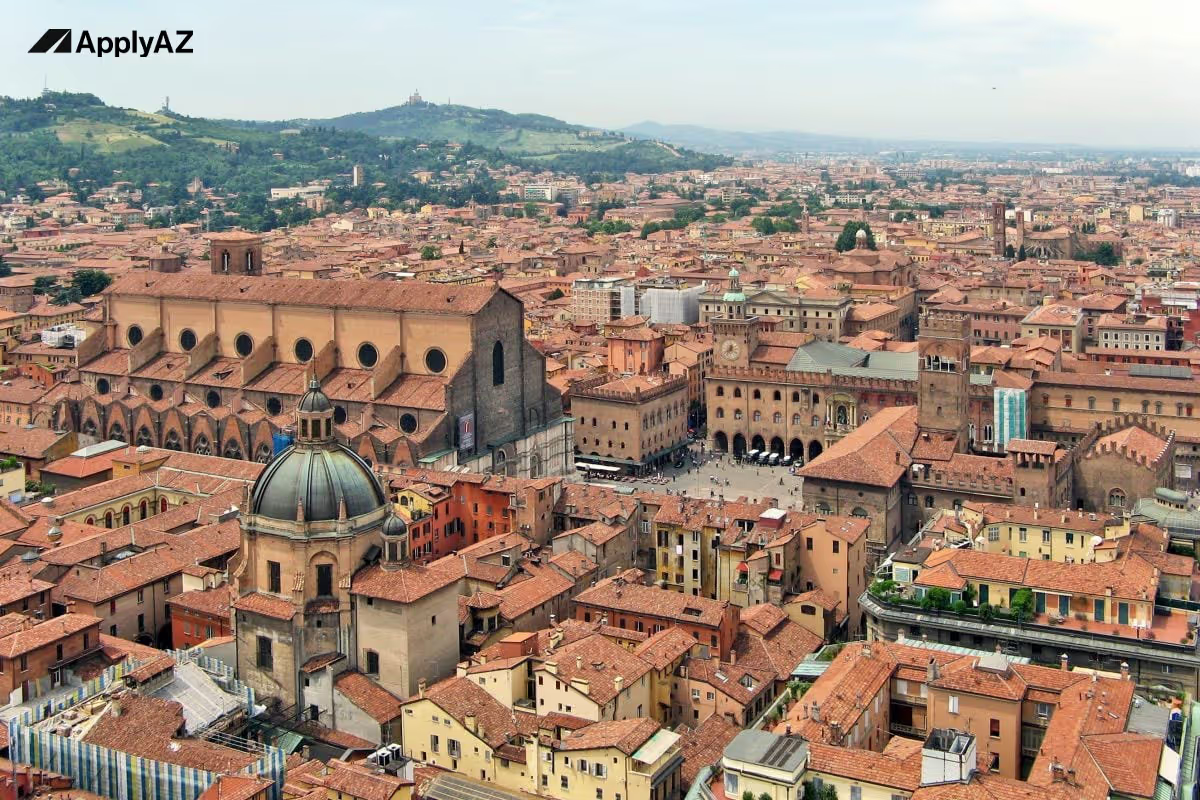
Food Animal Metabolism and Management in the Circular Economy is a two-year, 120 ECTS master's degree (class LM-86) taught in English by the University of Bologna at Ozzano dell'Emilia. It trains experts in sustainable livestock systems. Fees follow family income, so it can be tuition-free for eligible students.
Entry requirements
- A bachelor's degree in food and agriculture science, animal production or agricultural sciences (Italian classes L-26, L-38, or older L-20, L-40), or an equivalent foreign degree.
- Otherwise at least 30 credits in subjects such as veterinary anatomy, physiology, pathology, animal breeding, animal nutrition, agricultural economics or biochemistry.
- English at B2 level or above, shown by a certificate recognised by Unibo's Language Centre.
- No entrance test: a committee scores academic merit (75 points), CV (10), English (5) and reference letters (10); 60 points means direct admission, 50 to 59 leads to an online interview.
- Foreign graduates upload their qualification and transcript in Italian or English, with a Diploma Supplement where available.
About the programme
Food Animal Metabolism and Management in the Circular Economy is a two-year master's degree (laurea magistrale, class LM-86, livestock management) run by the Department of Veterinary Medical Sciences (DIMEVET) of the University of Bologna. It is delivered entirely in English at the Ozzano dell'Emilia campus near Bologna, with open access.
The course trains specialists who manage animal production systems from a circular perspective. It works on three levels: metabolism, animal health and welfare, and farming systems, technologies and the circular economy. It suits graduates in animal production, agriculture or food science who want to help livestock farming become more sustainable.
What you will study
The first year builds the science of animal production and metabolism; the second adds nutrition, data and business skills, then an internship and the thesis. Units in the 2026/27 plan include:
- Intensive and Circular Animal Production, covering poultry, fish, swine and ruminant farming
- Metabolism in Farm Animals, and Morpho-Functional and Pathological Basis of Animal Metabolism and Stress
- Circular Agri-Food Business Models
- High-Throughput Technologies for Sustainable Animal Breeding, and Management of Reproduction
- Sustainable Control of Transmissible Diseases in Food Animal Production Systems
- Food Animal Nutrition and Feeding for Sustainability and Safety
- Artificial Intelligence and Machine Learning for Business, and Business Data Analysis
How the programme is taught
The second year includes a Workshop in Animal Metabolism and Management, a 12 ECTS internship and a 20 ECTS final examination, whose preparation can also take place abroad. The university reports that 92% of students are international or from outside the region.
Career paths
Graduates work as animal production systems experts, handling farm organisation, innovation, big data, animal feed, genetic improvement and animal welfare. The university lists these employers:
- Agricultural, livestock and aquaculture companies
- Makers of equipment and management systems for animal production
- Consulting firms and technical assistance services for the agrifood sector
- Certification and control bodies in food production
- National and international public bodies, research institutions and development cooperation organisations
The degree also gives access to PhD programmes and second-level professional masters.
Fees and scholarships
Unibo links fees to family income. For 2026/27 all students pay €157.04 in fixed charges, and an ISEE or ISEE parificato up to €27,000, filed through ER.GO, removes the variable part. Students from listed non-OECD countries whose family income is abroad can instead ask for a reduced flat fee of €1,200 plus fixed charges. ER.GO also runs income-based grants, so the course can be tuition-free for eligible students.
How to apply from outside the EU
You apply on Studenti Online, uploading your CV, degree certificate and transcript, and an English B2 certificate. A committee scores the file and may call you for an online interview. The 2026/27 call has expired, and the 2027/28 call with its windows is not out yet.
Once admitted, you pay the first instalment and pre-enrol on Universitaly, and the university validates the pre-enrolment so you can request a study visa. Note that Unibo offices close for part of August. Italian B2 is also expected, and international students who lack it add Italian courses to their study plan.
How ApplyAZ helps
If this programme fits your goals, ApplyAZ can include it in a shortlist of 20 to 30 English-taught programmes at Italian public universities. We write your CV and a tailored statement of purpose, submit your applications and Universitaly pre-enrolment, file your DSU scholarship application and prepare your visa file, with a named person on each stage. The university decides admission, the region decides the scholarship and the consulate decides the visa. See how ApplyAZ works or check your eligibility.
Questions and answers
Is this master's taught in English?
Yes. All teaching is in English at the Ozzano dell'Emilia campus, and you need English at B2 level. Italian B2 is also expected, but international students who lack it take Italian courses within their study plan.
Which bachelor's degrees are accepted?
Degrees in food and agriculture science, animal production or agricultural sciences (classes L-26, L-38, L-20, L-40) or foreign equivalents. Other graduates need at least 30 credits in veterinary, animal science, agricultural economics or biochemistry subjects.
Is there an entrance test?
No written test. A committee scores academic merit, CV, English and reference letters out of 100. A score of 60 or more gives direct admission; 50 to 59 leads to an online interview.
When can I apply for 2027/28?
The 2027/28 call is not published yet. Applications go through Studenti Online, and the call on the programme's admission page sets the windows and deadlines.
How much are the fees?
Fees follow family income. For 2026/27 there were fixed charges of €157.04, no variable part up to an ISEE of €27,000, and a reduced flat fee of €1,200 plus fixed charges for listed countries. ER.GO grants are open to eligible students.
What jobs does it lead to?
Graduates manage sustainable animal production systems in livestock and aquaculture companies, equipment makers, agrifood consulting, certification bodies, public institutions, research and development cooperation.
Similar programmes
More programmes in this city

They began right where you are

