

Master in International Cooperation on Human Rights and Intercultural Heritage at University of Bologna
Two-year English-taught master in development cooperation at the University of Bologna's Ravenna campus, with curricula on intercultural heritage and on the protection of human rights, for careers in cultural heritage and international cooperation.
Master
2 years
Bologna
English
University of Bologna


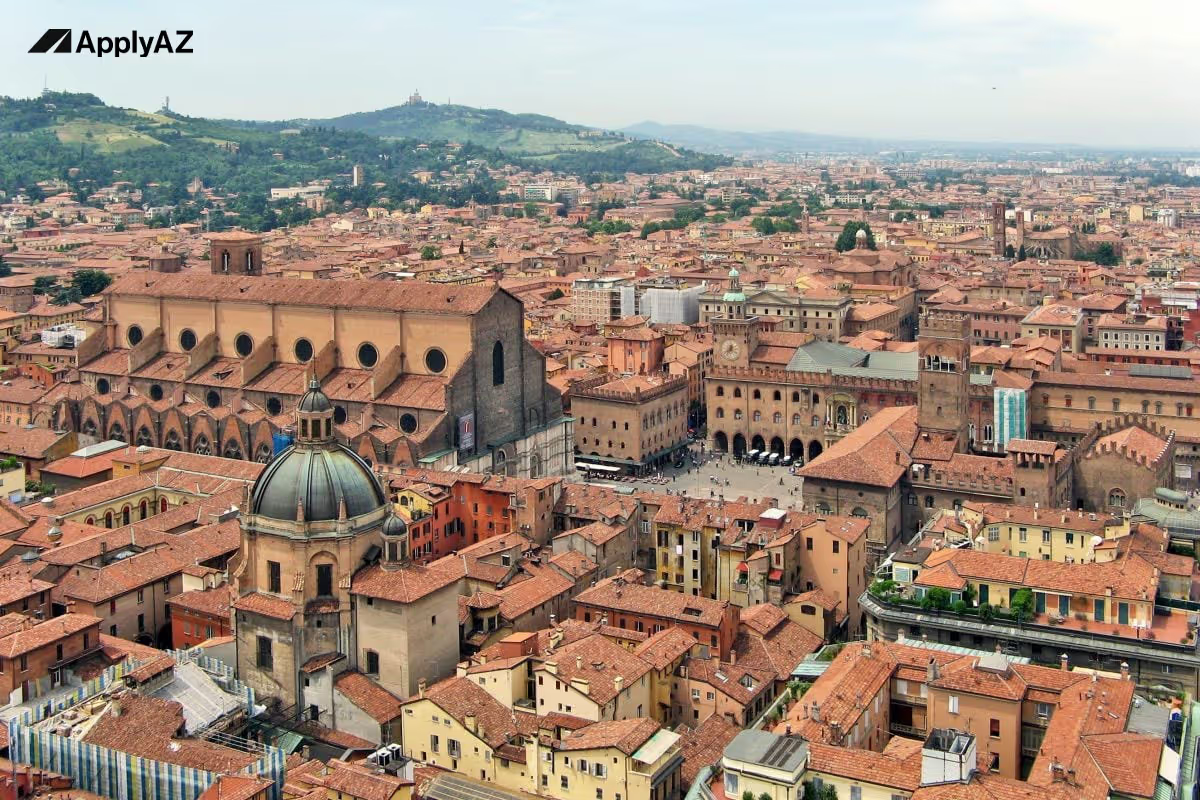
International Cooperation on Human Rights and Intercultural Heritage is a two-year, 120 ECTS master's degree (class LM-81 R) taught entirely in English at the University of Bologna's Ravenna campus, with curricula in intercultural heritage and human rights. Access is open, and tuition follows family income.
Entry requirements
- A bachelor's degree, or a foreign qualification that gives access to second-cycle study in the country where it was awarded, meeting the curricular requirements in the degree's admission notice.
- English proficiency at the level the admission notice sets; the whole degree is delivered in English.
- Open access: there is no fixed number of places, and your personal preparation is assessed as the notice describes.
- An application on Studenti Online within the window in the notice, then Universitaly pre-enrolment if you need a study visa.
- At enrolment, your translated degree certificate and transcript plus a Diploma Supplement, CIMEA statement, declaration of value or legalisation.
About the programme
International Cooperation on Human Rights and Intercultural Heritage is a two-year laurea magistrale in class LM-81 R, Development co-operation, run by the Department of Cultural Heritage (DBC) on the University of Bologna's Ravenna campus. It is worth 120 ECTS, is delivered entirely in English and has open access. Roberto Pasini is the degree programme director.
The degree trains future professionals in the field of cultural heritage and international cooperation. Its mission is to promote human rights and interculturality through international cooperation, summed up in the line "Protecting rights, enhancing cultures". It suits students who want to work where heritage, rights and development meet.
What you will study
Students choose one of two curricula, which share the same focus on international cooperation but lead in different directions:
- International Cooperation on Intercultural Heritage
- Protection of Human Rights and International Cooperation
The first centres on cultural heritage as a field of cooperation between countries and communities; the second on the protection of human rights within cooperation work. The course units, credits and teaching periods of each curriculum are published in the course structure diagram on the degree website. Check the 2027/28 version before you apply, since units can change.
Career paths
The degree prepares professionals for cultural heritage and international cooperation; the detailed profiles are listed in the prospects section of the degree website. Its notice board advertises openings in the field, such as the internship programme run by the Fondazione CRUI with the Italian Ministry of Foreign Affairs (MAECI) and an award for work on international cooperation themes. A laurea magistrale also gives access to PhD programmes.
Fees and scholarships
The 2026/27 maximum for this degree is €3,060 a year, one of the higher bands (the second-cycle standard is €2,550), plus a fixed €157.04. Your actual contribution depends on family income: an ISEE up to €27,000 means only the fixed part, which is zero euro tuition for eligible students. Non-OECD citizens, including countries like India, whose family income is only abroad may choose a reduced flat fee of €1,200 plus €157.04. ER.GO, the regional right-to-study body, runs the scholarship; winners pay just €157.04.
How to apply from outside the EU
Begin with the degree's admission notice, which states the curricular requirements, the English level, the check of personal preparation and the dates. The 2027/28 notice has not been published. Applications are submitted on Studenti Online, and as access is open there is no separate quota for non-EU applicants.
After admission, file the Universitaly pre-enrolment; the consulate needs the university's unconditional validation and proof of means of at least €10,179.85 (2026). Nothing is validated during the August closure. Once in Ravenna, you enrol, pay the first instalment and apply for a residence permit within eight days.
How ApplyAZ helps
If this programme fits your goals, ApplyAZ can include it in a shortlist of 20 to 30 English-taught programmes at Italian public universities. We write your CV and a tailored statement of purpose, submit your applications and Universitaly pre-enrolment, file your DSU scholarship application and prepare your visa file, with a named person on each stage. The university decides admission, the region decides the scholarship and the consulate decides the visa. See how ApplyAZ works or check your eligibility.
Questions and answers
Is the degree taught in English?
Yes. International Cooperation on Human Rights and Intercultural Heritage is delivered entirely in English on the Ravenna campus. The admission notice sets the English level and the accepted proof.
Which curricula can I choose?
Two: International Cooperation on Intercultural Heritage, and Protection of Human Rights and International Cooperation. Both focus on international cooperation, with heritage or human rights as the main field.
Where is the degree taught?
In Ravenna, on the University of Bologna's Ravenna campus, by the Department of Cultural Heritage. Non-EU students enrol and complete their document checks with the campus student administration office.
Is there a limit on places?
No. Access is open, so there is no fixed number of places. You must still meet the curricular requirements and the check of personal preparation in the admission notice.
How much are the fees?
For 2026/27 the maximum is €3,060 a year plus a fixed €157.04. With a family ISEE up to €27,000 you pay only €157.04. Non-OECD citizens with family income only abroad can choose €1,200 plus €157.04.
Can I get a scholarship?
Eligible students can apply for the ER.GO regional scholarship. Winners pay only the fixed €157.04 a year, and ER.GO, the Emilia-Romagna right-to-study body, decides the awards.
Similar programmes
More programmes in this city

They began right where you are

