

Master in Medical Engineering at University of Bergamo
Two-year English-taught LM-21 master's at the University of Bergamo's Dalmine campus that trains engineers to design and run medical technologies alongside clinicians, from biomechanics and imaging to clinical data science.
Master
2 years
Bergamo
English
University of Bergamo


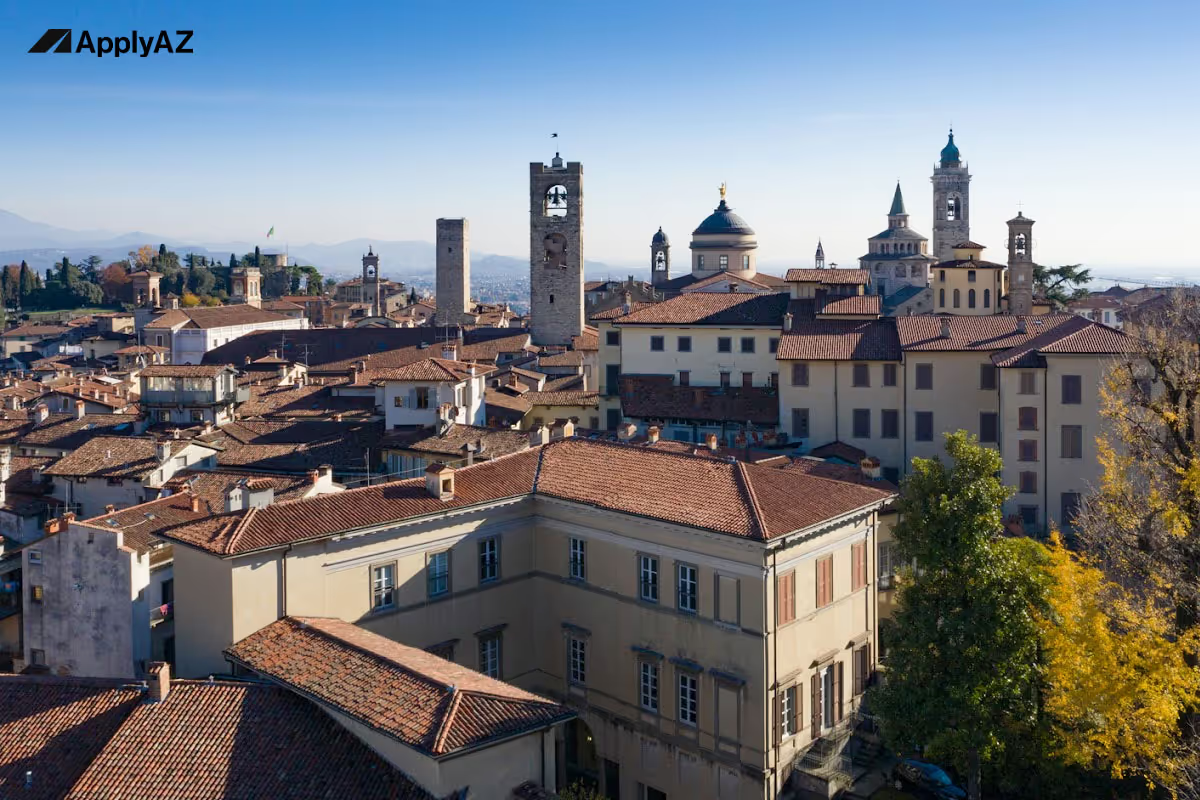
Medical Engineering is a two-year, 120 ECTS master's degree (class LM-21) taught in English by the University of Bergamo at its engineering campus in Dalmine. It joins biomedical engineering with clinical medicine and health data. Fees are set by family income, so it can be tuition-free for eligible students.
Entry requirements
- A bachelor's degree, or an equivalent foreign qualification judged suitable by the university.
- At least 35 ECTS in maths, physics, chemistry and statistics (15 of them in mathematical analysis), plus at least 20 ECTS in core industrial engineering subjects.
- At least 10 ECTS in bioengineering and at least 5 ECTS in medical or biological disciplines.
- English at B2 level, shown by a certificate such as IELTS, TOEFL or Cambridge, or by a degree taught in English.
- No entrance test: an admissions committee checks your curriculum and personal preparation. At least one reference is requested on the application portal.
About the programme
Medical Engineering is a two-year master's degree (laurea magistrale, class LM-21 biomedical engineering) worth 120 ECTS and taught in English. It is run by the Department of Management, Information and Production Engineering with the Department of Engineering and Applied Sciences, and classes take place at the University of Bergamo engineering campus in Dalmine.
The course starts from a simple idea: hospitals are becoming high-tech centres, and home monitoring and telemedicine are growing, so doctors need engineers who understand both devices and clinical practice. It suits graduates in biomedical or industrial engineering who already have some bioengineering and medical coursework.
What you will study
There is a single common curriculum. The first year mixes medicine with engineering, and the second year centres on sensors, imaging, regulation and two large laboratories, followed by 12 ECTS of electives and a 12 ECTS final examination. Course units in the 2026/27 plan include:
- Cardiovascular Medicine and General Medicine (8 ECTS)
- Biomechanics and Medical Device Simulations with Technologies for Regenerative Medicine (15 ECTS)
- Data Science in Medicine and Medical Informatics (12 ECTS)
- Medical Support Systems for Chronic Diseases, Healthcare Operations and Advanced Biomaterials
- Digital Human Modelling and Rehabilitation, and Biomedical Sensors (12 ECTS)
- Advanced Biomedical Imaging and Machine Learning, and Advanced Regulatory Affairs for Medical Devices
- Electives such as Forensic Medicine for Medical Technologies, Virtual and Physical Prototyping, Computational Fluid Dynamics or a 6 ECTS internship
How the programme is taught
Hands-on work is built into the second year through a Biomechanical Lab and an ICT/Electronic Lab, each worth 9 ECTS. Teaching is conventional and in person, and students can use elective credits for a training internship before the master's thesis.
Career paths
The university describes a new kind of biomedical engineer who works side by side with doctors and healthcare staff. Graduates define and run technological solutions for clinical and rehabilitation work, handle the mechanical, electronic and data side of medical devices, and use data analysis to improve the quality of health services.
- Hospitals and healthcare facilities, including services for chronic diseases
- Biomedical companies that design and produce medical devices
- Firms that supply goods and services to the clinical sector
- Public and private health organisations working on service quality
Fees and scholarships
The application portal lists this degree for 2026/27 with fees tied to family income: a first instalment of €0 to €400 and a second of €0 to €1,700, plus a €156 payment at enrolment. With a low enough family income, this programme can be tuition-free for eligible students. The Lombardy DSU scholarship is run by the university itself, and income and merit decide awards.
How to apply from outside the EU
Non-EU applicants with a foreign bachelor's request a pre-evaluation on the University of Bergamo DreamApply portal, uploading their degree, transcript, English certificate, passport and at least one reference. The €30 fee covers up to two master's degrees. For 2026/27 the calls ran between 24 November 2025 and 31 January 2026; the 2027/28 dates are not out yet.
Once admitted, you complete Universitaly pre-enrolment and apply for a type D study visa.
How ApplyAZ helps
If this programme fits your goals, ApplyAZ can include it in a shortlist of 20 to 30 English-taught programmes at Italian public universities. We write your CV and a tailored statement of purpose, submit your applications and Universitaly pre-enrolment, file your DSU scholarship application and prepare your visa file, with a named person on each stage. The university decides admission, the region decides the scholarship and the consulate decides the visa. See how ApplyAZ works or check your eligibility.
Questions and answers
Is Medical Engineering at Bergamo taught in English?
Yes. The 2026/27 course catalogue lists English as the teaching language for the whole degree, and applicants need English at B2 level.
Where are classes held?
At the University of Bergamo engineering campus in Dalmine, in the province of Bergamo.
What background do I need?
A bachelor's with at least 35 ECTS in maths, physics, chemistry and statistics, 20 ECTS in industrial engineering, 10 ECTS in bioengineering and 5 ECTS in medical or biological subjects.
Is there an entrance test?
No. An admissions committee checks that you meet the curricular requirements and assesses your personal preparation from your application.
What will I study?
Medicine for engineers, biomechanics, medical data science, biomaterials, sensors, biomedical imaging with machine learning and device regulation, plus a biomechanical lab and an ICT/electronic lab.
How much does it cost?
Fees depend on family income. For 2026/27 the first instalment is €0 to €400 and the second €0 to €1,700, plus €156 at enrolment. The application fee is €30.
Similar programmes
More programmes in this city

They began right where you are

