Contents
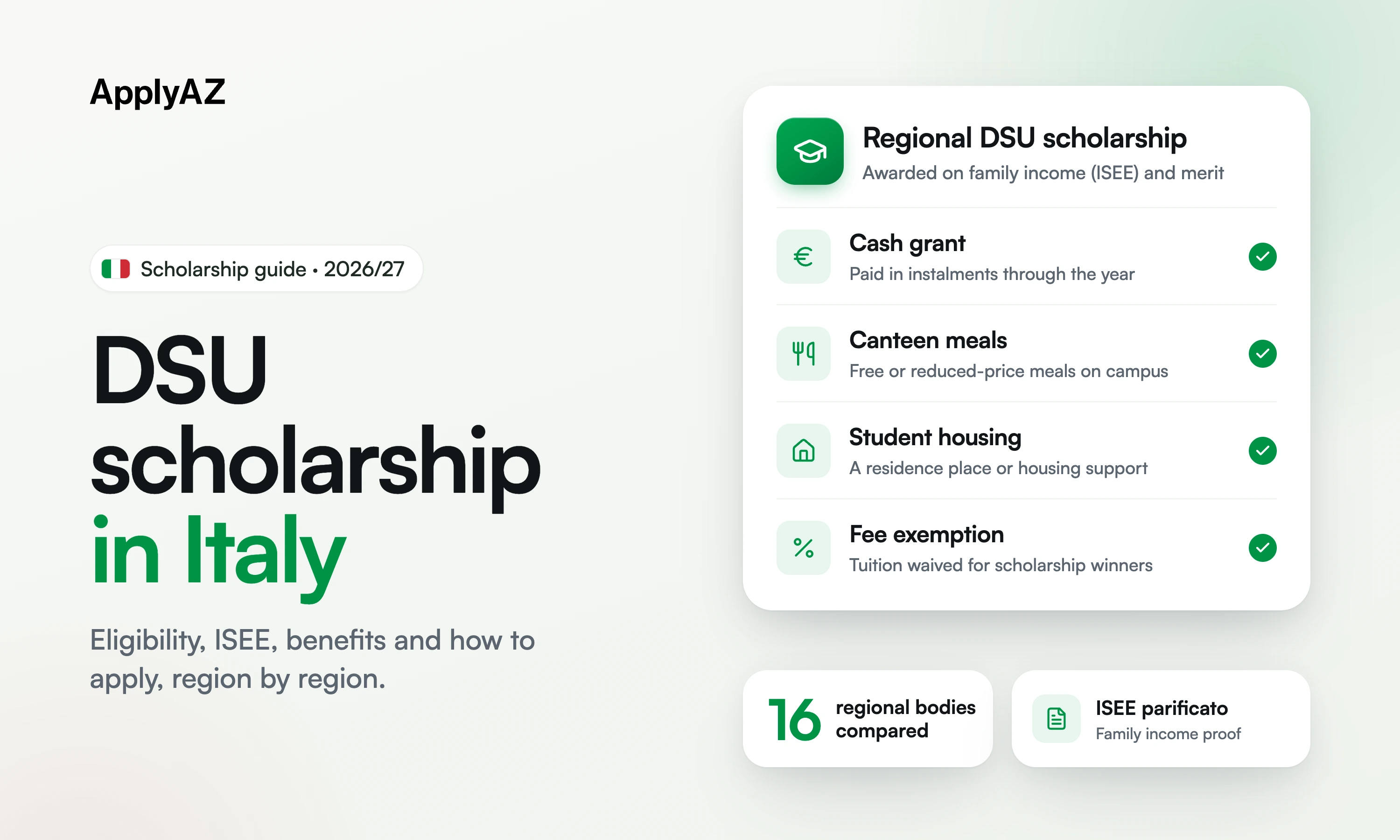
Madelyne Harding came to Italy from the United States. She is doing a master's in Marine Biology and Ecology at the University of Tuscia, a public university, taught in English at its Civitavecchia campus on the coast north of Rome. She pays no tuition, and she receives a DSU scholarship of €700 a year.
What is Madelyne studying, and where?
Marine Biology and Ecology at the University of Tuscia, a public university in the Lazio region. The course runs at the Civitavecchia campus, close to the sea, which suits a marine science degree.
What does Madelyne pay?
No tuition. Fees at Italian public universities are based on family income, and Madelyne documented that her family is in a low income bracket, so her tuition is waived. On top of that she receives a DSU scholarship of €700 a year.
Why €700 and not the €8,000 some students get? DSU amounts are banded by family income and assets, and the rules for documenting income from abroad differ by country. For Madelyne, the tuition waiver is where most of the saving comes from.
Public universities, honest numbers
At an Italian public university, what you pay comes from your family's documents, not from a brochure. That is why an adviser with nothing to sell starts with your paperwork and gives you the real number: the fee band you are likely to fall into, the scholarship you could apply for, and what living in that city costs.
ApplyAZ works only with public universities in Italy and has no tie-ups with private ones. There is no commission pulling a recommendation in any direction, so the advice is just: here is your realistic route, and here is what it costs.
Why Italy instead of the United States?
Cost. As Madelyne puts it, studying in Italy in English can save "thousands and thousands of dollars" compared with studying in the United States.
What did ApplyAZ do?
"ApplyAZ will make the whole process super easy. All you have to do is find your English course, upload all your documents, and they will take care of your visa, admissions and scholarship opportunities."
We don't need to push you toward a university because a university is paying us. We first check whether the public-university route in Italy genuinely makes sense for your profile.
How the ApplyAZ route works
- Check your eligibility. A free, two-minute check of whether your profile fits the public-university route.
- Book an Italy consultation. If it does, you speak with one of our Italy experts.
- Get your Italy roadmap. Realistic university options, admission strategy, scholarship pathway, visa process and next steps, laid out before you enrol.
- Enrol with ApplyAZ. Only if the roadmap makes sense to you.
- We handle the process A to Z. Shortlisting, CV and SOP, programme-specific documents, applications, DSU scholarship, student visa, and pre-arrival and arrival guidance.
Reality check
- Zero euro tuition depends on your income documents. Madelyne pays nothing because she proved a low family income. Students with higher incomes pay a fee, usually still far below US tuition.
- Scholarship amounts vary. Some students get around €8,000 a year, some a few hundred euros, some nothing. It depends on income, assets and the region.
- Living costs still apply. Budget for rent, food and travel even when tuition is waived.
Could this work for you?
Read about the University of Tuscia and our DSU scholarship guide 2026-27. Then take the first step: check your eligibility.
Frequently asked questions
Can Americans study a master's in Italy in English?
Yes. Italian public universities offer many master's degrees taught fully in English and accept students from the United States.
Is university in Italy free?
Not automatically. Public university fees are low and based on family income. Students who prove a low family income can pay no tuition at all, as Madelyne does. Whether you qualify depends on your income documents and the university's rules.
Does ApplyAZ work with private universities?
No. ApplyAZ works only with public universities in Italy and has no tie-ups with private universities, so no recommendation is driven by a university commission.
Why is Madelyne's scholarship €700 when other students get €8,000?
DSU amounts are banded by family income and assets, and the rules for documenting income from abroad differ by country. That is why grants range from a few hundred euros to around €8,000 a year.
What would Italy actually cost you?