

Immigration Consultants in Italy
Italy has no licensing body for immigration consultants, so the word certifies nothing. If you are applying to an Italian university from India, here is what to verify, what your file actually needs, and whether you need to hire anyone at all.

Free check
Less than 2 minutes
Limited intake, 1:1 support
international students trusted us
tuition for qualifying students
English-taught programmes
Italian regions covered
Italy has no licensing body for immigration consultants. There is no register to look someone up on, no number to quote, and no protected title, which is why the word appears on the website of a law firm in Milan and on the website of a two-person agency in a shopping complex without either one breaking a rule.
So the title tells you nothing. What you can check is the work underneath it, and this page shows you how, whether you end up hiring us or not.
Most people reading this are applying to an Italian university from India. If that is you, keep going.
Why does "immigration consultant" mean something different in Italy?
If you have compared destinations, you have seen credentials like Canada's RCIC number or an Australian MARA registration. Italy has no equivalent. What it has instead are four different kinds of help, each with a different check attached.
Avvocato. An Italian lawyer registered on a local bar roll. Can represent you before the Questura and the courts, and is the only one who can challenge a refusal. Verifiable by name against the bar of the city they claim.
Patronato. State-funded organisations such as ACLI, INCA and INAS that assist with residence permits and renewals once you are in Italy, much of it free of charge. Worth knowing about for later, not for the visa stage.
Agenzia di pratiche or CAF. Form filling and submission. Useful, cheap, and limited to exactly that.
Education and visa consultants in India. Not regulated as immigration practitioners anywhere in this process. The value is real but operational: admission, document legalisation, financial file construction, jurisdiction and appointment handling, interview preparation. Judge them on files completed, not on the word on the signboard.
None of this means a non-lawyer cannot help you. It means you check what sits underneath the title rather than the title.
Are you on the study route, or a different one?
Studying. Your process starts with an Italian university admission, runs through pre-enrolment on Universitaly, and ends with a type D study visa issued in India. Almost everything that decides the outcome happens before you fly. This page is built for you.
Working. An Italian employer applies for your work authorisation inside a government quota, on fixed application days. You cannot start this from India, and no agency here can file it for you, because the applicant is the employer. If someone offers you an Italy work visa without an Italian employer already holding a job for you, that is the end of the conversation.
Already in Italy, renewing a permit, joining family, or applying for citizenship. That is Italian legal work. It belongs with an avvocato or a patronato, not with any agency in India, including ours.
Mixing these up is the most expensive mistake in this market. A study consultant cannot fix a permit problem in Bologna, and an Italian law firm is not going to build your financial file for the New Delhi jurisdiction.
Do you need someone in India, or someone in Italy?
Split the timeline at the airport.
Before you fly, everything happens here: admission, pre-enrolment, legalisation and attestation of your certificates, the CIMEA statement or Dichiarazione di Valore, health insurance, accommodation proof, financial evidence, and the appointment at the consulate that holds jurisdiction over your state. Delhi, Mumbai and Kolkata cover different states and publish different checklists. A consultant who does not know which one covers you has not read your file.
After you land, everything happens there: the residence permit within eight working days of arrival, the codice fiscale, registration with the comune. That is where a patronato or an Italian lawyer is useful, and where an Indian agency's role normally ends.
Ask anyone you are considering which side they cover. A straight answer is a good sign. A claim to cover both, with no named partner in Italy, usually means neither.
What changed for 2026–27 that your consultant should already know?
Use these as live questions in your first call.
The money requirement rose sharply. The MUR procedures for 2026/27 and 2027/28 raised the minimum proof of financial means from €6,947.33 to €10,179.85 per year, close to a 46% jump in one cycle. Consulates also look at where the money came from and whether it can be traced, not only at the closing balance. A balance assembled the week before the appointment is one of the most common reasons for refusal that applicants never see coming.
Universitaly is free, and it is the only door. Pre-enrolment for a study visa is submitted exclusively through the Ministry's portal. No third party is needed to reach it, and nobody can make it move faster. A separate charge for portal access is a charge for nothing.
Validation is not approval. A university validating your pre-enrolment does not guarantee a visa appointment and confers no right to a visa. The consulate assesses your file independently. Any promise of an assured visa contradicts the circular it claims to rest on.
The calendar is fixed and staggered. For 2026/27, visa applications go to the consulate by 30 November 2026, while university pre-enrolment deadlines fall much earlier and vary widely, from mid-July to end-September depending on the institution. Plan backwards from your university's date, not the national one.
What should a study consultant actually be doing for your file?
The visible work is admission. The work that decides the outcome is the file.
- Course and university fit against your actual record, including whether the programme is open access or carries an entrance test such as IMAT or a TOLC, and whether your degree maps onto the Italian credit system.
- Document legalisation in the right order: transcripts, then attestation and apostille, then the CIMEA comparability statement or the Dichiarazione di Valore where your university or consulate asks for it. This runs to weeks and cannot be compressed at the end.
- Financial file construction: a sponsor with a real income trail, a maintained balance rather than a spike, and documents that agree with each other.
- Consistency across the whole file. Your statement of purpose, sponsor affidavit, gap explanation and bank statements need to tell one story. Refusals are rarely about one weak document. They are about two documents that disagree.
- Interview preparation for your specific jurisdiction, because what is asked at New Delhi and at Bengaluru is not the same.
- Scholarship applications on their own deadlines, particularly the regional DSU/DSC schemes, which are separate from admission and routinely missed.
A consultant who only forwards your documents to a university is doing roughly a fifth of the job.
How do you check someone before you pay them?
Four checks, none of which take long.
- Ask what they say about things you can verify yourself. Ask the current financial-means figure. Ask which consulate covers your state. Ask for one university pre-enrolment deadline. Wrong answers on public facts predict wrong answers on private ones.
- Ask for the scope in writing. What is included, what is not, who submits what, what happens after a refusal, and what is refundable. Verbal scope is where every dispute starts.
- Ask for one refusal story. Every real practitioner has had a case refused and can tell you the ground and what they did next. A flawless record is either a very short career or an untruth.
- If anyone ever offers you a job in Italy, recruitment for overseas employment requires a licence from the Protector General of Emigrants, and the register is public at emigrate.gov.in. A study consultant does not need that licence. Anyone promising you work does.
What should this cost, and what are the warning signs?
Study consultancy fees are not regulated, so price the work rather than the promise. A sound structure is staged: an assessment fee, an admission-stage fee, and a visa-file fee, each tied to something delivered. Full payment before anything is filed puts all the risk on you.
Stop if you hear any of these.
- A guaranteed visa, assured admission, or a quoted approval rate. Neither the university nor the consultant issues your visa.
- A fee to access Universitaly.
- An offer to arrange bank statements, sponsor income, or an experience letter. A fabricated document carries a long-term ban, and the ban attaches to you, not to the agency.
- Pressure to pay before you have read the scope.
- No office address, no named people, only a WhatsApp number.
- An Italy work visa offered without a named Italian employer.
Do you even need a consultant?
Honestly, not always. Every portal in this process is public and free, and people complete it unaided every year. If you are applying to one open-access programme, your documents are straightforward, and your funding sits in your own name with a clean history, you can do this yourself.
What you are paying for is sequencing, jurisdiction knowledge and error catching, in a process where one inconsistency costs you an intake rather than a document. If your case involves a study gap, a third-party sponsor, a change of field, restricted-access programmes, or a previous refusal, that is where the money earns its return.
Questions people ask before they hire anyone
Do Italian universities accept applications through consultancies?
Universities accept applications from applicants. A consultancy can prepare and submit on your behalf, but no agency holds special admission rights, and pre-enrolment runs through Universitaly either way. Partnership claims are marketing, not admission authority.
What happens if my study visa is refused?
You are given written grounds. Depending on the ground you either correct the file and reapply for a later intake, or challenge the decision, which is legal work in Italy. Ask before you hire how a refusal would be handled and what it would cost you.
Can I work while I study?
Yes, part-time, within the limits attached to a student residence permit. Treat it as support for living costs, not as part of your financial proof. Consulates do not count future earnings.
Can I bring my spouse on a study visa?
Not at the visa stage. Family reunification comes after you hold a valid residence permit and has its own income and housing requirements. Anyone bundling it into a student package is describing a process that does not exist.
Does studying in Italy lead to PR?
Not directly. Study time leads to a permit that can be converted for work, and long-term residence requires years of continuous legal stay after that. It is a long route, not a shortcut, and it is a poor reason to choose a course.
Your next step: before you pay anyone, put your file in front of someone who will tell you what is wrong with it. Send your academic documents, your intended intake and your funding position, and we will tell you which consulate holds your jurisdiction, what your file is currently missing, and whether your case is straightforward enough that you do not need us. If it belongs with an Italian lawyer instead, we will say so.
Where they're studying now
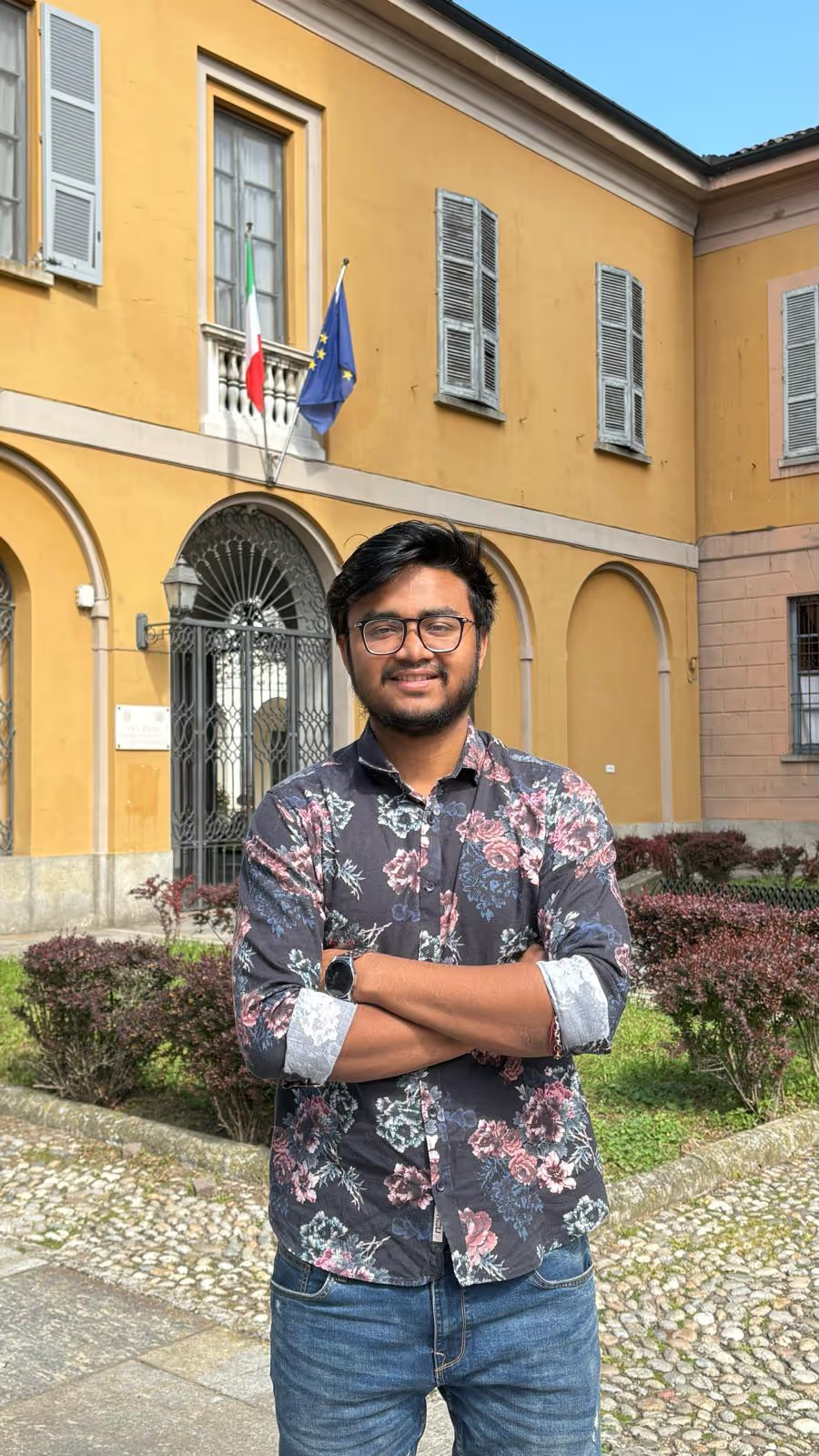
Students who started exactly where you are
English-taught programmes, €0 tuition for qualifying students, and the DSU grant landing in their account every year. The funding mechanics are identical at every Italian public university: the same ISEE Parificato, the same regional bando, the same ranking. Only the authority and the dates change.






They began right where you are

