Is Urbino a good place to study for international students?
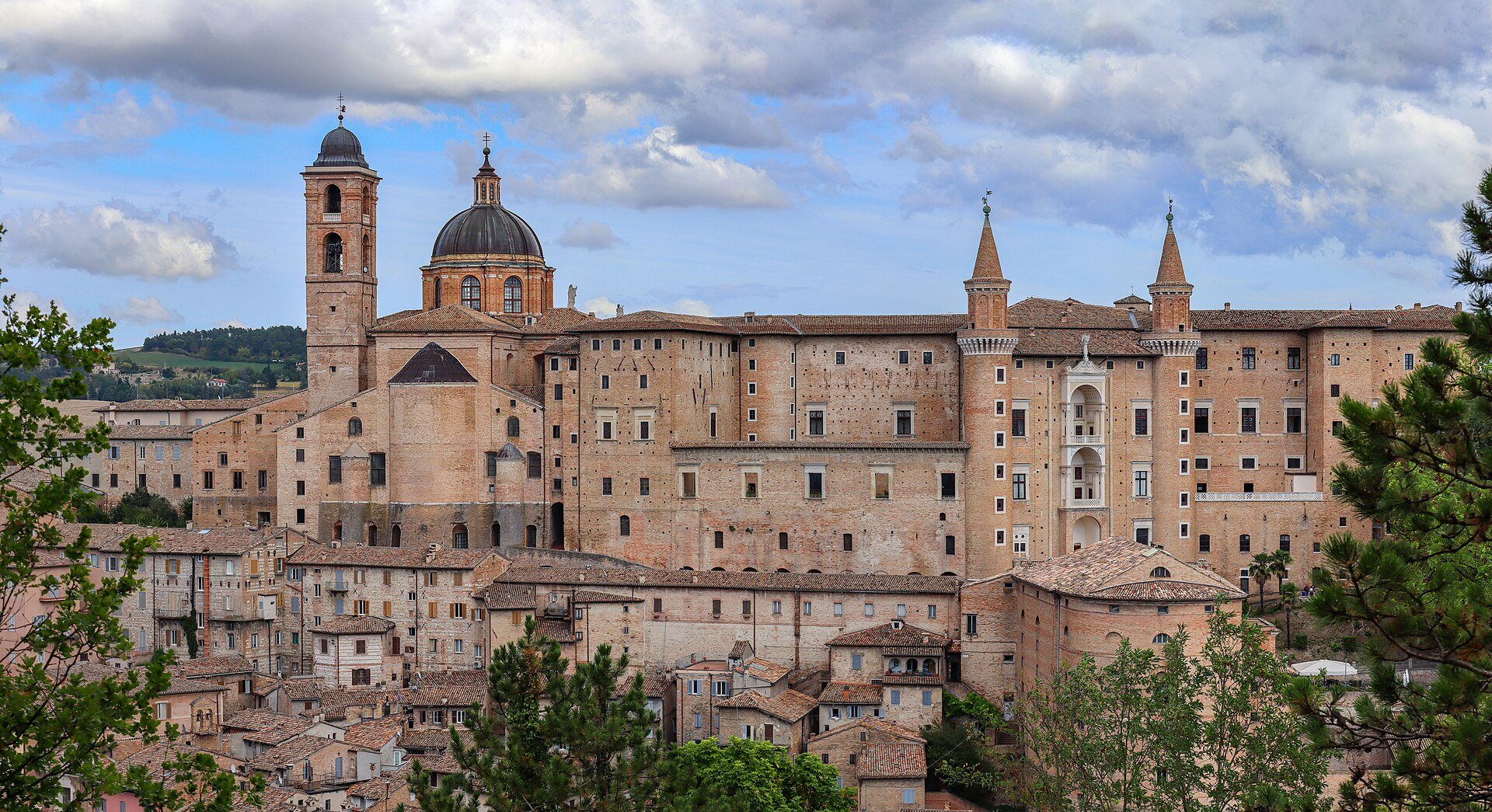
Yes, Urbino is a good place to study if you want a small, safe university town where student life is the town's life. This Renaissance hill town in Marche, birthplace of Raphael and a UNESCO World Heritage Site, has fewer than 15,000 residents but about 15,000 students at the University of Urbino Carlo Bo, founded in 1506. It suits students who want low costs and a close community, and who speak Italian or plan to learn it.
Which universities are in Urbino, and which are public?
Urbino has one public university, the University of Urbino Carlo Bo, with about 15,000 students and 49 programmes for 2026/27: 17 bachelor's, 23 master's, 5 single-cycle degrees and 4 PhDs, taught in Urbino and Fano. Its subjects range from pharmacy and physics to economics, languages and communication. Marche's other public universities are in Ancona, Macerata and Camerino. Tuition follows family income, with no annual contribution up to an ISEE of €30,000.
What can you study in English in Urbino?
In Urbino, English-taught study is limited: the University of Urbino Carlo Bo teaches most degrees in Italian, with two master's taught entirely in English. They are Economics and Management of Cultural Resources and Territories, and Modern Languages for Cooperation and International Organizations, both asking for B2 English. The Applied Informatics bachelor's also has an English e-learning option. For everything else you need Italian. See our English-taught programmes.
How much does it cost to live in Urbino as a student?
Living in Urbino as a student is cheap: the University of Urbino recommends budgeting €500 to €600 a month. Its cost guide, checked in September 2026, lists a private single room at €270 to €280 a month and a double at €190 to €200, each plus about €60 in bills, and ERDIS residence rooms at €170 to €200 for paying students. A full canteen meal costs €5.50 and a monthly bus pass €43. A meal out in a restaurant or pizzeria costs about €15 to €25, the guide adds.
- Private single room: €270 to €280 a month, plus about €60 in bills
- Private double room: €190 to €200 a month, plus about €60 in bills
- ERDIS residence room: €170 to €200 a month; €250 for foreign students
- University canteen: €5.50 for a full meal, €3 for a small meal
- Bus pass: €43 a month; single 90-minute ticket €1.25
- Monthly total: €500 to €600, as the University of Urbino recommends
How do you find student housing in Urbino?
In Urbino, housing is simpler than in big cities, but start early because the historic centre is small and fills before term. ERDIS Marche manages the university halls of residence in Urbino and assigns places through its scholarship call in the summer before you enrol. Private rooms are in and around the walled centre, with singles at about €270 to €280 a month plus bills. Many students live within walking distance of their department. Never pay a deposit before seeing the room.
Which scholarship covers students in Urbino, and how much is it worth?
The scholarship for students in Urbino is run by ERDIS Marche, the regional right-to-study agency, which also manages the university halls. For 2026/27 the ERDIS grant for off-site students is €7,171.11 a year, and winners are exempt from all university contributions except the €16 stamp duty. Tuition is set by family income (ISEE): at Urbino there is no annual contribution for an ISEE of €30,000 or less in 2026/27, if you meet the credit rules. Apply in the summer before you enrol.
How do you get to Urbino and get around once you are there?
Urbino is reached by bus: Pesaro station, on the Adriatic railway, is about 45 minutes away, and the nearest airports are Ancona, Rimini and Bologna. In town, almost everything is within walking distance, though the streets are steep, since Urbino sits at about 450 metres. The university's cost guide lists a single 90-minute bus ticket at €1.25, a weekly pass at €16.50 and a monthly pass at €43. Many students walk everywhere and use buses mainly for the coast.
What is student life like in Urbino?
Student life in Urbino is the life of the town: bars, squares and lecture halls sit inside the old walls, and students are about as many as residents. The Ducal Palace, home to the National Gallery of the Marche, and Raphael's family house are part of the daily scenery. Evenings are social rather than loud, around Piazza della Repubblica and the steep lanes. Winters on the hill are colder than on the coast, and in summer the beaches of Pesaro and Fano are close.
What should you sort out in your first weeks in Urbino?
In your first weeks in Urbino, sort out your paperwork before anything else, because your residence permit, tax code and health cover unlock rent, banking and scholarship payments. Non-EU students must request a permesso di soggiorno within 8 days of arrival, using the kit from a post office. The university's cost guide puts private health insurance at about €700 a calendar year. Then upload your passport, visa and permit receipt to the student portal.
- Request your permesso di soggiorno within 8 days, using the post office kit (non-EU students).
- Get your codice fiscale (tax code), needed for rent contracts, a SIM card and enrolment.
- Arrange health cover: private insurance or voluntary registration with the SSN.
- Confirm your ERDIS Marche place, or sign a registered rental contract.
- Upload your passport, visa and permit receipt to the student portal to complete enrolment.
Can you work part-time while studying in Urbino?
Yes, you can work part-time while studying in Urbino, within the limits of your permit. Non-EU students on a study permit may work up to 20 hours a week and 1,040 hours a year. Universities offer paid part-time student jobs, the collaborazioni 150 ore, through yearly calls. Urbino is a small town, so outside jobs are few and mostly in bars, shops and tourism, and nearly all need Italian. Budget as if you will not work, and treat any job as extra.
How does Urbino compare with other Italian student cities?
Urbino is far cheaper than Milan, Rome or Bologna: private singles at €270 to €280 a month compare with average singles of €599 in Bologna, €609 in Rome and €729 in Milan in March 2026 (Immobiliare.it Insights). It is also much smaller and quieter than any big city, with no big-city job market. Students pick Urbino for a traditional student-town experience, low costs and Italian-taught degrees, or for its two English-taught master's.
How can ApplyAZ help you study in Urbino?
ApplyAZ focuses on English-taught programmes at public universities, so we will tell you honestly whether Urbino fits: it works best if one of its two English-taught master's matches your plans. We build a shortlist of 20 to 30 programmes, write your CV and SOPs, submit applications and Universitaly pre-enrolment, file your ERDIS scholarship and prepare your visa file, with a named person owning each stage. We take no commissions. Next step: see how ApplyAZ works or check your eligibility.