
Contents
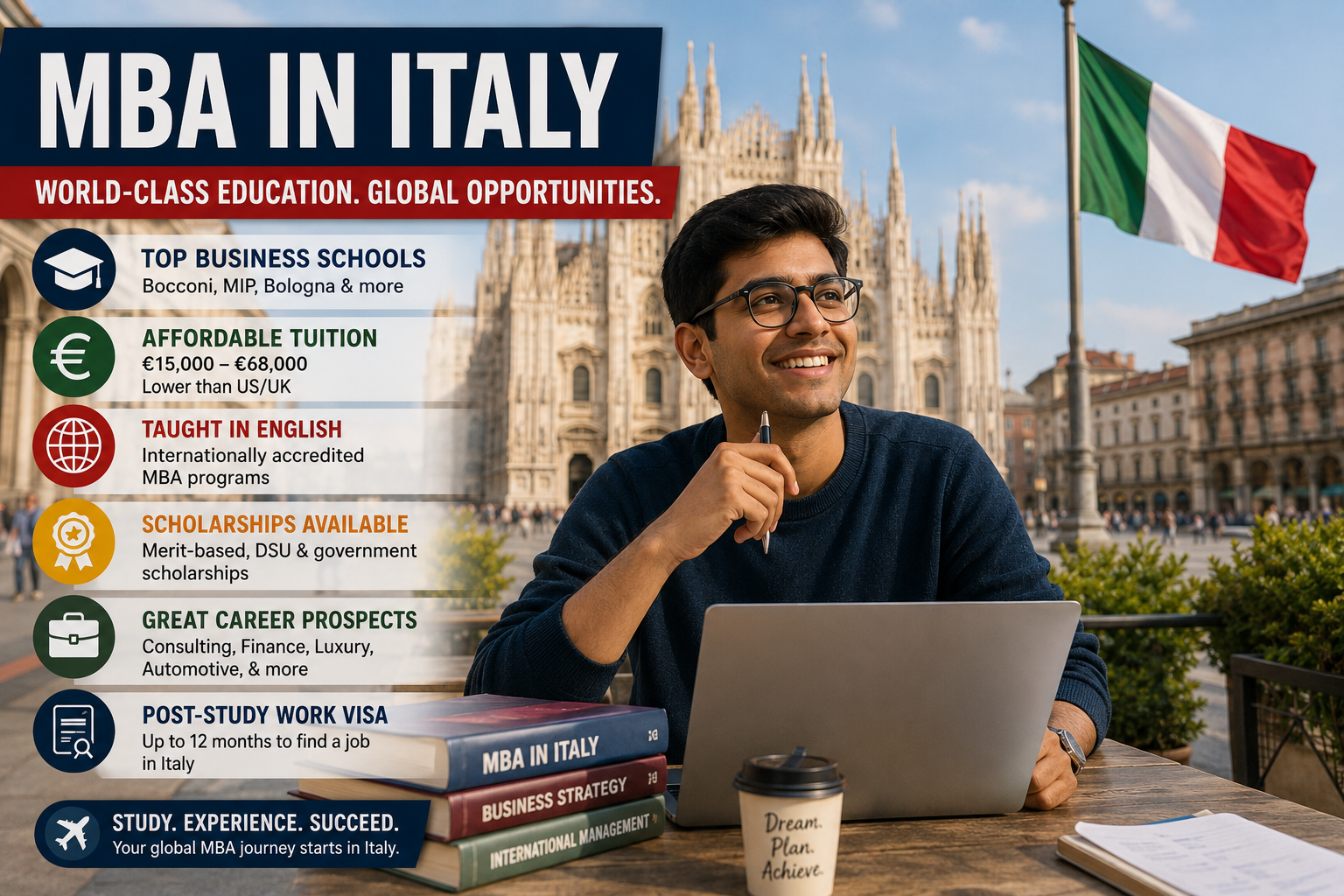
Italy has quietly become one of Europe's strongest MBA destinations — home to Bocconi, one of the world's top-ranked business schools, along with a handful of institutes that offer English-taught, internationally accredited programs at a fraction of US or UK tuition. If you're comparing MBA courses in Italy, this guide covers the universities worth shortlisting, real costs, eligibility, scholarships, and what your job prospects actually look like after graduation.
Why Study MBA in Italy?
Three reasons keep coming up with applicants: cost, accreditation, and location.
Tuition at Italian business schools runs lower than comparable-ranked programs in the US, UK, or even parts of Western Europe, while still offering "triple crown" accreditation (AACSB, EQUIS, AMBA) at schools like Bocconi — a distinction held by fewer than 1% of business schools globally. Italy also sits at the center of the EU, giving students easy access to internships and networking across the continent, plus a lower cost of living compared to London or major US cities.
Best MBA Universities in Italy
These fee ranges shift yearly — always check the university's admissions page for the current intake before applying.
Bocconi MBA in Italy: Is It Worth the Hype?
Bocconi (through SDA Bocconi School of Management) is the name most applicants search for first, and for good reason — it's the only Italian school that regularly appears in global top-25 MBA rankings. The MBA is taught entirely in English, class sizes are small and highly international, and the career services team has strong placement into consulting, finance, and luxury/fashion sectors — industries where Italy has a natural edge.
The trade-off is cost and competitiveness. Bocconi's MBA is priced closer to top European and US programs, and admission is selective — a competitive GMAT score and 3+ years of work experience meaningfully improve your chances. If budget is a bigger constraint than brand name, MIP Politecnico di Milano or University of Bologna offer a strong ranking-to-cost ratio.
MBA in Italy Cost: Tuition & Living Expenses
Total MBA cost in Italy has two parts — tuition and living expenses.
Tuition: Ranges from roughly €15,000 at Bologna to €65,000+ at Bocconi, depending on the school and program length.
Living costs: Budget €800–€1,200/month in Milan or Rome, and €600–€900/month in smaller cities like Bologna or Turin, covering rent, food, and transport.
For Indian students, the cost of an MBA in Italy — even at Bocconi — typically works out lower than a comparable-ranked program in the US or UK once you factor in tuition plus the shorter, often 12-month program length common in Europe.
Are MBA Courses in Italy Taught in English?
Yes — nearly all MBA programs at Italy's major business schools (Bocconi, MIP, LUISS, Bologna, Politecnico di Torino) are taught fully in English, specifically to attract international students. You won't need Italian language proficiency to study or to get by day-to-day in most university cities, though basic Italian helps with daily life and local internships. English test scores (IELTS/TOEFL) are still required for admission if English wasn't your language of prior education.
Eligibility Criteria for MBA in Italy
Requirements vary by school, but most Italian MBA programs ask for:
- A bachelor's degree (any discipline, though business/STEM backgrounds are common)
- 2–5 years of full-time work experience (higher-ranked schools like Bocconi expect 3+ years)
- GMAT or GRE score (some schools accept a waiver with strong work experience or offer their own aptitude test)
- IELTS/TOEFL score for English proficiency
- Statement of purpose, letters of recommendation, and an admissions interview
Can you get an MBA in Italy without GMAT or work experience? A few schools offer GMAT waivers case-by-case for candidates with significant leadership experience, and some accept fresh graduates into part-time or specialized MBA tracks — but for top-ranked full-time programs like Bocconi, work experience is expected, not optional.
Scholarships for MBA in Italy (Indian & International Students)
Italian MBA programs aren't free, but they're genuinely more accessible than most people expect once scholarships are factored in:
- Merit-based scholarships from the universities themselves, often covering 20–50% of tuition based on GMAT score and profile strength
- DSU (Diritto allo Studio) regional scholarships, awarded based on merit and financial need, which can significantly reduce living costs for eligible students
- Invest Your Talent in Italy, a government-backed program supporting international students (including many from India) in select master's and MBA-adjacent programs
Combining a merit scholarship with a DSU award can bring total costs down substantially — worth applying for early, since scholarship deadlines are often earlier than admission deadlines.
Jobs After MBA in Italy: Career Scope & Work Visa
Italy grants international graduates a post-study work permit — typically up to 12 months — to search for a job after completing their MBA, which can then convert to a work visa once employed.
Strongest sectors for MBA graduates in Italy include:
- Fashion & luxury goods (Milan is a global hub — Gucci, Prada, Armani, and others recruit locally)
- Consulting and finance (especially from Bocconi and MIP's strong recruiter networks)
- Manufacturing and automotive (strong around Turin/Politecnico di Torino)
- Food and agribusiness
That said, job hunting in Italy as a non-EU graduate is competitive, and industries outside Milan/Rome have smaller international hiring pools — worth weighing against your target industry.
Is an MBA in Italy Worth It for Indian Students?
For students prioritizing an internationally accredited, English-taught MBA at a lower cost than the US/UK, with genuine access to European job markets — yes, particularly through Bocconi, MIP, or Bologna. It's a stronger fit for candidates targeting fashion, luxury, consulting, or manufacturing sectors than for those set on tech/Big Four recruiting, which is more concentrated in Germany or the Netherlands.
FAQs
What is the best MBA in Italy?
SDA Bocconi is the highest-ranked globally, but "best" depends on budget and goals — MIP Politecnico di Milano and Bologna offer strong rankings at lower cost.
How much does an MBA cost in Italy for international students?
Typically €15,000–€68,000 in tuition depending on the school, plus €7,000–€14,000/year in living expenses.
Do I need work experience for an MBA in Italy?
Most full-time MBA programs expect 2–5 years; some schools offer exceptions for exceptional profiles or part-time/specialized tracks.
Can I stay in Italy after my MBA to work?
Yes — graduates can apply for a post-study job-search permit (up to 12 months) that converts to a work visa once employed.
Final Takeaway
Italy's MBA market is one of the few places in Europe where you can get a genuinely accredited, English-taught degree without paying US or UK prices — but the value only shows up if you pick the right school for your budget and pursue scholarships early. Bocconi buys you prestige, MIP and Bologna buy you ROI, and either way, the post-study work window gives you a real shot at staying on and building a career in Italy, provided you're realistic about which industries are actually hiring internationally.
Not Sure Which Italian MBA Fits Your Budget and Goals?


.jpeg)