
Contents
Italy has quietly become one of Europe's most practical choices for an MBA in Italy — home to globally accredited business schools, tuition that undercuts the US and UK by a wide margin, and a one-year format that gets you into the job market faster. But "MBA in Italy" isn't one product: a public-university MBA in Turin can cost €8,000, while a private SDA Bocconi MBA can run past €80,000. This guide breaks down exactly what separates them, which programs run fully in English, what you'll actually spend, and how to get in.
MBA in Italy: Quick Overview
Why Study an MBA in Italy?
An international MBA degree from Italy gives you three things most alternatives don't combine: EU-recognized accreditation, a genuinely lower cost of entry, and direct access to Europe's fashion, luxury, automotive, and manufacturing industries — sectors where Italian companies set the global benchmark.
- Accreditation that travels — SDA Bocconi and MIP Politecnico di Milano hold triple accreditation (AACSB, EQUIS, AMBA), the same standard held by top US and UK schools.
- Lower cost of entry — even premium private schools sit well below equivalent US/UK MBA tuition, and public-university options exist for a fraction of that.
- Industry-specific strength — Italy dominates in luxury brand management, food & wine business, design, and manufacturing — specializations rarely offered elsewhere.
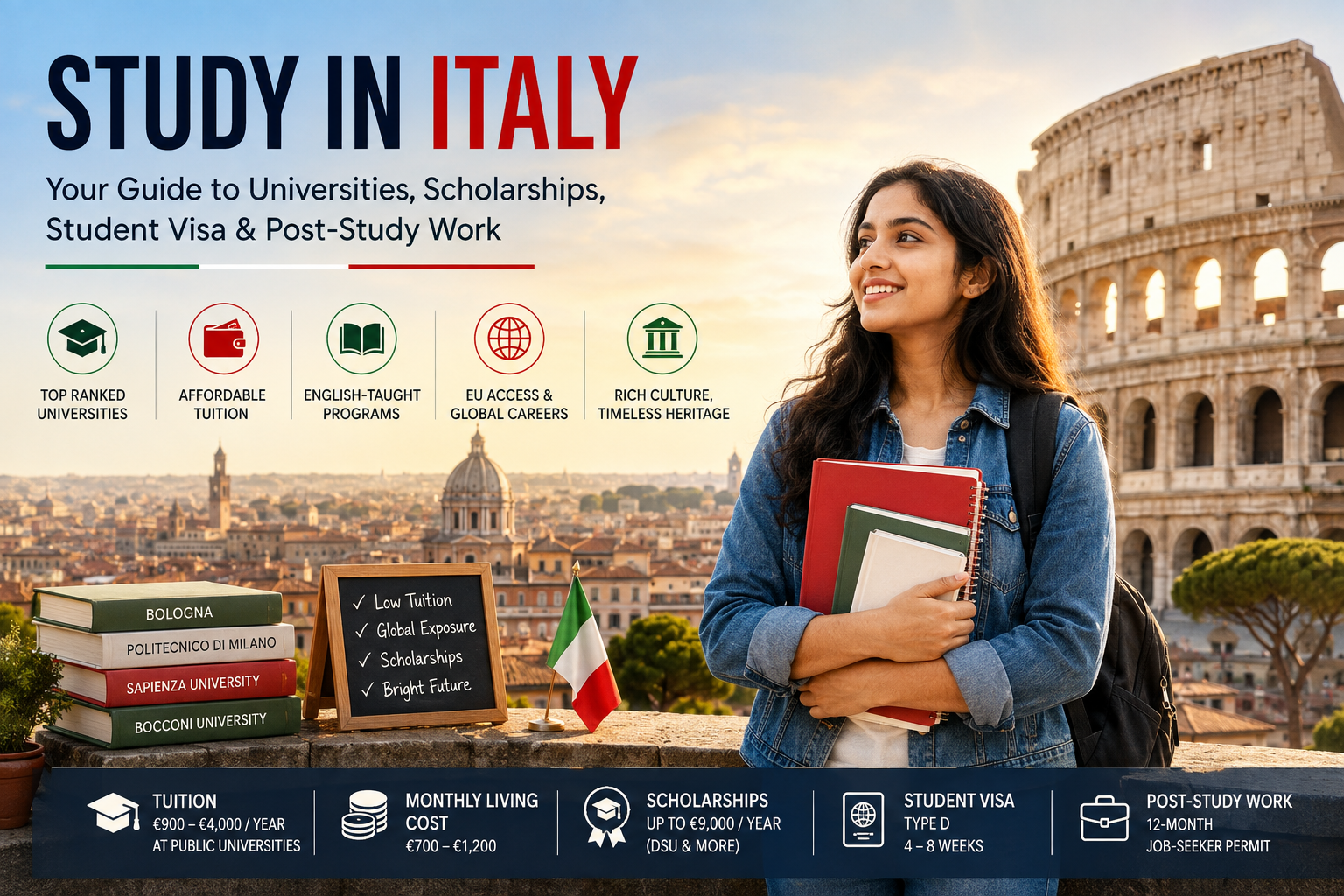
- A path to stay — graduates get a 12-month job-seeker residence permit, convertible into a work visa once employed.
- Class diversity — most global business MBA programs in Italy draw students from 30+ countries, which matters as much as the classroom content for building a usable network.
Public vs. Private Business Schools in Italy: Which Is Right for You?
This is the decision most guides skip — and it's the one that actually determines your budget and outcome.
Private business schools (SDA Bocconi, MIP, LUISS, Bologna Business School, Rome Business School) charge €14,000–€82,000, run intensive one-year formats, carry strong brand recognition with recruiters, and typically have dedicated placement teams.
Public university MBA programs (University of Pisa, University of Turin, University of Bologna's business faculty) charge €4,000–€15,000, are less brand-driven, but confer a fully recognized degree and cost a fraction of the private-school price — a realistic route if placement pedigree matters less to you than debt.
If your goal is consulting, finance, or luxury-sector roles at multinational firms, the private-school premium is usually worth it. If your goal is a globally valid MBA at minimum cost, public universities are the better fit.
Best MBA Colleges in Italy for International Students
Italy's strongest business schools in Italy for MBA, ranked by reputation and industry connections:
For most MBA colleges in Italy for international students, admission runs on rolling deadlines — apply 6–8 months before your target intake, since scholarship funds and seats are limited.
MBA in Italy Cost: Tuition and Living Expenses
The MBA in Italy cost has two components — tuition and living — and both vary sharply by city and school type.
Tuition: Public universities: €4,000–€15,000/year. Private business schools: €14,000–€82,000 for the full program (SDA Bocconi and MIP sit at the top end; Rome Business School and MIB Trieste at the affordable end of the private tier).
Cost of living (monthly, per city):
Rent is the largest variable — expect €300–€700 for shared accommodation, more in Milan. Budget an additional €50–€90/month for local transport and €100–€250 for food and utilities combined, depending on lifestyle.
MBA in Italy in English: Programs You Can Complete Without Italian
A large share of MBA seekers assume Italian fluency is required — it isn't. Every school listed above teaches its MBA entirely in English, including admissions, coursework, and exams. Italian is genuinely useful for day-to-day life, internships with local firms, and networking, but it is not a prerequisite for enrolment at SDA Bocconi, MIP, LUISS, Bologna Business School, Rome Business School, or MIB Trieste. Public-university MBAs are more mixed — confirm the language of instruction directly with the specific faculty, since some public programs run bilingual or Italian-medium tracks alongside their English one.
Eligibility Criteria for International Students
- A recognized bachelor's degree (3- or 4-year program) with a minimum of 55–60% or equivalent GPA
- Minimum age typically 21 years
- English proficiency via IELTS/TOEFL (often waived if your previous degree was English-medium)
- Work experience: not mandatory at most schools, but 2–5 years strengthens applications to top-tier private schools
- Some schools run their own entrance interviews or written tests in place of standardized scores
GMAT/GRE: Which Schools Require It
GMAT/GRE requirements vary by school rather than being a blanket rule for MBA in Italy for international students:
- Typically required or strongly preferred: SDA Bocconi, LUISS Business School (for competitive scholarship consideration)
- Optional or waived with strong academic/work profile: MIP Politecnico di Milano, Bologna Business School, Rome Business School, MIB Trieste, most public universities
If you don't have a GMAT score, target schools in the second group first, or confirm directly whether your specific undergraduate GPA and work experience qualify for a waiver.
Scholarships for MBA in Italy
Apply for scholarships alongside your program application, not after — most have the same or an earlier deadline than admission itself.
Step-by-Step Admission Process
- Shortlist programs based on specialization, city, and budget (public vs. private).
- Check eligibility — degree, GPA, work experience, and whether GMAT/GRE is required.
- Prepare documents: transcripts, updated CV, Statement of Purpose, 2–3 Letters of Recommendation, English test score, passport copy, photographs.
- Apply online via the university portal, paying the application fee where applicable.
- Attend the interview, if shortlisted — most private schools interview every applicant.
- Accept your offer and pay the tuition deposit to secure your seat.
- Apply for a Type D student visa at the Italian consulate, and complete Universitaly pre-enrolment before travel.
Apply 6–8 months ahead of your intake — scholarship and seat availability tighten closer to deadlines.
Student Visa Requirements
To study MBA in Italy for international students, you'll need a Type D long-stay student visa, applied for after receiving your official admission letter. Required documents include a valid passport, proof of admission, proof of financial means (bank statements or sponsor letter), accommodation proof, travel/health insurance, and the visa fee (approx. €50–€60). After arrival, you register for a Permesso di Soggiorno (residence permit) within 8 days.
Career Prospects and Salary After MBA in Italy
Graduates typically move into finance, marketing, consulting, luxury brand management, and international business roles, with average starting salaries ranging €30,000–€60,000 per year depending on school tier, specialization, and sector. After graduation, the job-seeker residence permit gives you up to 12 months to convert into a formal work visa once you have an offer — and after five years of legal residence and employment, you can apply for permanent residency (Carta di Soggiorno).
MBA in Italy vs. Other Study Destinations
FactorItalyUKUSAGermanyTuition (private, full program)€14,000–€82,000£30,000–£100,000+$80,000–$200,000+€0–€30,000Duration1–2 years1 year2 years1–2 yearsPublic/low-cost optionYes (€4,000–€15,000)RareRareYesPost-study work visaUp to 12 months2 yearsLimited (OPT)18 months
Italy sits between Germany (cheapest, less brand recognition for MBA specifically) and the UK/US (higher brand value, far higher cost) — a middle path for students who want accredited education without US/UK-level debt.
Frequently Asked Questions
Is an MBA in Italy worth it for international students?
Yes, for students prioritizing cost-to-value ratio — you get internationally accredited degrees, English-taught programs, and a post-study work visa at a fraction of US/UK tuition.
Can I do an MBA in Italy without GMAT?
Yes. MIP Politecnico di Milano, Bologna Business School, Rome Business School, MIB Trieste, and most public universities accept applicants without GMAT if academic and professional profiles are strong.
Is work experience mandatory for an MBA in Italy?
No, not universally. Public universities and several private schools admit students straight from a bachelor's degree, though 2–5 years of experience strengthens applications to top-tier schools like Bocconi and LUISS.
Which is the best MBA in Italy for international students?
SDA Bocconi School of Management (Milan) ranks highest overall; MIP Politecnico di Milano and LUISS Business School follow closely for industry connections and ROI.
Do I need to know Italian for an MBA in Italy?
No — every major MBA program listed here is taught fully in English. Italian helps with daily life and local internships but isn't required for coursework or admission.
How much does an MBA in Italy cost in total, including living expenses?
Budget €10,000–€90,000 for tuition depending on school, plus €650–€1,300/month for living costs — roughly €18,000–€30,000/year all-in for a mid-range private program, less for public universities.
Can I stay in Italy after completing my MBA?
Yes. You can apply for a 12-month job-seeker residence permit after graduation, convert it into a work visa once employed, and apply for permanent residency after five years.
Ready to Find Your MBA in Italy?


.jpeg)
.jpg)