.jpg)

Contents
Europe has quietly become one of the most practical options for Indian medical aspirants who miss out on a government seat back home. MBBS in Europe means direct, donation-free admission, English-medium teaching in most destinations, and total costs that stay well under what a private Indian medical college charges — while still leading to an NMC-recognised degree, provided you pick the right country and university.
This guide breaks down real fees, eligibility, the countries worth considering, and the red flags most agents won't tell you about.
MBBS in Europe: Quick Facts (2026-27)
Why Study MBBS in Europe?
- No donation, no capitation fee. Admission runs purely on your 10+2 marks and NEET qualification — what's quoted on the fee schedule is what you pay.
- Lower total cost than Indian private colleges. A full 6-year MBBS in Europe (tuition + living) typically comes in well under what private medical seats cost in India.
- English-medium programs in most popular destinations, so there's no language barrier for classroom learning (some clinical years need basic local-language exposure for patient interaction).
- Globally recognised degrees, provided the university carries NMC, WHO and FAIMER recognition — this is the one thing you should verify yourself, not just take an agent's word for.
- Early clinical exposure, since many European curricula fold hospital rotations into the course structure sooner than Indian colleges do.
Cheapest MBBS in Europe for Indian Students
If low cost is your main filter, here's how the popular destinations actually compare on tuition alone:
Georgia and Belarus are usually the two cheapest entry points for a first-generation medical aspirant on a tight budget; Poland and Romania sit a notch higher but come with a stronger EU-mobility advantage after graduation.
MBBS in Europe Fees for Indian Students: Full Cost Breakdown
Tuition is only part of the bill. A realistic annual budget includes:
Across a 6-year program, that puts the all-in cost of most Eastern European destinations between ₹35 lakh and ₹75 lakh — still meaningfully lower than a private MBBS seat in India, which regularly crosses ₹1 crore. (Exchange rates shift; always convert on the day you're budgeting, not off an old blog post.)
Eligibility Criteria for MBBS in Europe for Indian Students
- Minimum 17 years old by 31st December of the admission year.
- Passed 10+2 with Physics, Chemistry, Biology and English, scoring at least 50% (relaxed to 40–45% for SC/ST/OBC in most destinations — this varies by country, so confirm with the specific university).
- NEET qualification is mandatory if you intend to practise medicine in India after graduating — European universities themselves don't require it for admission, but NMC does for licensing.
- No IELTS/TOEFL requirement in most English-medium programs, though a couple of universities do ask for basic proficiency proof.
Documents Required for MBBS in Europe Admission
- 10th and 12th mark sheets (recognised board)
- NEET scorecard
- Valid passport
- Passport-size photographs
- Medical fitness certificate
- Police clearance certificate
- Bank statement showing financial capability
- Offer/admission letter from the university (for visa stage)
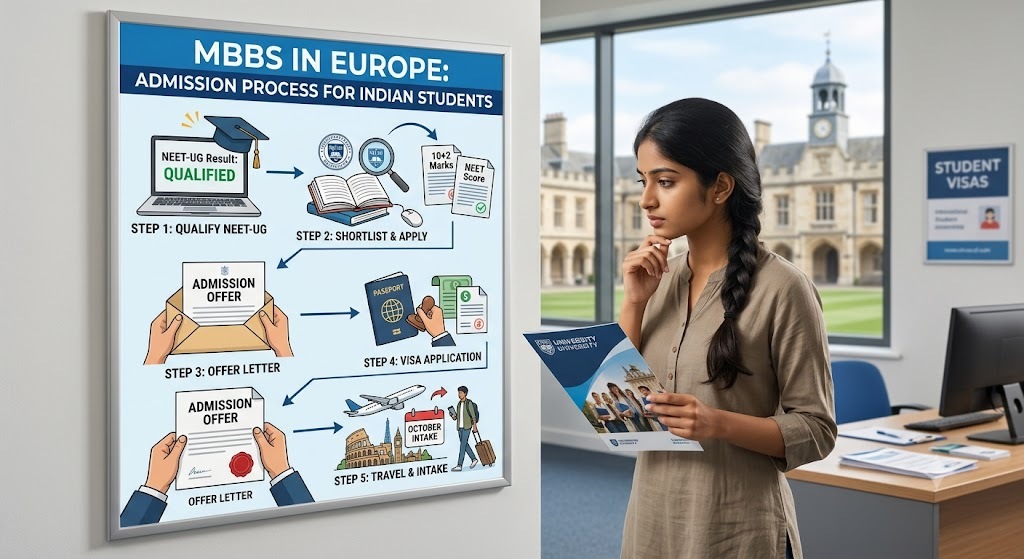
Admission Process for MBBS in Europe
- Shortlist universities by NMC recognition status, tuition, and location — don't shortlist by agent recommendation alone.
- Apply online with your documents and NEET scorecard.
- Receive the offer letter, usually within 1–6 weeks depending on the university.
- Apply for your student visa using the offer letter; processing typically takes 2–8 weeks.
- Book travel and prepare for departure once the visa is stamped.
Top Universities to Study MBBS in Europe
- Tbilisi State Medical University, Georgia
- Georgian National University (SEU), Georgia
- Medical University of Lodz, Poland
- Medical University of Silesia, Poland
- Nicolaus Copernicus University, Poland
- "Carol Davila" University of Medicine and Pharmacy, Romania
- Medical University of Varna, Bulgaria
Cross-check every name against the NMC's list of approved foreign medical institutions before you pay any fee — recognition status is updated periodically and a university can lose it.
Scholarships for MBBS in Europe
Several countries offer partial or full scholarships to international students, which can meaningfully cut down the "cheapest MBBS in Europe" equation:
Western Europe vs Eastern Europe for MBBS: Which Should You Choose?
This is the part most guides skip, and it's usually where students go wrong.
- Western Europe (Germany, Italy, France): Excellent education, but seats for international students are limited, competition is high, and most programs are taught in the local language beyond the first year. Realistic only if you're prepared for a language requirement or have a strong academic profile for the few English-taught seats.
- Eastern & Central Europe (Georgia, Poland, Romania, Bulgaria, Belarus): This is what most "MBBS in Europe for Indian students" packages actually mean — direct admission, fully English-medium, lower fees, and a well-worn pipeline for Indian students including hostel food and community support.
If your goal is affordability and a straightforward admission path, Eastern/Central Europe is the practical answer. If you're chasing a Western European degree specifically, budget for either a language year or a much more selective application.
Degree Recognition, NEET & NExT: What Changes After You Graduate
- Your MBBS (often awarded as an "MD" title in Europe — this is the entry-level degree, not a postgraduate one) needs to come from a university on the NMC-approved list.
- To practise in India, you'll sit the NExT (National Exit Test) — this has replaced the older FMGE screening exam, and functions as both your licensing exam and your final-year MBBS assessment going forward.
- Graduates can alternatively pursue USMLE (USA) or PLAB (UK) to practise abroad instead of returning to India.
Career Options and Stay-Back Opportunities After MBBS in Europe
Graduates aren't limited to returning to India. Common paths include:
- Practising in India after clearing NExT
- Staying back in the EU — several countries offer post-study residence permits, though clinical work usually requires local language proficiency
- Pursuing USMLE/PLAB to work in the US or UK
- Higher studies or research (MD/PhD) within Europe or elsewhere
Broadly, general practitioners and specialists in Europe are well-compensated, and the degree's international recognition keeps these paths genuinely open — not just theoretical.
FAQs
Is MBBS in Europe good for Indian students?
Yes, provided the university is NMC-recognised. It offers a donation-free admission route, English-medium teaching in most Eastern/Central European countries, and a total cost well below Indian private colleges.
What is the cheapest country for MBBS in Europe?
Georgia and Belarus are typically the most affordable, with annual tuition starting around USD 4,000.
Is NEET compulsory for MBBS in Europe?
NEET isn't required for university admission, but it's mandatory if you plan to practise medicine in India afterward, as per NMC guidelines.
How many years is MBBS in Europe?
Most programs run 5 to 6 years, structured as 5 years of coursework plus 1 year of internship — the exact split varies by country.
Is FMGE still applicable for MBBS graduates from Europe?
FMGE has been replaced by NExT (National Exit Test), which Indian-origin graduates from foreign medical universities, including those in Europe, now need to clear to practise in India.
Not Sure Which European University Is Right for You?


.jpeg)