


Contents
Italy has quietly become one of Europe's best-value study destinations — low tuition at public universities, a growing list of English-taught degrees, and some of the oldest academic institutions in the world. But "affordable" doesn't mean "simple." Between the Declaration of Value, the Universitaly portal, and scholarship paperwork, the process trips up a lot of applicants.
This guide breaks down how to study in Italy as an international student — costs, scholarships, visas, the post-study work route, and an honest look at the pros and cons — with a dedicated section for students applying from India.
Why Study in Italy?
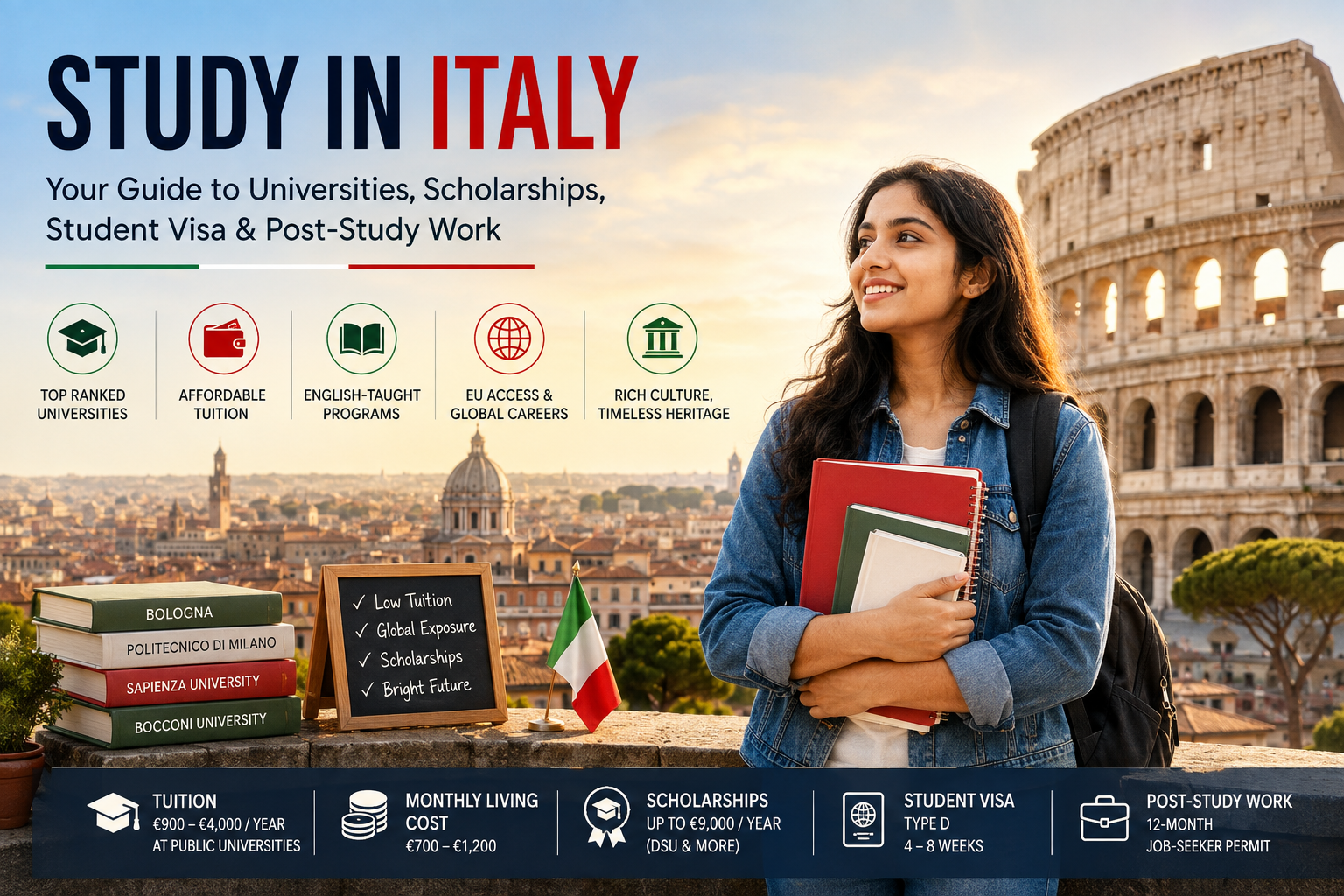
- Globally ranked universities — Bologna (the world's oldest university), Politecnico di Milano, Sapienza Rome, and Bocconi all place in global top rankings.
- Low tuition at public universities — often €900–€4,000/year, a fraction of US, UK, or Australian fees.
- Growing number of English-taught programs — engineering, business, design, and data science are increasingly offered without needing Italian.
- EU access — an Italian degree opens doors across the EU job market, not just in Italy.
- Culture as a curriculum — design, art, architecture, and food heritage that international students can't get from a classroom alone.
Study in Italy: Fast Facts
Popular Programs and Top Universities
Students most commonly apply for business & economics, engineering, design, MBBS, humanities, and hospitality management. Among the universities that consistently attract international applicants:
- University of Bologna
- Politecnico di Milano
- Sapienza University of Rome
- Politecnico di Torino
- Bocconi University
- University of Padua
Public universities tend to be significantly cheaper than private ones, and most now run parallel English- and Italian-taught tracks for the same degree.
Study in Italy for Indian Students
Studying in Italy from India is procedurally different from applying to Italian or EU applicants — mainly because of one extra document: the Dichiarazione di Valore (Declaration of Value), which certifies that your Indian degree/certificates are equivalent to an Italian qualification. Agencies and Italian consulates in India handle this alongside CIMEA (the body that evaluates foreign qualifications).
Eligibility basics:
- Bachelor's: Class 12 with ~70%+ (varies by university), IELTS 6.0 or TOEFL iBT 80+
- Master's: Recognized bachelor's degree (67–75%+), same English proficiency bands
- Entrance tests required for select programs (IMAT for Medicine, TOLC/CENT-S for Engineering)
How to Study in Italy from India: Step-by-Step
- Shortlist university and course based on English availability, ranking, and budget.
- Check eligibility and collect documents — transcripts, passport, SOP, recommendation letters.
- Get your Declaration of Value / CIMEA equivalency — this step is India-specific and often the slowest.
- Pre-enroll via the Universitaly portal, then apply directly to the university.
- Receive your admission/acceptance letter.
- Apply for the Type D student visa through VFS Global (Italian visa center in India) with proof of funds and accommodation.
- Travel and register — enroll at the university and apply for your Permesso di Soggiorno (residence permit) within 8 days of arrival.
Cost of Studying in Italy for Indian Students
Monthly living costs:
Milan and Rome run higher than smaller university towns like Padua, Pisa, or Trento — city choice is one of the biggest levers on your total budget.
.png)
Scholarships in Italy: How to Study for Free (or Nearly Free)
Italy isn't free by default — but for eligible students, it can be close to it. There are two real paths: need-based (income-linked) and merit-based (grades/portfolio-linked).
- DSU Regional Scholarships — the biggest lever for "free" study. Based on family income and merit, these can cover full tuition plus a housing/meal allowance (roughly €5,000–€9,000/year). Most Indian applicants underuse this because the income-eligibility paperwork feels unfamiliar.
- MAECI Government Scholarships — for international students, ~€900/month, tuition waiver included at public universities.
- Invest Your Talent in Italy — full tuition + roughly €8,000+ annual stipend for STEM, design, and management master's programs.
- Erasmus Mundus Joint Master's — full tuition, travel, and a monthly stipend for select joint-degree programs.
- University-specific scholarships — Politecnico di Milano, Bocconi, and Bologna all run their own merit awards, often €2,000–€10,000/year.
Study in Italy with a Full Scholarship
If your goal is genuinely fee-free study, prioritize applications in this order: DSU regional scholarship → MAECI → Invest Your Talent → Erasmus Mundus → university merit awards. Apply to all that fit your profile — most Indian students who study "for free" are stacking a tuition waiver with a stipend, not relying on one single scholarship.
Jobs You Can Expect During and After Studying in Italy
While studying: International students can work up to 20 hrs/week on a student visa. Common part-time roles include campus assistant positions, tutoring, hospitality (cafes, restaurants), retail, and au pair work in bigger cities — enough to cover a meaningful chunk of monthly living costs, though rarely full tuition.
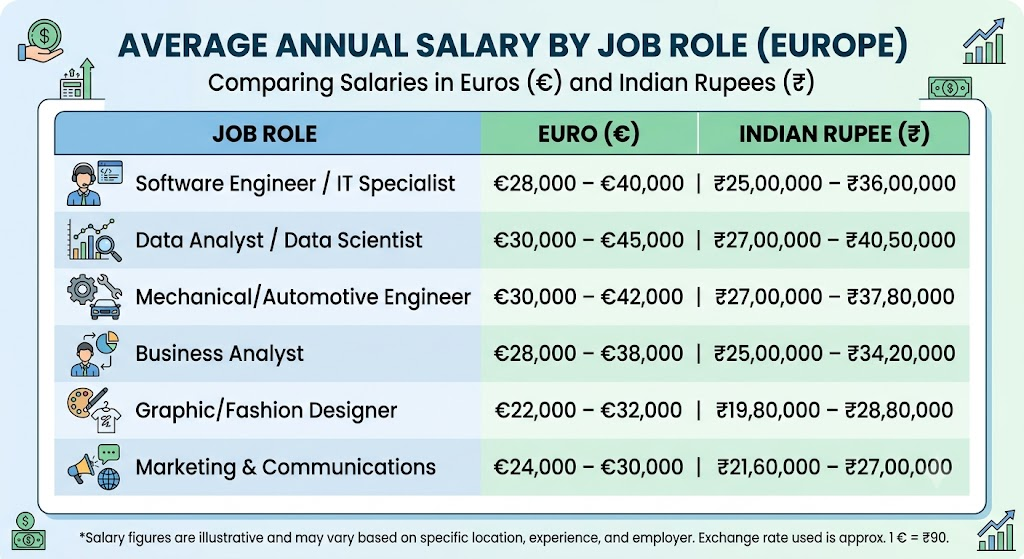
After graduating, the job market leans toward the sectors Italy is strongest in — engineering, design, business, and tech:
Salaries in Milan and northern Italy tend to run higher than the national average, reflecting where most multinational and design-sector employers are based. Roles in English-speaking or multinational companies are easier to land straight out of graduation; Italian-speaking roles open up considerably more once you have language proficiency.
Italy Student Visa Process
Non-EU students need a Type D (national) visa, applied for after receiving an admission letter. Required documents typically include:
- Valid passport
- University admission letter
- Proof of financial resources (bank statements/sponsorship)
- Accommodation proof
- Health insurance
- Academic documents
Processing generally takes 4–8 weeks. After arrival, you must apply for a Permesso di Soggiorno (residence permit) within 8 working days — this is separate from the visa and is what actually lets you stay legally beyond the visa's entry window.
Post-Study Work Visa in Italy
This is where most guides go quiet. After graduating, non-EU students can convert their student permit into a 12-month job-seeker permit, giving you a year to find employment without needing a job offer first. Once you secure a role, that permit converts into a standard work permit, tied to your employer.
From there:
- After a few years of continuous employment, you may qualify for an EU Blue Card, which eases mobility across other EU countries.
- After 5 years of legal residence, non-EU graduates become eligible to apply for Italian permanent residency.
It's not an automatic stay-back like some destinations — you do need to actively job-hunt within that 12-month window — but it's a real, workable runway if you start early.
Pros and Cons of Studying in Italy
Pros:
- Genuinely low tuition compared to the US, UK, and Australia
- World-recognized degrees and centuries-old academic institutions
- Central access to the rest of the EU for travel, internships, and jobs
- Rich cultural and design ecosystem, especially for art, fashion, and architecture students
- 20 hrs/week part-time work allowance to offset living costs
Cons:
- Bureaucracy is slow — the Permesso di Soggiorno and Declaration of Value can take weeks and involve in-person appointments
- Outside major English-taught programs, day-to-day life and job-hunting still favor Italian speakers
- Public university housing is limited; private rentals in Milan/Rome are competitive and pricier
- The post-study work visa requires active job-seeking within 12 months — it isn't a guaranteed stay
- Fewer world-ranked universities overall compared to the US/UK, concentrated mainly in a handful of cities
FAQs
Is education in Italy free for international students?
Not automatically — but DSU regional scholarships, MAECI, and Invest Your Talent in Italy can bring the real cost down to little more than living expenses for eligible students.
Is IELTS or TOEFL required for an Italy student visa?
Not for the visa itself, but you'll need IELTS (6.0+) or TOEFL iBT (80+) for admission to most English-taught programs.
Can Indian students get PR after studying in Italy?
Yes — after completing your degree, you can apply for a 12-month job-seeker permit, convert it to a work permit once employed, and apply for permanent residency after 5 years of legal residence.
How long does the Italy student visa take?
Typically 4–8 weeks, so apply as soon as you receive your admission letter.
Is Italy expensive for Indian students?
No — it's one of the more affordable EU destinations, especially at public universities, though Milan and Rome cost more than smaller university towns.
Do I need a Declaration of Value to study in Italy from India?
Yes, for most programs — it's the document that certifies your Indian academic qualifications are equivalent to Italian ones, and it's usually the slowest step in the process, so start it early.
Ready to Start Your Italy Study Journey?


.jpeg)
.jpg)