

Study Masters In Italy For Indian Students
A QS-ranked master's degree, 600+ programs taught in English, and a 12-month stay-back to find work — at a fraction of UK or USA fees. Here's exactly what it costs, how to apply, and how to cut your tuition to €0.

Free check
Less than 2 minutes
Limited intake, 1:1 support
international students trusted us
tuition for qualifying students
English-taught programmes
Italian regions covered
Italy has become the go-to European destination for Indian students who want a globally ranked master's degree without the ₹30–40 lakh price tag of the UK or USA. The reason is specific and often misunderstood: at Italian public universities, your tuition is set by your family income, not your nationality — which is why an Indian student can pay as little as €156 a year to study in Milan or Bologna.
This page breaks down exactly what a masters in Italy costs, whether you can study fully in English, how admission works, and what happens after you graduate — including the one visa detail most guides still get wrong.
Quick facts
How much does a master's in Italy actually cost?
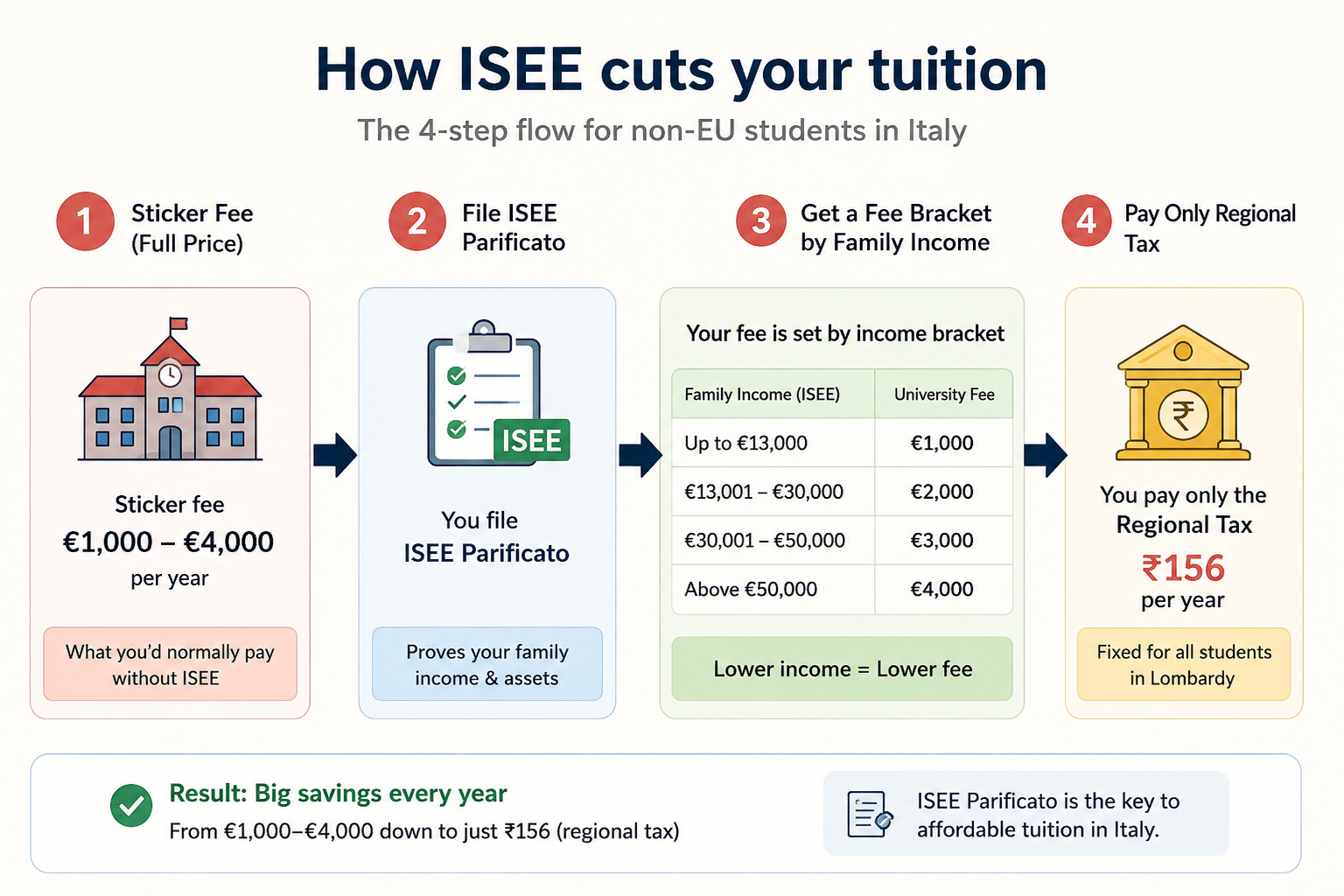
Italian public universities use the ISEE system to set tuition based on your family's financial situation. As an international student, you file the ISEE Parificato, which converts your family's Indian income and assets into an Italian score. A lower score puts you in a lower fee bracket. Students below the regional threshold (roughly €23,000–€26,000) often pay only the regional tax (around €130–€190) plus a small stamp duty — meaning total annual fees under €200.
For the 2026/27 academic year, the ISEE Parificato is calculated on your family's 2024 income. Miss the university's ISEE deadline (usually October–November) and you're charged the maximum bracket by default, so this is not paperwork to leave for later.
Private universities like Bocconi or Politecnico's design school don't use ISEE — their fees are fixed at €6,000–€20,000/year, sometimes offset by merit scholarships.
Rough all-in budget for two years at a public university, before scholarships: ₹12–22 lakh including tuition, rent, food, and insurance.
Is Italy really that cheap, or is there a catch?
It's genuinely affordable — but the low fees are conditional, and it's fair to know where the effort goes:
- The €156 tuition is real, but only if your ISEE Parificato is filed correctly and on time. Errors in translated income documents are the most common reason students get bumped to a higher bracket.
- Living cost, not tuition, is your real expense. Milan runs €1,000–€1,400/month; southern cities like Pisa, Bari, or Palermo run €600–€800.
- Bureaucracy is slow. The residence permit (permesso di soggiorno) and document legalization take time and patience. Budget for it.
If you want the honest version: Italy is cheap on tuition and rich on lifestyle, but it rewards students who plan documents early and are willing to learn some Italian.
Can I do a master's in Italy fully in English?
Yes. Italy offers 600+ master's programs taught entirely in English, concentrated in engineering, computer science, data science, design, architecture, economics, and management. You do not need Italian to complete the degree in these programs.
For admission, most English-taught programs ask for IELTS 6.0–6.5 or equivalent TOEFL. You can often skip IELTS with a Medium of Instruction (MOI) letter if your bachelor's was taught in English — but confirm this per university, since policies differ.
One honest caveat: while the classroom is English, daily life, part-time jobs, and the local job market still favour Italian. Learning to a basic conversational level (A2–B1) makes both your stay and your post-study job hunt far easier.
Which universities in Italy are best for a master's?
Laurea Magistrale vs Master Universitario — which one is a "real" master's?
This trips up many applicants. Italy has two different things called a "master":
If your goal is to work in the EU or continue to a PhD, apply for the Laurea Magistrale.
What are the admission requirements for a master's in Italy?
The requirements are straightforward compared to most countries:
- A recognized bachelor's degree in a relevant field, with academic transcripts
- English proficiency: IELTS/TOEFL, or an MOI letter
- GRE/GMAT only for some business, finance, or management programs — not most
- SOP, CV, and two LORs
- A portfolio for design, fashion, or architecture programs
- Declaration of Value (DOV) or a CIMEA statement of comparability to validate your Indian degree
You apply either directly on the university portal or through the national Universitaly platform, then pay a €30–€50 application fee. Start the DOV or CIMEA process by May–June for a September intake — it's the step students underestimate most.
When should you apply? September 2027 intake timeline
Italy runs on a September intake as the main entry point, with a smaller February intake for limited programs. The mistake most Indian students make is treating this as a same-year process — it isn't. For September 2027, your real work starts in late 2026, because scholarship and ISEE deadlines close months before classes begin.
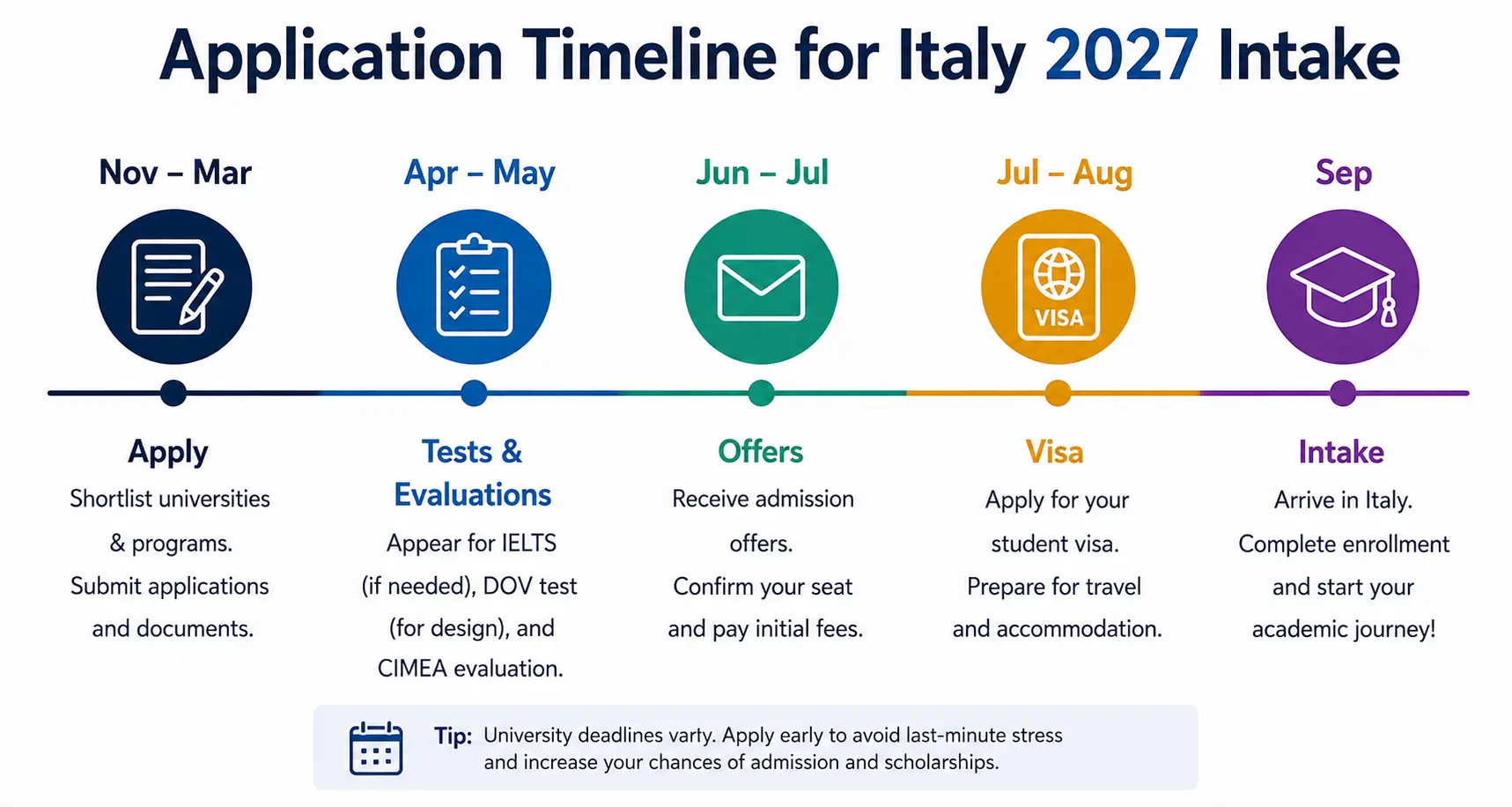
Here's the realistic timeline:
The one-line rule: work backwards from your visa appointment, not forwards from the intake month. Students who start the DOV and English test by December sail through; those who wait until spring scramble.
What scholarships can Indian students get?
Scholarships stack on top of the already-low ISEE tuition:
- DSU (Diritto allo Studio) — the big one. A need-based regional grant that can cover full tuition, subsidized accommodation, canteen meals, and a stipend up to ~€7,000/year. Eligibility is tied to your ISEE Parificato score.
- Invest Your Talent in Italy — government scholarship specifically for master's programs, with a monthly stipend.
- MAECI — Italian government scholarship for international students.
- University merit scholarships — Bologna, Padua, and Milan offer grants of €5,000–€11,000/year.
Because most of these depend on your ISEE, the same document that lowers your tuition also unlocks your funding. File it once, benefit twice.
Can I stay and work in Italy after my master's?
Yes — and this is where accuracy matters, because most guides are outdated.
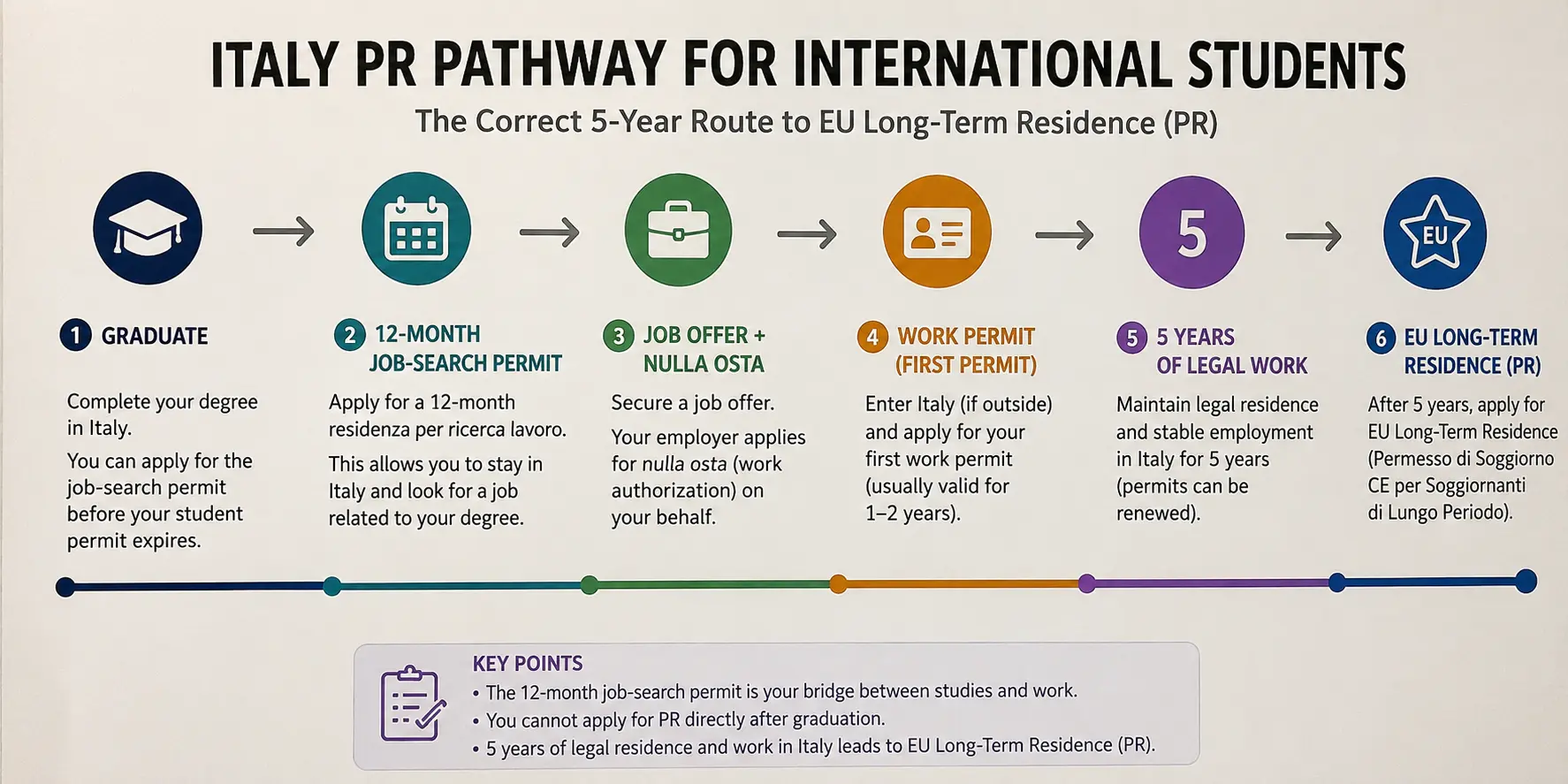
After graduating, non-EU students can apply for the permesso di soggiorno per attesa occupazione (job-search residence permit). Under current 2026-27 rules, it is a one-time, fixed 12-month permit — not "6 months extendable," and not renewable. You don't need a job offer to apply; you apply to get the year to find one.
Here's how the path works:
- Apply for the job-search permit before your student permit expires (start ~2 months ahead).
- Once you get a job offer, your employer requests the nulla osta, and you convert to a work permit (permesso per lavoro).
- After 5 years of continuous legal residence (counting from your original student permit), you can apply for EU long-term residence — Italy's PR equivalent — which requires stable income and A2 Italian.
Since the 2023 Cutro Decree, there are no annual quota limits on converting a graduate permit to a work permit, which removed a major bottleneck.
What jobs and salaries can you expect?
Italy has real demand in engineering, IT and data science, design and fashion, pharma, and business. Typical starting salaries for master's graduates:
The candidates who convert their stay-back into a job are, honestly, the ones who learned functional Italian and started networking during — not after — their studies.
Who should NOT choose Italy?
Skip Italy if you need a fast, English-only route to permanent settlement, or if you can't handle a document-heavy, slower bureaucratic process. Countries with formal multi-year graduate visas may suit you better. But if your priority is a QS-ranked degree at near-zero tuition, in English, inside the EU — with a genuine 12-month runway to find work — few destinations match Italy's value in 2026-27.
FAQ
Can I study a master's in Italy without IELTS?
Often yes. Universities like Bologna, Sapienza, and Padua accept a Medium of Instruction (MOI) letter or an interview in place of IELTS if your prior education was in English. Confirm per university.
How long is a master's in Italy?
The standard Laurea Magistrale is 2 years (120 ECTS). Some professional Master Universitario courses run 1 year.
Is a master's in Italy really free?
Not free like Germany, but close for low-income families. After ISEE-based reduction plus a DSU grant, many Indian students pay only the ~€156 regional tax and receive a stipend.
When should I apply for the September 2026-27 intake?
Applications typically run November to March, with English tests and DOV/CIMEA done by spring. Earlier is safer — scholarship and ISEE deadlines close first.
Can I get PR in Italy after my master's?
Yes, but it's a multi-step path: job-search permit → work permit → EU long-term residence after 5 years of continuous legal stay, with A2 Italian and stable income.
Planning your 2026-27 intake?
The two decisions that make or break an Italy application are choosing the right ISEE-friendly public university and filing your ISEE Parificato on time. Get a free profile assessment to map your shortlist, fees, and scholarship eligibility before the deadlines close.
Where they're studying now
Students who started exactly where you are
English-taught programmes, €0 tuition for qualifying students, and the DSU grant landing in their account every year. The funding mechanics are identical at every Italian public university: the same ISEE Parificato, the same regional bando, the same ranking. Only the authority and the dates change.




They began right where you are

