

Master in Chemistry
Master in Chemistry at FAU Erlangen-Nürnberg suits students who want strong scientific depth and can enjoy disciplined lab and theory work at the same time. ApplyAZ manages the admissions paperwork, scholarship search, and visa process for students applying here.
Master
4 semesters
Erlangen
English
FAU Erlangen-Nürnberg



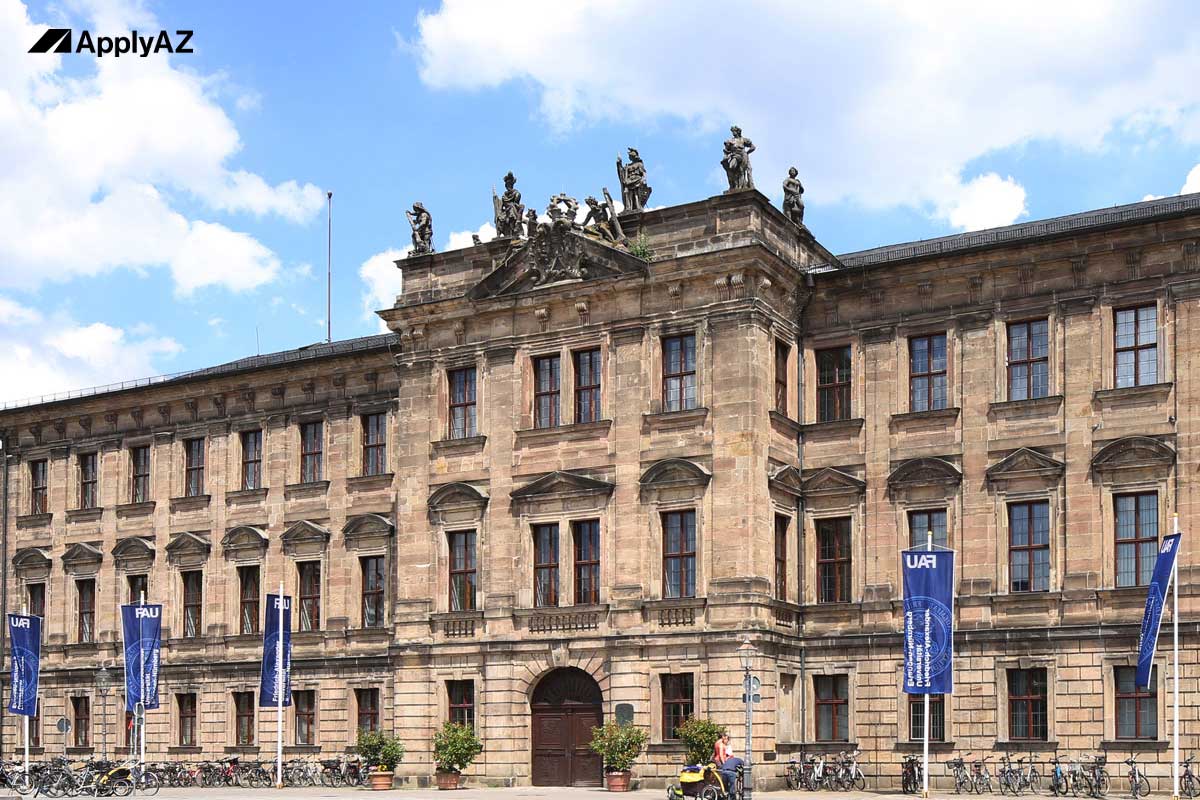
Finding Your Place at FAU
First look at FAU Erlangen-Nürnberg
FAU Erlangen-Nürnberg sits in a part of Germany where student life and industry life often overlap. Many students choose it because it feels like a serious research university, but daily life can still be manageable if you plan well. The campus experience is not one single “closed” campus. It often feels spread across the city and nearby areas, so routines matter. ApplyAZ helps you translate this into real decisions, like where to live, how to schedule travel, and how to avoid picking a programme that looks right on paper but fits poorly in practice.
When you judge a university, look at how it supports learning, not only reputation. Ask yourself how you learn best: structured teaching, independent projects, labs, or theory-first study. At FAU Erlangen-Nürnberg, many students succeed because they build a steady weekly rhythm and use the academic system properly. That means reading module details carefully, understanding exam formats early, and treating admin steps as part of the workload. ApplyAZ guides you through these steps so the move feels controlled, not chaotic.
What studying feels like there (teaching, exams, pace)
Studying at FAU Erlangen-Nürnberg often rewards independence. You usually get clear academic expectations, but you must manage your own pace. Many modules move fast once the semester starts. If you fall behind in weeks two or three, catching up later can feel heavy. Exams can be demanding because they test understanding, not memorisation. A common scenario is a student who studies only near the exam and realises too late that problem-solving needs practice over time. ApplyAZ helps you plan a realistic study rhythm before you arrive.
Another thing students misunderstand is feedback timing. In some courses, you may not receive detailed feedback every week. You learn by doing exercises, comparing solutions, and asking targeted questions. Group study can help, but it works best when the group is disciplined. If you are new to Germany’s academic style, you may also notice that rules are strict. Deadlines, exam registration, and module choices are not flexible. Treat planning as part of studying, and you will feel more confident.
English-taught options and how to check the right track
FAU Erlangen-Nürnberg offers English-taught study paths, but students often confuse “some English modules” with a fully English-taught programme. The safest approach is to check the programme language at the programme level, then check each module’s teaching language. Some tracks look English-friendly but include key compulsory modules in German. Another common scenario is a student who plans for an English thesis but learns later that supervision or lab work may operate partly in German. ApplyAZ helps you verify these details and choose a track that matches your language comfort.
You should also think beyond language and check the learning format. Some English-taught programmes are research-heavy and expect academic writing early. Others are more applied and focus on projects. Ask how many compulsory modules exist and how much freedom you have to shape your plan. If your goal is industry, look for project work, applied labs, and a thesis structure that produces a usable portfolio. If your goal is research, look for strong methods modules and supervisors in your interest area.
Admissions reality: what matters most (and what doesn’t)
Admissions decisions usually come down to fit and evidence. Fit means your past study covers the core knowledge the programme needs. Evidence means your transcript and course content show that coverage clearly. Students often over-focus on writing a strong motivation letter and under-focus on the academic match. A clean, honest story matters, but it cannot replace missing foundations. ApplyAZ supports you by mapping your transcript to what the programme likely expects, so you do not waste cycles on programmes that will reject you for structural reasons.
What matters less than people think is “perfect branding” of your profile. You do not need to sound like a marketing brochure. You need to show readiness, consistency, and realistic direction. If you changed fields, your job is to explain the bridge: what you learned, what you built, and why the step makes sense now. Another underestimated factor is timing. Late documents, unclear translations, or missing module descriptions can delay evaluation. A strong application is often a simple one that is complete and easy to assess.
Documents students underestimate (prepare early)
Many students prepare the obvious documents and miss the ones that prove academic content. If your programme is technical, module descriptions can be as important as the transcript. If your background is mixed, course content proof becomes even more critical. Another common delay is inconsistent names across documents or unclear scans that create back-and-forth. ApplyAZ builds a document readiness checklist early and checks it like a reviewer would, so weak points are fixed before submission.
- Module descriptions for key courses (maths, methods, core technical subjects)
- Clear grading scale explanation and any official transcript notes
- Consistent name format across passport, transcript, and certificates
- Translation strategy where needed, kept clean and readable
- CV that shows tools, projects, and outcomes in plain language
A good rule is this: if a reviewer cannot verify your readiness in two minutes, your file will slow down. Prepare for clarity, not volume.
Tuition and real costs in daily life
Costs in Germany can feel “simple” at first glance, but the day-to-day reality depends on your housing and your timing. Tuition at public universities is often low compared to many countries, yet you still plan for semester contributions, insurance, and setup costs. Students often budget for rent and food but forget deposits, initial furniture, registration-related fees, and the first weeks of transport. ApplyAZ helps you build a practical budget that separates one-time costs from monthly costs, so you do not feel surprised after arrival.
- Semester contributions and student services fees
- Health insurance and required registrations
- Housing deposit and initial setup costs
- Monthly living costs (rent, food, transport, phone)
- Buffer for unexpected delays or short-term housing
If your funds are in another currency, exchange-rate shifts can also matter. Planning a buffer is not pessimistic. It is what makes your plan stable.
Scholarships and funding: how to think, not guess
Scholarships and funding work best when you treat them as a strategy, not a hope. Start by listing what you can fund reliably and what depends on outcomes. Then match funding routes to timelines, because some options require documents you may not have early. A typical student mistake is waiting for “a scholarship result” before preparing visa-ready funding papers. That can create last-minute stress. ApplyAZ helps you build a plan with a safe base and an upside option, so your timeline stays under control.
Funding also includes practical tools beyond scholarships. Some students fund through savings, family support, and structured financing. Finance it with loan options via ApplyAZ. The key is to choose a method that aligns with your timeline and paperwork needs. Whatever route you choose, keep your funding story simple and provable. Complicated funding explanations often create extra questions and delays, which you want to avoid.
Housing and arrival planning (what to decide before you land)
Housing is often the make-or-break factor for a calm start. Students who secure stable housing early settle faster, study better, and avoid expensive short-term options. A common scenario is arriving with only a short stay planned and then spending weeks on housing search, which drains energy and money. You should decide your housing priority before you land: lowest cost, shortest commute, or easiest setup. You rarely get all three. ApplyAZ helps you plan this decision around your programme location and your daily routine.
Arrival planning is also paperwork planning. In Germany, early steps like registration and insurance matter. Missing a step can create delays in opening a bank account, accessing services, or finalising other admin items. Plan your first two weeks like a project. Keep digital and printed copies of key documents. Know where you must show proof of address and where you must show insurance proof. Small organisation early prevents bigger stress later.
After graduation: work options and direction
Your best work options after FAU Erlangen-Nürnberg depend on the story your studies create. Employers and research groups look for proof of depth. That proof usually comes from your projects, your thesis, and your ability to explain what you built and why it works. A common mistake is choosing modules randomly and finishing with a scattered profile. A better approach is to choose a focus area, then build supporting skills around it. ApplyAZ helps you shape this early so your study plan points to a clear direction.
You should also think about language and workplace reality. Some roles are fully English, but many teams operate partly in German. Even basic German can improve your daily life and broaden options. Another useful step is to treat your thesis as a portfolio piece. Choose a topic that matches your target direction and produces demonstrable work. When you graduate, your transcript matters, but your ability to show applied skills often matters more.
How ApplyAZ supports you step-by-step
ApplyAZ supports you from first university fit to arrival planning. We start by shortlisting programmes at FAU Erlangen-Nürnberg that match your background and goals. Then we build a document readiness plan that reduces delays, with checks for transcript clarity, module descriptions, translations, and consistency. We help you shape your application story so it is honest, technical where needed, and easy for reviewers to assess. This keeps your file clean and reduces unnecessary back-and-forth.
Next, ApplyAZ supports your scholarship strategy and your visa guidance, with timelines that match real document lead times. We help you plan your budget, housing approach, and arrival checklist so your first weeks feel organised. The goal is not to add complexity. It is to remove uncertainty and prevent avoidable errors. You stay in control because you always know what is done, what is pending, and what needs attention next.
If you share your background with ApplyAZ, we can create a personalised shortlist at FAU Erlangen-Nürnberg and review your documents for readiness. Tell us what you studied, what you want to study next, and your preferred start date. We will help you plan the safest path forward with calm, practical steps.
Chemistry With Direction and Depth
A quick sense-check: who Master in Chemistry suits
Master in Chemistry at FAU Erlangen-Nürnberg in Germany suits students who want strong scientific depth and can enjoy disciplined lab and theory work at the same time. You do well when you can hold detail in your head, write clearly, and stay consistent week to week. You like asking “why does this behave this way?” and you are comfortable proving it with data, not assumptions. ApplyAZ helps you check fit early by mapping your bachelor-level chemistry and lab exposure to what this kind of master’s normally expects.
You are usually a strong match if you have a bachelor’s in chemistry or a closely related field with real lab modules. Chemical engineering can fit when you have enough core chemistry and analytical training. Biochemistry can fit when you also have physical chemistry and lab competence beyond biology-heavy modules. A pure biology background often needs bridging in physical and inorganic chemistry. A materials or pharmacy background can fit when you can show enough chemistry depth and lab methods. ApplyAZ helps you spot gaps early and decide whether the gap is small, fixable, or a warning sign.
What you will gain by the end (real outcomes)
By the end of Master in Chemistry, you should be able to plan experiments with clear logic, choose methods with intent, and defend your results in writing and discussion. You learn to connect molecular structure, thermodynamics, kinetics, and spectroscopy to real observations. You also gain the ability to read research papers with a critical eye and replicate methods without copying mistakes. A realistic outcome is confidence with uncertainty: when data is messy, you learn how to check assumptions and confirm what is real. ApplyAZ helps you define which outcomes matter for you before you pick modules and thesis direction.
You should also leave with practical lab maturity. That includes safe work habits, clean documentation, and an understanding of error sources. You learn to troubleshoot instruments and recognise when a result is an artefact. You build skills in presenting results, not only collecting them. Many students also gain a clearer sense of their “chemistry identity”, such as analytical, physical, organic, inorganic, or materials-focused. This matters because it shapes thesis choice and job direction. ApplyAZ helps you turn that identity into a coherent study plan.
The learning style you should expect
Expect a balance of lectures, seminars, and laboratory work, with a strong focus on independent study. Many students find the pace manageable when they build a weekly rhythm. Chemistry modules often build on each other, so gaps show quickly. A common scenario is a student who is strong in organic chemistry but struggles in physical chemistry because the maths foundation is rusty. Another scenario is the opposite: strong modelling skills, but weaker lab confidence. ApplyAZ helps you plan your preparation so you do not learn the hard way during the semester.
You should also expect formal structure in assessments. Some courses lean on written exams, others on lab reports, presentations, or continuous assessment. Lab reports can take more time than students predict, because good writing requires clarity and consistent formatting. If you have not written scientific reports recently, start early. The best strategy is to treat each report like a small publication. Keep a clean lab notebook, write methods while fresh, and track conditions carefully. This reduces stress and improves your grades.
Modules, projects, and thesis (how the year often flows)
Most students experience a flow where foundations and advanced methods come first, then deeper specialisation, then the thesis. Early modules often refresh or deepen core concepts like spectroscopy, quantum chemistry concepts, kinetics, thermodynamics, and advanced synthetic or analytical methods, depending on track. You begin to see how method choice shapes what you can claim from results. If your interest is industry-facing chemistry, you may lean into analytical, materials, or applied methods. If your interest is academic chemistry, you may lean into mechanistic depth and research seminars. ApplyAZ helps you plan a path that stays coherent.
Project work often becomes the bridge between modules and thesis. This is where you practise designing experiments, choosing controls, and explaining limitations. Students who do well usually pick projects that build toward a thesis theme. A common mistake is choosing unrelated topics because they sound interesting, then feeling lost when thesis time arrives. Thesis work typically rewards students who already know their preferred methods and can work independently. ApplyAZ helps you choose a thesis direction that matches your strengths, risk tolerance, and timeline.
Entry requirements (clear checklist)
Entry requirements usually focus on two things: proof of a chemistry foundation and proof that you can handle advanced lab and theory work. Titles alone are not enough. The programme needs evidence through course content, grades, and lab exposure. ApplyAZ checks this with a reviewer mindset, so you can see what is essential and what can be clarified.
- A relevant bachelor’s degree with strong chemistry content
- Core coverage in key areas (typically organic, inorganic, physical, analytical)
- Laboratory modules with documented methods and reports
- Evidence of scientific writing and data handling
- Proof of language ability if required in the admissions process
What is often flexible is exact course naming and the balance across subfields. What is usually not flexible is the absence of physical chemistry or the absence of meaningful lab work. What often needs clarification is mixed degrees where chemistry is present but not dominant.
How to read your transcript against the requirements
Read your transcript like a scientist, not like a student. Group your courses into evidence blocks: core chemistry, maths and physics support, lab methods, and research experience. Then ask two questions. First, do you cover the “must-have” chemistry foundations? Second, do you show progression from basic to advanced? A transcript with only introductory chemistry may look weak even if the overall grade is high. ApplyAZ helps you map each course to a skill block and spot where your evidence is thin or unclear.
Use simple decision logic. If you have strong core chemistry plus lab modules in at least two subfields, you are usually in good shape. If you have strong chemistry theory but limited lab, you need to strengthen proof of hands-on methods. If you have strong lab but weak physical chemistry, you may need bridging work before you apply. If you have a mixed background like materials or biochemistry, you must show the chemistry depth clearly, not assume reviewers will infer it. ApplyAZ helps you build a clear narrative based on evidence.
Documents to prepare early (avoid delays)
Most delays come from missing proof, not missing passion. Chemistry programmes often require clear, readable documentation because reviewers need to confirm course content and lab exposure. A typical student mistake is preparing documents late and discovering that course descriptions are hard to obtain or need official formatting. Another mistake is sending unclear scans or inconsistent names, which triggers repeated checks. ApplyAZ creates a document readiness plan early and checks it for clarity, not just completeness.
- Course descriptions or syllabi for key chemistry modules
- Clear transcript format with grading scale explanation
- Proof of lab work and research exposure where relevant
- CV focused on methods, instruments, and outcomes
- Motivation letter that explains fit with evidence, not claims
Prepare translations carefully when needed. Keep the language simple and consistent. Name files cleanly. Small discipline here prevents big delays later.
Tuition, fees, and living costs (real planning)
Planning costs in Germany works best when you separate fixed fees from daily life spending. Public universities often have low tuition compared to many countries, but you still plan for semester contributions and practical costs. The largest variable is housing, followed by insurance and daily spending. A common scenario is a student budgeting only for monthly rent and forgetting deposits, initial setup, and short-term housing during the search. ApplyAZ helps you build a realistic budget with buffers so you can handle the first months calmly.
You should also plan for timing. The first weeks can be expensive because you pay deposits, buy essentials, and handle registrations. If your funds come from abroad, exchange-rate changes can affect your budget. Build a buffer for this. Keep your plan simple and documented, because financial clarity supports both peace of mind and smoother visa preparation. When you plan costs well, you study better, because money stress usually becomes time stress.
Scholarships and funding (smart approach)
A smart approach to funding starts with a stable base plan, then adds opportunities. Scholarships can be helpful, but they come with timelines and rules, and outcomes are never guaranteed. Treat scholarships as “upside”, not as your only option. A common mistake is waiting for scholarship results before preparing other funding documents, which compresses timelines later. ApplyAZ helps you plan funding in layers: what you can secure early, what depends on decisions, and what depends on results.
Funding can include structured financing if needed. Finance it with loan options via ApplyAZ. The key is alignment: your funding route must fit your timeline and paperwork needs. Keep your funding story simple and provable. Avoid complicated transfers, unclear sponsorship letters, or last-minute changes. These things create questions and delays. ApplyAZ helps you build a clean plan that stays consistent from application through arrival.
Career direction after Master in Chemistry
Career direction after Master in Chemistry depends on your specialisation and the evidence you build through projects and thesis. Many graduates move toward analytical chemistry, quality and process roles, R&D, materials and polymers, pharma-related environments, environmental and food labs, or research pathways. What usually matters in hiring is not only grades, but your ability to explain methods, validate results, and work safely and reliably. Your thesis can become your strongest proof of competence if it is planned well. ApplyAZ helps you shape your study plan so your thesis supports your intended direction.
Another realistic point is that chemistry careers often value method fluency. If you want lab roles, show strong practical methods and clean documentation habits. If you want computational or physical chemistry roles, show maths confidence and modelling logic. If you want interdisciplinary roles, show you can communicate across teams and still keep scientific rigor. A common mistake is staying too broad and graduating with no clear “signal”. A better approach is to build one strong theme and support it with complementary skills.
How ApplyAZ supports you step-by-step
ApplyAZ supports you from first fit judgement to arrival planning. We start by checking your academic match for Master in Chemistry at FAU Erlangen-Nürnberg and flagging any gaps that could block admission or study success. Then we build an application plan with clear timelines for documents, translations, and course description proof. We help you present your background in a calm, evidence-based way, so reviewers can assess your file quickly and confidently.
Next, ApplyAZ supports scholarship strategy and visa guidance, with a focus on preventing delays. We help you plan costs, organise funding documents, and prepare an arrival checklist that fits real timelines. We also help you choose a coherent direction for modules and thesis so your outcomes match your career goals. If you share your background with ApplyAZ, we can review fit, build a shortlist, and create a document readiness plan tailored to your timeline. We will keep the steps clear and practical, so you can move forward with confidence.
Tuition and scholarships
Public universities in Germany charge no tuition fees for international students. A semester contribution typically applies, covering administrative costs and often a public transport pass.
DAAD (German Academic Exchange Service) offers scholarships for international master's students, covering living costs and a travel allowance. Apply through the DAAD portal separately from your university application.
The Deutschlandstipendium provides €300 per month, co-funded by the federal government and private sponsors. Applications go through the university's scholarship office after enrolment.
For Indian applicants
Indian graduates with a degree recognised by AIU (Association of Indian Universities) can apply to German public universities through uni-assist. The uni-assist portal handles degree equivalency verification and is the standard route for most non-EU applicants. Check your eligibility with us first.
Similar programmes
More free programmes in this city

They Began right where you are

