

Master in Physics
Master in Physics at FAU Erlangen-Nürnberg suits students who want deep, rigorous training in modern physics. ApplyAZ supports applicants through the entry requirements, scholarship options, and visa steps tied to this program.
Master
4 semesters
Erlangen
English
FAU Erlangen-Nürnberg



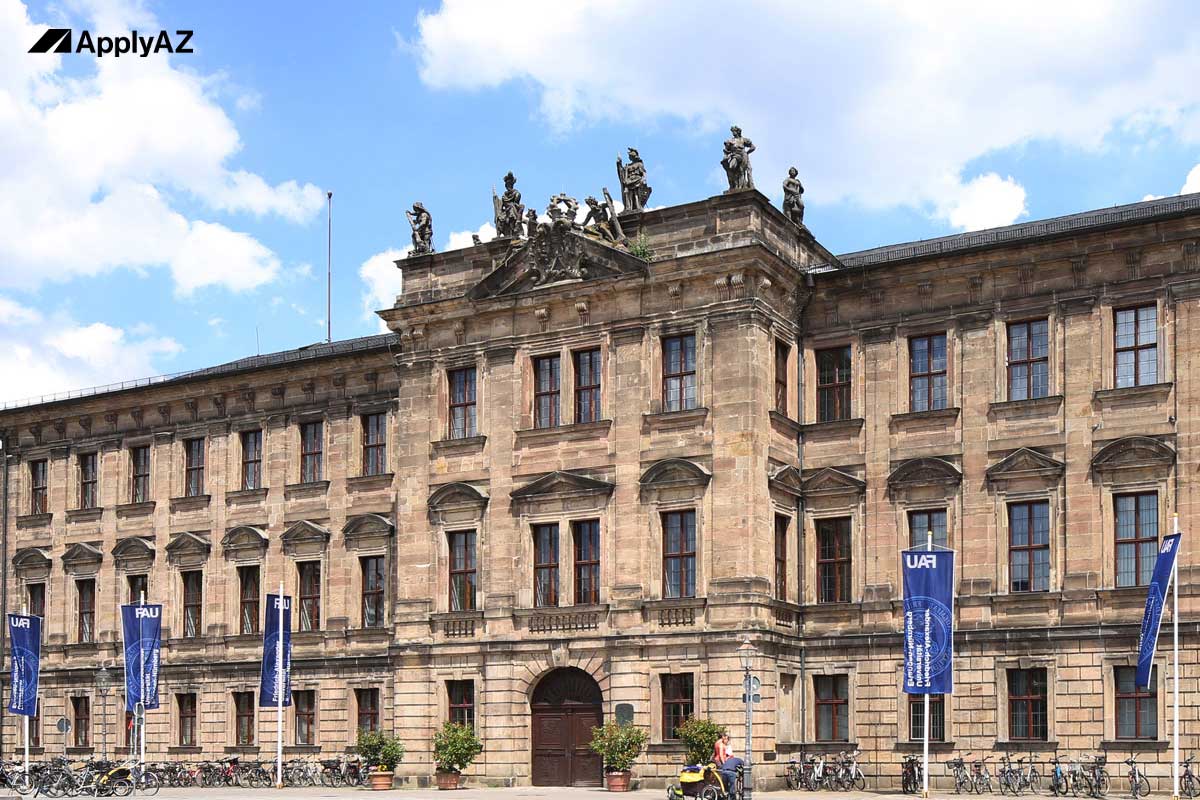
Finding Your Place at FAU
First look at FAU Erlangen-Nürnberg
FAU Erlangen-Nürnberg sits in a part of Germany where student life and industry life often overlap. Many students choose it because it feels like a serious research university, but daily life can still be manageable if you plan well. The campus experience is not one single “closed” campus. It often feels spread across the city and nearby areas, so routines matter. ApplyAZ helps you translate this into real decisions, like where to live, how to schedule travel, and how to avoid picking a programme that looks right on paper but fits poorly in practice.
When you judge a university, look at how it supports learning, not only reputation. Ask yourself how you learn best: structured teaching, independent projects, labs, or theory-first study. At FAU Erlangen-Nürnberg, many students succeed because they build a steady weekly rhythm and use the academic system properly. That means reading module details carefully, understanding exam formats early, and treating admin steps as part of the workload. ApplyAZ guides you through these steps so the move feels controlled, not chaotic.
What studying feels like there (teaching, exams, pace)
Studying at FAU Erlangen-Nürnberg often rewards independence. You usually get clear academic expectations, but you must manage your own pace. Many modules move fast once the semester starts. If you fall behind in weeks two or three, catching up later can feel heavy. Exams can be demanding because they test understanding, not memorisation. A common scenario is a student who studies only near the exam and realises too late that problem-solving needs practice over time. ApplyAZ helps you plan a realistic study rhythm before you arrive.
Another thing students misunderstand is feedback timing. In some courses, you may not receive detailed feedback every week. You learn by doing exercises, comparing solutions, and asking targeted questions. Group study can help, but it works best when the group is disciplined. If you are new to Germany’s academic style, you may also notice that rules are strict. Deadlines, exam registration, and module choices are not flexible. Treat planning as part of studying, and you will feel more confident.
English-taught options and how to check the right track
FAU Erlangen-Nürnberg offers English-taught study paths, but students often confuse “some English modules” with a fully English-taught programme. The safest approach is to check the programme language at the programme level, then check each module’s teaching language. Some tracks look English-friendly but include key compulsory modules in German. Another common scenario is a student who plans for an English thesis but learns later that supervision or lab work may operate partly in German. ApplyAZ helps you verify these details and choose a track that matches your language comfort.
You should also think beyond language and check the learning format. Some English-taught programmes are research-heavy and expect academic writing early. Others are more applied and focus on projects. Ask how many compulsory modules exist and how much freedom you have to shape your plan. If your goal is industry, look for project work, applied labs, and a thesis structure that produces a usable portfolio. If your goal is research, look for strong methods modules and supervisors in your interest area.
Admissions reality: what matters most (and what doesn’t)
Admissions decisions usually come down to fit and evidence. Fit means your past study covers the core knowledge the programme needs. Evidence means your transcript and course content show that coverage clearly. Students often over-focus on writing a strong motivation letter and under-focus on the academic match. A clean, honest story matters, but it cannot replace missing foundations. ApplyAZ supports you by mapping your transcript to what the programme likely expects, so you do not waste cycles on programmes that will reject you for structural reasons.
What matters less than people think is “perfect branding” of your profile. You do not need to sound like a marketing brochure. You need to show readiness, consistency, and realistic direction. If you changed fields, your job is to explain the bridge: what you learned, what you built, and why the step makes sense now. Another underestimated factor is timing. Late documents, unclear translations, or missing module descriptions can delay evaluation. A strong application is often a simple one that is complete and easy to assess.
Documents students underestimate (prepare early)
Many students prepare the obvious documents and miss the ones that prove academic content. If your programme is technical, module descriptions can be as important as the transcript. If your background is mixed, course content proof becomes even more critical. Another common delay is inconsistent names across documents or unclear scans that create back-and-forth. ApplyAZ builds a document readiness checklist early and checks it like a reviewer would, so weak points are fixed before submission.
- Module descriptions for key courses (maths, methods, core technical subjects)
- Clear grading scale explanation and any official transcript notes
- Consistent name format across passport, transcript, and certificates
- Translation strategy where needed, kept clean and readable
- CV that shows tools, projects, and outcomes in plain language
A good rule is this: if a reviewer cannot verify your readiness in two minutes, your file will slow down. Prepare for clarity, not volume.
Tuition and real costs in daily life
Costs in Germany can feel “simple” at first glance, but the day-to-day reality depends on your housing and your timing. Tuition at public universities is often low compared to many countries, yet you still plan for semester contributions, insurance, and setup costs. Students often budget for rent and food but forget deposits, initial furniture, registration-related fees, and the first weeks of transport. ApplyAZ helps you build a practical budget that separates one-time costs from monthly costs, so you do not feel surprised after arrival.
- Semester contributions and student services fees
- Health insurance and required registrations
- Housing deposit and initial setup costs
- Monthly living costs (rent, food, transport, phone)
- Buffer for unexpected delays or short-term housing
If your funds are in another currency, exchange-rate shifts can also matter. Planning a buffer is not pessimistic. It is what makes your plan stable.
Scholarships and funding: how to think, not guess
Scholarships and funding work best when you treat them as a strategy, not a hope. Start by listing what you can fund reliably and what depends on outcomes. Then match funding routes to timelines, because some options require documents you may not have early. A typical student mistake is waiting for “a scholarship result” before preparing visa-ready funding papers. That can create last-minute stress. ApplyAZ helps you build a plan with a safe base and an upside option, so your timeline stays under control.
Funding also includes practical tools beyond scholarships. Some students fund through savings, family support, and structured financing. Finance it with loan options via ApplyAZ. The key is to choose a method that aligns with your timeline and paperwork needs. Whatever route you choose, keep your funding story simple and provable. Complicated funding explanations often create extra questions and delays, which you want to avoid.
Housing and arrival planning (what to decide before you land)
Housing is often the make-or-break factor for a calm start. Students who secure stable housing early settle faster, study better, and avoid expensive short-term options. A common scenario is arriving with only a short stay planned and then spending weeks on housing search, which drains energy and money. You should decide your housing priority before you land: lowest cost, shortest commute, or easiest setup. You rarely get all three. ApplyAZ helps you plan this decision around your programme location and your daily routine.
Arrival planning is also paperwork planning. In Germany, early steps like registration and insurance matter. Missing a step can create delays in opening a bank account, accessing services, or finalising other admin items. Plan your first two weeks like a project. Keep digital and printed copies of key documents. Know where you must show proof of address and where you must show insurance proof. Small organisation early prevents bigger stress later.
After graduation: work options and direction
Your best work options after FAU Erlangen-Nürnberg depend on the story your studies create. Employers and research groups look for proof of depth. That proof usually comes from your projects, your thesis, and your ability to explain what you built and why it works. A common mistake is choosing modules randomly and finishing with a scattered profile. A better approach is to choose a focus area, then build supporting skills around it. ApplyAZ helps you shape this early so your study plan points to a clear direction.
You should also think about language and workplace reality. Some roles are fully English, but many teams operate partly in German. Even basic German can improve your daily life and broaden options. Another useful step is to treat your thesis as a portfolio piece. Choose a topic that matches your target direction and produces demonstrable work. When you graduate, your transcript matters, but your ability to show applied skills often matters more.
How ApplyAZ supports you step-by-step
ApplyAZ supports you from first university fit to arrival planning. We start by shortlisting programmes at FAU Erlangen-Nürnberg that match your background and goals. Then we build a document readiness plan that reduces delays, with checks for transcript clarity, module descriptions, translations, and consistency. We help you shape your application story so it is honest, technical where needed, and easy for reviewers to assess. This keeps your file clean and reduces unnecessary back-and-forth.
Next, ApplyAZ supports your scholarship strategy and your visa guidance, with timelines that match real document lead times. We help you plan your budget, housing approach, and arrival checklist so your first weeks feel organised. The goal is not to add complexity. It is to remove uncertainty and prevent avoidable errors. You stay in control because you always know what is done, what is pending, and what needs attention next.
If you share your background with ApplyAZ, we can create a personalised shortlist at FAU Erlangen-Nürnberg and review your documents for readiness. Tell us what you studied, what you want to study next, and your preferred start date. We will help you plan the safest path forward with calm, practical steps.
Learning Physics With Depth and Discipline
A quick sense-check: who Master in Physics suits
Master in Physics at FAU Erlangen-Nürnberg in Germany suits students who enjoy building understanding from first principles and proving it with maths and evidence. You like hard problems and you do not panic when an idea takes time to click. You enjoy modelling, careful measurement, and explaining assumptions clearly. You are comfortable being wrong at first and correcting your path through calculation and experiment. ApplyAZ helps you judge fit early by checking whether your background shows enough core physics depth and whether your profile supports the programme’s pace.
You are usually a strong fit if you studied physics or applied physics with strong maths and lab training. Engineering can fit when you have serious physics content, not only applied courses, and when you can show proof-based thinking. Mathematics can fit when you have enough physics fundamentals and lab readiness. A typical “fits well” case is a physics graduate with quantum mechanics, electromagnetism, statistical mechanics, and lab courses. A typical bridging case is an engineer strong in maths but missing core quantum or lab evidence. ApplyAZ helps you label your case and plan bridging steps.
What you will gain by the end (real outcomes)
By the end of Master in Physics, you should be able to work independently on advanced physics problems, from defining a model to checking results. You learn to move between theory and experiment with discipline. You will strengthen your ability to derive results, not only apply formulas. You will also gain the skill of reading research papers and understanding what is truly new versus what is standard background. A realistic outcome is stronger judgement about approximation: knowing when an assumption is safe and when it breaks. ApplyAZ helps you plan module and thesis choices so these outcomes match your future path.
You should also gain research habits that matter for PhD work and technical roles. That includes clean documentation, reproducible analysis, and careful error thinking. You learn to interpret data honestly and to defend your conclusions with clear logic. Many students finish with a thesis that shows a complete research workflow. This can involve simulation, measurement, or a mix. That thesis becomes strong evidence of your capability, especially when you apply for doctoral positions or research-driven industry roles.
The learning style you should expect
Expect a demanding pace and a high level of independence. Many modules assume you can learn through problem sets, reading, and discussion, not only through lectures. A common scenario is a student who understands the lecture but struggles with weekly exercises because the exercises require deeper derivations. Another scenario is a student who can derive results but needs to strengthen programming and numerical methods for simulations. ApplyAZ helps you plan which skills to refresh before you start, so you do not lose the first month to catching up.
You should also expect that assessment can feel strict. Exams often test reasoning under pressure, and lab work often tests method discipline. If you delay weekly practice, physics becomes stressful fast because topics build on each other. Build a routine early: solve problems, check units, track assumptions, and write short summaries of key ideas. These small habits reduce errors and improve confidence. If you treat the semester as a steady process, the programme becomes far more manageable.
Modules, projects, and thesis (how the year often flows)
Many students experience a flow where advanced foundations come early, then specialisation grows through electives, then thesis work becomes central. Early phases often deepen core ideas such as quantum mechanics, statistical physics, electrodynamics, and condensed matter or similar advanced topics, depending on track. You also strengthen mathematical tools and modelling approaches. This is where students often discover which areas feel natural and which ones require more effort. ApplyAZ helps you plan module combinations so you do not overload yourself with multiple proof-heavy courses at the same time.
Later phases often become more project-driven and closer to research. You may join a group, work on simulations, or work on experimental setups depending on your direction. A good approach is to choose projects that build toward a thesis theme. A common mistake is selecting unrelated modules and then struggling to find a thesis topic that connects. ApplyAZ helps you build a coherent path early, so your thesis becomes a capstone of growing depth, not a separate scramble near the end.
Entry requirements (clear checklist)
Entry requirements usually focus on whether you have deep physics foundations and the mathematical level needed for graduate work. Reviewers often look for evidence of core physics topics and lab readiness. ApplyAZ checks your transcript and course content with a reviewer mindset and helps you understand what is essential, what is flexible, and what needs clarification.
- A relevant bachelor’s degree with strong physics content
- Core coverage in quantum mechanics, electromagnetism, and classical mechanics
- Strong maths foundations (calculus, linear algebra, differential equations)
- Laboratory training and scientific reporting experience
- Programming or numerical methods exposure (often helpful)
- Proof of language ability if required in the admissions process
What is flexible is the exact naming of modules across universities. What is usually not flexible is missing core physics subjects. What often needs clarification is applied degrees where the depth level is not obvious.
How to read your transcript against the requirements
Read your transcript as proof of depth, not a list of topics. Group courses into core physics blocks, maths support, lab training, and computation. Then check progression. Reviewers want to see advanced-level work, not only introductions. One basic quantum course may not be enough if the programme expects advanced understanding. If your course titles are unclear, course descriptions can be crucial. ApplyAZ helps you map each course to what it demonstrates and decide what needs extra explanation.
Use decision logic to reduce uncertainty. If you have strong core physics plus lab courses, you are usually well positioned. If you have strong maths but weak lab evidence, show research readiness through projects or placements. If you have engineering physics but missing quantum depth, you likely need bridging. If your profile is computationally strong, show how it links to physics modelling and validation, not only coding. ApplyAZ helps you build a clear story that matches your transcript evidence.
Documents to prepare early (avoid delays)
Delays often happen because students underestimate how much proof a physics programme needs. Core coverage must be visible, and level must be clear. Another common delay is weak documentation of lab and research experience. If you have a thesis, internship, or research project, present it clearly with your role, tools, and outcomes. ApplyAZ builds a document readiness plan early and checks it for clarity, consistency, and completeness.
- Course descriptions for core physics modules (quantum, EM, stat mech, labs)
- Transcript with grading scale explanation and official notes
- CV focused on technical skills, simulations, lab tools, and outcomes
- Motivation letter that explains direction with evidence, not claims
- Proof of research work where relevant (thesis summary, supervisor confirmation)
- Proof of language ability if requested
Keep scans clean and names consistent. Prepare translations early if needed. Small errors here can create long delays.
Tuition, fees, and living costs (real planning)
Planning costs in Germany works best when you separate fixed fees, monthly living costs, and one-time setup costs. Public universities often have low tuition compared to many countries, but semester contributions and daily living costs still matter. Housing is usually the biggest variable. A common scenario is arriving late, paying high short-term rent, and losing study focus during the housing search. ApplyAZ helps you build a realistic budget with buffers so your first months stay stable.
Also plan for study needs. Many physics students need reliable computing for simulations and data analysis. First month costs like deposits, insurance, registrations, transport, and basic setup add up quickly. If your funds are in another currency, exchange-rate shifts can affect your plan. Keep a buffer. Cost planning is not only financial. It supports academic stability, because less stress means more focus and better performance.
Scholarships and funding (smart approach)
A smart approach to funding starts with a base plan that works without best-case outcomes, then adds opportunities. Scholarships can help, but criteria and timelines vary, and results are never guaranteed. A common mistake is waiting for scholarship decisions before preparing other funding documents. That compresses timelines and creates stress. ApplyAZ supports scholarship strategy by helping you identify realistic options, align documents with criteria, and plan deadlines around real document lead times.
Funding can also include structured financing if needed. Finance it with loan options via ApplyAZ. The key is to keep your funding story simple, consistent, and easy to prove. Avoid last-minute changes, unclear sponsorship explanations, or complicated transfers. These often trigger questions and delays. ApplyAZ helps you keep the plan stable from application through arrival, so you can focus on study rather than uncertainty.
Career direction after Master in Physics
Career direction after Master in Physics often depends on your thesis focus and the skills you can demonstrate. Many graduates move toward doctoral research, especially if they enjoy deep theory or experimental development. Others move into roles that value modelling and problem-solving, such as simulation, data analysis, imaging-related work, semiconductor-related environments, energy and materials research, or scientific software roles. What usually matters is proof of skills: clear reasoning, careful data handling, and the ability to build and test models. Your thesis and projects can be your strongest proof. ApplyAZ helps you shape your choices so your profile stays coherent.
A practical tip is to choose a “home base” direction early. For example, computational physics, condensed matter, optics, or another area that matches your strengths. Then pick modules and projects that reinforce that direction. A common mistake is collecting unrelated topics and graduating with a scattered story. A better approach is depth in one area with enough breadth to collaborate across fields. This makes your next step clearer and easier to explain.
How ApplyAZ supports you step-by-step
ApplyAZ supports you from fit judgement to arrival planning. We start by checking your match for Master in Physics at FAU Erlangen-Nürnberg and identifying gaps that could block admission or reduce study success. Then we build an application plan with clear timelines for transcripts, course descriptions, translations where needed, and research proof. We help you present your background in a calm, evidence-based way so reviewers can assess your file quickly and fairly.
After that, ApplyAZ supports scholarship strategy and visa guidance, with a focus on preventing delays. We help you plan costs, organise funding documents, and prepare an arrival checklist that fits real timelines. We also help you choose a coherent module and thesis direction so your work builds a clear story. Share your background with ApplyAZ for a fit review, a shortlist, and a document readiness plan. We will keep the steps practical and calm so you can move forward with confidence.
Tuition and scholarships
Public universities in Germany charge no tuition fees for international students. A semester contribution typically applies, covering administrative costs and often a public transport pass.
DAAD (German Academic Exchange Service) offers scholarships for international master's students, covering living costs and a travel allowance. Apply through the DAAD portal separately from your university application.
The Deutschlandstipendium provides €300 per month, co-funded by the federal government and private sponsors. Applications go through the university's scholarship office after enrolment.
For Indian applicants
Indian graduates with a degree recognised by AIU (Association of Indian Universities) can apply to German public universities through uni-assist. The uni-assist portal handles degree equivalency verification and is the standard route for most non-EU applicants. Check your eligibility with us first.
Similar programmes
More free programmes in this city

They Began right where you are

