

Master in Economics at University of Turin
Two-year English-taught LM-56-R economics master at the University of Turin, with a quantitative core in econometrics, macroeconomics, microeconomics and Python and Stata, then four electives and an 18 ECTS thesis. Entry needs economics and maths credits, a high final grade and English at B2.
Master
2 years
Turin
English
University of Turin



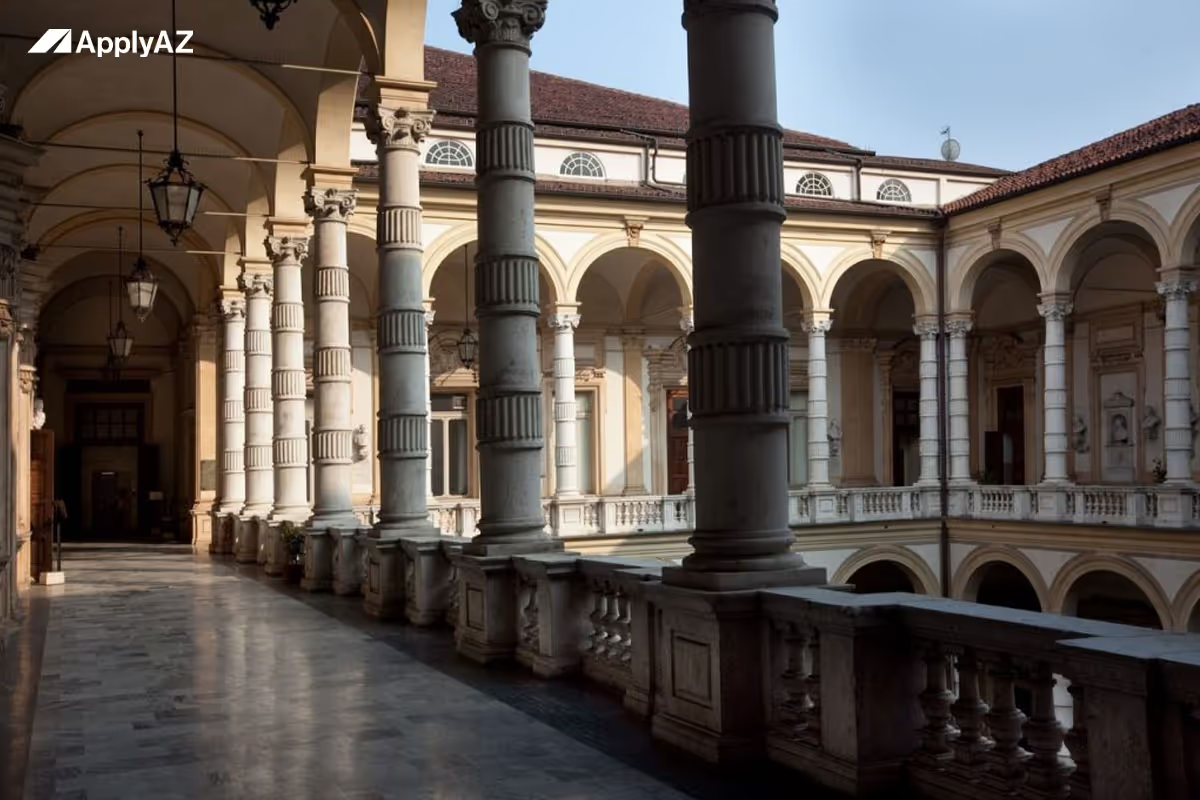
The Master in Economics is a two-year, 120 ECTS master's degree (class LM-56-R) taught in English at the University of Turin. Entry needs a bachelor's with a tenth of its credits in economics and a tenth in maths and statistics, a grade of at least 9/10 of the maximum or a top-ranked department, and English at B2. Students abroad pay a contribution set by their country, and the programme can be tuition-free for eligible students.
Entry requirements
Detailed entry requirements
Turin's Master in Economics asks for a three-year bachelor's degree with at least a tenth of its credits in economics and a tenth in maths and statistics, a final grade of at least 9/10 of the maximum or a degree from a top-ranked economics department, and English at B2. Reviewed 8 October 2026. [1]
Degree, grade and credits
You need a first-cycle (bachelor's) degree earned after at least three years of university study, or a foreign equivalent obtained after at least 15 years of schooling in total. [1][4]
- Grade or ranking: for 2026/27, Apply@UniTo considered applicants who met at least one of two criteria: a final grade of at least 9/10 of the highest possible grade (99/110 for an Italian degree), or a degree from an institution in the top 12.5% of the RePEc ranking of economics departments. [1]
- Economics credits: at least one tenth of your bachelor's credits in economics, which for an Italian degree means 18 credits in sectors SECS-P/01 to SECS-P/06. [1][2]
- Maths and statistics credits: at least one tenth in mathematics and statistics, which for an Italian degree means 18 credits in sectors SECS-S/01 to SECS-S/06 or MAT/06. [1][2]
Italian degrees in classes L-18 (formerly L-17) and L-33 (formerly L-28) count as meeting both credit rules. [2]
What this means for your transcript
The rule looks at the share of your degree spent on economics and on maths and statistics, and at your final grade. As a guide, based on the rule above:
- Usually a fit: a BA or B.Sc. in Economics that includes mathematics and statistics papers, if your final grade reaches 9/10 of the maximum (for example 9.0 on a 10-point CGPA scale).
- Check carefully: a B.Com or BBA often covers the economics tenth but can fall short on mathematics and statistics, and a B.Sc. in Mathematics or Statistics covers the quantitative tenth but may lack economics.
- Often short: a B.Tech, B.E. or BCA usually covers maths but rarely has a tenth of its credits in economics.
The grade criterion is demanding: under the 2026/27 rule, a final grade below 9/10 of the maximum qualifies only if your university is in the RePEc top 12.5%. [1]
English
English at CEFR B2 or higher, shown by an international certificate no more than three years old. Accepted proofs and minimum scores for 2026/27: [1]
- IELTS: 5.5 overall, with no component below 5.5
- TOEFL iBT: 69 out of 120, with no component below 17
- PTE Academic: 65
- Cambridge First (FCE): 173
- Cambridge Advanced (CAE), Cambridge Proficiency (CPE) or Trinity ISE II
- An official document from your previous university stating that English was the medium of instruction
The programme's admission page adds that applicants without a certificate may be interviewed in English. [2]
Selection and interview
Access is open, with no written entrance test. [8] A committee checks your grade, credits and English. [2]
- If a requirement is not met, the committee may invite you to an interview, held in English. [2][8]
- Without an English certificate, the interview checks that you can write, speak and read English fluently. [2]
- Otherwise it covers your weak areas, such as microeconomics, macroeconomics, mathematics or statistics, and may include a written part. [2]
For 2026/27 the degree had 50 places for non-European applicants residing abroad. [1]
2026/27 deadlines
- Apply@UniTo for non-EU applicants living abroad: 25 November 2025 to 29 January 2026. [3]
- Universitaly pre-enrolment for the study visa: by 15 July 2026. [3]
You can apply before graduating, but you need the degree preferably by the start of courses and no later than the final enrolment deadline, around mid-December. [2] The next call sets the 2027/28 dates.
Documents and non-EU steps
Non-EU applicants living abroad apply on Apply@UniTo, where one application covers up to two programmes. [3]
- Your degree certificate and a full transcript of records listing all exams, marks and hours or credits. A Diploma Supplement in the international format, with the full transcript, can replace both. [4]
- A CV and a motivation letter in English or Italian. [1][4]
- Proof of authenticity of your degree, needed to enrol: legalisation, an apostille, an ENIC-NARIC statement of verification or an official digital verification service. [4]
- A CIMEA declaration of value or statement of comparability is optional but useful. [4]
- Documents in languages other than English, French, Italian or Spanish need a certified translation. [1][4]
- If you have not yet graduated, an official certificate of enrolment in your final year and a score report for the years completed. [4]
After admission you complete Universitaly pre-enrolment for one programme and apply for a type D study visa at the Italian embassy or consulate for your country of residence. Admission does not by itself secure the visa or enrolment. [3]
Sources and verification
Checked by the ApplyAZ admissions team against the university's official documents listed below. Entry rules can change with each new call, and we re-check them before every application.
- University of Turin. Apply@UniTo course page, Master's degree in Economics (LM-56-R), academic year 2026/27. Reviewed 8 October 2026.
- University of Turin, Master's degree in Economics. Admission requirements, undated (page last updated March 2021). Reviewed 8 October 2026.
- University of Turin. Application for non-EU citizens residing abroad, academic year 2026/27. Reviewed 8 October 2026.
- University of Turin. Required documents for international students, undated. Reviewed 8 October 2026.
- University of Turin. Tuition fees for international students, academic year 2026/27. Reviewed 8 October 2026.
- University of Turin. Tuition fee exemptions, academic year 2026/27. Reviewed 8 October 2026.
- University of Turin. Scholarships for international students: Talents 4 UniTo, academic year 2026/27. Reviewed 8 October 2026.
- University of Turin. Economics programme page (degree class, language, access, interview and study plan). Reviewed 8 October 2026.
About the programme
Economics is a two-year master's degree in class LM-56-R, economic sciences. It is worth 120 ECTS, taught in English and run in Turin by the University of Turin's Department of Economic-Social and Mathematical-Statistical Sciences (ESOMAS). Access is open, with no written entrance test: a committee checks your grade, credits and English, and may call candidates who miss a requirement for an interview. [2][8]
The first year is a compulsory quantitative core, and the second year is largely yours to shape through electives and the thesis. The degree suits graduates in economics or a quantitative field who want graduate-level training in theory, econometrics and policy analysis.
What you will study
The first year covers 60 ECTS of required units, including programming in Python and Stata. In the second year you take corporate and insolvency law for economics, choose four electives and write the thesis. Electives include behavioural and experimental economics, financial econometrics, growth and development, industrial economics, international macroeconomics, policy evaluation and public economics. Required units include:
- Econometrics (12 ECTS)
- Macroeconomics (12 ECTS)
- Quantitative Methods for Economics (12 ECTS)
- Microeconomics of Consumption, Production and Uncertainty
- Strategies, Behavior and Organizations
- Applied Corporate Finance
- Programming: Python and Programming: Stata
- Corporate and Insolvency Law for Economics
How the programme is taught
The second year leaves 24 ECTS for four electives chosen from 19 units, and ends with a final thesis worth 18 ECTS. International students can add optional Italian language courses of 3 ECTS each. The degree is based in Turin.
Career paths
The university's English course page does not list professional profiles for this degree. The study plan builds skills in econometrics, quantitative methods, macroeconomic and microeconomic analysis and programming in Python and Stata, which are the tools of economic research, policy evaluation and data-driven analysis in finance and business.
Electives let you lean towards finance, development, industrial organisation, public policy or economic research, and the 18 ECTS thesis gives research experience that can lead on to a PhD.
Fees and scholarships
Students residing abroad pay UniTo a yearly contribution set by the GDP per capita of their country of residence. If your country is on the ministry's list of particularly poor countries, you are exempt from this contribution. [5] EDISU Piemonte scholarship winners and eligible applicants have the regional tax refunded and do not pay the later instalments, so this programme can be tuition-free for eligible students. [6] For 2026/27, UniTo also funded 40 two-year Talents 4 UniTo scholarships for first-year students of open-access master's taught in English, such as Economics; that call is closed. [7]
How to apply from outside the EU
Meeting the grade, credit and English requirements lets you skip the interview, so include your full transcript and English certificate. For 2026/27 the degree had 50 places for non-European applicants residing abroad. [1] They applied on Apply@UniTo, where one application covers up to two programmes, from 25 November 2025 to 29 January 2026. [3] We also upload your degree with proof of authenticity, a CV and a motivation letter. [4]
After admission we complete the Universitaly pre-enrolment (by 15 July 2026 for 2026/27), and you apply for a study visa. The Italian consulate makes the visa decision. [3] The next call sets the 2027/28 dates.
How ApplyAZ helps
ApplyAZ is an Italy-based consultancy that works only with public universities. We can include this programme in a shortlist of 20 to 30 English-taught programmes that fit your profile, so your plan never rests on a single application.
For eligible students who start with us, a named person owns each stage, from A to Z:
- We check your transcript against Turin's entry rules for this programme.
- We write your CV and a tailored statement of purpose.
- We prepare and submit your Apply@UniTo application and Universitaly pre-enrolment.
- We help you declare your family income for reduced fees and file your EDISU Piemonte scholarship application at the right time and in the right format.
- We prepare your visa file.
With operations in all 20 Italian regions, we follow each region's scholarship rules and deadlines as they change. The university decides admission, the region decides the scholarship and the consulate decides the visa, so no one can promise an outcome. You pay in milestones, and every service you pay for is either delivered or its fee is refunded (terms apply).
Programmes at Italian public universities can be tuition-free for eligible students. Check if you are eligible and book a one-to-one consultation session with one of our Italy experts, or see how ApplyAZ works.
Questions and answers
What bachelor's degree do I need for Turin's Master in Economics?
A three-year bachelor's with at least a tenth of its credits in economics and a tenth in maths and statistics. For 2026/27 you also needed a final grade of at least 9/10 of the maximum or a degree from a department in the RePEc top 12.5%. [1][2]
Is there an entrance exam?
No written test. A committee checks your grade, credits and English. If a requirement is missing, it may call you for an interview in English, on your English or on microeconomics, macroeconomics, maths or statistics, which can include a written part. [2][8]
What English level is required? Do I need IELTS?
English at B2, with a certificate no more than three years old. For 2026/27 that meant IELTS 5.5 with no component below 5.5, TOEFL iBT 69 with no component below 17, PTE Academic 65, or an official medium of instruction letter. [1]
When is the deadline for non-EU students?
For 2026/27, non-EU applicants living abroad applied on Apply@UniTo from 25 November 2025 to 29 January 2026 and completed Universitaly pre-enrolment by 15 July 2026. The next call sets the 2027/28 dates. [3]
Can I apply before I graduate?
Yes. You upload a certificate of enrolment in your final year and a score report for the years completed. You need the degree preferably by the start of courses and no later than the final enrolment deadline, around mid-December. [2][4]
I have a B.Com or a B.Tech. Can I apply?
Possibly. A B.Com often covers the economics tenth but can fall short on maths and statistics, while a B.Tech covers maths but rarely has a tenth of its credits in economics. The 9/10 grade rule also applies unless your university is in the RePEc top 12.5%. [1][2]
What will I study?
A first-year core in econometrics, macroeconomics, microeconomics, quantitative methods and Python and Stata programming, then corporate and insolvency law, four electives from 19 fields and an 18 ECTS thesis. [8]
How are fees set for students living abroad?
Students residing abroad pay a yearly contribution set by the GDP per capita of their country. EDISU Piemonte winners and eligible applicants skip the later instalments, so the programme can be tuition-free for eligible students. [5][6]
Can someone handle my whole application to the Master in Economics at Turin?
Yes. ApplyAZ, an Italy-based consultancy that works only with public universities, checks your transcript against Turin's rules for this programme, handles the application and Universitaly pre-enrolment, helps you file the EDISU Piemonte scholarship application at the right time and in the right format, and prepares your visa file, for eligible students. Start by checking your eligibility.
I'm applying from India. What is the route into the Master in Economics?
A recognised three-year Indian bachelor's, earned after 15 years of schooling, can fit if a tenth of its credits are in economics and a tenth in maths and statistics, with a final grade of at least 9/10 of the maximum and English at B2. The steps are an Apply@UniTo application and Universitaly pre-enrolment. [1][2] Indian students apply for the type D study visa at the Italian embassy or consulate that covers their state, such as New Delhi, Mumbai or Bengaluru.
Is the route different from Pakistan, Bangladesh or Sri Lanka?
No. The academic rules for the Master in Economics are the same whatever your nationality. Applicants from Pakistan, Bangladesh and Sri Lanka follow the same steps as India: an Apply@UniTo application, the admission review and Universitaly pre-enrolment, then a type D study visa from the Italian mission for their country of residence. Read our guide for students in Dhaka.
I live in the UAE, Saudi Arabia, Qatar, Kuwait, Oman or Bahrain. Where do I apply for the visa?
At the Italian embassy or consulate responsible for the country where you legally live, after Universitaly pre-enrolment. The academic rules for the Master in Economics are the same whatever your nationality, and Gulf residents follow the same steps: an Apply@UniTo application, the admission review and Universitaly pre-enrolment. Read our guides for Dubai, Riyadh and Doha.
I studied or live in London, New York, Toronto, Vancouver, Singapore or Kuala Lumpur. What is the route?
The academic rules for the Master in Economics are the same whatever your nationality, and your degree is assessed like any other foreign qualification. Non-EU applicants who live abroad follow the same route: an Apply@UniTo application, the admission review and Universitaly pre-enrolment, then a type D study visa from the Italian mission for where they live. Read our guides for students in London, New York, Toronto, Vancouver, Singapore and Kuala Lumpur.
More English-taught programmes at this university
Other public universities in this city

They began right where you are

