

Master in Chemical Engineering
Master in Chemical Engineering at FH Münster University of Applied Sciences suits students who like turning science into working processes. For this program, ApplyAZ helps with eligibility checks, scholarship strategy, and visa preparation.
Master
4 semesters
Steinfurt
English
FH Münster University of Applied Sciences


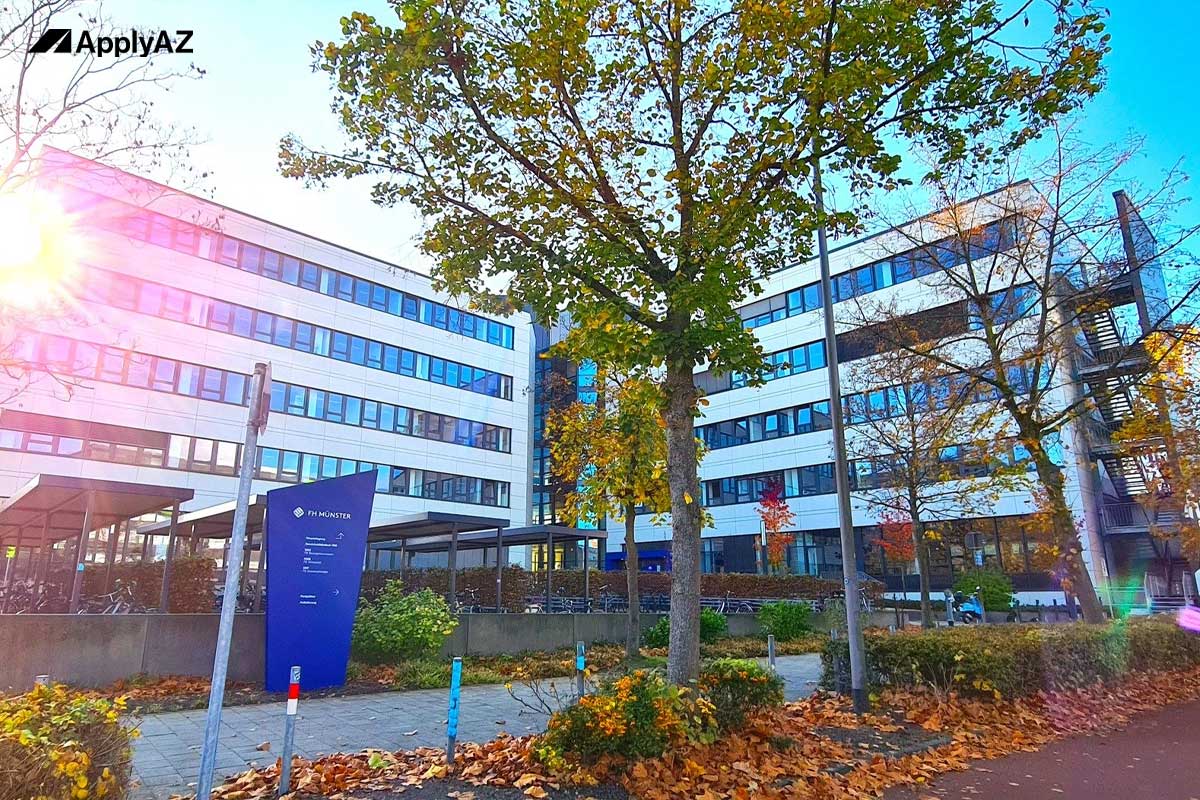
Studying at FH Münster
First look at FH Münster University of Applied Sciences
FH Münster University of Applied Sciences is a classic German university of applied sciences. That matters because the whole system is built for practice. Courses are designed around projects, real tools, and professional habits, not only theory. Many students choose it because they want a clear route from classroom to workplace. From day one, ApplyAZ helps you read the university the right way: which faculty owns your programme, which campus your classes happen on, and what the degree is really preparing you for.
A good first check is simple: look at the department, not only the programme title. In Germany, titles can sound similar while the content is very different. Also notice whether the curriculum is industry-facing or research-heavy, and whether internships or project semesters are part of the plan. These details shape your weekly life more than rankings ever will.
What studying feels like there (teaching, exams, pace)
Expect structure and steady pressure. Teaching is usually a mix of lectures, smaller practical classes, lab work, and group projects. The pace tends to be consistent, with many small deadlines rather than one giant final exam. This feels manageable if you stay organised, but it can surprise students who are used to last-minute studying. ApplyAZ supports you early by helping you estimate workload from the module plan, so you do not pick a programme that looks good on paper but is a poor fit for your learning style.
Exams can include written tests, oral exams, presentations, reports, and project submissions. In applied programmes, assessment often rewards clear thinking and correct method, not fancy writing. A common scenario is a student doing well in class but losing marks because they missed a formatting rule, a citation style, or a required appendix. Planning for these details is part of studying smart, not studying harder.
English-taught options and how to check the right track
Some programmes, tracks, or individual modules can be offered in English, but you must verify the exact path. Many students misunderstand this and assume the whole degree is English because a programme page looks international. The safest approach is to check the language of instruction for each semester and confirm whether the thesis and internship can be done in English. ApplyAZ helps you interpret programme structures and spot hidden conditions, like a German-taught first semester or a later specialisation that switches language.
Also check what “English-taught” actually requires from you. Often, the university needs a recognised test score, a minimum level, and the right timing. Another common misunderstanding is mixing up “English support” with “English degree”. If the programme includes teamwork with local companies, basic German can still be a big advantage for daily life and part-time work, even if the lectures are in English.
Admissions reality: what matters most (and what doesn’t)
Admissions in Germany are less about storytelling and more about fit on paper. The university wants to see that your previous studies match the core subjects, that your credits make sense, and that you can handle the academic level. Grades matter, but relevance can matter just as much. A typical student with a decent GPA but strong subject match often beats a higher GPA with weak match. ApplyAZ supports you by mapping your background to the curriculum, so your application aligns with what the faculty is actually selecting for.
What matters less than students think: long motivational speeches, generic certificates, or filling your CV with unrelated courses. Keep it credible and tight. What often matters more: clear module titles, consistent academic timeline, correct degree type, and meeting the language requirement exactly. Planning also means respecting deadlines and intake rules. Missing a small requirement can lead to a clean rejection, even if you are otherwise a good candidate.
Documents students underestimate (prepare early)
Most rejections that feel “unfair” are actually document issues. Students underestimate how strict German universities can be about format, completeness, and proof. Your documents are not just paperwork. They are the evidence that you match the curriculum and meet the rules. ApplyAZ supports you by reviewing your set like an admissions office would, spotting gaps early, and helping you fix them before the deadline pressure starts.
Key items students often miss or prepare too late:
- Full transcript with grades for every semester, not only a final mark sheet
- Degree certificate or provisional certificate with clear award date
- Module or course descriptions (especially for borderline subject match)
- Official grading scale explanation from your university
- Correct translations and consistent name spelling across all documents
If one piece is weak, the whole file looks risky. Preparing early protects your options.
Tuition and real costs in daily life
Tuition at German public universities is usually low compared to many countries, but “low tuition” does not mean “low cost”. Your real budget is shaped by rent, health insurance, food, transport, and the one-time costs of arrival. A common scenario is a student planning only for monthly rent, then getting hit by deposit, first-month upfront payment, and basic setup costs. ApplyAZ helps you plan realistically so your financial proof and day-to-day budget match what usually happens on the ground.
Build your cost plan around categories, not guesses:
- Housing: rent plus deposit and possible agency fees
- Health insurance: monthly, and often required before enrolment
- Semester fee: student services and transport ticket (if included)
- Daily life: groceries, phone plan, learning materials
- Arrival costs: temporary stay, bedding, kitchen basics, local registration needs
This is the difference between a calm start and a stressful first month.
Scholarships and funding: how to think, not guess
Funding is not a lottery if you treat it like a strategy. The first step is knowing which scholarships apply to your programme type, your university location, and your profile. Many students waste time chasing the wrong funding because they start with what sounds popular, not what fits. ApplyAZ supports you by building a funding plan alongside your programme shortlist, so deadlines, documents, and requirements match the applications you are actually submitting.
Think in layers: base affordability, then scholarship opportunities, then backup funding. Even when scholarships exist, they can have timing and renewal rules. Your job is to reduce risk: apply where you are eligible, prepare documents early, and keep a realistic financial buffer. Finance it with loan options via ApplyAZ. The goal is not to “hope”. The goal is to arrive with a plan that still works if one funding route takes longer than expected.
Housing and arrival planning (what to decide before you land)
Housing is often the hardest part, not the university. Good rooms move fast, and many students underestimate how early they must start. Decide your priorities before you search: budget range, commute tolerance, and whether you can accept temporary housing first. ApplyAZ supports you by helping you plan the arrival sequence, so you are not trying to solve everything in the same week. A typical safe approach is short-term stay first, then a longer rental once you can attend viewings and verify contracts properly.
Before you land, decide:
- Your first 2 to 4 weeks plan (temporary housing, location, budget)
- What documents landlords may ask for (proof of funds, ID, university letter)
- How you will handle deposits and secure payments safely
- Your timeline for city registration and bank account setup
Good arrival planning reduces stress, protects your money, and helps you start classes focused.
After graduation: work options and direction
A degree from a university of applied sciences is designed to connect to jobs, but outcomes depend on choices you make early. Internships, thesis topics, and project partners can shape your first job more than your final grade. A common scenario is a student selecting an easy thesis topic, then struggling to explain their value to employers. ApplyAZ supports you by encouraging programme choices that keep career doors open, and by helping you present your academic work in a clear, employer-friendly way.
Also think about language and location. Even with an English-taught programme, basic German can expand part-time work options and make the job search smoother. Start building direction by semester two: pick electives that match a role, collect evidence of skills through projects, and build a clean portfolio of what you can do. Germany rewards proof: results, tools, teamwork, and reliability.
How ApplyAZ supports you step-by-step
Most students struggle because they try to do everything at once: shortlist programmes, translate documents, write a motivation letter, and guess deadlines. That creates mistakes and stress. ApplyAZ supports you in a sequence that matches how admissions actually works: first build the right shortlist, then build a complete document set, then tailor each application. This keeps your efforts focused and improves quality without adding confusion. You always know what is next, what is urgent, and what can wait.
We also help you avoid the hidden traps: applying to a programme that looks suitable but requires specific credits, submitting a CV that does not match German expectations, or sending a motivation letter that is strong but off-topic for that faculty. Alongside admissions, we plan scholarship readiness and visa steps early, so your acceptance turns into a smooth arrival, not a last-minute scramble.
How ApplyAZ Gets You In
Most students find one program they like and hope for the best. That is not how we work.
It starts with a quick eligibility check, about 2 minutes, so you instantly know if this opportunity is a real option for your profile. If you are eligible, you book a private one-to-one consultation with one of our experts, where you get a clear and personalised plan built around your exact situation: your best-fit programs, your real deadlines, your scholarship path, and your exact next steps.
If you decide to move forward with us after that call, you enroll, upload your documents, and we take it from there. Our admissions team goes through your transcripts course by course, maps your background against real university requirements, and builds you a shortlist of 20 or more programs that you genuinely qualify for, across prestigious public universities, career-forward degrees taught in English, with strong graduate placement records. You review them, approve the ones you like, and then you lay back.
We write your CV and motivation letter for each program, submit every application, and track every deadline. Alongside admissions, we actively work on securing scholarships that fit your program, university, and country, whether that is DSU, DAAD, or other funding available to your profile, so you have the strongest possible shot at studying public (€0 for eligible students) with your living costs covered. Then we stay with you through visa preparation, arrival, and every practical step that follows.
Depending on your profile, you may qualify for far more programs, universities, and funding opportunities than you would ever find on your own. The only way to know is to start.
Check your eligibility now. It takes about 2 minutes. Because everything begins there.
Master in Chemical Engineering at FH Münster University of Applied Sciences
A quick sense-check: who Master in Chemical Engineering suits
Master in Chemical Engineering at FH Münster University of Applied Sciences suits students who like turning science into working processes. If you enjoy balancing theory with practical design choices, you will feel at home. Typical good fits include chemical engineering, process engineering, industrial chemistry, and related engineering degrees. ApplyAZ helps you sense-check fit early by comparing your previous modules to the programme’s core areas, not just the title. This prevents the common mistake of applying with a background that looks close but misses key foundations.
This programme can also suit adjacent profiles if your transcript shows the right mix. For example, a mechanical engineer with strong thermodynamics and fluid mechanics may fit well. A pure chemistry background can work if there is enough engineering maths and process content. If you are missing an area, the key is spotting it early, so you can plan bridging or choose a different track.
What you will gain by the end (real outcomes)
By the end, you should be able to analyse and improve chemical processes with a professional mindset. That includes selecting unit operations, thinking in systems, and making trade-offs between safety, cost, energy, and quality. You are not only learning formulas. You are learning how to move from a lab idea to a scalable process. ApplyAZ keeps the outcome focused by matching your goals to the programme style, so you do not end up in a path that is too research-only or too narrow for your career plan.
In real terms, many students graduate able to speak clearly about process design choices, data-based optimisation, and risk awareness. A typical student leaves with stronger problem framing: what information matters, what assumptions are acceptable, and what decisions cannot be delayed. This is what employers value, especially when you can show it through projects and a thesis connected to real constraints.
The learning style you should expect
Expect a structured, applied rhythm. Teaching often moves between lectures, problem sessions, labs, and project work. The programme usually rewards consistency, not last-minute effort. If you like learning by doing and testing ideas, you will do well. If you prefer only reading and exams, you may find the project load heavier than expected. ApplyAZ prepares you for this by reading the module design with you and explaining where the workload truly sits across the semester.
Assessment can involve written exams, lab reports, presentations, and teamwork deliverables. A common challenge is learning German-style academic organisation: clear formatting, careful referencing, and strict submission rules. Students sometimes lose marks for avoidable details. Treat this as part of professional training. The goal is to learn how to deliver engineering work that others can trust and use.
Modules, projects, and thesis (how the year often flows)
Most students experience the first part as foundation and alignment. You revisit core ideas at a higher level and learn shared tools that bring the cohort onto the same page. Then projects become the centre. You might work on process simulation, process control concepts, separation thinking, or materials and reaction pathways depending on the focus. ApplyAZ helps you judge whether this flow matches your strengths and your patience for teamwork, because group projects can be rewarding but demanding.
The thesis is where many students either accelerate their career or lose time. A thesis with a clear problem and measurable output can become your strongest evidence for jobs. A vague topic can create delays and stress. Plan the thesis like a project with milestones. Think early about the kind of lab, company, or research group you want, and how it connects to your post-graduation direction.
Entry requirements (clear checklist)
Requirements are usually decided by your academic match, not your personal story. You must show that your previous degree fits the engineering core and that your credits make sense. ApplyAZ checks this with a practical lens: what is essential, what is flexible, and what needs clarification from the department. The biggest risk is assuming that “related” is enough. German programmes often mean “specific”.
Use this decision logic:
- Essential: relevant bachelor’s degree, strong maths and engineering basics, solid core subject match
- Often flexible: minor gaps if your overall match is strong and your progression is clear
- Needs clarification: unusual degree titles, mixed transcripts, missing course descriptions, non-standard grading scales
If one item is unclear, do not guess. Build the proof in your documents.
How to read your transcript against the requirements
Transcript matching is where most students misunderstand the process. It is not about your final GPA alone. It is about what you studied, how much you studied it, and whether the content aligns. A typical strong profile shows steady progression in maths, thermodynamics, transport phenomena, reaction engineering, and process-related subjects. ApplyAZ supports you by mapping your modules into the programme’s expected areas, so your application looks coherent to an admissions reviewer.
A common scenario: a student has the right degree title but missing depth in one key area, like mass transfer or process control. Another scenario: a chemistry student has excellent lab skills but weak engineering maths. The solution is not always “apply anyway”. Sometimes it is better to select a different programme, or to prepare strong course descriptions that prove equivalency. The earlier you do this, the more options you keep.
Documents to prepare early (avoid delays)
Delays usually come from documents, not from academic ability. Start early because universities can be strict about format and completeness. ApplyAZ helps you prepare a clean set that answers questions before they are asked. That is the difference between a fast review and a back-and-forth that burns weeks.
Prepare these early:
- Full transcripts for every semester, with grading scale details
- Degree certificate or official provisional certificate with award date
- Course descriptions for key modules that prove subject match
- Proof of language level as required by the programme
- Consistent translations and consistent name spelling across all files
If your degree is from a system the university may not know well, course descriptions become even more important.
Tuition, fees, and living costs (real planning)
Many students focus on tuition and forget daily reality. In Germany, tuition can be low at public universities, but you still need a stable plan for rent, insurance, food, and arrival costs. A typical issue is underestimating deposits and first-month payments. ApplyAZ supports your planning by turning costs into a timeline: what you pay before arrival, what you pay in the first month, and what becomes monthly.
Also plan for “friction costs”. These are small but real: temporary housing, local registration needs, and basic setup. Treat your budget as risk management. Build a buffer for delays, because housing and paperwork can take longer than expected. If you plan calmly, you start stronger academically and you avoid making desperate choices that cost more later.
Scholarships and funding (smart approach)
Funding works best when you treat it as a system, not a hope. First, understand what scholarships apply to your type of programme and your situation. Then prepare documents early, because many funding routes depend on timing and proof. ApplyAZ supports you by aligning your application plan with your scholarship plan, so you are not accepted but unprepared financially.
A smart approach is layered: plan the base budget, pursue scholarships that match your profile, then keep a backup funding route. Finance it with loan options via ApplyAZ. The key is to avoid a single-point failure. Students often lose time because they chase one funding option and ignore deadlines for others. If you plan in layers, you reduce stress and protect your timeline.
Career direction after Master in Chemical Engineering
Career outcomes depend on how you shape your evidence. Employers care about what you can do, not only the degree name. A strong graduate can talk clearly about process decisions, safety thinking, optimisation, and structured problem solving. Your projects and thesis can become proof of these skills. ApplyAZ helps you keep career direction in focus while you apply, so your choices in electives and thesis topic support the roles you want.
Common directions include process engineering, production and operations, quality and validation, sustainability and energy systems, and technical roles in chemicals, materials, and manufacturing. A typical mistake is choosing the easiest thesis topic rather than the most useful. Pick a topic that lets you show real methods and results. Even a small project can become powerful if you can explain your approach and your decisions.
How ApplyAZ supports you step-by-step
ApplyAZ supports you from the first decision to arrival planning. We start by checking programme fit properly, based on your transcript and goals. Then we build an application plan that respects deadlines and avoids last-minute surprises. Next, we review your documents for gaps and fix issues early, especially course descriptions and grading clarity. We support motivation letter and CV alignment so your file reads as consistent and credible, not generic.
We also keep scholarship and visa planning connected to admissions. Many students treat these as separate steps and lose time. We treat them as one timeline. That means fewer delays, fewer document errors, and a calmer process. You always know what matters now, what can wait, and what decisions reduce risk later.
We Handle Everything. You Just Need to Qualify.
You upload your transcripts. We go through them carefully, match you to 20 or more English-taught programs at prestigious public universities with strong placement records, write your applications, and actively pursue every scholarship available for your profile, whether that is DSU, DAAD, or others depending on the university and country.
You review your shortlist, approve what fits, and we take care of the rest.
The only thing left for you to do right now is find out if you qualify.
Check your eligibility. It takes about 2 minutes.
Tuition and scholarships
Public universities in Germany charge no tuition fees for international students. A semester contribution typically applies, covering administrative costs and often a public transport pass.
DAAD (German Academic Exchange Service) offers scholarships for international master's students, covering living costs and a travel allowance. Apply through the DAAD portal separately from your university application.
The Deutschlandstipendium provides €300 per month, co-funded by the federal government and private sponsors. Applications go through the university's scholarship office after enrolment.
For Indian applicants
Indian graduates with a degree recognised by AIU (Association of Indian Universities) can apply to German public universities through uni-assist. The uni-assist portal handles degree equivalency verification and is the standard route for most non-EU applicants. Check your eligibility with us first.
Similar programmes
More free programmes in this city

They Began right where you are

