

Master of Arts in European Studies
Master of Arts in European Studies at University of Flensburg suits students who want to understand EU politics, policy, and integration in depth. ApplyAZ maps out the entry requirements, funding routes, and visa timeline for this program specifically.
Master
4 semesters
Flensburg
English
University of Flensburg



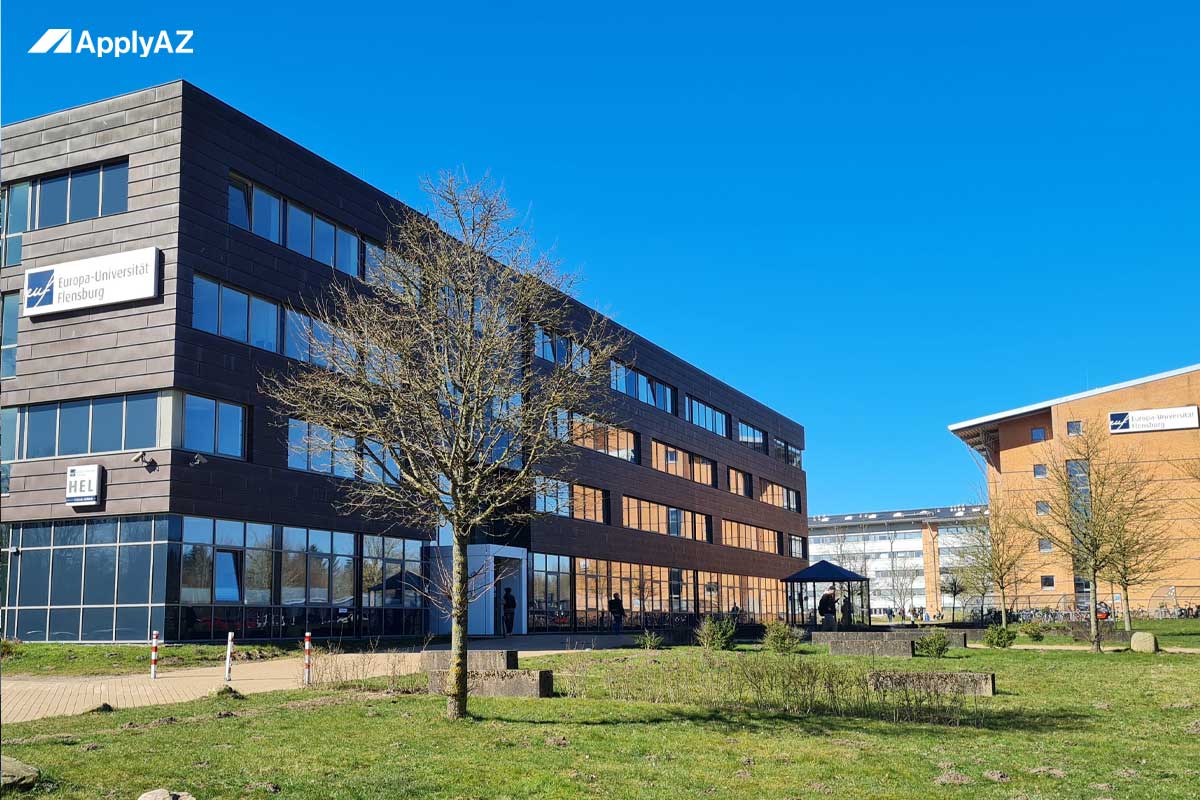
A guide to Europa-Universität Flensburg
First look at Europa-Universität Flensburg
Europa-Universität Flensburg sits in Germany’s far north, close to the Danish border. That location shapes the whole experience. The city is smaller and calmer than the big student hubs. Many students like the focus it creates, especially if they want fewer distractions and more routine. The university itself feels compact and walkable. You usually learn the campus fast, which reduces stress in the first weeks.
ApplyAZ typically starts here by helping you define what “fit” means for you, not in theory, but in daily life. Some students want a quiet place to study. Others need a bigger job market during the semester. This single choice affects your housing, budget, and even the type of programme you should choose.
When you compare universities, do not only compare rankings or city photos. Look at what will shape your week. Think about travel time, part-time work options, and how international the classroom feels. Those things are often more important than the name on the degree.
What studying feels like there (teaching, exams, pace)
At Europa-Universität Flensburg, the pace usually rewards consistency more than last-minute effort. Many students coming from systems where exams decide everything get surprised by how often you are assessed through the term. You might have readings, seminars, group work, presentations, and smaller written assignments that build toward the final grade. If you enjoy steady progress, this can feel fair. If you are used to cramming, it will require a new rhythm.
Teaching can be discussion-based, especially in seminar formats. That means you are expected to speak, not only listen. A typical student notices that preparation matters. When you come to class with notes and questions, you get more out of it. If you come unprepared, it shows quickly, because participation is visible.
Exams vary by department. Some are written exams, some are papers, some are project-based. What matters is learning how your specific programme evaluates you. ApplyAZ helps students read module descriptions properly so you know what the semester will actually demand, not what you assume it will demand.
English-taught options and how to check the right track
English-taught options exist, but the key is making sure you are looking at the correct track and intake. Many students misunderstand this step. They see an English description and assume the whole programme is English. In reality, some programmes are mixed, some have English modules but German requirements later, and some have different tracks inside the same degree.
A common scenario is a student choosing a programme that looks perfect, then later realising the thesis supervision or core modules require German. Another scenario is missing the right application window because a track starts only in one semester. Your job is to confirm three things early: language of instruction for core modules, intake term, and the exact admission route for international applicants.
ApplyAZ supports this step by checking programme pages and module handbooks with you, then translating the information into clear decisions. We do not only ask “is it English-taught”. We ask “will you be able to complete every required module, internship, and thesis path in your language”.
Admissions reality: what matters most (and what doesn’t)
Admissions in Germany often looks simple from the outside, but details decide outcomes. What matters most is whether your prior education matches the programme’s academic requirements. This is not about how confident you feel. It is about modules, credits, and the subject area fit. Many programmes are strict about prerequisites. If they want specific coursework, they want it clearly shown in transcripts and course descriptions.
What often matters less than students think is “personal story” on its own. Motivation letters can help, but they rarely replace missing academic requirements. A strong letter supports a strong match, it does not create one. Another common misunderstanding is GPA obsession. Some programmes have minimum thresholds. Others focus more on eligibility and document completeness. It depends on the department and the admissions model.
ApplyAZ works like a filter at this stage. We separate “eligible on paper” from “hopeful but risky”. Then we plan a shortlist that protects you from wasted time, wasted fees, and missed intakes.
Documents students underestimate (prepare early)
Most rejections that feel “unfair” are actually document problems. Students underestimate how picky universities can be about format, wording, and completeness. The earlier you prepare, the fewer surprises you face when deadlines get close.
Here are documents that commonly cause delays:
- Course descriptions or syllabi that clearly show what you studied
- Transcripts with correct grading scale context
- Degree certificates and provisional certificates with clear issue dates
- Language test results that meet the programme’s exact rules
- Passport validity and name consistency across all documents
A typical mistake is submitting a course description that is too vague. Another is having different spellings of the same name across documents. Those issues create back-and-forth when you can least afford it. ApplyAZ supports this step by checking your documents as a set, not individually. We look for consistency, missing pieces, and anything that could trigger a request for clarification.
This is also where planning beats speed. If you wait until the last week, you will pay extra in stress, courier time, and rushed translations. If you build your file early, applications become execution, not panic.
Tuition and real costs in daily life
Tuition in Germany is often lower than many countries, but “cheap” is not the same as “easy”. Your real cost is daily life. Rent, health insurance, semester contributions, transport, food, and upfront arrival expenses add up. A typical student budget challenge is the first two months, when deposits, registration steps, and setup costs hit at once.
Living in a smaller city can help, but it depends on the housing market and your timing. Do not assume that a calm city means easy housing. It can still be competitive if supply is limited. Also plan for the costs that are not monthly, such as residence permit fees, winter clothing, and occasional travel.
ApplyAZ helps you build a realistic budget based on your study plan and your expected timeline, so you do not underfund the start. Finance it with loan options via ApplyAZ.
The best decision you can make here is to plan cash flow, not only totals. Knowing when you need money is as important as knowing how much you need overall.
Scholarships and funding: how to think, not guess
Funding is not a lottery if you approach it correctly. The smart way is to map what you qualify for, then align it with the right intake and programme type. Many students waste time chasing scholarships that do not match their citizenship, degree level, or programme category. Others miss good options because they assumed “scholarship” only means a full tuition waiver.
Think in layers. Some funding supports living costs. Some reduces tuition. Some is linked to academic merit. Some is linked to need, background, or a specific subject area. The key is deadlines and rules. Funding options often close earlier than you expect, and they can require documents you cannot produce in a week.
Two signals usually matter: how clearly you fit the criteria, and how clean your document package is. ApplyAZ supports this step by building a funding strategy alongside your admissions plan, not after. That means you do not apply first and hope later. You choose programmes with funding paths that make sense for your profile and timeline.
When you hear “everyone gets funding”, treat it as noise. What matters is what you can prove, what you can submit, and what you can submit on time.
Housing and arrival planning (what to decide before you land)
Arrival planning is where small mistakes become expensive. You do not want to land and then start making decisions that should have been made weeks earlier. The best arrivals look boring on paper because everything important is already decided. Housing plan, temporary accommodation, city registration steps, health insurance setup, and transport are all mapped.
Before you land, decide:
- Your housing strategy (student housing, private room, short-term then move)
- Your first 14 days plan (address, registration appointment, essentials)
- Your document folder for local steps (printed copies plus digital backups)
A common scenario is arriving with a temporary address that cannot be used for registration, then losing time and paying for extra accommodation. Another is not understanding what proof is needed for contracts and payments. ApplyAZ helps you plan this stage with practical checklists, timing guidance, and realistic options based on your intake month.
If you do this well, your first week feels calm. If you do it poorly, your first week becomes admin chaos, and that affects your studies from day one.
After graduation: work options and direction
After graduation, the strongest outcomes come from early direction. Many students wait until the final semester to think about work. That is usually too late. What helps most is aligning your programme choice with your target roles, then building proof during your studies. Proof means projects, internships, part-time work, and networking, not only good grades.
Germany rewards relevance. If your coursework and experience match the role, your chances rise. If they do not, you may struggle even with a good degree. This is why programme fit is not only about interest. It is about what the programme trains you to do and what employers in your field actually hire for.
ApplyAZ supports students by keeping the “after graduation” plan in mind during shortlisting. We look at the likely outcomes of each programme and the kind of student who thrives in it. A typical student benefits from a plan that starts in semester one: build language skills if needed, choose modules with market value, and secure practical experience early.
Your degree opens doors, but your decisions during the degree decide which doors stay open.
How ApplyAZ supports you step-by-step
ApplyAZ supports students end-to-end, but the value is in doing each step in the right order. We start by reducing risk. That means confirming your academic match, your language fit, and your intake timeline before you spend months applying. Then we build a shortlist that is not random. It is built around what you genuinely qualify for and what makes sense for your future direction.
Next comes document readiness. This is where most students lose time. We review your full set, identify gaps, and guide you to fix them early. Then we support application execution: CV alignment, motivation letters that match the programme, and submission tracking so deadlines do not sneak up.
Scholarship strategy is not an add-on. We plan it alongside admissions so your funding path matches your choices. Visa guidance follows naturally when your admissions and funding plan are clear, because visa success is usually the result of clean planning, not last-minute fixes.
How ApplyAZ Gets You In
Most students find one program they like and hope for the best. That is not how we work.
It starts with a quick eligibility check, about 2 minutes, so you instantly know if this opportunity is a real option for your profile. If you are eligible, you book a private one-to-one consultation with one of our experts, where you get a clear and personalised plan built around your exact situation: your best-fit programs, your real deadlines, your scholarship path, and your exact next steps.
If you decide to move forward with us after that call, you enroll, upload your documents, and we take it from there. Our admissions team goes through your transcripts course by course, maps your background against real university requirements, and builds you a shortlist of 20 or more programs that you genuinely qualify for, across prestigious public universities, career-forward degrees taught in English, with strong graduate placement records. You review them, approve the ones you like, and then you lay back.
We write your CV and motivation letter for each program, submit every application, and track every deadline. Alongside admissions, we actively work on securing scholarships that fit your program, university, and country, whether that is DSU, DAAD, or other funding available to your profile, so you have the strongest possible shot at studying public (€0 for eligible students) with your living costs covered. Then we stay with you through visa preparation, arrival, and every practical step that follows.
Depending on your profile, you may qualify for far more programs, universities, and funding opportunities than you would ever find on your own. The only way to know is to start.
Check your eligibility now. It takes about 2 minutes. Because everything begins there.
Studying Master of Arts in European Studies at Europa-Universität Flensburg in Germany
A quick sense-check: who Master of Arts in European Studies
fits students who want to understand Europe as a lived system, not just a political idea. If you enjoy connecting policy, society, economics, history, and law, you will likely feel at home. A typical good-fit student likes reading, writing, and discussing complex issues in a structured way. You should also be comfortable with nuance. Many questions will not have one correct answer, but they will have stronger and weaker arguments.
This programme often suits backgrounds like political science, international relations, sociology, economics, history, law, or area studies. If you come from business, engineering, or STEM, you can still fit, but you must prove your link to European affairs through coursework, internships, or clear motivation. ApplyAZ helps you test fit early by comparing your transcript and experience to the programme’s focus, so you do not apply based on assumptions.
What you will gain by the end (real outcomes)
By the end, you should be able to analyse European issues with discipline. That means you can take a topic like migration, energy security, democracy, trade, or EU enlargement and break it into parts: actors, institutions, incentives, and real-world constraints. You will learn how to write in an academic style that is clear and defensible. That skill matters because many roles in policy, research, and international organisations rely on written analysis.
You will also gain a practical ability to work across perspectives. European studies often teaches you to compare systems and avoid oversimplified narratives. A typical outcome is that students become stronger at reading policy documents, framing research questions, and presenting findings to mixed audiences. ApplyAZ supports you by helping you align your application story with these outcomes, so your motivation letter shows you understand what the degree actually trains you to do, not just what the title sounds like.
The learning style you should expect
Expect a seminar-driven style. You will likely read regularly and come prepared to discuss texts, case studies, and current debates. Many students underestimate how important weekly preparation is. If you show up without having done the reading, you fall behind quickly because discussion builds on shared material. You do not need to be loud, but you do need to be ready to contribute thoughtfully.
Assessment often includes essays, research papers, presentations, and sometimes written exams. Group work may appear, especially for projects that simulate policy or research settings. The pace tends to reward steady work rather than late bursts. ApplyAZ helps you judge whether this learning style fits you by reading module descriptions carefully with you and translating them into what your week will actually look like, including the workload peaks you should plan for.
Modules, projects, and thesis (how the year often flows)
The year often starts with foundations: key European institutions, theories, and methods. Many students experience the first semester as a “reset” in how they think and write. Even if you studied related subjects before, you may need to adjust to a new academic culture and expectations for evidence and structure. A typical second-semester shift is toward applied themes, where you pick focus areas and begin forming a research direction.
Projects usually help you practise real skills: analysing policy problems, comparing countries, or building a research design. Your thesis is where the degree becomes personal. A strong thesis topic is not just interesting. It is narrow enough to answer, supported by accessible sources, and aligned with supervisor expertise. ApplyAZ supports this planning by helping you choose programmes and tracks where your likely thesis interests are realistic, and by ensuring your application materials reflect a clear direction without locking you into a topic too early.
Entry requirements (clear checklist)
Entry rules can look simple, but the details decide eligibility. You should treat requirements as a checklist you can prove with documents, not a wish list. What matters most is academic match and whether your prior coursework covers the expected areas.
Key items to confirm early:
- Relevant undergraduate degree or clearly related coursework
- Proof of language level required for the programme
- Transcript that shows course titles and grading clearly
- Any required credit areas (if specified) and how you meet them
- Application timing and intake rules for international students
Some parts may be flexible, such as exact job experience or the “perfect” background, but core academic fit is rarely flexible. ApplyAZ guides you by checking what is essential versus what needs clarification, so you avoid applying with a weak assumption like “my degree is close enough” when the programme expects specific content.
How to read your transcript against the requirements
Most students read requirements like marketing. You must read them like an admissions officer. Start by mapping your modules to the programme’s expected foundation areas. Do not rely on your degree title alone. Admissions teams often judge fit by course content, not by what you call your major. If your transcript is vague, course descriptions become the evidence that protects you.
A common scenario is a student with a general social science degree who is a good match, but their transcript uses broad titles like “Contemporary Issues”. Without descriptions, it can look weak. Another scenario is a business graduate who fits through EU-related electives and internship experience, but only if they present it clearly. ApplyAZ helps by reviewing your transcript course by course, identifying gaps, and suggesting how to present your academic link honestly. The goal is not to exaggerate. The goal is to make the true match visible.
Documents to prepare early (avoid delays)
Delays usually come from documents, not from “bad luck”. If you prepare your file early, the whole process becomes calmer and cleaner. Many students do not realise how long it can take to get correct versions of certain documents, especially when signatures, stamps, translations, or verifications are involved.
Prepare these early:
- Official transcript plus an explanation of the grading scale
- Degree certificate or provisional certificate with issue date
- Course descriptions for key modules that prove relevance
- Language test results that match the programme’s exact rules
- Passport and name consistency across every document
The most common mistake is rushing translations or uploading mismatched versions. Another is submitting course descriptions that are too short to prove content. ApplyAZ prevents these delays by checking your full document set as one package, spotting inconsistencies, and telling you what to fix before the deadline pressure starts.
Tuition, fees, and living costs (real planning)
Tuition in Germany is often manageable, but your real costs are daily life and timing. You should plan for semester contributions, health insurance, rent, deposits, and the first-month setup expenses that hit all at once. A typical student gets caught by cash-flow issues, not by the total amount. The first six to eight weeks are often the tightest period, because housing deposits and registrations happen before your routine stabilises.
Living in a smaller city can reduce costs, but housing can still be competitive if supply is limited. Plan your budget with a buffer for temporary accommodation, travel, winter basics, and admin fees. ApplyAZ helps you build a realistic cost plan based on your intake month and your likely housing route, so you avoid underestimating the start-up phase. Finance it with loan options via ApplyAZ.
Scholarships and funding (smart approach)
Funding works best when it is planned alongside admissions, not after. Many students lose time chasing “big scholarships” without checking if they qualify. A smarter approach is to map funding by eligibility rules and deadlines, then choose programmes where your funding path makes sense. You should also separate tuition support from living support. They are not the same, and they often have different application timelines.
A typical mistake is applying to a programme and only later learning that a funding path requires earlier paperwork or specific documents. Another is assuming funding depends only on grades. In practice, clean documentation and correct timing matter just as much. ApplyAZ supports this stage by building a funding strategy with your programme shortlist and your timeline, so you are not guessing. The goal is to reduce uncertainty and increase the number of realistic options you can pursue without missing key steps.
Career direction after Master of Arts in European Studies
Career direction depends on how you position the degree. This programme can lead toward policy analysis, research, public affairs, NGOs, international organisations, journalism, consulting, or roles connected to EU-facing industries. But the degree alone is not a job. What matters is evidence. A student who writes strong research papers, builds a clear theme, and gains practical experience often progresses faster than a student who only collects credits.
A good way to choose direction is to ask: do you prefer research, stakeholder work, or implementation. Research-oriented students can aim for think tanks or PhD routes. Stakeholder-oriented students can look at public affairs, communications, and programme coordination. Implementation-oriented students can target project roles in NGOs or agencies. ApplyAZ helps you keep this in mind during programme selection and application writing, so your narrative matches the outcomes and makes sense to employers later.
How ApplyAZ supports you step-by-step
ApplyAZ supports you end-to-end, but the key is doing steps in the right order. We start with programme fit, using your transcript and experience to confirm whether Master of Arts in European Studies
is realistic and sensible for your goals. Then we move to document readiness, because strong fit still fails if your file is incomplete or inconsistent. We check your transcript details, course descriptions, grading scale clarity, and language proof so your application reads clean and credible.
Next comes the application plan. We build a shortlist that reduces risk and protects deadlines. Then we shape your CV and motivation letter to match the programme’s real focus, not generic phrases. We also plan scholarship strategy alongside admissions, so funding decisions are not left to chance. Finally, we support visa guidance and arrival planning, so what you submit aligns with the practical realities of moving to Germany.
We Handle Everything. You Just Need to Qualify.
You upload your transcripts. We go through them carefully, match you to 20 or more English-taught programs at prestigious public universities with strong placement records, write your applications, and actively pursue every scholarship available for your profile, whether that is DSU, DAAD, or others depending on the university and country.
You review your shortlist, approve what fits, and we take care of the rest.
The only thing left for you to do right now is find out if you qualify.
Check your eligibility. It takes about 2 minutes.
Tuition and scholarships
Public universities in Germany charge no tuition fees for international students. A semester contribution typically applies, covering administrative costs and often a public transport pass.
DAAD (German Academic Exchange Service) offers scholarships for international master's students, covering living costs and a travel allowance. Apply through the DAAD portal separately from your university application.
The Deutschlandstipendium provides €300 per month, co-funded by the federal government and private sponsors. Applications go through the university's scholarship office after enrolment.
For Indian applicants
Indian graduates with a degree recognised by AIU (Association of Indian Universities) can apply to German public universities through uni-assist. The uni-assist portal handles degree equivalency verification and is the standard route for most non-EU applicants. Check your eligibility with us first.
Similar programmes
More free programmes in this city

They Began right where you are

