

Master in Resource Efficiency in Architecture and Planning
Master in Resource Efficiency in Architecture and Planning at HafenCity University Hamburg in Germany suits students who want to work on the built environment with a clear sustainability lens. In terms of outcomes, career direction depends on the niche you build. ApplyAZ maps out the entry requirements, funding routes, and visa timeline for this program specifically.
Master
4 semesters
Hamburg
English
HafenCity University Hamburg



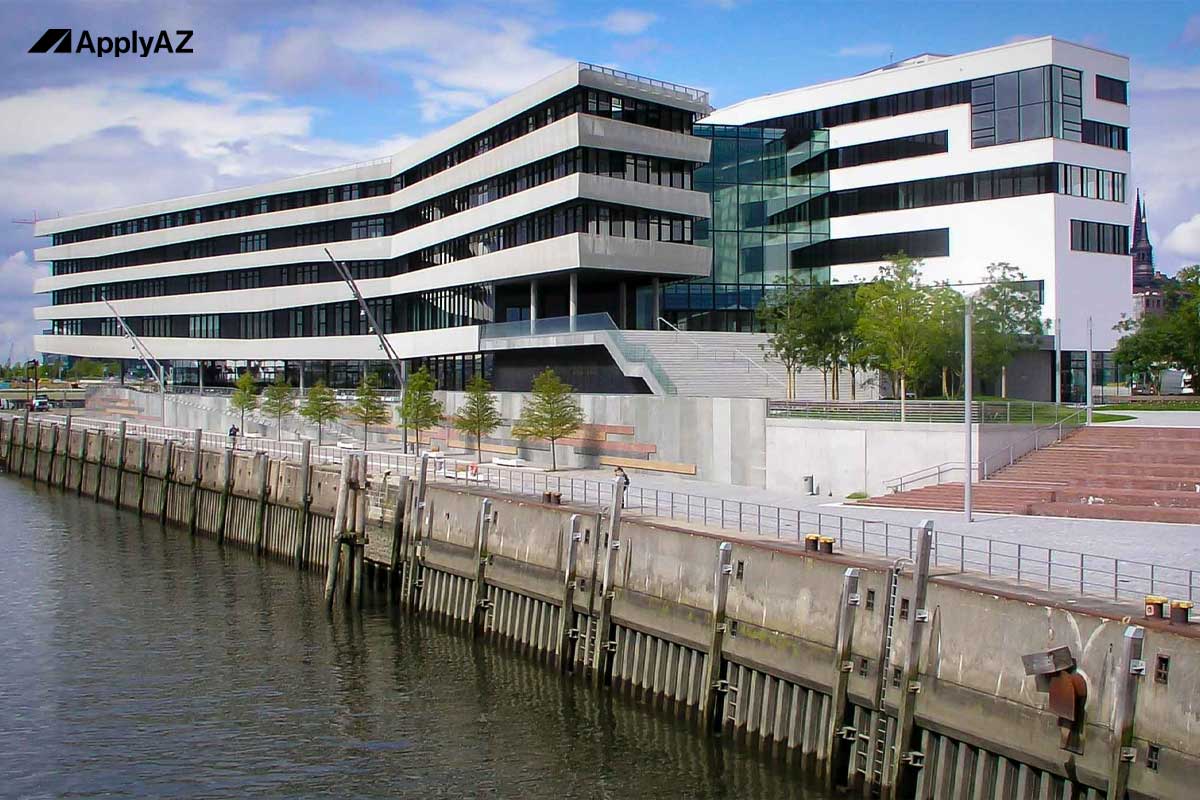
HafenCity University Hamburg
First look at HafenCity University Hamburg
HafenCity University Hamburg is a small, specialist public university with a clear focus: the built environment. That usually means architecture, urban planning, civil engineering, geomatics, and related research on cities. Students often choose it because they want a university where most people are working on similar questions, not a general campus where your subject is one corner of a big system.
When ApplyAZ guides a student here, we start by confirming whether their goals match that focus. If you want a broad business degree, this is not the place. If you want to work on real spatial problems, sustainability, housing, transport, infrastructure, or digital mapping, this kind of specialist university can be a strong fit. The value comes from depth, not variety.
What studying feels like there (teaching, exams, pace)
Expect a studio and project culture in many tracks. Learning is often built around assignments that develop over weeks, with reviews, presentations, critiques, and iterative improvements. Even in more technical areas, you may see teamwork and applied tasks, not only final exams. That changes how you should prepare. Many students underestimate the time needed for a good project submission compared with a classic exam revision cycle.
A typical student week may involve reading, software work, group coordination, and feedback sessions. Your pace is driven by deadlines and checkpoints. If you work well with structure and can handle multiple parallel tasks, you will likely feel comfortable. If you prefer one clear exam at the end, you need to adjust early. ApplyAZ helps students plan workload realistically, including how to balance part-time work with submission-heavy semesters.
English-taught options and how to check the right track
Germany has many programmes that are partly English, fully English, or English with some German requirements later. The difference matters for admissions, visa planning, and your day-to-day life. At a specialist university, English-taught options may sit within certain departments, or be offered as specific Master’s tracks rather than across the whole university.
Do not rely on a single line that says “language: English.” You need to confirm what language is used in teaching, what language is used in exams, and whether internships or project partners require German. ApplyAZ checks these details with you at shortlisting stage, because choosing the wrong track can cost a full intake year. A common scenario is a student applying to a programme that is taught in English but expects German for local planning studios or site coordination.
Admissions reality: what matters most (and what doesn’t)
For a built-environment university, your academic fit often matters more than your brand-name CV lines. Admissions teams usually look for evidence that you can handle the discipline: relevant modules, a coherent learning path, and the right foundation skills. If your background is not perfectly aligned, you may still succeed if you can show clear continuity through courses, projects, and motivation.
What tends to matter: degree relevance, module content, portfolio or project evidence (where applicable), and how well you explain your direction. What tends to matter less than students think: fancy job titles, generic certificates, or a long list of online courses with no applied outcome. ApplyAZ supports you by translating your background into the language admissions reviewers care about, so your application reads like a logical next step, not a random pivot.
Documents students underestimate (prepare early)
Students often think documents are “admin work” and leave them for later. In Germany, documents are part of the evaluation itself. Missing items can slow review, reduce credibility, or make you miss a deadline even if you are academically strong. Prepare early because universities often ask for exact formats and certified versions.
Commonly underestimated items include:
- Detailed transcripts with course titles, grades, and credit hours, not only a final marks sheet
- Degree certificate or provisional certificate with clear award date
- Proof of language ability that matches the programme’s exact accepted tests and minimums
ApplyAZ checks your document set for completeness and consistency before you apply. We look for mismatches that trigger delays, like different spellings of names, missing grading scales, or unclear credit systems that make your academic level hard to judge.
Tuition and real costs in daily life
Public universities in Germany often have low tuition compared with many other countries, but “low tuition” is not the same as “low cost.” You should plan for semester fees, health insurance, housing deposits, and month-to-month living expenses. A typical student expense pattern includes a large upfront arrival cost, then a stable monthly budget once you settle.
Hamburg can be more expensive than smaller cities, especially for rent. Many students run into trouble because they plan only for the monthly number and forget the first-month realities: deposit, temporary accommodation, transport setup, and basic household items. ApplyAZ helps you map your budget to the real timeline, so you do not arrive underfunded. Finance it with loan options via ApplyAZ, but always plan the repayment logic before you commit.
Scholarships and funding: how to think, not guess
Funding in Germany is rarely a single magic solution. The smart approach is to build a funding strategy that combines what you can control (timelines, documents, strength of profile) with what you cannot (competition, quota limits, changing rules). Students often guess based on social media posts and assume eligibility. That creates false confidence and late planning.
A better method is to treat funding like a pipeline: shortlist scholarships that match your nationality, level, and programme type, then check deadlines and required documents early. Some options reward strong academic alignment, others focus on need, and others are tied to institutions or regions. ApplyAZ supports scholarship strategy by aligning your programme choices with realistic funding pathways, and by making sure your documents and narratives match the scholarship logic, not just the admission logic.
Housing and arrival planning (what to decide before you land)
Housing is one of the biggest stress points in Germany, especially in major cities. The key decision is not only “where will I live,” but “how will I bridge the first weeks.” Many students need temporary housing while they search for longer-term options. That is normal, but it must be planned financially and emotionally.
Before you land, decide:
- Your maximum rent and deposit comfort level
- Whether you can accept shared housing to start faster
- Your arrival buffer, including temporary stay and transport setup
A common scenario is a student who arrives with a tight budget and no buffer, then has to accept the first available room and commute far, which impacts study performance. ApplyAZ helps you plan the sequence: initial stay, registration needs, and the realistic window for finding stable housing.
After graduation: work options and direction
If you study a built-environment discipline, your career direction often depends on your specialisation and your language strategy. Technical roles can be more accessible in English-first contexts, but many roles linked to local planning, permitting, or public-facing work may value German more. You do not need perfect German on day one, but you should plan how you will build it alongside study if your target roles require it.
Think in outcomes, not job titles. Do you want design and concept work, technical delivery, data-driven spatial analysis, or research-led pathways? Internships and student jobs often shape the post-graduation story. ApplyAZ helps students choose programmes with structure that supports employability, and we guide you on how to present your projects, thesis focus, and internships as a coherent professional profile.
How ApplyAZ supports you step-by-step
ApplyAZ supports you from first shortlist to arrival planning, with clear actions at each stage. We start by making sure HafenCity University Hamburg matches your academic and career direction, then we check the language and track details so you apply to the right programme version. After that, we focus on document readiness, because strong applicants still get delayed by missing or inconsistent files.
We then shape your CV and motivation so they speak the university’s language: alignment, evidence, and direction. We also help you plan funding and visa documentation in parallel, not after admission, because timing is where many students lose momentum. Finally, we support practical planning: housing strategy, arrival steps, and how to reduce common risks that come from last-minute decisions.
How ApplyAZ Gets You In
Most students find one program they like and hope for the best. That is not how we work.
It starts with a quick eligibility check, about 2 minutes, so you instantly know if this opportunity is a real option for your profile. If you are eligible, you book a private one-to-one consultation with one of our experts, where you get a clear and personalised plan built around your exact situation: your best-fit programs, your real deadlines, your scholarship path, and your exact next steps.
If you decide to move forward with us after that call, you enroll, upload your documents, and we take it from there. Our admissions team goes through your transcripts course by course, maps your background against real university requirements, and builds you a shortlist of 20 or more programs that you genuinely qualify for, across prestigious public universities, career-forward degrees taught in English, with strong graduate placement records. You review them, approve the ones you like, and then you lay back.
We write your CV and motivation letter for each program, submit every application, and track every deadline. Alongside admissions, we actively work on securing scholarships that fit your program, university, and country, whether that is DSU, DAAD, or other funding available to your profile, so you have the strongest possible shot at studying public (€0 for eligible students) with your living costs covered. Then we stay with you through visa preparation, arrival, and every practical step that follows.
Depending on your profile, you may qualify for far more programs, universities, and funding opportunities than you would ever find on your own. The only way to know is to start.
Check your eligibility now. It takes about 2 minutes. Because everything begins there.
Designing With Less
A quick sense-check: who Master in Resource Efficiency in Architecture and Planning suits
Master in Resource Efficiency in Architecture and Planning at HafenCity University Hamburg in Germany suits students who want to work on the built environment with a clear sustainability lens. It fits people who enjoy asking hard questions about materials, energy, land use, and the long-term impact of design decisions. If you like combining design thinking with evidence, policy awareness, and real constraints, this programme will feel purposeful rather than abstract.
ApplyAZ usually sees strong fit from architecture, urban planning, civil engineering, environmental design, landscape-related fields, and building services. A common borderline case is someone from pure business or social sciences who is passionate about sustainability but has limited design or technical foundations. That can still work, but you need a clear bridge plan and a convincing portfolio of relevant projects.
What you will gain by the end (real outcomes)
By the end, you should be able to evaluate design and planning choices through resource use, life-cycle thinking, and climate impact. That means you can move beyond “green statements” and show how a building, district, or policy choice performs under real assumptions. You also learn to communicate these decisions to different audiences, including technical reviewers and non-technical stakeholders.
Your practical outcome is credibility. Employers and project partners want people who can balance sustainability goals with cost, feasibility, and regulation. A typical graduate can contribute to early-stage concept decisions, retrofit planning, material strategies, and urban sustainability projects. ApplyAZ helps students keep their outcomes career-linked by guiding elective choices and thesis direction early, so your portfolio reads like a clear specialism, not a collection of unrelated sustainability topics.
The learning style you should expect
Expect a project-led learning style. You will likely work with case studies, design tasks, and applied research, often in teams. The pace can feel fast because many deliverables build on each other: you analyse a context, define a resource problem, test options, and then present a defensible strategy. This is not only about creativity. It is also about structure, assumptions, and clear reasoning.
A common mistake is treating sustainability as a “theme” instead of a method. Students sometimes present attractive concepts without showing measurable logic or trade-offs. Reviewers notice quickly. ApplyAZ prepares students for this by helping you frame your prior work in a way that shows how you think, how you justify decisions, and how you handle constraints, which is exactly what the programme will test.
Modules, projects, and thesis (how the year often flows)
Many students experience the programme in phases. Early work often builds shared foundations: resource concepts, assessment methods, and the language of sustainable planning. Then projects become more applied, where you test strategies in realistic contexts. Later, electives and thesis work let you narrow your direction, such as circular construction, low-carbon planning, adaptive reuse, or resilient urban systems.
Treat the thesis as your strongest career signal. A well-chosen thesis can connect you to future employers or research groups because it proves you can take a complex sustainability problem and produce a structured answer. ApplyAZ supports this flow by planning your story from the start: what you want to become, what project themes support that, and how your thesis can produce an output that is easy for employers to understand and trust.
Entry requirements (clear checklist)
Entry requirements can look simple on paper, but the real filter is relevance and evidence. Use this checklist to judge whether you are close, then identify what needs clarification.
- A relevant first degree connected to architecture, planning, engineering, or built-environment studies
- Evidence of design, planning, or technical coursework that supports the programme’s core work
- Proof of language ability that matches the track’s stated requirement
- A transcript that clearly shows course titles, grades, and credits
- Supporting work that proves fit, such as project documentation or a portfolio where applicable
ApplyAZ checks whether your degree label matches the content. Many applicants get stuck because they assume the degree title is enough. Evaluators often look deeper.
How to read your transcript against the requirements
Read your transcript like a reviewer, not like a student. The question is not “did I pass.” It is “does this transcript prove I can handle the programme’s workload.” Highlight modules that show built-environment fundamentals, design studios, planning methods, building physics, sustainability, materials, environmental systems, or project-based work. Then consider depth. One course in sustainability is weaker evidence than a sustained sequence across semesters.
Realistic fit examples help. Background A in architecture with studios and building science often aligns well. Background B in civil engineering can fit if it includes urban or environmental applications and project work. Background C in environmental science may need stronger built-environment evidence, like spatial planning, design methods, or applied projects tied to buildings or cities. ApplyAZ maps your modules to the programme’s expectations and helps you present that match clearly.
Documents to prepare early (avoid delays)
Delays usually come from missing details, not from weak motivation. Your documents must be complete, readable, and consistent across files. Germany is strict on clarity. If reviewers cannot interpret your credits, grading scale, or degree status quickly, your application can stall.
Prepare early:
- Transcript with credits and grading scale, plus official translations if needed
- Degree certificate or provisional completion proof with a clear award date
- Language certificate that matches accepted tests and minimums
- CV that shows built-environment work with evidence, not generic claims
- Portfolio or project samples if requested, formatted cleanly and labelled clearly
ApplyAZ reviews documents for consistency, checks common mismatch risks, and helps you avoid avoidable back-and-forth with admissions.
Tuition, fees, and living costs (real planning)
Public study in Germany can be affordable, but the financial plan still matters. Budget for semester fees, health insurance, and the real cost of settling in, not only monthly living. Hamburg can be expensive for rent, and housing deposits can create a large upfront need. A typical student runs into stress because they plan for “average monthly costs” but arrive without enough for deposit, temporary accommodation, and setup costs.
Plan by timeline: first-month costs first, then your stable monthly budget. If you plan to work part-time, be honest about project deadlines and team work commitments, which can limit your flexibility. Finance it with loan options via ApplyAZ, but treat it as part of a structured plan, not a last-minute solution. Good planning protects your study performance.
Scholarships and funding (smart approach)
Funding works best when you stop guessing and start building a strategy. Many students apply for scholarships late, with generic documents, and then assume rejection means “no options.” A smarter approach is to treat scholarships as a parallel track: shortlist what matches your nationality and programme type, map deadlines early, and prepare supporting documents before you need them.
Your story must align with the programme’s purpose. Resource efficiency is not only about values. It is about method, impact, and professional direction. ApplyAZ helps you align admissions and funding narratives so they reinforce each other, and we help you avoid common funding mistakes such as missing deadlines, using inconsistent statements across documents, or failing to show how your past work connects to your proposed focus.
Career direction after Master in Resource Efficiency in Architecture and Planning
Career direction depends on the niche you build. This programme can lead to roles in sustainable design and planning, circular construction, retrofit and renovation strategy, urban sustainability projects, consulting, policy-linked planning work, and research-oriented tracks. Employers often want people who can turn sustainability into decisions: what to keep, what to change, how to measure improvement, and how to justify trade-offs.
A common mistake is graduating with broad interest but no clear professional identity. Try to exit with a sentence that is easy to believe, such as “I specialise in resource-efficient retrofit strategies” or “I focus on circular material planning for buildings and districts.” Your projects and thesis should prove that claim. ApplyAZ helps you shape this direction so your CV and portfolio feel coherent and credible.
How ApplyAZ supports you step-by-step
ApplyAZ guides you through the full process with practical steps. We start by checking fit based on your academic background and project evidence, not only on your interest in sustainability. Then we build an application plan around real deadlines, document readiness, and programme-specific expectations. We review your transcript carefully and identify what needs clearer proof, what can be framed stronger, and what gaps need a bridging explanation.
Next, we shape your CV and motivation letter to match evaluator logic: relevance, evidence, and direction. We also build your scholarship strategy in parallel, so funding is planned early rather than treated as an afterthought. Finally, we support visa guidance and arrival planning, including budgeting and housing strategy, so you arrive ready for the pace of study.
We Handle Everything. You Just Need to Qualify.
You upload your transcripts. We go through them carefully, match you to 20 or more English-taught programs at prestigious public universities with strong placement records, write your applications, and actively pursue every scholarship available for your profile, whether that is DSU, DAAD, or others depending on the university and country.
You review your shortlist, approve what fits, and we take care of the rest.
The only thing left for you to do right now is find out if you qualify.
Check your eligibility. It takes about 2 minutes.
Tuition and scholarships
Public universities in Germany charge no tuition fees for international students. A semester contribution typically applies, covering administrative costs and often a public transport pass.
DAAD (German Academic Exchange Service) offers scholarships for international master's students, covering living costs and a travel allowance. Apply through the DAAD portal separately from your university application.
The Deutschlandstipendium provides €300 per month, co-funded by the federal government and private sponsors. Applications go through the university's scholarship office after enrolment.
For Indian applicants
Indian graduates with a degree recognised by AIU (Association of Indian Universities) can apply to German public universities through uni-assist. The uni-assist portal handles degree equivalency verification and is the standard route for most non-EU applicants. Check your eligibility with us first.
Similar programmes
More free programmes in this city

They Began right where you are

