

Master in Mathematical Engineering at University of Padua
Two-year English-taught LM-44-R master's at the University of Padua between engineering and applied mathematics, with curricula in mathematical modelling or financial engineering. Entry needs a three-year bachelor's with strong maths, physics and statistics, and English at B2.
Master
2 years
Padua
English
University of Padua



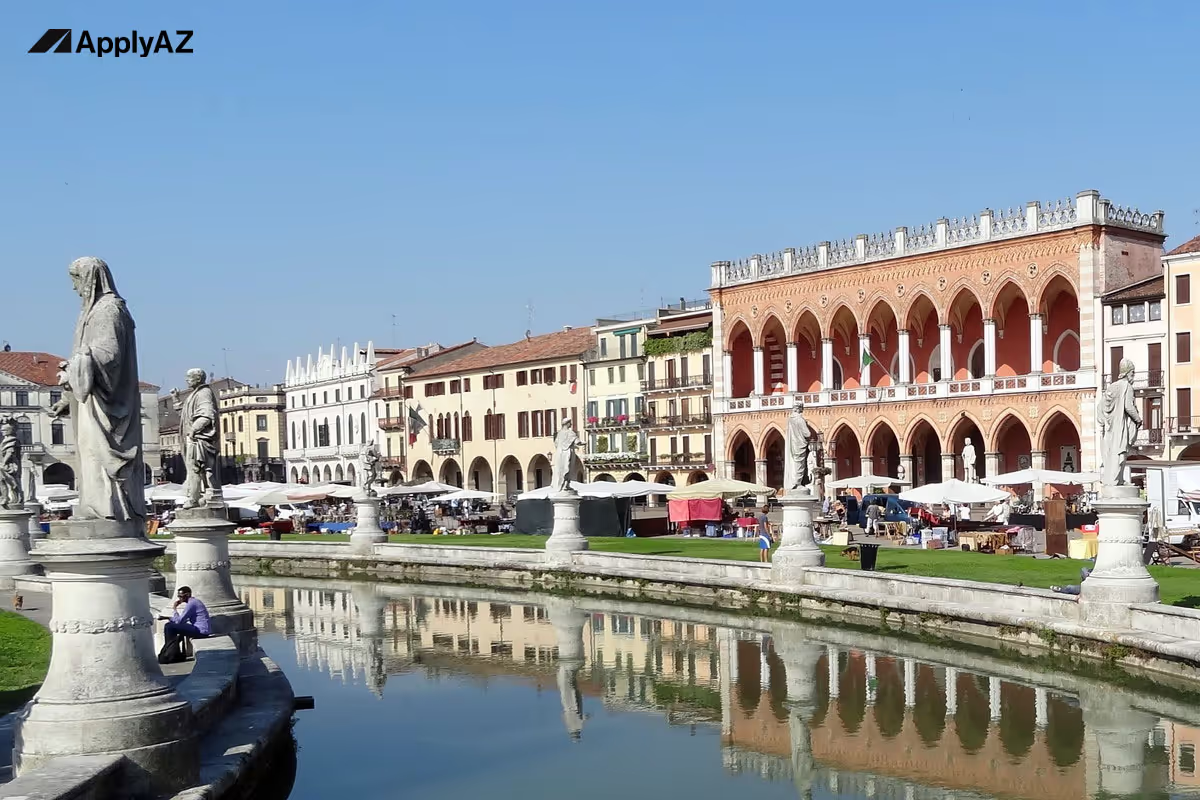
Mathematical Engineering is a two-year, 120 ECTS master's degree (class LM-44-R) taught in English at the University of Padua, with curricula in Mathematical Modelling for Engineering and Science or Financial Engineering. Entry needs a bachelor's of at least three years with strong mathematics, physics and statistics, and English at B2. Regional scholarship winners are exempt from fees, so it can be tuition-free for eligible students.
Entry requirements
Detailed entry requirements
Padua's Mathematical Engineering master asks for a bachelor's degree of at least three years, preferably in engineering, mathematics, physics or computer science, with solid mathematics, physics and statistics, plus English at B2. There is no entrance test: a committee reviews your grades, transcript, CV and reference letter. Reviewed 8 October 2026. [1]
Degree and subject requirements
You need an undergraduate degree of at least three years, or an equivalent qualification, preferably in Civil and Environmental Engineering, Information Engineering, Industrial Engineering, Mathematics, Physics or Computer Science. [1]
Other degrees can be considered if they cover: [1]
- Mathematics: mathematical analysis, algebra, geometry, probability and mathematical statistics, mathematical physics and numerical analysis.
- Physics.
- Statistics: statistics, and mathematical methods for economics, finance and actuarial sciences.
The degree must come from an institution accredited in its own country's system. [6] For holders of Italian degrees, the 2026/27 call asked for at least 25 credits in mathematics, physics and statistics sectors (unless the degree was in a listed engineering, physics, mathematics or computer science class) and a final grade of at least 84/110. [3]
Country rules and minimum grades
The university's 2027/28 country list sets these master's entry titles and minimum grades: [2]
- India: a 3 or 4-year Honours bachelor's, a professional bachelor's of 4, 5 or 5.5 years, or a 3-year pass or general bachelor's plus a postgraduate bachelor's or at least a 1-year master's. Minimum GPA 70/100, 7.0/10, 5.6/8 or 2.8/4.
- Pakistan: a 3-year bachelor's (Honours), a 4 or 5-year professional bachelor's, or a 2-year pass bachelor's plus a 2-year master's. Minimum GPA 3.3/4.0.
- Bangladesh: a 4-year Honours bachelor's or a 4 or 5-year professional bachelor's. Minimum GPA 3.3/4.0.
- Sri Lanka: a 4-year bachelor's or a Special Degree. Minimum GPA 3.0/4.0.
What this means for your transcript
As a guide, based on the rules above:
- Usually a fit: a four-year B.Tech or B.E. with strong mathematics (calculus, linear algebra, probability, numerical methods) and physics, or an Honours degree in Mathematics or Physics, with a grade above your country's minimum.
- Check carefully: an Honours degree in Statistics or Computer Science, or a BCA, where physics or numerical analysis may be thin. A three-year pass B.Sc. from India also needs a postgraduate qualification to meet the country rule.
- Often short: a B.Com, BBA or BA without university-level mathematics and physics, even for the Financial Engineering curriculum.
English
English at CEFR level B2 or higher. [1] For 2027/28, accepted B2 scores include IELTS Academic or General Training 6.0, TOEFL iBT 86 for tests taken until 20 January 2026 or 4.5 for tests taken from 21 January 2026, PTE Academic 65, Cambridge B2 First 173, Trinity ISE II and Duolingo English Test 115. [5]
Certificates must still be valid or, where they have no expiry date, be no more than two years old on 15 September 2026. You can upload one after applying, up to 31 July 2027. [5]
You are exempt if you are a native speaker from a listed English-speaking country, or completed your qualification entirely in English in one of those countries or in the EU or Schengen area. India, Pakistan, Bangladesh and Sri Lanka are not on that list. [5]
Selection
There is no entrance test. The committee evaluates your GPA, your transcript with emphasis on mathematics, physics and statistics, your CV and a reference letter, and may invite you to an interview if it has questions about your background. You choose your curriculum before applying. [1]
Mathematical Modelling for Engineering and Science has open admission with requirements and no ranking. Financial Engineering has limited places and a ranking: in 2026/27 there were 28 places for EU and equivalent candidates [3] and 2 for non-EU applicants living abroad, ranked on the relevance of the degree, final GPA and grades in mathematics, physics and statistics, counting only credits already earned. [4]
2027/28 deadlines
Non-EU applicants living abroad can apply in Call One, from 15 September to 15 November 2026, or Call Two, from 1 December 2026 to 1 March 2027. Call Three, from 1 April to 1 June 2027, is only for EU citizens and non-EU citizens living in Italy. You can apply to a programme only once per academic year, and classes start on 1 October 2027. [1]
In 2026/27 the Financial Engineering curriculum ran a separate call for non-EU applicants living abroad, from 7 January to 7 March 2026, with the ranking from 10 April 2026. We confirm which call applies to your curriculum for 2027/28. [4]
You can apply before graduating, but you must complete your degree by 31 July 2027. [2]
Documents and non-EU steps
The application needs your passport, transcript, degree certificate if already awarded, CV, motivation letter and English certificate. Transcripts and diplomas must be official, in Italian or English or with official translations. No legalised documents are needed at this stage. [1][6]
- If admitted, you must formally accept your place to secure it. [1]
- Non-EU citizens living outside Italy complete Universitaly pre-enrolment by 15 July and apply for a type D study visa. [6]
- At enrolment, your degree and transcript must be translated into Italian or English and legalised or apostilled, or covered by a CIMEA certificate of verification. [6]
Sources and verification
Checked by the ApplyAZ admissions team against the university's official documents listed below. Entry rules can change with each new call, and we re-check them before every application.
- University of Padua, international application portal. Master's degree in Mathematical Engineering: entry qualification, evaluation criteria, language requirement, fees and application calls, academic year 2027/28. Reviewed 8 October 2026.
- University of Padua, Global Engagement Office. Specific entry requirements for qualifications awarded by non-Italian education systems, updated 15 September 2026 and valid for academic year 2027/28. Reviewed 8 October 2026.
- University of Padua, School of Engineering. Call for admission, Master's degree in Mathematical Engineering, candidates with an Italian degree, academic year 2026/27. Reviewed 8 October 2026.
- University of Padua, Global Engagement Office. Call for applications, Mathematical Engineering, Financial Engineering study track, non-EU students residing abroad, academic year 2026/27. Reviewed 8 October 2026.
- University of Padua, Global Engagement Office. Language requirement for admission to degree programmes, with the list of accepted English certificates and exemptions, academic year 2027/28. Reviewed 8 October 2026.
- University of Padua. Admission of international students: how to apply, documents required and how to enrol with a foreign qualification, academic year 2027/28. Reviewed 8 October 2026.
About the programme
Mathematical Engineering is a master's degree in class LM-44-R (mathematical and physical modelling for engineering), taught in English in Padua by the School of Engineering and the Department of Civil, Environmental and Architectural Engineering. It lasts two years and carries 120 ECTS. The Mathematical Modelling for Engineering and Science curriculum has open admission with requirements, while Financial Engineering has limited places.
The programme offers a multidisciplinary, high-level education that sits between engineering and applied mathematics. It combines in-depth applied mathematics and other basic sciences, especially physics and finance, with advanced engineering knowledge, and pairs a solid understanding of physical processes with strong theoretical and technological skills. Graduates learn advanced modelling and mathematical tools for experimental, computational, technological and economic problems. It suits graduates in engineering, mathematics, physics or computer science who enjoy quantitative work.
What you will study
You choose one of two curricula, and the choice is made before you submit your application:
- Mathematical Modelling for Engineering and Science
- Financial Engineering
The admission rules show the mathematical base the degree expects: mathematical analysis, algebra, geometry, probability and mathematical statistics, mathematical physics and numerical analysis, together with physics and statistics.
Career paths
Graduates work in research and development centres and as consultants for public and private organisations in advanced technological fields. The university names:
- Engineering companies, in design and testing support
- Civil, environmental and industrial engineering firms
- Software houses and IT laboratories
- Banks, insurance companies and financial institutions
- Energy companies and consulting firms
- Public administrations and public or private research institutions
Fees and scholarships
Mathematical Engineering belongs to fee Group B with the other engineering degrees. Under the 2026/27 fee call, non-EU students whose household lives abroad pay a fixed annual amount that is not recalculated by income, with a reduction for citizens of countries on the ministry's list of particularly poor countries. The ISEE parificato only lowers the regional tax. Veneto regional scholarship winners are exempt, so this programme can be tuition-free for eligible students, and applicants abroad are also considered for merit scholarships and fee waivers. See the fees page.
How to apply from outside the EU
Choose your curriculum first; we then apply on apply.unipd.it with your transcript, CV, a reference letter, motivation letter and English certificate; legalised documents are not needed yet. The committee looks closely at your mathematics, physics and statistics exams. For 2027/28, non-EU applicants living abroad can apply from 15 September to 15 November 2026 or from 1 December 2026 to 1 March 2027. In 2026/27 the Financial Engineering curriculum also ran its own call for non-EU applicants living abroad, with 2 places, from 7 January to 7 March 2026.
Once admitted, you accept your place, we complete the Universitaly pre-enrolment by 15 July, and you apply for a type D study visa. You must graduate by 31 July 2027, and at enrolment your degree and transcript must be translated into Italian or English and legalised or apostilled, or covered by a CIMEA certificate of verification.
How ApplyAZ helps
ApplyAZ is an Italy-based consultancy that works only with public universities. We can include this programme in a shortlist of 20 to 30 English-taught programmes that fit your profile, so your plan never rests on a single application.
For eligible students who start with us, a named person owns each stage, from A to Z:
- We check your transcript against Padua's entry rules for this programme.
- We write your CV and a tailored statement of purpose.
- We prepare and submit your application on the university portal, place acceptance and Universitaly pre-enrolment.
- We help you declare your family income for reduced fees and file your University of Padua DSU scholarship application at the right time and in the right format.
- We prepare your visa file.
With operations in all 20 Italian regions, we follow each region's scholarship rules and deadlines as they change. The university decides admission, the region decides the scholarship and the consulate decides the visa, so no one can promise an outcome. You pay in milestones, and every service you pay for is either delivered or its fee is refunded (terms apply).
Programmes at Italian public universities can be tuition-free for eligible students. Check if you are eligible and book a one-to-one consultation session with one of our Italy experts, or see how ApplyAZ works.
Questions and answers
What bachelor's degree do I need for Mathematical Engineering at Padua?
A degree of at least three years, preferably in civil, environmental, information or industrial engineering, mathematics, physics or computer science. Other degrees can qualify if they cover mathematical analysis, algebra, geometry, probability and statistics, mathematical physics, numerical analysis, physics and statistics. [1]
Is there an entrance exam?
No. The committee evaluates your GPA, your transcript with emphasis on mathematics, physics and statistics, your CV and a reference letter. It may invite you to an interview if it has questions about your background or preparation. [1]
What English level is required? Do I need IELTS?
English at B2. For 2027/28, accepted scores include IELTS 6.0, TOEFL iBT 86 (or 4.5 for tests from 21 January 2026), PTE Academic 65, Cambridge B2 First 173 and Duolingo 115. You can upload the certificate after applying, up to 31 July 2027. [5]
When is the deadline for non-EU students?
For 2027/28, non-EU applicants living abroad can apply in Call One, from 15 September to 15 November 2026, or Call Two, from 1 December 2026 to 1 March 2027. You can apply only once per year. [1]
Can I apply before I graduate?
Yes. You can apply while finishing your bachelor's, but you must complete your degree by 31 July 2027 to enrol for 2027/28. [2]
What grade do I need?
The 2027/28 country list sets minimums of 70/100 or 7.0/10 for India, a GPA of 3.3/4.0 for Pakistan and Bangladesh, and 3.0/4.0 for Sri Lanka. The committee then weighs your grades in mathematics, physics and statistics. [1][2]
Is Financial Engineering harder to get into?
Yes. You choose the curriculum before applying. Mathematical Modelling for Engineering and Science has open admission with requirements, while Financial Engineering has limited places: in 2026/27 there were 2 for non-EU applicants living abroad, decided by ranking. [1][3][4]
I have a B.Com or BBA. Can I apply?
Only if your transcript covers the required mathematics, physics and statistics, which most commerce and business degrees do not. A three-year Indian degree must also be Honours, or be followed by a postgraduate qualification, to meet the 2027/28 country rule. [1][2]
Can someone handle my whole application to Mathematical Engineering at Padua?
Yes. ApplyAZ, an Italy-based consultancy that works only with public universities, checks your transcript against Padua's rules for this programme, handles the application and Universitaly pre-enrolment, helps you file the University of Padua DSU scholarship application at the right time and in the right format, and prepares your visa file, for eligible students. Start by checking your eligibility.
I'm applying from India. What is the route into Mathematical Engineering?
Padua's 2027/28 country list accepts Indian 3 or 4-year Honours bachelor's degrees and professional bachelor's degrees of 4 years or more, such as a B.Tech or B.E., with a minimum of 70/100 or 7.0/10. Your transcript should show solid mathematics, physics and statistics, and you need English at B2. The steps are the online application, place acceptance and Universitaly pre-enrolment. [1][2] Indian students apply for the type D study visa at the Italian embassy or consulate that covers their state, such as New Delhi, Mumbai or Bengaluru.
Is the route different from Pakistan, Bangladesh or Sri Lanka?
No. The academic rules for Mathematical Engineering are the same whatever your nationality. Applicants from Pakistan, Bangladesh and Sri Lanka follow the same steps as India: online application in Call One or Call Two, admission decision, place acceptance and Universitaly pre-enrolment, then a type D study visa from the Italian mission for their country of residence. Read our guide for students in Dhaka.
I live in the UAE, Saudi Arabia, Qatar, Kuwait, Oman or Bahrain. Where do I apply for the visa?
At the Italian embassy or consulate responsible for the country where you legally live, after Universitaly pre-enrolment. The academic rules for Mathematical Engineering are the same whatever your nationality, and Gulf residents follow the same steps: online application in Call One or Call Two, admission decision, place acceptance and Universitaly pre-enrolment. Read our guides for Dubai, Riyadh and Doha.
I studied or live in London, New York, Toronto, Vancouver, Singapore or Kuala Lumpur. What is the route?
The academic rules for Mathematical Engineering are the same whatever your nationality, and your degree is assessed like any other foreign qualification. Non-EU applicants who live abroad follow the same route: online application in Call One or Call Two, admission decision, place acceptance and Universitaly pre-enrolment, then a type D study visa from the Italian mission for where they live. Read our guides for students in London, New York, Toronto, Vancouver, Singapore and Kuala Lumpur.
More English-taught programmes at this university
Other public universities in this city

They began right where you are

