

Master in International MBA – Focus International Logistics & Supply Chain Management
Master in International MBA with a focus on International Logistics & Supply Chain Management at Bremen University of Applied Sciences suits students who want MBA-level training focused on global logistics. For this program, ApplyAZ helps with eligibility checks, scholarship strategy, and visa preparation.
Master
2 semesters, 3 semesters
Bremen
English
Bremen University of Applied Sciences



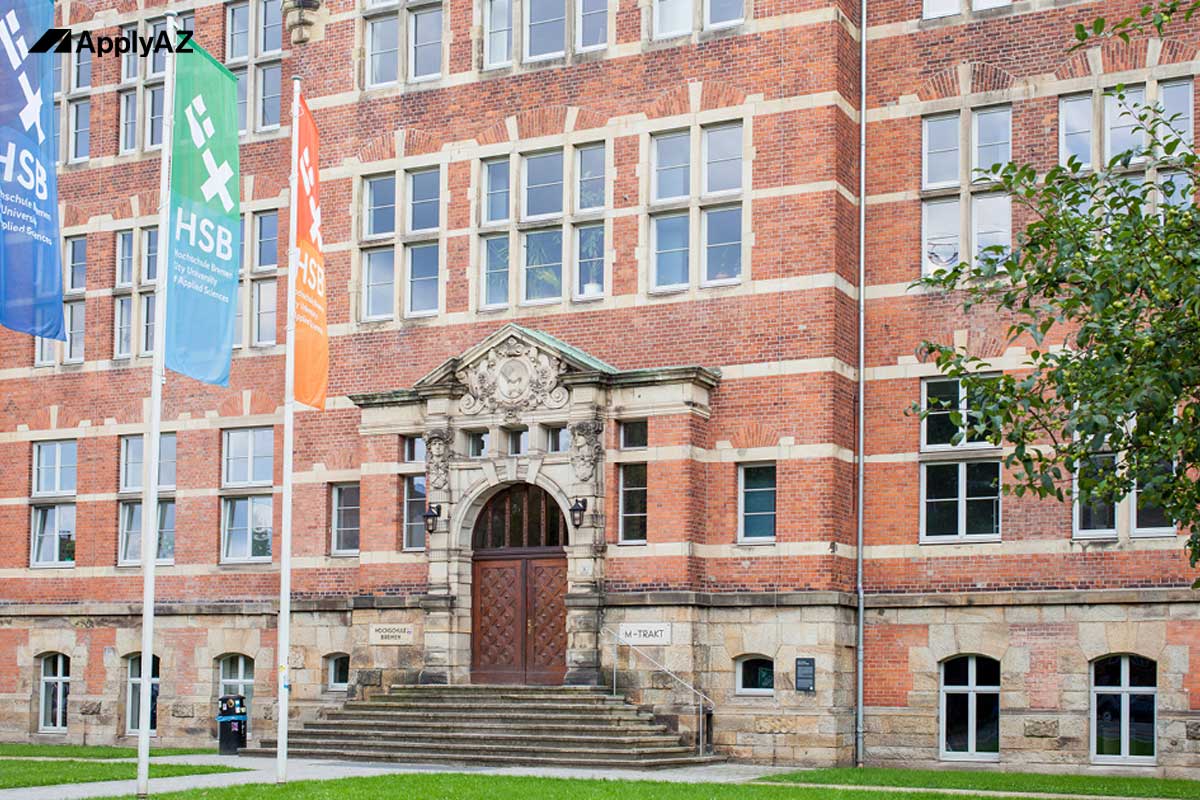
A Guide to Bremen University of Applied Sciences
First look at Bremen University of Applied Sciences
Bremen University of Applied Sciences sits in a working port city with a very practical mindset. That matters because the university’s strongest value is applied learning. You will see this in how modules are shaped around real problems, case work, and project deadlines, not just theory for its own sake. Many students choose it because they want a clear link between what they learn and what they can do with it.
At ApplyAZ, we start by helping you translate “I like the university” into a decision you can defend. We look at the department strength, the programme structure, and what your week will actually look like. When students skip this step, they often pick a name first, then later realise the track does not match their background or goals.
Bremen is also a place where logistics are part of student life. Housing, registration, and settling in can be smoother if you plan early. A good university choice is not only about academics. It is also about whether you can arrive, adapt, and keep momentum without constant stress.
What studying feels like there (teaching, exams, pace)
Expect a steady pace and a strong focus on doing, not only reading. In many applied sciences universities, the rhythm is shaped by assignments, lab work, group projects, and presentations. Even when a module has a final exam, you often build your grade through work across the term. That can feel fair if you manage your time, but it can feel heavy if you leave things late.
A common scenario is a student who is used to memorising for one big test. They arrive and realise they now need to deliver every week. That shift is not hard, but it requires a system. You need a calendar, a way to track tasks, and the habit of asking questions early instead of waiting for exam week.
At ApplyAZ, we guide students to choose programmes that match their learning style. If you thrive with structure and deadlines, this environment can be a great fit. If you prefer more independent study, you will want to check how much group work and continuous assessment the track includes.
English-taught options and how to check the right track
English-taught programmes can be a good path, but students often misunderstand what “English-taught” covers. Sometimes the full degree is in English. Sometimes only certain tracks, specialisations, or semesters are in English. Sometimes the courses are in English, but key admin steps still run in German. The difference matters for day-to-day life and your confidence in the first months.
The safest way to check is to look at the exact programme track and module language, not only the headline. You want to confirm the language of teaching, the language of assessments, and whether there are required German modules. You also want to see if internships or projects require German in practice.
At ApplyAZ, we help you verify the track, not just the title. We also help you compare the English-taught option to a similar programme elsewhere, so you can judge whether you are choosing the best fit or simply the easiest to understand.
Admissions reality: what matters most (and what doesn’t)
Admissions is rarely about one magic detail. Most decisions are based on fit between your previous studies and the programme requirements, plus your document quality and timing. Students often focus too much on “big” things like the university’s reputation, and too little on the basics that actually decide the outcome.
What usually matters most is whether your background matches the core subjects of the programme, whether your transcript clearly shows that match, and whether your motivation letter explains your direction in a simple, believable way. What often matters less than students think is fancy formatting, long writing, or trying to sound impressive.
At ApplyAZ, we bring discipline to the process. We check your fit early, then build an application plan that respects real deadlines. Strong applicants do not “hope” their file is understood. They make it easy for the reader to approve them.
Documents students underestimate (prepare early)
Students often underestimate how long documents take, not how hard they are. The delays usually come from third parties: universities, exam boards, translators, notaries, or apostille processes. If you start late, you may end up submitting incomplete files or rushing and making avoidable mistakes.
These are common items that create last-minute problems:
- Transcripts that are missing stamps or official signatures
- Degree certificates that are not issued yet, or issued with name differences
- Translation and certification steps that require appointments
Another common issue is inconsistency. A small mismatch in name spelling, dates, or grading scales can trigger extra checks. The solution is simple: prepare a clean document set early, and keep a master list so nothing changes from one file to the next.
At ApplyAZ, we run document readiness like a checklist, not a guess. We tell you what to request, how to format it, and how to avoid the typical back-and-forth that wastes weeks.
Tuition and real costs in daily life
In Germany, tuition at public institutions is often low compared to many other countries, but “low tuition” does not mean “low cost”. Your monthly budget will depend on housing, health insurance, transport, food, and how often you travel. Most students who struggle financially did not fail at earning money. They failed at planning realistic monthly costs.
A typical student expense pattern is stable during the term and then spikes at the start. The first month can be expensive due to deposits, initial setup, registration steps, and basic items for housing. If you do not plan for that, you start your studies already stressed.
At ApplyAZ, we help you map costs as a timeline, not a single number. You need to know what must be paid before arrival, what must be paid in the first weeks, and what is recurring monthly. Finance it with loan options via ApplyAZ.
Scholarships and funding: how to think, not guess
Funding is not a single door. It is a strategy. Students often treat scholarships like a lottery, and that mindset creates poor decisions. A better approach is to identify what types of funding fit your profile, what deadlines are realistic, and what documents you need to compete properly.
A common misunderstanding is mixing up admission and funding. You can be admitted and still have weak funding readiness. You can also have a strong funding plan but miss admission deadlines. The best plan connects both, so you do not win one part and lose the other.
At ApplyAZ, we help you build a funding path alongside your applications. We identify options that match your country and programme, and we make sure your document set supports that path. The goal is not to chase everything. It is to pursue what fits you and can be executed well.
Housing and arrival planning (what to decide before you land)
Housing is often the main stress point, not lectures. You can handle a hard course if your life is stable. You struggle with an easy course if your housing is uncertain. That is why arrival planning should start early, even while your application is still in progress.
Before you land, you should decide your first-month plan. Where will you stay initially, what documents you need for registration steps, and how you will handle the gap between arrival and your longer-term housing. Many students try to solve everything after they arrive. That usually costs more and creates pressure.
At ApplyAZ, we guide you through a practical arrival plan. We help you prepare the documents you will need right away, organise timelines, and avoid the common trap of arriving without a clear first-week structure.
After graduation: work options and direction
What happens after graduation depends on your direction long before graduation. Students who do well are not always the smartest. They are the ones who align their programme choice with a clear target: a type of role, a type of industry, and a set of skills they can prove.
A common scenario is a student who studies something broad and only later asks, “What job can I do?” A better path is to ask the reverse early: “What roles interest me, and what programme builds those skills?” Then you use projects, internships, and thesis choices to create evidence of ability.
At ApplyAZ, we help you pick programmes where the skill outcomes make sense for your profile. We also help you plan your academic choices so you are not only graduating with a degree, but also with a story and proof that employers can understand fast.
How ApplyAZ supports you step-by-step
ApplyAZ supports you from the first decisions to the final practical steps. We start with shortlisting that is based on fit, not hype. We then move into document readiness, so your file is consistent, complete, and easy to assess. After that, we structure applications with a timeline that respects deadlines and reduces risk.
We also support scholarship strategy in parallel, because funding is part of the plan, not something you “try later”. Finally, we guide visa preparation and the practical steps that follow, so the transition is smoother. Students often feel confident about academics and underestimate process complexity. Our job is to make the process calm, structured, and realistic.
How ApplyAZ Gets You In
Most students find one program they like and hope for the best. That is not how we work.
It starts with a quick eligibility check, about 2 minutes, so you instantly know if this opportunity is a real option for your profile. If you are eligible, you book a private one-to-one consultation with one of our experts, where you get a clear and personalised plan built around your exact situation: your best-fit programs, your real deadlines, your scholarship path, and your exact next steps.
If you decide to move forward with us after that call, you enroll, upload your documents, and we take it from there. Our admissions team goes through your transcripts course by course, maps your background against real university requirements, and builds you a shortlist of 20 or more programs that you genuinely qualify for, across prestigious public universities, career-forward degrees taught in English, with strong graduate placement records. You review them, approve the ones you like, and then you lay back.
We write your CV and motivation letter for each program, submit every application, and track every deadline. Alongside admissions, we actively work on securing scholarships that fit your program, university, and country, whether that is DSU, DAAD, or other funding available to your profile, so you have the strongest possible shot at studying public (€0 for eligible students) with your living costs covered. Then we stay with you through visa preparation, arrival, and every practical step that follows.
Depending on your profile, you may qualify for far more programs, universities, and funding opportunities than you would ever find on your own. The only way to know is to start.
Check your eligibility now. It takes about 2 minutes. Because everything begins there.
An MBA for Moving Goods and Making Decisions
A quick sense-check: who Master in International MBA – Focus International Logistics & Supply Chain Management suits
Master in International MBA – Focus International Logistics & Supply Chain Management at Bremen University of Applied Sciences suits students who like systems, flow, and real-world constraints. If you enjoy understanding how products move from suppliers to customers, how delays happen, and how costs and quality are controlled, this focus can fit you well. It is also a good match if you want a management role, but you prefer operational reality over pure theory.
A typical strong fit is a student with engineering, business, economics, logistics, operations, or industrial backgrounds. Another fit is a professional with experience in procurement, warehousing, shipping, manufacturing, or planning who wants a stronger management profile. At ApplyAZ, we sense-check whether your profile shows process thinking and whether your motivation is specific to logistics and supply chain, not just “international business” in general.
If you want a purely marketing-driven path, this focus may feel too operational.
What you will gain by the end (real outcomes)
By the end, you should be able to manage supply chain decisions with structure. That includes understanding demand and supply planning, procurement choices, inventory trade-offs, transport decisions, and basic risk management. You also learn how to connect operations to finance, because supply chain is often where profit is protected or lost.
A practical outcome is that you can explain your decisions in a way different teams accept. For example, you can justify why a company should hold more stock, change suppliers, redesign routes, or adjust service levels. You learn to quantify trade-offs instead of arguing from preference.
At ApplyAZ, we help you translate these outcomes into a career direction before you apply. Without a clear target, students often finish with broad skills but a weak story. With a target, your projects and thesis become proof of your ability.
The learning style you should expect
Expect applied learning with steady deadlines. Many supply chain modules rely on cases, scenario work, group tasks, and structured analysis. You may work with datasets, process maps, or planning logic. The pace is manageable if you do weekly work, but it becomes stressful if you delay, because tasks often build on earlier concepts.
You should also expect teamwork. Logistics and supply chain management is rarely a solo activity, so programmes often mirror that reality through group projects and presentations. Some students dislike group work, but it is also where you learn how decisions are negotiated in real operations.
At ApplyAZ, we help you prepare for this learning style and present evidence of discipline, teamwork, and applied thinking in your application. This reduces doubts about your readiness.
Modules, projects, and thesis (how the year often flows)
The year often begins with MBA foundations, then moves deeper into logistics and supply chain topics. Early modules build shared management language. Later modules focus more on operational decision-making, such as how to plan, source, move, and deliver products under constraints. The most valuable learning often comes from seeing how small changes create big effects across a chain.
Projects are where your profile becomes real. A strong student chooses topics like supplier evaluation, demand planning, network design, sustainability in logistics, or risk and resilience. A common mistake is choosing generic topics that do not show operations skill. The thesis is your chance to go deeper and show direction, for example in port logistics, inventory optimisation, procurement strategy, or supply chain risk.
At ApplyAZ, we help you plan projects and thesis early so your work builds one coherent story. This matters for jobs, because employers want proof, not just a degree.
Entry requirements (clear checklist)
Think of entry requirements as decision logic. First confirm the essentials, then check whether your background shows readiness for analytical and operational thinking. Finally, identify what needs clarification early, before you invest time.
Use this checklist as your first pass:
- A recognised Bachelor’s degree (or equivalent)
- A transcript that shows business or analytical readiness
- Proof of English proficiency if required
- Any work experience requirement, if the programme expects it
- A complete document set that meets official rules and deadlines
Business and economics backgrounds often fit smoothly. Engineering and industrial backgrounds often fit well because they show systems thinking. If your background is far from operations, you can still fit if you show a clear bridge through electives, internships, or work. At ApplyAZ, we check your profile against the programme logic and help you strengthen what is missing.
How to read your transcript against the requirements
Read your transcript the way an admissions reader does. They are checking whether you can handle the programme’s thinking style: structured analysis, process logic, and applied decision-making. They often look for signals like quantitative methods, statistics, operations, supply chain basics, engineering fundamentals, management modules, or economics, depending on your first degree.
A clear fit example is a student with modules that show operations and analytics, even if the title is not “logistics”. Another fit is a business student with supply chain electives or relevant internships. A higher-risk case is an applicant with no quantitative evidence and no operations exposure, because the focus can look like a random pivot.
At ApplyAZ, we map your transcript course-by-course and build a clean narrative that shows readiness. This reduces “unclear fit” outcomes and avoids preventable rejections.
Documents to prepare early (avoid delays)
Most delays come from documents, not from the application form. Students often underestimate how long official transcripts, certificates, translations, and certifications take. If you start late, you may submit incomplete files or rush and make errors that trigger extra checks.
Common mistakes to avoid:
- Submitting unofficial documents when official versions are required
- Missing stamps, signatures, or correct certification steps
- Inconsistent name spelling, dates, or grading details across documents
The best approach is to build one clean document set early and keep it consistent. At ApplyAZ, we run document readiness as a process with checkpoints. That way, you do not lose weeks to avoidable back-and-forth near deadlines, when offices are slow and options are limited.
Tuition, fees, and living costs (real planning)
Plan your costs as a timeline, not a single number. Even when tuition is low compared to other countries, your real budget includes semester fees, health insurance, housing, transport, food, and the start-up costs in the first month. The first month can be expensive because of deposits and setup, so planning only monthly costs can mislead you.
A practical method is to split expenses into three phases: pre-arrival costs, first month costs, and recurring monthly costs. This makes your funding plan realistic and helps with visa preparation because you know what must be paid when. Finance it with loan options via ApplyAZ.
At ApplyAZ, we help you build this cost timeline alongside your application timeline. When your plan is clear, arrival decisions become calmer and faster.
Scholarships and funding (smart approach)
Funding is strongest when you treat it like a strategy with deadlines. Students often chase every option they hear about and end up missing the ones they could actually execute well. A better approach is to identify realistic funding routes for your profile and country, then prepare the specific documents those routes require.
A common misunderstanding is separating admission and funding. You can be admitted and still be unprepared for funding steps. You can also prepare funding documents early and miss admission deadlines. The best plan runs both tracks together, with clear milestones.
At ApplyAZ, we align scholarship strategy with your programme plan and document readiness. We help you focus effort where it can convert into outcomes, instead of spreading effort too thin.
Career direction after Master in International MBA – Focus International Logistics & Supply Chain Management
This focus can support roles such as supply chain analyst, procurement and sourcing roles, logistics and transport planning, operations management, inventory planning, and supply chain project management. Your prior background shapes which path is most credible. Engineers often move into operations and planning roles. Business graduates often move into procurement, coordination, or strategy-adjacent supply chain work.
What employers respond to is proof. Your projects, thesis topic, and any internship work often matter as much as the degree name. If you can show you analysed a real supply chain problem, proposed a plan, and defended it with logic, interviews become much easier. If your work is too general, your profile can feel vague.
At ApplyAZ, we help you build a clear career story early so your module and project choices produce evidence for the roles you want.
How ApplyAZ supports you step-by-step
ApplyAZ supports you from programme fit to visa readiness. We start by confirming whether this logistics and supply chain focus matches your background and goals, and whether it is the best route compared to similar programmes. We then run document checks early, because completeness and consistency often decide outcomes.
We map your transcript against programme expectations and craft a motivation narrative that is specific and believable. We build an application plan with deadlines and checkpoints, so you avoid last-minute rush and incomplete submission. Alongside admissions, we guide scholarship strategy so funding is planned, not guessed. Finally, we support visa guidance and practical preparation so your arrival is controlled, not chaotic.
We Handle Everything. You Just Need to Qualify.
You upload your transcripts. We go through them carefully, match you to 20 or more English-taught programs at prestigious public universities with strong placement records, write your applications, and actively pursue every scholarship available for your profile, whether that is DSU, DAAD, or others depending on the university and country.
You review your shortlist, approve what fits, and we take care of the rest.
The only thing left for you to do right now is find out if you qualify.
Check your eligibility. It takes about 2 minutes.
Tuition and scholarships
Public universities in Germany charge no tuition fees for international students. A semester contribution typically applies, covering administrative costs and often a public transport pass.
DAAD (German Academic Exchange Service) offers scholarships for international master's students, covering living costs and a travel allowance. Apply through the DAAD portal separately from your university application.
The Deutschlandstipendium provides €300 per month, co-funded by the federal government and private sponsors. Applications go through the university's scholarship office after enrolment.
For Indian applicants
Indian graduates with a degree recognised by AIU (Association of Indian Universities) can apply to German public universities through uni-assist. The uni-assist portal handles degree equivalency verification and is the standard route for most non-EU applicants. Check your eligibility with us first.
Similar programmes
More free programmes in this city

They Began right where you are

