

Master in Environmental Humanities at Ca’ Foscari University of Venice
Two-year English-taught LM-1 R master at Ca' Foscari in Venice that reads the environmental crisis through anthropology, history, literature, philosophy and climate science, with an internship. Limited places; entry needs a listed degree or 42 credits and English at B2.
Master
2 years
Venice
English
Ca’ Foscari University of Venice


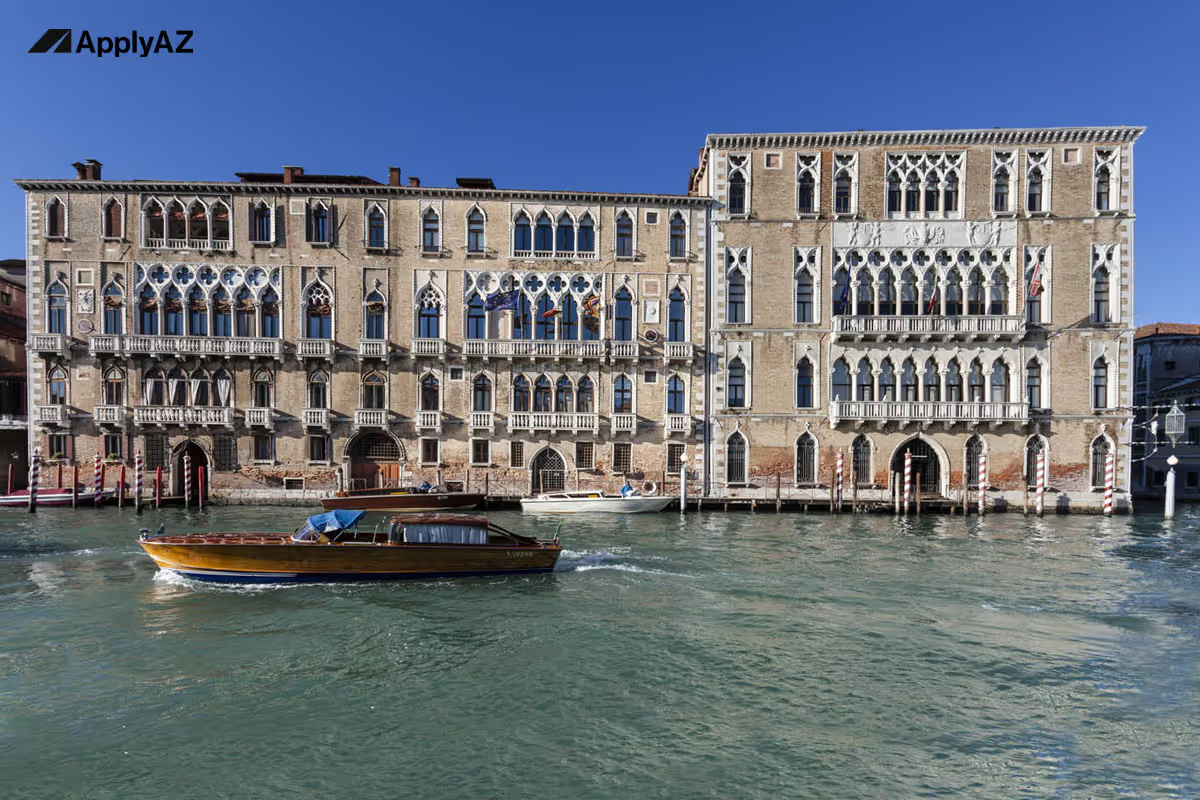
Environmental Humanities is a two-year, 120 ECTS master's degree (class LM-1 R) taught in English at Ca' Foscari University of Venice. Entry needs a bachelor's of at least three years in a listed field, or 42 credits in listed subjects, plus English at B2. Places are limited, and selection uses your CV and a presentation letter. Non-EU fees follow citizenship, and the programme can be tuition-free for eligible students.
Entry requirements
Detailed entry requirements
Ca' Foscari's Environmental Humanities master asks for a bachelor's degree of at least three years in a listed field, or with at least 42 CFU in listed subjects, English at B2 by enrolment, and a place in a limited-admission selection based on your CV and a presentation letter. Reviewed 8 October 2026. [1]
Degree and the 42-credit rule
You need a bachelor's degree of at least three years. A degree earned abroad first goes through Ca' Foscari's preliminary evaluation, and the Teaching Committee then reviews your transcript and CV. [1][2]
A degree in one of these Italian classes, or an equivalent foreign degree, meets the curricular requirements directly: L-1 Cultural Heritage, L-5 Philosophy, L-10 Humanities, L-11 Modern Languages, L-12 Linguistic Mediation, L-13 Biology, L-25 Agriculture and Forestry, L-32 Environmental Sciences, L-33 Economics and L-42 History. [1] The programme's admission page and the provisional 2027/28 portal page also list L-3 Visual Arts, Music, Performing Arts and Fashion. [2][3]
Graduates of other degrees need at least 42 CFU in these subject areas: [1][3]
- Life and earth sciences: environmental and applied botany, zoology, ecology and anthropology (BIO/03, 05, 07 and 08), and palaeontology and palaeoecology (GEO/01).
- Arts and English: history of contemporary art (L-ART/03), English and Anglo-American language and literature (L-LIN/10, 11 and 12), and, on the admission page, cinema, photography and television (L-ART/06).
- Anthropology, philosophy, education and psychology: population studies, ethnography and anthropology (M-DEA/01), philosophy (M-FIL/01, 03, 05 and 06), general and social pedagogy (M-PED/01), and general and social psychology (M-PSI/01 and 05).
- Geography, economics and social sciences: geography (M-GGR/01 and 02), political economics and economic policy (SECS-P/01 and 02), demography (SECS-S/04), and political philosophy, political science, international relations history and sociology (SPS/01, 04, 06, 07, 08, 09 and 10).
Missing credits must be made up before enrolment, only through bachelor's-level single courses at Ca' Foscari or another accredited institution. [3]
Ca' Foscari's country rules for master's entry include: [4]
- India: a three-year honours bachelor's, a four-year professional bachelor's, or a pass or general bachelor's plus a postgraduate bachelor's or two-year master's.
- Pakistan: a three-year honours bachelor's, a four-year professional bachelor's, or a two-year pass bachelor's plus a two-year postgraduate bachelor's.
- Bangladesh: a three-year honours or four-year bachelor's, or a two-year pass bachelor's plus a two-year master's.
- Sri Lanka: a bachelor's of at least four years (honours or special degree).
- UK: a three-year honours bachelor's with at least an upper second-class (2:1) result.
Transcripts for all years of the degree are required. [4]
What this means for your transcript
Italian CFU and the credits on a foreign transcript are not the same unit, and the Teaching Committee looks at the subjects you studied, not just your total. As a guide, based on the rule above:
- Usually a fit: a BA in History, Philosophy, English or modern languages, a BA or B.Sc. in Economics, or a B.Sc. in Biology, Environmental Science, Agriculture or Forestry, as these match the listed degree fields.
- Check carefully: a BA in Sociology, Geography, Psychology, Political Science or Anthropology, or a B.Com, which can reach the 42 credits but need each unit mapped to the listed subjects.
- Often short: a B.Tech, B.E., BCA, BBA or a B.Sc. in Computer Science, Physics or Chemistry, which usually has few credits in the listed humanities, social and environmental subjects.
Missing credits can only be cleared through single courses before you enrol, so we map your transcript against the list first. [3]
English and Italian
English at CEFR level B2 is mandatory for enrolment. You can apply before you have a certificate, but you cannot enrol unless you meet the requirement by the enrolment deadline. Ca' Foscari does not test English during the application. [2][3]
Ca' Foscari's recognised B2 list includes IELTS 5.5, TOEFL iBT 72 (or 4 on the new scale for tests taken from 21 January 2026), PTE Academic 59, Cambridge First (FCE) and Trinity ISE II, taken within the last five years. Some applicants fall into an exemption category instead. [9]
Students without Italian citizenship must earn 3 CFU in Italian to graduate, unless they already have Italian at B1 or above. [3]
Selection for limited places
Admission is limited. Non-EU applicants who need a visa are selected directly on Ca' Foscari's application portal through an evaluation of their CV and a presentation letter in English of up to 500 words. The letter describes your past studies and activities and how they prepare you for this degree, and the portal also asks for a motivation letter written for this programme. [2]
Graduates of the listed degree classes with at least 90/110 are normally considered to have adequate personal preparation. Others are assessed on their CV and may be called for an interview. [1]
The 2026/27 call set 55 places and reserved 15 for non-EU students who need a visa. For other applicants, the ranking was based only on the CV (up to 60 points) and the presentation letter (up to 40 points), with no written exam. [1]
2026/27 deadlines
For 2026/27, Ca' Foscari began accepting applications on 17 December 2025, in rounds set by citizenship. The window for non-EU applicants who need a visa has now closed. Master's applicants could expect an answer about eight weeks after their round closed. [4][5]
Universitaly pre-enrolment for visa applicants closed on 30 September 2026, and the final enrolment deadline is 18 December 2026. [6] The 2027/28 admission rules on the portal are provisional, and the next rounds set the new dates. [2]
Documents and non-EU steps
You apply on Ca' Foscari's application portal, and one application covers up to two programmes ranked by preference. Documents must be in English or Italian, or come with a professional translation. [2][4]
After the letter of enrolment eligibility come Universitaly pre-enrolment and the study visa. To enrol, you upload your study visa, your bachelor's diploma and transcript with translations where needed, your English certificate, and one of these: a CIMEA Statement of Comparability, a declaration of value from the Italian diplomatic mission, an ARDI Statement of Correspondence with a CIMEA Statement of Verification, or a Diploma Supplement from a university in the European Higher Education Area. [6]
Sources and verification
Checked by the ApplyAZ admissions team against the university's official documents listed below. Entry rules can change with each new call, and we re-check them before every application.
- Ca' Foscari University of Venice. Call for applications, Master's degree in Environmental Humanities (class LM-1 R), academic year 2026/27, Rector's Decree no. 188/2026. Reviewed 8 October 2026.
- Ca' Foscari University of Venice, Welcome Unit. MA Environmental Humanities course page on the international application portal, provisional information for academic year 2027/28. Reviewed 8 October 2026.
- Ca' Foscari University of Venice. Environmental Humanities admission and enrolment page, academic year 2026/27. Reviewed 8 October 2026.
- Ca' Foscari University of Venice, Welcome Unit. Preliminary evaluation of international qualifications, and entry requirements for applicants with an international qualification, academic year 2026/27. Reviewed 8 October 2026.
- Ca' Foscari University of Venice, Welcome Unit. Admission rounds notice for the 2026/27 academic year on the international application portal. Reviewed 8 October 2026.
- Ca' Foscari University of Venice, Welcome Unit. Pre-enrolment and visa application, and enrolment for non-EU students who require a visa, academic year 2026/27. Reviewed 8 October 2026.
- Ca' Foscari University of Venice. Tuition fees for non-EU students, academic year 2026/27. Reviewed 8 October 2026.
- Ca' Foscari University of Venice. Financial aid for high-achieving international students, academic year 2027/28. Reviewed 8 October 2026.
- Ca' Foscari University of Venice. Recognised language certifications, list in use from academic year 2024/25. Reviewed 8 October 2026.
- Ca' Foscari University of Venice. Environmental Humanities programme page (degree class, language, duration, campus and attendance), enrolment from 2025/26. Reviewed 8 October 2026.
About the programme
Environmental Humanities is a two-year master's degree in class LM-1-R (Cultural anthropology and ethnology), taught entirely in English on Ca' Foscari's Linguistic Campus in Venice and linked to the Department of Asian and North African Studies. [2][10]
It is worth 120 ECTS, has a limited number of places, and attendance is not compulsory. [10] The 2026/27 call set 55 places and reserved 15 of them for non-EU students who need a visa, including 3 for Chinese citizens in the Marco Polo project. [1]
The university presents it as the first degree in Italy to treat the environmental crisis as a cultural emergency as well as a scientific and technological one.
It brings the natural sciences, social sciences and humanities into dialogue, and uses Venice, where high water returns several times a year, as a place to study how people live with a changing environment.
It suits graduates in the humanities, social sciences or environmental and life sciences who want to work on sustainability through culture, education and communication.
What you will study
The 2026/27 first-year timetable mixes environmental anthropology, ethnography and the Anthropocene with climate science, history, literature, economics and philosophy, and offers a wide range of electives, from critical animal studies to environmental cinema. Units on offer include:
- Environmental Anthropology
- Ethnography for Environmental Humanities
- Environmental Humanities and the Anthropocene
- The Climate System and Its Variability
- Global Inequalities, Environment, and Migration
- Political Ecology
- Poetry and Ecocriticism
- Economics of the Environment
How the programme is taught
Coursework is combined with a curricular internship in Italy or abroad and a final thesis. [2]
The programme takes part in the EUTOPIA European University Alliance and connects students with partners such as the Rachel Carson Center in Munich and Cappadocia University in Türkiye.
Students can also spend one or two semesters at a partner university through Ca' Foscari's exchange programmes. [2]
Career paths
The degree trains people who can imagine, narrate and teach a more sustainable future. The university lists these roles and settings:
- Environmental educator
- Designer and curator of cultural activities with an environmental focus
- Expert in cultural mediation and communication
- Environmental consulting
- NGOs, museums, parks and media organisations
Fees and scholarships
Non-EU students pay a yearly flat rate set by citizenship.
For master's degrees in 2026/27 the rate is lower for countries on the ministry's low human development list and higher for non-EU OECD countries such as the UK and the US. [7]
Non-EU students can apply for the regional scholarship under the yearly regional call. Scholarship recipients pay only the regional tax and stamp duty, so this programme can be tuition-free for eligible students. [7]
Applicants with a CGPA of 85% or more can also seek Ca' Foscari's merit-based aid, which in 2026/27 could be requested only in the first two admission rounds. [5] For students starting in 2027/28, Ca' Foscari offers 20 Honours Scholarships of €10,000 a year for two years to new master's students, and the call is due in the late autumn. [8]
How to apply from outside the EU
Because places are limited, non-EU applicants who need a visa go through a selection on Ca' Foscari's application portal. The Teaching Committee checks your transcript and CV against the curricular requirements, then assesses your CV and a presentation letter in English of up to 500 words. [2]
Visa applicants take part in this selection through their profile on apply.unive.it, where one application covers up to two programmes, ranked by preference. [4] For 2026/27, Ca' Foscari began accepting applications on 17 December 2025, in rounds set by citizenship, and the window for non-EU applicants who need a visa has now closed. The 2027/28 admission rules on the portal are provisional, and the 2027/28 rounds are not yet published. [2][4][5]
Once you hold an eligibility letter, we complete Universitaly pre-enrolment, and you apply for a type D study visa. Enrolment needs a CIMEA Statement of Comparability, a declaration of value, an ARDI statement with CIMEA verification, or a Diploma Supplement. For 2026/27, Universitaly pre-enrolment closed on 30 September 2026 and the final enrolment deadline is 18 December 2026. [6]
How ApplyAZ helps
ApplyAZ is an Italy-based consultancy that works only with public universities. We can include this programme in a shortlist of 20 to 30 English-taught programmes that fit your profile, so your plan never rests on a single application.
For eligible students who start with us, a named person owns each stage, from A to Z:
- We check your transcript against Ca' Foscari's entry rules for this programme.
- We write your CV and a tailored statement of purpose.
- We prepare and submit your application on Ca' Foscari's portal with your CV and presentation letter, and Universitaly pre-enrolment.
- We help you declare your family income for reduced fees and file your regional DSU scholarship application at the right time and in the right format.
- We prepare your visa file.
With operations in all 20 Italian regions, we follow each region's scholarship rules and deadlines as they change. The university decides admission, the region decides the scholarship and the consulate decides the visa, so no one can promise an outcome. You pay in milestones, and every service you pay for is either delivered or its fee is refunded (terms apply).
Programmes at Italian public universities can be tuition-free for eligible students. Check if you are eligible and book a one-to-one consultation session with one of our Italy experts, or see how ApplyAZ works.
Questions and answers
What bachelor's degree do I need for Environmental Humanities at Ca' Foscari?
A bachelor's of at least three years. Degrees in fields such as cultural heritage, philosophy, humanities, modern languages, biology, agriculture, environmental sciences, economics or history meet the rule directly. Other graduates need at least 42 CFU in listed subjects such as ecology, anthropology, philosophy, geography, sociology or English. [1][2]
Is there an entrance exam?
There is no written exam. Places are limited, and non-EU applicants who need a visa are selected on their CV and a presentation letter in English of up to 500 words. In the 2026/27 call for other applicants, the CV counted for up to 60 points and the letter for up to 40. [1][2]
What English level is required? Do I need IELTS?
English at B2, certified by the enrolment deadline. You can apply before you have the certificate, but you cannot enrol without it. Ca' Foscari's B2 list includes IELTS 5.5, TOEFL iBT 72, PTE Academic 59 and Cambridge First, taken within the last five years. [2][9]
When is the deadline for non-EU students?
For 2026/27, Ca' Foscari began accepting applications on 17 December 2025, in rounds set by citizenship, and the window for visa applicants has now closed. Universitaly pre-enrolment closed on 30 September 2026. The 2027/28 rounds are not yet published, and the portal marks the 2027/28 rules as provisional. [2][5][6]
Can I apply before I graduate?
Yes. The portal accepts applicants who hold or will hold a qualifying bachelor's, but you need your diploma and transcript to enrol. For 2026/27, the final enrolment deadline for non-EU students who need a visa is 18 December 2026. [2][6]
I have a B.Com or a B.Tech. Can I still apply?
Possibly, but check first. Economics is a listed field, so a B.Com with strong economics units may come close. A B.Tech, BCA or BBA usually lacks the 42 credits in the listed humanities, social and environmental subjects, and missing credits must be made up through single courses before enrolment. [1][3]
Is the programme fully taught in English?
Yes. Teaching is in English in Venice, on the Linguistic Campus. Students without Italian citizenship must also earn 3 CFU in Italian before graduating, unless they already have Italian at B1 or above. [2][3][10]
What jobs can graduates do?
The university lists environmental educator, creator and curator of cultural activities on the environment, and expert in cultural mediation and communication. The degree aims to train teachers, leaders and cultural operators who can imagine, narrate and raise awareness of a sustainable future. [2]
Can someone handle my whole application to Environmental Humanities at Ca' Foscari?
Yes. ApplyAZ, an Italy-based consultancy that works only with public universities, checks your transcript against Ca' Foscari's rules for this programme, handles the application and Universitaly pre-enrolment, helps you file the regional DSU scholarship application at the right time and in the right format, and prepares your visa file, for eligible students. Start by checking your eligibility.
I'm applying from India. What is the route into Environmental Humanities?
Ca' Foscari accepts a three-year honours or four-year professional bachelor's from India, or a pass degree plus a postgraduate degree. A BA in history, philosophy, English or economics is the closest fit, and other degrees need 42 credits in the listed subjects. You also need English at B2. The steps are the portal application with your CV and presentation letter, the eligibility letter and Universitaly pre-enrolment. [1][2][4] Indian students apply for the type D study visa at the Italian embassy or consulate that covers their state, such as New Delhi, Mumbai or Bengaluru.
Is the route different from Pakistan, Bangladesh or Sri Lanka?
No. The academic rules for Environmental Humanities are the same whatever your nationality. Applicants from Pakistan, Bangladesh and Sri Lanka follow the same steps as India: portal application with your CV and presentation letter, the letter of enrolment eligibility and Universitaly pre-enrolment, then a type D study visa from the Italian mission for their country of residence. Read our guide for students in Dhaka.
I live in the UAE, Saudi Arabia, Qatar, Kuwait, Oman or Bahrain. Where do I apply for the visa?
At the Italian embassy or consulate responsible for the country where you legally live, after Universitaly pre-enrolment. The academic rules for Environmental Humanities are the same whatever your nationality, and Gulf residents follow the same steps: portal application with your CV and presentation letter, the letter of enrolment eligibility and Universitaly pre-enrolment. Read our guides for Dubai, Riyadh and Doha.
I studied or live in London, New York, Toronto, Vancouver, Singapore or Kuala Lumpur. What is the route?
The academic rules for Environmental Humanities are the same whatever your nationality, and your degree is assessed like any other foreign qualification. Non-EU applicants who live abroad follow the same route: portal application with your CV and presentation letter, the letter of enrolment eligibility and Universitaly pre-enrolment, then a type D study visa from the Italian mission for where they live. Read our guides for students in London, New York, Toronto, Vancouver, Singapore and Kuala Lumpur.
More English-taught programmes at this university
Other public universities in this city

They began right where you are

