

Master in Economics and Data Analysis at University of Verona
Two-year English-taught LM-56 R master's at the University of Verona combining microeconomics, econometrics, finance and machine learning, with a Würzburg double degree option. International entry needs an economics-related bachelor's, a first-class or 85% average and B2 English.
Master
2 years
Verona
English
University of Verona



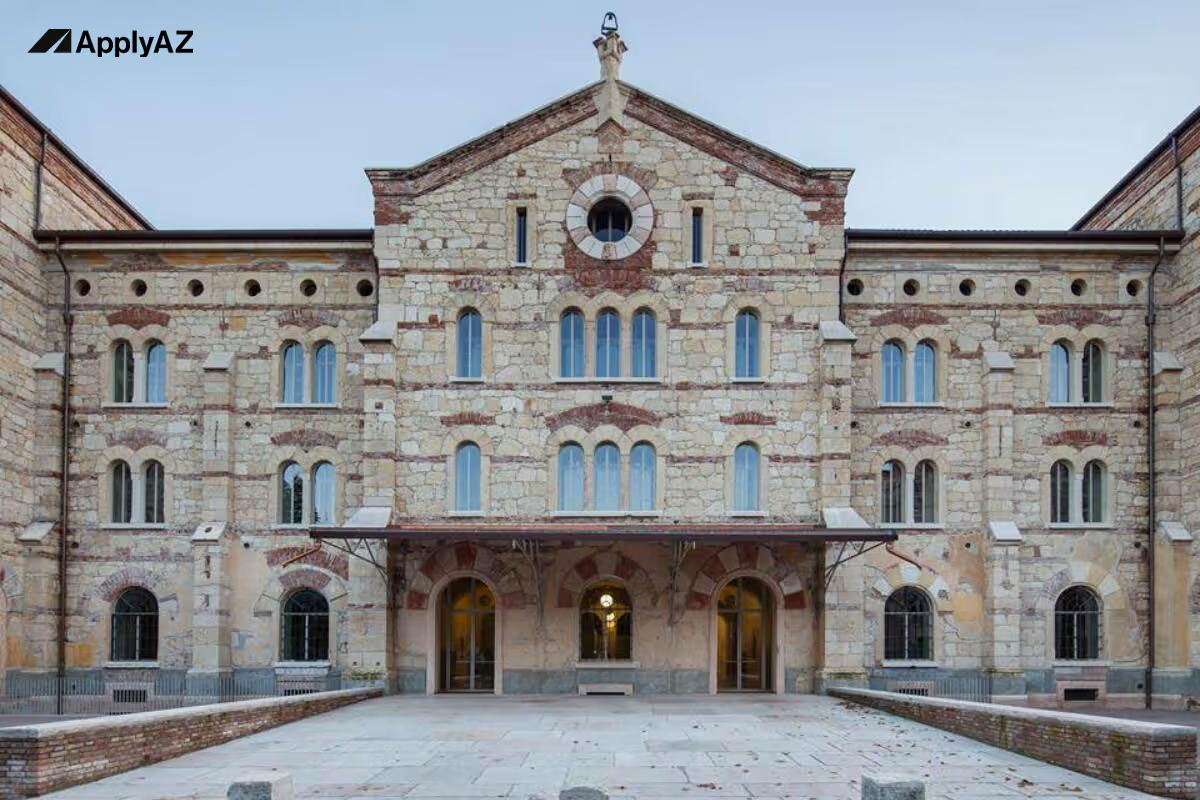
Economics and Data Analysis is a two-year, 120 ECTS master's degree (class LM-56 R) taught in English at the University of Verona in Verona. International applicants need a three-year bachelor's in economics or a related field with 12 ECTS in maths and 48 in economics and statistics, a first-class or 85% average, and English at B2. Fees follow family income, so it can be tuition-free for eligible students.
Entry requirements
Detailed entry requirements
Verona's Economics and Data Analysis master asks international applicants with a foreign degree for a three-year bachelor's in economics or a related field with at least 12 ECTS in maths and 48 in economics and statistics, a first-class or 85% average, English at B2 and pre-admission by the programme coordinators. Reviewed 8 October 2026. [1]
Degree requirement
For candidates with a foreign degree who are not Italian citizens and do not live in Italy, the 2026/27 international call asks for: [1]
- Subject area: a three-year bachelor's degree in economics or another field related to economics, statistics and finance, with at least 12 ECTS in the mathematics area and at least 48 ECTS in the economics and statistics area.
- Grades: a credit-weighted average (CGPA or equivalent) at first-class level, or at least 85% of the maximum mark on your grading scale.
- Degree level: a three-year degree at EQF level 6 or higher. If your bachelor's lasted two years, you also submit your master's degree.
Applicants outside the international call, such as those with an Italian degree, follow the programme's standard 2026/27 rules: at least 60 CFU, made up of 12 in statistics or maths, a further 18 in economics, statistics, maths, business or law, and a further 30 in those areas or in physics, computer science, engineering or the social and political sciences. A tolerance of up to 10% applies to each group as long as the total reaches 60. A weighted exam average of at least 22/30 is needed, otherwise an interview with a teaching committee. [2]
What this means for your transcript
Verona counts your credits by subject area and checks your average, not only your degree title. As a guide, based on the rule above:
- Usually a fit: a BA or B.Sc. in Economics, or a B.Sc. in Statistics with economics papers, with a first-class or 85% average.
- Check carefully: a B.Com, BBA or B.Sc. in Mathematics. These can meet the maths block, but the 48 credits in economics and statistics depend on how many of your papers are economics or statistics rather than accounting, management or pure maths. A 10-point CGPA or an Indian first class also needs checking, as the call does not say how either maps to its first-class or 85% level.
- Often short: a B.Tech, B.E. or BCA without economics papers, a BA outside economics, or any degree with an average well below 85%.
We check your transcript against both credit blocks and the grade rule before you apply. [1]
English
English at CEFR level B2, shown by a certificate obtained by the time you apply, or a previous degree taught in English. The call refers to the university's list of accepted certificates rather than listing scores. Duolingo certificates are accepted only from candidates from Iran and Afghanistan. [1]
Applicants to English-taught master's programmes are exempt from the university's Italian language test. [4]
Pre-admission and scholarship scoring
There is no written test. The programme coordinators grant pre-admission to candidates whose qualifications meet the curricular requirements and show the necessary preparation, and you hear by email within 45 days of applying. [1]
For the scholarships and reduced fees, a committee then scores pre-admitted candidates out of 100: [1]
- CV and relevance of your academic background, including grades in economics and statistics exams, internships, summer schools and work: up to 40 points. GRE or GMAT scores count in your favour.
- English above B2, or a previous degree taught in English: up to 4 points.
- Bachelor's average, normalised so that an upper second class scores 0 and a first class scores 26: up to 26 points.
- Zoom interview: up to 30 points, only for the candidates the committee judges comparatively most deserving.
A final score of at least 60/100 makes you eligible, and ties go to the younger candidate. [1]
2026/27 deadlines
These dates come from the 2026/27 international call. The 2027/28 call sets the new dates. [1]
- Applications: 29 January 2026 to 31 March 2026, 3 pm Italian time.
- Graduation: final-year students had to graduate by 30 June 2026.
- Ranking: published by 15 May 2026, with seven days for scholarship and reduced-fee winners to accept.
- Visa and Universitaly: non-EU candidates had to apply for the study visa and complete Universitaly pre-enrolment by 30 June 2026.
Applicants on the standard route registered for the eligibility check from 3 June to 15 October 2026, or until 12 November 2026 with enrolment by 21 December 2026 and a late fee. [2]
Documents and non-EU steps
The application needs: [1]
- the personal information pages of your passport
- your three-year degree certificate, or an enrolment certificate showing your expected completion date
- a transcript in English listing all modules and exams, with ECTS credits, weighted average and grade range if possible (a transcript of records or Diploma Supplement)
- a CV in English, two pages at most
- your English certificate
You can apply to no more than two programmes in the call. After pre-admission, you submit an official translation and legalisation of your diploma and a Declaration of Value. A CIMEA Statement of Comparability can replace the Declaration of Value, and a CIMEA Statement of Verification can replace legalisation. Non-EU candidates then complete Universitaly pre-enrolment, for one programme only, and apply for a type D study visa. The call notes that the visa needs personal funds of at least €546 a month (€6,555 a year). [1][4]
Sources and verification
Checked by the ApplyAZ admissions team against the university's official documents listed below. Entry rules can change with each new call, and we re-check them before every application.
- University of Verona. Call for applications for pre-admission and for the award of scholarships and reduced flat-rate student fees, International Master's degree programmes, with Annex 1 (admission requirements and evaluation criteria), academic year 2026/2027. Reviewed 8 October 2026.
- University of Verona, Department of Economics. Master's degree in Economics and Data Analysis, admission requirements and how to enrol, academic year 2026/2027. Reviewed 8 October 2026.
- University of Verona, Department of Economics. Master's degree in Economics and Data Analysis, programme overview, study plan and academic regulations, academic year 2026/2027. Reviewed 8 October 2026.
- University of Verona. Information for international degree-seeking students, academic year 2026/2027. Reviewed 8 October 2026.
- University of Verona. Right-to-study (DSU) scholarship calls, including the call for academic year 2026/2027. Reviewed 8 October 2026.
About the programme
Economics and Data Analysis is a two-year master's degree (laurea magistrale, class LM-56 R) taught in English by the Department of Economics at the University of Verona, on the Verona campus. Lectures and exams are held in person, attendance is not compulsory and part-time enrolment is possible. [3]
The degree combines economic theory with modern data analysis. It prepares you to read local and international economic trends critically and to apply empirical techniques to business and market questions. It suits graduates in economics, business, statistics or maths who want a quantitative master's with a policy and market angle.
What you will study
The first year lays the foundations in microeconomics, quantitative methods, econometrics and international economic law. The second year moves to macroeconomics and finance, with a choice of applied modules in business, risk, development, health, the environment and machine learning. Course units in the study plan include:
- Microeconomics (advanced) (12 ECTS)
- Quantitative Methods for Business and Economics (12 ECTS)
- Econometrics (9 ECTS) and International Economic Law (6 ECTS)
- Game Theory with Economic Applications or Public Sector Economics
- Macroeconomics and Finance (9 ECTS)
- Options such as Investments, Resilience and Risk Management and International Business and Management
- Options such as Machine Learning for Economics, Health Economics, Environmental Economics and Time Series and Forecasting
How the programme is taught
The degree carries 120 ECTS, including a 3 ECTS internship, 3 ECTS of further language skills, 9 ECTS of free-choice activities and a 15 ECTS final exam. [3] Teaching mixes lectures with seminars and talks from business leaders, guest lectures by faculty from universities abroad, project work and case analysis. Students can spend time abroad through mobility programmes, and a double degree runs with the MSc in International Economic Policy at the University of Würzburg in Germany, with the first year in Verona and the second in Würzburg. [3]
Career paths
The university describes two professional profiles for graduates:
- Specialist in economic analysis and management: economic consultant or research analyst in public and private institutions, working on micro and macroeconomic analysis.
- Business and market analyst: consultant in private firms, business analyst or risk analyst, focused on market analysis and investment evaluation.
Fees and scholarships
Fees follow family income (ISEE), so programmes can be tuition-free for eligible students. [2] Economics and Data Analysis is in Verona's 2026/27 international master's call, which offered this programme two €8,000 a year scholarships with a fee exemption (one for a non-EU and one for an EU candidate) and up to four fee reductions for non-EU candidates, both for two years. The scholarship cannot be combined with a regional scholarship. [1]
Outside the call, international students holding a study visa or permit may apply for a differentiated flat rate set by their country's World Bank income group. [4] The university itself runs the regional right-to-study (DSU) scholarship call for eligible students; the 2026/27 call closed on 30 September 2026. [5]
How to apply from outside the EU
Non-EU applicants living abroad with a foreign degree apply through the university's international master's call. It asks for a three-year degree in economics or a related field with at least 12 ECTS in maths and 48 in economics and statistics, a first-class or 85% average and English at B2. For 2026/27 the call opened on 29 January and closed on 31 March 2026, and the scholarship ranking was due by 15 May 2026. The 2027/28 call is not yet published. [1]
After pre-admission comes Universitaly pre-enrolment, for one programme only, and the type D study visa application, both due by 30 June 2026 in the 2026/27 cycle. The university asks for an official translation and legalisation of your diploma and a Declaration of Value, or CIMEA statements in their place. [1][4]
How ApplyAZ helps
ApplyAZ is an Italy-based consultancy that works only with public universities. We can include this programme in a shortlist of 20 to 30 English-taught programmes that fit your profile, so your plan never rests on a single application.
For eligible students who start with us, a named person owns each stage, from A to Z:
- We check your transcript against Verona's entry rules for this programme.
- We write your CV and a tailored statement of purpose.
- We prepare and submit your international call application, Universitaly pre-enrolment and your Declaration of Value or CIMEA statements.
- We help you declare your family income for reduced fees and file your regional DSU scholarship application at the right time and in the right format.
- We prepare your visa file.
With operations in all 20 Italian regions, we follow each region's scholarship rules and deadlines as they change. The university decides admission, the region decides the scholarship and the consulate decides the visa, so no one can promise an outcome. You pay in milestones, and every service you pay for is either delivered or its fee is refunded (terms apply).
Programmes at Italian public universities can be tuition-free for eligible students. Check if you are eligible and book a one-to-one consultation session with one of our Italy experts, or see how ApplyAZ works.
Questions and answers
What bachelor's degree do I need for Verona's Economics and Data Analysis master?
With a foreign degree, a three-year bachelor's in economics or a field related to economics, statistics and finance, with at least 12 ECTS in maths and 48 in economics and statistics, and a first-class average or at least 85% of the top mark. [1]
Is there an entrance exam?
No written test. The programme coordinators review your degree for pre-admission and reply within 45 days. For the scholarships and reduced fees, a committee scores your CV (up to 40 points, with GRE or GMAT counting in your favour), English (4), grades (26) and a Zoom interview (30) for the strongest candidates. [1]
What English level is required? Do I need IELTS?
English at CEFR B2, shown by a certificate held when you apply or by a previous degree taught in English. The call refers to the university's list of accepted certificates rather than naming scores, so we check which proof your file can use. Duolingo counts only for applicants from Iran and Afghanistan. [1]
When is the deadline for non-EU students?
For 2026/27, the international call for foreign-degree holders living outside Italy ran from 29 January to 31 March 2026, and Universitaly pre-enrolment and the visa application were due by 30 June 2026. The 2027/28 call sets the new dates. [1]
Can I apply before I graduate?
Yes, if you graduate in time. For 2026/27, final-year students could apply with an enrolment certificate showing the expected completion date, provided they graduated by 30 June 2026. [1]
I have a B.Com or a BBA. Can I apply?
Possibly. The call counts credits by area: 12 ECTS in maths and 48 in economics and statistics. A B.Com or BBA with strong economics and statistics papers can fit, while a degree built mainly on accounting or management may fall short. You also need a first-class or 85% average. We check your transcript before you apply. [1]
Is there a double degree?
Yes. The programme runs a double degree with the MSc in International Economic Policy at the University of Würzburg in Germany. Students on it spend the first year in Verona and the second in Würzburg. [3]
What jobs can I do after this degree?
The university names two profiles: specialist in economic analysis and management, such as economic consultant or research analyst in public and private institutions, and business and market analyst, such as business or risk analyst in consulting firms. The degree also prepares you for a PhD in economics. [3]
Can someone handle my whole application to Economics and Data Analysis at Verona?
Yes. ApplyAZ, an Italy-based consultancy that works only with public universities, checks your transcript against Verona's rules for this programme, handles the application and Universitaly pre-enrolment, helps you file the regional DSU scholarship application at the right time and in the right format, and prepares your visa file, for eligible students. Start by checking your eligibility.
I'm applying from India. What is the route into Economics and Data Analysis?
A recognised three-year Indian bachelor's in economics or a related field, such as a BA or B.Sc. in Economics, or a B.Com with strong economics and statistics papers, can fit if it covers the 12-credit maths and 48-credit economics and statistics blocks, with a first-class or 85% average and English at B2. The steps are the international call application, pre-admission and Universitaly pre-enrolment. [1] Indian students apply for the type D study visa at the Italian embassy or consulate that covers their state, such as New Delhi, Mumbai or Bengaluru.
Is the route different from Pakistan, Bangladesh or Sri Lanka?
No. The academic rules for Economics and Data Analysis are the same whatever your nationality. Applicants from Pakistan, Bangladesh and Sri Lanka follow the same steps as India: an application to the international call, pre-admission and Universitaly pre-enrolment, then a type D study visa from the Italian mission for their country of residence. Read our guide for students in Dhaka.
I live in the UAE, Saudi Arabia, Qatar, Kuwait, Oman or Bahrain. Where do I apply for the visa?
At the Italian embassy or consulate responsible for the country where you legally live, after Universitaly pre-enrolment. The academic rules for Economics and Data Analysis are the same whatever your nationality, and Gulf residents follow the same steps: an application to the international call, pre-admission and Universitaly pre-enrolment. Read our guides for Dubai, Riyadh and Doha.
I studied or live in London, New York, Toronto, Vancouver, Singapore or Kuala Lumpur. What is the route?
The academic rules for Economics and Data Analysis are the same whatever your nationality, and your degree is assessed like any other foreign qualification. Non-EU applicants who live abroad follow the same route: an application to the international call, pre-admission and Universitaly pre-enrolment, then a type D study visa from the Italian mission for where they live. Read our guides for students in London, New York, Toronto, Vancouver, Singapore and Kuala Lumpur.
More English-taught programmes at this university
Other public universities in this city

They began right where you are

