

Master in Economic Analysis and Policy at University of Turin
Two-year English-taught economics master in Turin linked to the EPOG Erasmus Mundus Joint Master, with pathways in innovation and sustainability or development, a core in econometrics and development economics, and a 16 ECTS thesis.
Master
2 years
Turin
English
University of Turin



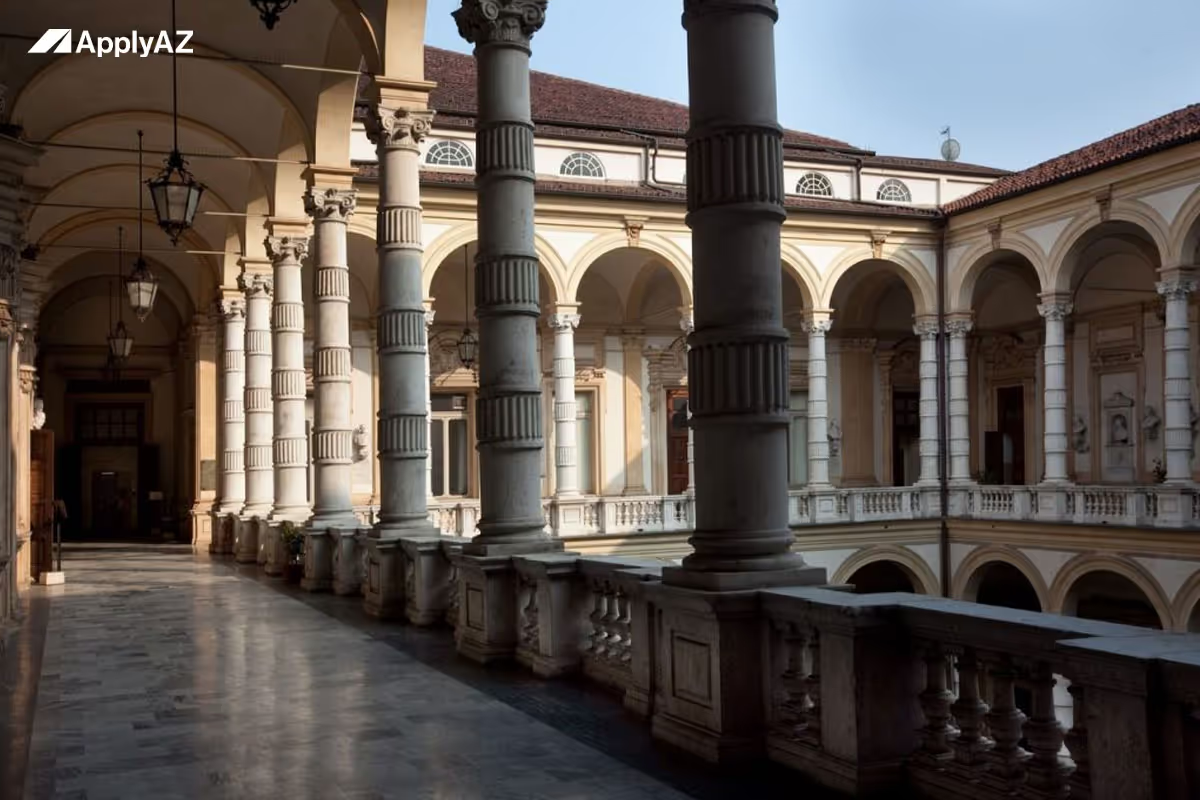
Economic Analysis and Policy at Turin follows EPOG-JM selection. Current standard entry includes a relevant 180-ECTS first degree, 24 economics credits, 6 statistics/econometrics credits and C1 English, with committee-defined exceptions. The 2027 to 2029 call deadline is 27 January 2027 at 13:00 Paris time.
Entry requirements
Detailed entry requirements
Economic Analysis and Policy uses the EPOG-JM consortium’s application and pathway selection. Its current 2027-2029 rules require stronger standard economics and English preparation than the older Turin listing, with explicitly defined discretionary exceptions. Official sources were reviewed on 6 October 2026. [1-6]
Current consortium standard: 180 ECTS and 24 economics credits
The current EPOG two-year admission page requires a bachelor’s or equivalent degree of at least 180 ECTS. A degree in economics or another field must support the specified academic background: at least 24 ECTS or equivalent in economics and 6 ECTS in statistics or econometrics, together with the requirements of the chosen major/minor. The current selection criteria also expect the bachelor’s GPA to be at least 70% of the maximum scale. [1]
Turin’s catalogue and older 2026/27 listing print 18 economics CFU and 6 statistics CFU. The current consortium page sets 24/6 as its ordinary standard and explains circumstances in which 18/6 can still be considered. The lower Turin figure is therefore not unconditional current eligibility for every EPOG pathway. [1-3]
Major A permits basic/advanced economics, with management courses forming part of the 24-credit background. Major B requires microeconomics and macroeconomics, with international economics for minor B1. In Major C, minor C1 asks for basic/advanced economics, minor C2 for microeconomics/macroeconomics/international economics, while C3/C4 have no additional subject-content condition beyond the published overall requirements. We check that the chosen major/minor leads to the intended Turin-related mobility and degree path. [1]
Discretionary exceptions for outstanding applicants
For Major A and Major C minors C1/C4, the consortium can consider applicants with at least 18 economics credits and 6 statistics credits; outstanding applicants below these figures may receive a conditional outcome requiring additional courses. This is a committee decision rather than an applicant’s automatic waiver. [1]
For Major B and minor C2, outstanding applicants who have microeconomics, macroeconomics and international economics or close substitutes can be considered even without 24 credits; where the expected 6 statistics/econometrics credits are missing, a course in that field is required in the first year if enrolled. For minor C3, the committee considers closeness to both thresholds case by case, with the corresponding statistics/econometrics completion condition. We work from the specific admission offer and any Turin curricular clearance. [1, 2]
Current English requirement: C1 and the accepted scores
The current consortium page requires CEFR C1 or higher and English proof no later than June 10 in the admission cycle. It lists TOEFL iBT at least 95, accepting MyBest Scores; IELTS Academic at least 7.0; Cambridge C1 Advanced (CAE) grade B or higher; C2 Proficiency (CPE) grade C or higher; or PTE Academic at least 67. The reviewed source does not print universal IELTS component minima or a differently scaled TOEFL conversion. [1]
A GRE General Test with verbal reasoning at least 150, analytical writing at least 4 and quantitative reasoning at least 151 can be considered English evidence. It is a language-evidence alternative, rather than a universal GRE requirement for admission. No individual English test is required for native English speakers or applicants with a higher-education degree entirely taught in English. For an exemption, or a test still pending at submission, we use the consortium’s sworn-statement procedure and file the required evidence by its deadline. [1]
The older Turin listing gives B2, IELTS 6.5 and TOEFL 87. Those figures do not replace the current consortium’s C1/IELTS 7.0/TOEFL 95 standard. French, Italian or German is not generally mandatory but documented competence is considered. Minor C4 additionally requires evidence of Portuguese; native or fully bilingual Spanish speakers may be considered for Portuguese study under the programme’s stated conditions. [1, 3]
Complete online file: CV, qualifications and translations
We submit the completed form through the EPOG application platform. The consortium instructs applicants to upload documents in the form’s Attachments section rather than email them. The file needs a full CV; Europass is suggested but not compulsory. We scan the original qualifying diploma showing a relevant tertiary award of at least 180 ECTS, and all higher-education transcripts covering all completed courses, rather than only the latest year. A Diploma Supplement is encouraged where available. [1]
If the degree or transcripts are not in English, English translations go alongside the originals. The consortium permits a non-official translation for the initial application but requires an official translation if preselected; selected students must provide certified/legally attested English translations by June 10. The transcripts must substantiate the standard or approved exceptional credit route and chosen major/minor. [1]
Candidates planning to graduate by July 31 can apply with the specified sworn statement and provisional acceptance, then provide degree-certificate copies by August 31. These pending-degree milestones do not remove the qualifying-degree requirement; we follow the exact dates assigned to the admission cycle and the separate certified-record requirements. [1]
Statement, two references, nationality and additional evidence
The statement of purpose must be no more than 500 words and explain motivation, relevant academic/work experience and career plans. It names the desired major(s)/minor(s) in preference order and shows interest in the programme’s heterodox approaches to economics. The file also includes the English proof or the published exemption/pending-test statement. [1]
Two recommendation letters are compulsory, from teachers/professors or job supervisors, explicitly assessing ability to follow EPOG-JM. Each should identify its date, recommender’s name, institution, position, signature, official stamp if available, and phone/email contact details. A valid passport scan establishes nationality; EU citizens can use an ID, and dual nationals must provide the passport corresponding to the nationality used in the application. Other expected funding information is optional. [1]
Turin’s catalogue additionally describes a research proposal for the master’s thesis in its preliminary dossier. The current consortium upload list does not separately enumerate that proposal. We prepare it where the actual Turin/path application requests it, alongside the current compulsory EPOG statement and two references, not as a substitute for those documents. [1, 2]
Selection weights, interviews and the current deadline
The consortium weights educational background 15%, academic records 35%, motivation/recommendation letters 20% and languages 30%. Initial filtering checks minimum requirements. Two referees from different member institutions review each file; the committee preselects candidates and conducts video interviews, then establishes main and reserve lists. These academic referees are part of the selection process and are separate from the applicant’s two recommendation letters. [1]
Turin’s catalogue describes its TAPP personal-preparation interview as 15 minutes over Zoom, followed by academic clearance if passed. The consortium describes video interviews for shortlisted candidates without a universal fixed duration. We prepare you for the interview set out in your pathway’s invitation. The older Turin portal lists 20 places for non-European applicants abroad for 2026/27; that is not a newly verified overall 2027-2029 consortium capacity. [1-3]
For the 2027-2029 two-year cohort, the consortium publishes opening in October 2026 and the deadline 27 January 2027 at 13:00 Paris time. Interviews are in March 2027 and selection results at the end of March. At the 6 October review the official platform displayed no open campaign, so the October announcement did not mean the application was already open at that moment. A possible later self-funded call is described only as a possibility, without a confirmed deadline. [1, 4]
Mobility and final university enrolment
Physical mobility is compulsory for enrolled EPOG-JM students, whether or not they receive an Erasmus Mundus scholarship. The host countries/institutions and degrees depend on the chosen major/minor, so the route does not mean studying only in Turin. Academic eligibility, scholarship selection, admission, mobility arrangements and visa/residence requirements are distinct stages. We follow the current cohort’s offer and host-university instructions. [1]
Where final enrolment is in Turin, the university assesses the qualifying first degree’s recognition, level, duration, academic rights and authenticity and requests complete records/identity documentation. The International Students Office checks the file before issuing payment instructions. Its published visa/payment guidance is labelled 2026/27; a 2026 visa or Universitaly deadline is not an already confirmed 2027/28 rule. We use the correct academic-year host instructions when issued. [5, 6]
Sources and verification
- EPOG-JM consortium, Admission, current requirements and 2027-2029 cohort timetable; publication date not stated; reviewed 6 October 2026.
- University of Turin, Economic Analysis and Policy, current degree catalogue with 2026/27 teaching entries, Admission requirements; publication date not stated; reviewed 6 October 2026.
- University of Turin, Apply@UniTo course 683: Economic Analysis and Policy, 2026/27 listing; reviewed 6 October 2026.
- EPOG official application platform, public campaign state checked 6 October 2026.
- University of Turin, Required documents for international students, standing guidance; reviewed 6 October 2026.
- University of Turin, Enrolment for international students, 2026/27 guidance; reviewed 6 October 2026.
About the programme
Economic Analysis and Policy is a two-year master's degree in class LM-56-R, economic sciences, worth 120 ECTS and taught in English in Turin by the University of Turin's Department of Cultures, Politics and Society. Access is open, but a committee screens every application and shortlisted candidates have a short interview on Zoom.
The degree is linked to EPOG, an Erasmus Mundus Joint Master in economic policy run with partner universities. UniTo's pages send applicants to the EPOG application form, and students on the joint-degree route spend part of the programme at partner institutions, depending on their path. It suits economics graduates interested in innovation, sustainability and development policy.
What you will study
The first year starts with a shared core, then students follow a pathway: a generic path, a path focused on innovation and sustainability, or a path focused on development. The second year combines a common culture module, quantitative methods, an elective and the thesis. Italian for international students and French are optional extras. Units in the 2026/27 study plan include:
- Econometrics (9 ECTS)
- Economics and sociology of development in a globalised world (12 ECTS)
- Economics of Knowledge (9 ECTS)
- Innovation and Sustainability (18 ECTS, innovation and sustainability path)
- Complexity Economics and Agent-Based Modelling (elective)
- Microeconomics, Industrial and Trade Policy, and Political Economy of Development I (development path)
- Development and Sustainable Development (12 ECTS, second year, development path)
- Quantitative Methodologies for Empirical Work (6 ECTS)
How the programme is taught
For EPOG students, the Apply@UniTo course page sets out the mobility. On one path the first two semesters are in Turin and the third in Paris; on another the first semester is in Turin, the second at the University of the Witwatersrand in South Africa and the third in Paris, with the final semester still to be defined. The thesis is worth 16 ECTS, and 3 ECTS go to other training activities.
Career paths
The course pages reviewed do not list professional profiles for this degree. The EPOG programme site states its aim: training international experts who can design and evaluate economic policies, drawing on heterodox and institutionalist approaches as well as standard theory, for the digital, socio-economic and ecological transitions.
The study plan builds skills in econometrics, development and innovation economics and empirical methods. These are the tools of economic research and policy analysis, and the thesis can be a first step towards doctoral study.
Fees and scholarships
Fees depend on your route. Under UniTo's 2026/27 fee regulation, students enrolled for the EPOG joint degree pay the tuition set by the Université de Technologie de Compiègne (France), and fees for students enrolling within the Erasmus Mundus project are covered by project funds. Otherwise fees for students residing abroad follow their country of residence. EDISU Piemonte scholarship winners are exempt from UniTo's tuition instalments.
How to apply from outside the EU
Applications go through EPOG’s online platform for the intended major/minor. We check your file against the current consortium’s academic, C1 English, document and selection requirements. For the 2027 to 2029 cohort, the published deadline is 27 January 2027 at 13:00 Paris time, with opening announced for October 2026. We match final host-university enrolment and visa steps to the new academic year's instructions. [1, 4-6]
How ApplyAZ helps
ApplyAZ is an Italy-based consultancy that works only with public universities. We can include this programme in a shortlist of 20 to 30 English-taught programmes that fit your profile, so your plan never rests on a single application.
For eligible students who start with us, a named person owns each stage, from A to Z:
- We check your transcript against Turin's entry rules for this programme.
- We write your CV and a tailored statement of purpose.
- We prepare and submit your EPOG-JM online application, supporting documents and Universitaly pre-enrolment.
- We help you declare your family income for reduced fees and file your EDISU Piemonte scholarship application at the right time and in the right format.
- We prepare your visa file.
With operations in all 20 Italian regions, we follow each region's scholarship rules and deadlines as they change. The university decides admission, the region decides the scholarship and the consulate decides the visa, so no one can promise an outcome. You pay in milestones, and every service you pay for is either delivered or its fee is refunded (terms apply).
Programmes at Italian public universities can be tuition-free for eligible students. Check if you are eligible and book a one-to-one consultation session with one of our Italy experts, or see how ApplyAZ works.
Questions and answers
Is 18 economics credits enough?
The current consortium standard is 24 economics credits and 6 statistics/econometrics credits. Certain majors/minors can consider 18/6 or other outstanding profiles with conditions. This requires a committee decision, rather than automatic eligibility. [1]
I have a B.Com or BA in Economics. Can I apply?
It depends on your transcript. The standard needs a degree of at least 180 ECTS with at least 24 ECTS in economics and 6 in statistics or econometrics, plus the subject content of your chosen major/minor. We map your courses against these rules. [1]
Is B2 English enough for the new call?
No. The current consortium requires C1 or higher. Accepted scores include IELTS Academic 7.0, TOEFL iBT 95 with MyBest accepted, and PTE Academic 67. The older Turin B2 figures do not replace these current rules. [1, 3]
Can an English-medium degree replace a test?
Yes. The consortium exempts native English speakers and applicants whose higher-education degree was entirely taught in English. We follow its sworn-statement and evidence procedure and the admission-cycle deadline. [1]
Are recommendation letters compulsory?
Yes. Two letters from teachers/professors or job supervisors must assess your ability to follow EPOG-JM and identify the recommender, institution, position, signature, date and contact details. [1]
Can I apply before graduating?
Yes, if you plan to graduate by July 31 and use the specified sworn statement. Provisionally accepted applicants must supply degree-certificate copies by August 31, with other certified records/language evidence by the applicable deadlines. [1]
What is the next application deadline?
For the 2027 to 2029 two-year cohort, 27 January 2027 at 13:00 Paris time. Opening is announced for October 2026; the platform still displayed no open campaign at the 6 October check. Interviews are in March 2027. [1, 4]
Will I study only in Turin?
No. Physical mobility is compulsory for enrolled EPOG-JM students, and the host countries, institutions and degrees depend on your chosen major/minor. The Turin course listing describes paths that start in Turin, with a later semester in Paris. [1, 3]
Can someone handle my whole application to Economic Analysis and Policy at Turin?
Yes. ApplyAZ, an Italy-based consultancy that works only with public universities, checks your transcript against Turin's rules for this programme, handles the application and Universitaly pre-enrolment, helps you file the EDISU Piemonte scholarship application at the right time and in the right format, and prepares your visa file, for eligible students. Start by checking your eligibility.
I'm applying from India. What is the route into Economic Analysis and Policy?
Indian applicants apply through the EPOG-JM consortium. The standard entry is a bachelor's degree of at least 180 ECTS with at least 24 ECTS in economics and 6 in statistics or econometrics, and a GPA of at least 70% of the scale [1]. English must be C1, such as IELTS Academic 7.0 or TOEFL iBT 95 [1]. Shortlisted candidates have a video interview [1]. We prepare your EPOG file and Universitaly. Indian students apply for the type D study visa at the Italian embassy or consulate that covers their state, such as New Delhi, Mumbai or Bengaluru.
Is the route different from Pakistan, Bangladesh or Sri Lanka?
No. The academic rules for Economic Analysis and Policy are the same whatever your nationality. Applicants from Pakistan, Bangladesh and Sri Lanka follow the same steps as India: an EPOG-JM online application, the consortium selection and interview, and Universitaly pre-enrolment, then a type D study visa from the Italian mission for their country of residence. Read our guide for students in Dhaka.
I live in the UAE, Saudi Arabia, Qatar, Kuwait, Oman or Bahrain. Where do I apply for the visa?
At the Italian embassy or consulate responsible for the country where you legally live, after Universitaly pre-enrolment. The academic rules for Economic Analysis and Policy are the same whatever your nationality, and Gulf residents follow the same steps: an EPOG-JM online application, the consortium selection and interview, and Universitaly pre-enrolment. Read our guides for Dubai, Riyadh and Doha.
I studied or live in London, New York, Toronto, Vancouver, Singapore or Kuala Lumpur. What is the route?
The academic rules for Economic Analysis and Policy are the same whatever your nationality, and your degree is assessed like any other foreign qualification. Non-EU applicants who live abroad follow the same route: an EPOG-JM online application, the consortium selection and interview, and Universitaly pre-enrolment, then a type D study visa from the Italian mission for where they live. Read our guides for students in London, New York, Toronto, Vancouver, Singapore and Kuala Lumpur.
More English-taught programmes at this university
Other public universities in this city

They began right where you are

