

Master in Cellular and Molecular Biology at University of Turin
Two-year English-taught master in Turin in cell and molecular biology, with neurobiological, biomedical and biomolecular tracks, a shared core in molecular biology, bioinformatics and pharmacology, and an online admission test for international applicants.
Master
2 years
Turin
English
University of Turin



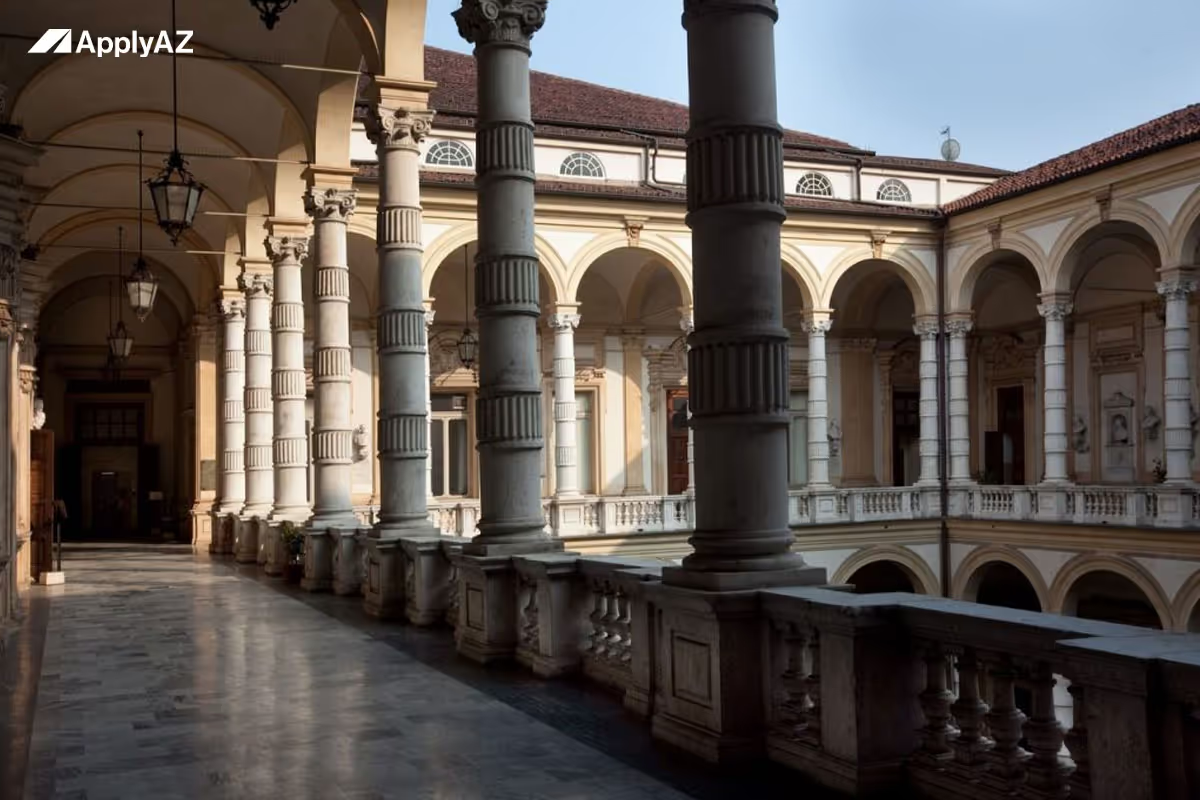
Cellular and Molecular Biology is a two-year, 120 ECTS master's degree (class LM-6-R) taught in English by the University of Turin's Department of Life Sciences and Systems Biology in Turin, with neurobiological, biomedical and biomolecular tracks. Admission is by a test in English and an interview. Students residing abroad pay a fixed contribution set by their country.
Entry requirements
Detailed entry requirements
Cellular and Molecular Biology requires a suitable first degree with the stated final grade, adequate scientific preparation, a two-stage admission test and English at least B1. The department publishes a detailed 2026/27 test structure. Sources were reviewed on 6 October 2026. [1-6]
Qualifying degree, grade and subject preparation
Hold a three-year first-level/bachelor’s degree or a foreign equivalent recognised as satisfactory by the admissions committee. The international portal requires a final grade of at least 8.3/10 of the highest possible grade and prints 92/110 as the Italian equivalent. The departmental 2026/27 page also specifies the 8.3/10 reference. The committee determines equivalence and suitability of a foreign record. [1, 2]
For applicants with an Italian bachelor’s degree other than L-13 Biological Sciences or L-2 Biotechnology, the departmental rules require at least 60 credits in one or more of the specified scientific sectors: BIO/01-07, BIO/09-12, BIO/14, BIO/16, BIO/18-19; CHIM/01-03 and CHIM/06; FIS/01-08; MAT/01-09; INF/01; ING-INF/05; MED/04 and MED/42. This is the explicitly stated Italian-other-degree curricular rule. For foreign applicants, we document equivalent academic preparation for the international committee assessment, as a foreign degree title alone does not establish eligibility. [1, 2]
Stage one: 60 weighted questions in 70 minutes
The 2026/27 department page specifies a Moodle written test of 60 multiple-choice questions in sequential order, with no return to earlier questions. Time allowed is 70 minutes. Questions have at least four possible answers and different weights. To proceed to interview you must achieve at least 50% of the maximum weighted score. This is not necessarily the same as answering exactly 30 questions correctly. [2]
- Anatomy/Histology: 6 questions; Biochemistry: 10; Cell Biology: 10; Genetics: 8; Microbiology: 8; Molecular Biology: 10; Physiology: 8. These add to 60. [2]
- For in-person candidates, at least two programme teachers check identity. International candidates taking the test remotely connect to the supplied Webex/Zoom session on the appointed date and time, show an official photo document and keep video and audio active throughout the written test. [2]
- Use the department’s syllabus and sample questions to prepare. The current instructions do not provide an automatic exemption based on degree class or high grade, or a universal fee-based alternative test. [1, 2]
Stage two: explanation of answers and English assessment
Applicants who achieve at least 50% of the written maximum are interviewed by at least two programme teachers. The interview discusses the written test: you must explain why you chose your answers and demonstrate adequate English. Passing the written stage only qualifies you for this second stage; it does not complete admission. [2]
The international listing sets English at at least CEFR B1 and says it is checked at the admission interview. The reviewed programme rules do not demand a universal IELTS, TOEFL or PTE certificate/score. English is also part of the academic preparation syllabus. We supply any additional evidence actually requested by your applicant checklist or committee. [1, 2]
Scientific and laboratory syllabus
Prepare the core biological disciplines at undergraduate level. The international listing identifies the following content, in addition to the department’s question distribution. [1]
- Anatomy/physiology: cardiovascular, digestive, respiratory, excretory, reproductive, endocrine and nervous systems; biological membranes and diffusion. Cytology/histology: eukaryotic cells, organelles, mitosis/meiosis, principal tissues and immunohistochemistry. [1]
- Biochemistry: protein structure/function and allostery; enzymes/catalysis; bioenergetics and metabolism; protein purification/characterisation. Cell biology: communication/signalling, junctions/adhesion, cell-cycle control, death/survival, protein trafficking and basic cell culture. [1]
- Microbiology: prokaryotic structure, metabolism, growth and genetics; cultivation, quantification and identification of bacteria; viral structures and replication. Molecular biology/genetics: DNA/RNA, genomes, replication, mutation/repair, transcription/RNA processing/protein synthesis, gene-expression regulation, recombinant DNA, recombination/heredity, population genetics and basic bioinformatics. [1]
- Laboratory preparation: solutions, dilution methods and basic laboratory safety. [1]
Application evidence and the category-specific quota
The file includes the first-cycle award, complete transcript with grades/credits or hours, CV, motivation letter and identity/authenticity evidence. We document the scientific courses that support your preparation and any curricular review requested by the commission. You attend both assigned admission stages, and we keep the committee’s clearance for enrolment. The portal reserves 50 places for non-European applicants residing abroad. Open access does not waive the degree, grade, test or language requirements. [1, 2, 4]
Recognition and the complete foreign-qualification file
The university requires a first-cycle or integrated qualification at the relevant EQF/EHEA/ISCED level 6, obtained after at least 15 total years of education, and assesses recognition/accreditation, qualification level, duration, academic rights and document authenticity. The file includes the first-cycle or integrated award and any intermediate qualification used to reach it; a master’s or doctorate alone does not replace the entry qualification. Curricular suitability for this programme remains a separate condition. [3, 4]
We prepare the qualifying degree and a full transcript recording all examinations, grades, study hours and/or credits, with all informative pages and reverse sides; a CV; and a motivation letter in English or Italian. We include programme-specific language, subject and assessment evidence. An official international-model Diploma Supplement can replace degree/transcript documents only if it includes complete records, is signed/sealed and carries required authenticity evidence. [1, 4]
The file needs valid identity evidence: an ID for eligible Italian/EU/equivalent applicants, or a passport for non-EU applicants. Non-EU residents in Italy need the applicable permit allowing university enrolment. Documents are accepted in Italian, English, French or Spanish; otherwise include both originals and certified translations into an accepted language. Unsigned or unstamped/unsealed documents and incomplete applications are not accepted. [4]
If you are graduating later, the file includes the official last-year enrolment certificate identifying the study path and expected qualification, plus an official transcript/score report for completed semesters. The final qualifying award is necessary for enrolment. Detailed syllabi, the grading scale and a Declaration of Value/CIMEA Comparability are useful and can become mandatory if the office or programme requests them. [4]
2026/27 international calls and application fee
Foreign qualifications normally require an Apply@UniTo application, regardless of citizenship, except the university’s explicitly exempt categories. One application permits selection of up to two programmes. We use the programme’s checklist as well as the central document requirements. [3, 4]
For 2026/27, the principal postgraduate application window was 25 November 2025 to 29 January 2026. The second open-access postgraduate call was 25 August to 8 September 2026 and restricted to Italians, EU/equivalent applicants and non-EU citizens legally resident in Italy. Both windows have closed at the review date. The October window on the central page concerns undergraduate and five/six-year degrees, rather than these two-year master’s programmes. No confirmed 2027/28 calendar is provided in the reviewed sources. [3]
For non-EU visa applicants abroad, the published 2026/27 Universitaly pre-enrolment deadline was 15 July 2026 for this category of programme. We select the correct academic year, one programme and the competent diplomatic representation. University eligibility or Universitaly validation does not complete university enrolment or determine the embassy’s visa decision. [3]
Departmental admission, MyUniTo and final enrolment
This programme appears in the university’s open-access postgraduate procedures. After the required academic evaluation, we follow the department’s own instructions and dates. The listed local preliminary route is type A: Pre-enrolment for courses with free admission. For a foreign qualification, this local procedure must be read together with the international application instructions; it does not create a replacement Apply deadline. [3, 6]
The ordinary 2026/27 MyUniTo enrolment window runs from 23 July 2026 at 09:30 to 14 January 2027 at 15:00 Italian time, subject to any earlier programme-specific deadline. Registration requires the academic clearance, valid identity document, suitable photograph and Italian tax-code details. International students cannot independently pay the first instalment: the International Students Office checks the request and emails payment instructions. [5, 6]
A later first-payment completion date of 31 March 2027 at 15:00 is available under the central policy only for students already admitted to a first year with open access who followed all required enrolment procedures on time but still lack documentation. This is not a new admission round or a universal extension of departmental requirements. [5]
For non-EU applicants abroad, final payment/enrolment requires the appropriate 2026/27 study visa, residence-permit application receipt, official Italian fiscal code and complete authenticated study documentation. We follow the current instructions for supplying the permit after issuance. Applicants in other categories supply their corresponding identity/residence and study records. [4, 5]
Authenticity evidence and final academic records
Final enrolment requires verification of the degree and transcript. Accepted methods depend on the issuing system and can include legalisation, an apostille, ENIC-NARIC verification or an accepted official digital service. The university specifies direct sharing procedures for electronic transcripts. Translation, comparability and authenticity are different checks; a translated document alone does not establish that it is authentic. [4]
The university can request additional qualification evidence or originals. Providing valid authenticity evidence at application can speed up final checks, but an optional CIMEA comparison document is not mandatory for every initial application. We supply each document actually requested in your applicant file within the applicable dates. [4, 5]
Sources and verification
- University of Turin, Apply@UniTo course 345: Cellular and Molecular Biology, 2026/27 listing; reviewed 6 October 2026.
- University of Turin, Cellular and Molecular Biology, Admission requirements A.A. 2026/27, HowToEnrol departmental page; publication date not stated; reviewed 6 October 2026.
- University of Turin, Application for international students, current 2026/27 guidance; reviewed 6 October 2026.
- University of Turin, Required documents for international students, standing qualification and document guidance; reviewed 6 October 2026.
- University of Turin, Enrolment for international students, current 2026/27 guidance; reviewed 6 October 2026.
- University of Turin, Postgraduate degrees with free admission, 2026/27 procedures; reviewed 6 October 2026.
About the programme
Cellular and Molecular Biology is a two-year master's degree in class LM-6-R, biology.
It is worth 120 ECTS, taught in English and run in Turin by the Department of Life Sciences and Systems Biology of the University of Turin.
Access is open, subject to an admission test in English and an interview.
The degree deepens the study of cells and molecules and then lets you focus on one of three tracks: Neurobiological, Biomedical or Biomolecular.
It suits biology and life science graduates who want advanced training in molecular mechanisms, disease biology or neurobiology, with laboratory and bioinformatics training.
What you will study
All students take a shared core in advanced cell and molecular biology, bioinformatics and pharmacology.
The Neurobiological track adds neuroanatomy, cellular neurobiology and neural plasticity; the Biomedical track adds virology, immunopathology and medical genetics; the Biomolecular track adds biophysics, proteomics and systems biology. Course units in the study plan include:
- Advanced Cell Biology and Biotechnology (9 ECTS)
- Advanced Molecular Biology (9 ECTS)
- Bioinformatics
- General and Molecular Pharmacology
- Integrative Neurobiology Laboratory (Neurobiological)
- Oncology and Molecular Pathology (Biomedical and Biomolecular)
- Medical and Cancer Genetics (Biomedical)
- Systems Biology (Biomolecular)
How the programme is taught
Teaching is in person in Turin, with laboratory units such as the integrative neurobiology lab, and the degree ends with a thesis. Two first-year electives, Developmental Neurobiology and Cell Physiology, are delivered online.
Students can add short courses through UNITA à la carte and use flexibility windows to shape their study plan, and international students can take Italian language courses.
Career paths
The university's English course page does not list professional profiles for this degree. Its three tracks lead towards different areas of the life sciences: neurobiology and brain research, biomedical and cancer research, and molecular and structural biology with systems approaches.
Typical settings for this training are research laboratories in universities, hospitals and public institutes, and biotechnology or pharmaceutical companies. Graduates can also continue to a PhD in the life sciences.
Fees and scholarships
Students residing abroad do not need an ISEE at UniTo: they pay a fixed contribution tied to the GDP per capita of their country.
Those from countries on the ministry's list of particularly poor countries pay a reduced amount. Winning an EDISU Piemonte scholarship means this programme can be tuition-free for eligible students.
Open-access English-taught master's like this one were also eligible for UniTo's 40 Talents 4 UniTo scholarships in 2026/27.
How to apply from outside the EU
Applicants with a foreign qualification apply through Apply@UniTo. They must meet this programme’s academic, language and assessment requirements and provide the complete document file. The detailed requirements section identifies the published 2026/27 deadlines, any test/interview exemptions and the separate final-enrolment stages. [1-6]
How ApplyAZ helps
ApplyAZ is an Italy-based consultancy that works only with public universities. We can include this programme in a shortlist of 20 to 30 English-taught programmes that fit your profile, so your plan never rests on a single application.
For eligible students who start with us, a named person owns each stage, from A to Z:
- We check your transcript against Turin's entry rules for this programme.
- We write your CV and a tailored statement of purpose.
- We prepare and submit your Apply@UniTo application and Universitaly pre-enrolment.
- We help you declare your family income for reduced fees and file your EDISU Piemonte scholarship application at the right time and in the right format.
- We prepare your visa file.
With operations in all 20 Italian regions, we follow each region's scholarship rules and deadlines as they change. The university decides admission, the region decides the scholarship and the consulate decides the visa, so no one can promise an outcome. You pay in milestones, and every service you pay for is either delivered or its fee is refunded (terms apply).
Programmes at Italian public universities can be tuition-free for eligible students. Check if you are eligible and book a one-to-one consultation session with one of our Italy experts, or see how ApplyAZ works.
Questions and answers
What final grade is required?
The international portal requires at least 8.3/10 of the maximum and prints 92/110 as the Italian equivalent. Foreign equivalence and academic suitability are assessed by the committee. [1, 2]
How long is the written test?
Seventy minutes for 60 multiple-choice questions on Moodle. Questions are sequential, so you cannot go back to earlier ones. [2]
Are 30 correct answers enough to reach the interview?
The requirement is at least 50% of the maximum weighted score. Questions have different weights, so 30 correct answers are not necessarily equivalent to that threshold. [2]
Can international applicants test online?
Yes. The current instructions provide a remote supervised route, with a supplied Webex/Zoom session, official photo identification and video/audio kept active throughout the written test. [2]
What happens at the interview?
A committee of at least two teachers asks you to explain your written-test answers and demonstrate adequate English. You reach this stage only after attaining the written-score threshold. [2]
Is an IELTS certificate compulsory?
The international listing requires at least B1 English and checks it at the admission interview. It does not print a universal IELTS/TOEFL/PTE certificate requirement for this programme. [1]
Can someone handle my whole application to Cellular and Molecular Biology at Turin?
Yes. ApplyAZ, an Italy-based consultancy that works only with public universities, checks your transcript against Turin's rules for this programme, handles the application and Universitaly pre-enrolment, helps you file the EDISU Piemonte scholarship application at the right time and in the right format, and prepares your visa file, for eligible students. Start by checking your eligibility.
I'm applying from India. What is the route into Cellular and Molecular Biology?
You need a three-year bachelor's with a final grade of at least 8.3/10 of the maximum, and the committee assesses your scientific preparation, so a B.Sc. in Biology, Biotechnology or a related life science sits closest to the rules [1, 2]. Admission is by a 60-question written test and an interview that checks English at B1 [1, 2]. The steps are Apply@UniTo, the test and interview, and Universitaly pre-enrolment. Indian students apply for the type D study visa at the Italian embassy or consulate that covers their state, such as New Delhi, Mumbai or Bengaluru.
Is the route different from Pakistan, Bangladesh or Sri Lanka?
No. The academic rules for Cellular and Molecular Biology are the same whatever your nationality. Applicants from Pakistan, Bangladesh and Sri Lanka follow the same steps as India: Apply@UniTo application, written test and interview, and Universitaly pre-enrolment, then a type D study visa from the Italian mission for their country of residence. Read our guide for students in Dhaka.
I live in the UAE, Saudi Arabia, Qatar, Kuwait, Oman or Bahrain. Where do I apply for the visa?
At the Italian embassy or consulate responsible for the country where you legally live, after Universitaly pre-enrolment. The academic rules for Cellular and Molecular Biology are the same whatever your nationality, and Gulf residents follow the same steps: Apply@UniTo application, written test and interview, and Universitaly pre-enrolment. Read our guides for Dubai, Riyadh and Doha.
I studied or live in London, New York, Toronto, Vancouver, Singapore or Kuala Lumpur. What is the route?
The academic rules for Cellular and Molecular Biology are the same whatever your nationality, and your degree is assessed like any other foreign qualification. Non-EU applicants who live abroad follow the same route: Apply@UniTo application, written test and interview, and Universitaly pre-enrolment, then a type D study visa from the Italian mission for where they live. Read our guides for students in London, New York, Toronto, Vancouver, Singapore and Kuala Lumpur.
More English-taught programmes at this university
Other public universities in this city

They began right where you are

