

Master in Applied Experimental Psychological Sciences at University of Milan-Bicocca
Two-year English-taught LM-51 master at the University of Milano-Bicocca in Milan that applies experimental psychology to real human needs, with 65 places in 2026/27, 20 for non-EU visa applicants. Entry needs 88 psychology credits and English at B2.
Master
2 years
Milan
English
University of Milan-Bicocca



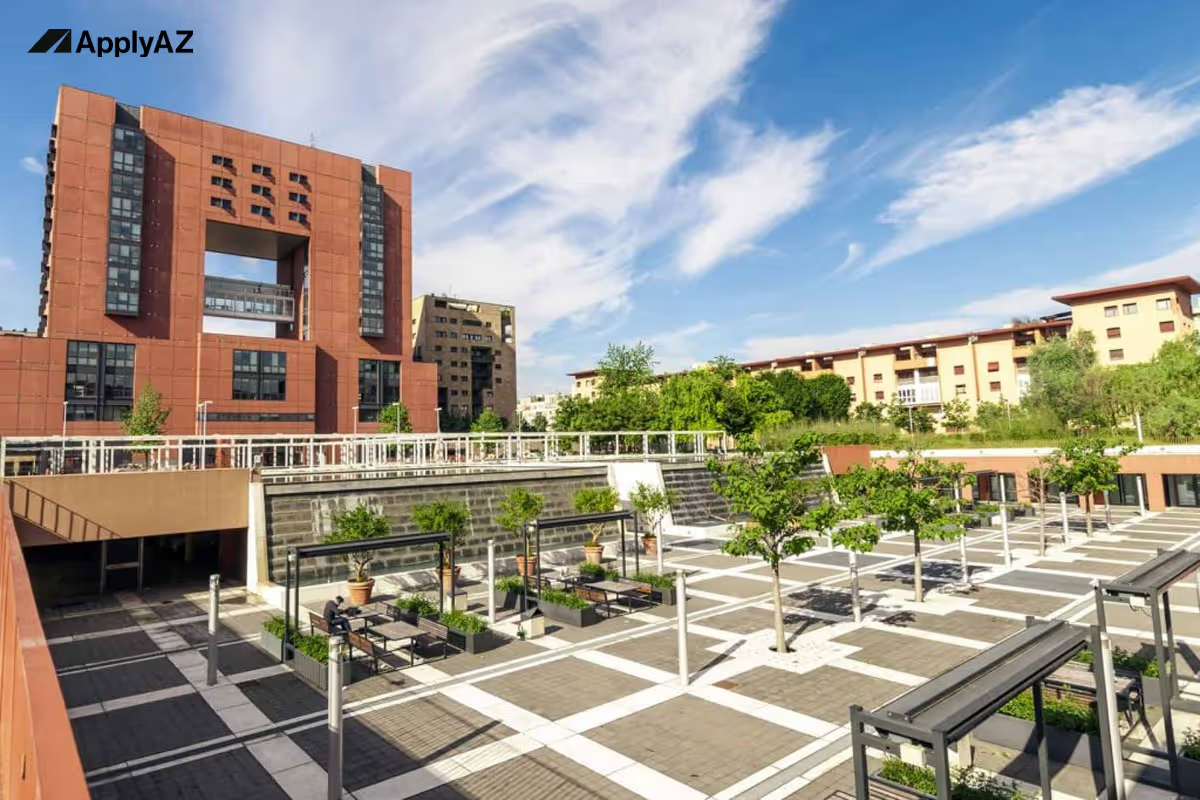
Applied Experimental Psychological Sciences is a two-year, 120 CFU master's degree (class LM-51) taught in English at the University of Milano-Bicocca in Milan. Entry needs a degree with at least 88 graded credits in psychology and English at B2, with selection on study record and CV. Regional scholarship winners get a 50% or 100% fee reduction, so it can be tuition-free for eligible students.
Entry requirements
Detailed entry requirements
Milano-Bicocca's Applied Experimental Psychological Sciences master asks for a bachelor's or recognised foreign degree with at least 88 graded credits in psychology subjects, plus English at B2. There is no entrance test: a committee ranks applicants on their study record and CV. Reviewed 8 October 2026. [1]
Degree and psychology credits
You need a bachelor's degree, a master's degree or a foreign academic qualification that the university's International Admissions Office judges suitable. [1]
- 88 credits in psychology: at least 88 CFU suitably spread across the eight psychology sectors: general psychology, psychobiology and neuroscience, psychometrics and quantitative methods, developmental and educational psychology, social psychology, work and organisational psychology, psychodynamic psychology, and clinical and health psychology (M-PSI/01 to 08, now PSIC-01 to 04).
- Graded exams only: the credits must come from university courses with a mark, not a pass or fail judgement.
- Earned by the deadline: for 2026/27, all 88 credits had to be earned by the application deadline of 31 March 2026.
For foreign degrees, the committee works out the equivalent from the teaching hours shown on your transcript or course syllabi. As a rough guide, an Italian 6 CFU course has about 42 hours of lectures and an 8 CFU course about 56. Courses with only some psychology content may not count. [1]
What this means for your transcript
As a guide, based on the rule above:
- Usually a fit: a three-year BA or B.Sc. in Psychology, or a BA with Psychology Honours, where most graded courses are psychology papers.
- Check carefully: a BA in which psychology is one of two or three main subjects, or a B.Sc. in Cognitive Science or Neuroscience. These reach 88 credits only if enough courses map to the psychology sectors.
- Often short: a B.Tech, B.E., BCA, B.Com, BBA or a B.Sc. in a non-psychology subject, even with some statistics or behavioural courses, because statistics outside psychology may map to a maths sector instead.
Credits from single-course exams can count towards the 88, except courses that match compulsory AEPS units. [1]
English
You need English at CEFR level B2 or higher. With a foreign degree, you can show it in one of three ways: [1]
- An English certificate at B2 or above that the university recognises, issued no more than five years before.
- A bachelor's degree taught entirely in English, with a statement from your university.
- A passport from a listed country, including Australia, Ireland, Malta, New Zealand, the United Kingdom, the United States and other countries on the university's list.
The requirement had to be met by 31 March 2026. Foreign-degree applicants without any of these could be admitted on condition that they obtained a suitable certificate by 31 July 2026. A recognised certificate above B2 earns 1 extra point in the ranking. The call does not list specific test scores. [1]
Selection and ranking
The call sets no entrance test and no interview. A committee appointed by the psychology teaching council checks the minimum requirements and then ranks applicants on two separate lists, one of them for non-EU visa applicants. [1]
- Study record: up to 60 points, for example your degree mark and the marks in your 88 psychology credits.
- CV and other titles: up to 39 points, covering your CV and a motivation letter in English of up to 1,500 characters.
- English above B2: 1 extra point.
When scores tie, the younger candidate ranks higher. [1]
Places and 2026/27 deadlines
The 2026/27 call offered 65 places: 45 for Italian and EU citizens and non-EU citizens legally living in Italy, and 20 for non-EU citizens who need a visa. Unused visa places pass to the other list. [1]
Applicants with a foreign degree applied from 18 February to 31 March 2026 and paid the non-refundable application fee by the same date. Final-year students could apply if they graduated by 31 October 2026. Rankings were published by 18 May 2026, and if places stayed free after the ranking moved, applications reopened from 7 July to 7 September 2026. The 2027/28 call sets the next dates. [1]
Documents and non-EU steps
With a foreign degree you upload your degree certificate, or a certificate of enrolment if you are still studying, an updated transcript, your motivation letter, proof of English and a passport or ID card. Detailed course syllabi in English or Italian are not compulsory but strongly recommended. The university may also ask for a CIMEA statement of comparability or verification if it needs further checks. [1]
Admitted candidates accept the offer and pay a deposit on the admissions platform, then upload the legalised degree certificate, a translation if needed, an Italian tax code and their visa documents. For 2026/27 the deadline for these was 31 October 2026, and visa applicants had to arrive in Italy by 31 January 2027. [1]
Sources and verification
Checked by the ApplyAZ admissions team against the university's official documents listed below. Entry rules can change with each new call, and we re-check them before every application.
- University of Milano-Bicocca. Call for admission to the Master's degree programme in Applied Experimental Psychological Sciences (class LM-51), academic year 2026/27. Reviewed 8 October 2026.
- University of Milano-Bicocca, Applied Experimental Psychological Sciences programme page (language, degree class, duration, department, aims and access). Reviewed 8 October 2026.
- University of Milano-Bicocca. Student contribution guide for degree programmes, academic year 2026/27. Reviewed 8 October 2026.
- University of Milano-Bicocca. Guide to fee exemptions, academic year 2026/27. Reviewed 8 October 2026.
About the programme
Applied Experimental Psychological Sciences (AEPS) is a two-year master's degree (laurea magistrale, class LM-51) taught in English at the University of Milano-Bicocca. It is run by the Department of Psychology on the Bicocca campus in Milan and has limited enrolment. [2]
The degree applies advanced psychological science to real human needs in different settings. It covers current thinking on the cognitive, social, emotional and neural processes behind thought, behaviour, language, knowledge and decision-making. [2]
What you will learn
The programme aims to give you advanced theoretical and empirical knowledge and research methods you can transfer between contexts, then apply to one specific problem during the course. It balances flexible methods with depth in a single applied question. [2]
The degree is worth 120 CFU. The 2026/27 call describes it as a master's degree that qualifies graduates for the psychologist profession in Italy, and it includes 8 CFU of practical evaluative training (Tirocinio Pratico Valutativo). Graduates of an Italian psychology bachelor's (class L-24) can have up to 8 CFU of earlier practical training recognised; other graduates complete the 8 CFU on top of the 120. [1]
If your foreign degree is judged comparable in content to an Italian psychology bachelor's, you can ask after enrolment for up to 8 CFU of certified practical activities to be recognised. [1]
Career paths
The university says graduates can build careers in academia, the private sector and the public sector, in Italy and abroad, and that the degree is a foundation for doctoral study. [2]
Fees and scholarships
Milano-Bicocca places its psychology programmes in fee Area A. Students with foreign citizenship, a foreign qualification and residence abroad pay a fixed yearly amount set by country group, and Group 1, which includes India, Pakistan, Bangladesh and Sri Lanka, has the lowest rate. [3]
Winners of a regional DSU scholarship get a 50% or 100% reduction of the main university contribution, depending on the type of award, so this programme can be tuition-free for eligible students. [4]
How to apply from outside the EU
For 2026/27 the call offered 65 places, 20 of them reserved for non-EU citizens who need a visa, on a separate ranking. There is no entrance test: a committee scores your study record and your CV. [1]
Applicants with a foreign degree applied on the university's international admissions platform from 18 February to 31 March 2026, and rankings were published by 18 May 2026. Admitted visa applicants then uploaded their enrolment documents by 31 October 2026 and had to obtain the visa and arrive in Italy by 31 January 2027. The 2027/28 call sets the next dates. [1]
How ApplyAZ helps
ApplyAZ is an Italy-based consultancy that works only with public universities. We can include this programme in a shortlist of 20 to 30 English-taught programmes that fit your profile, so your plan never rests on a single application.
For eligible students who start with us, a named person owns each stage, from A to Z:
- We check your transcript against Milano-Bicocca's entry rules for this programme.
- We write your CV and a tailored statement of purpose.
- We prepare and submit your online application with your transcript, syllabi and motivation letter, enrolment documents and Universitaly pre-enrolment.
- We help you declare your family income for reduced fees and file your regional DSU scholarship application at the right time and in the right format.
- We prepare your visa file.
With operations in all 20 Italian regions, we follow each region's scholarship rules and deadlines as they change. The university decides admission, the region decides the scholarship and the consulate decides the visa, so no one can promise an outcome. You pay in milestones, and every service you pay for is either delivered or its fee is refunded (terms apply).
Programmes at Italian public universities can be tuition-free for eligible students. Check if you are eligible and book a one-to-one consultation session with one of our Italy experts, or see how ApplyAZ works.
Questions and answers
What bachelor's degree do I need for Applied Experimental Psychological Sciences at Milano-Bicocca?
A bachelor's or recognised foreign degree with at least 88 credits in psychology subjects from graded exams, across areas such as general, developmental, social, clinical and work psychology, psychobiology and psychometrics. For 2026/27 the credits had to be earned by 31 March 2026. [1]
Is there an entrance test or interview?
No. The 2026/27 call set no test or interview. A committee ranked applicants on their study record, up to 60 points, and their CV and English motivation letter, up to 39 points, with 1 extra point for English above B2. [1]
What English level is required? Do I need IELTS?
English at B2 or higher, shown by a recognised certificate from the last five years, a bachelor's taught entirely in English or a passport from a listed country. The call does not list specific scores, so we check which proof your file can use. [1]
When is the deadline for non-EU students?
For 2026/27, applicants with a foreign degree applied from 18 February to 31 March 2026, and rankings came out by 18 May 2026. The 2027/28 call sets the next dates. [1]
Can I apply before I graduate?
Yes. For 2026/27, non-EU visa applicants could apply if they graduated by 31 October 2026, but the 88 psychology credits had to be earned by the 31 March 2026 deadline. [1]
How many places are there for non-EU students?
For 2026/27 the call offered 65 places, 20 of them for non-EU citizens who need a visa, ranked on a separate list. Unused visa places pass to the other list. [1]
I have a BA with psychology as one of my subjects. Can I apply?
Possibly. A BA where psychology is one of several main subjects may not reach 88 graded psychology credits. The committee converts your courses using teaching hours, so a detailed syllabus helps, and statistics taught outside psychology may not count. [1]
Does this degree qualify me as a psychologist?
The 2026/27 call lists AEPS as a master's degree that qualifies for the psychologist profession in Italy. It includes 8 credits of practical evaluative training, which graduates without an Italian psychology bachelor's complete on top of the 120 credits unless earlier training is recognised. [1]
Can someone handle my whole application to Applied Experimental Psychological Sciences at Milano-Bicocca?
Yes. ApplyAZ, an Italy-based consultancy that works only with public universities, checks your transcript against Milano-Bicocca's rules for this programme, handles the application and Universitaly pre-enrolment, helps you file the regional DSU scholarship application at the right time and in the right format, and prepares your visa file, for eligible students. Start by checking your eligibility.
I'm applying from India. What is the route into Applied Experimental Psychological Sciences?
A recognised Indian bachelor's in psychology, such as a BA or B.Sc. in Psychology, can meet the rule if it includes at least 88 credits of graded psychology courses. You also need English at B2. [1] The steps are the online application with your transcript, syllabi and motivation letter, a place on the ranking for the 20 visa places, and Universitaly pre-enrolment. Indian students apply for the type D study visa at the Italian embassy or consulate that covers their state, such as New Delhi, Mumbai or Bengaluru.
Is the route different from Pakistan, Bangladesh or Sri Lanka?
No. The academic rules for Applied Experimental Psychological Sciences are the same whatever your nationality. Applicants from Pakistan, Bangladesh and Sri Lanka follow the same steps as India: online application with your transcript, syllabi and motivation letter, a place on the visa ranking and Universitaly pre-enrolment, then a type D study visa from the Italian mission for their country of residence. Read our guide for students in Dhaka.
I live in the UAE, Saudi Arabia, Qatar, Kuwait, Oman or Bahrain. Where do I apply for the visa?
At the Italian embassy or consulate responsible for the country where you legally live, after Universitaly pre-enrolment. The academic rules for Applied Experimental Psychological Sciences are the same whatever your nationality, and Gulf residents follow the same steps: online application with your transcript, syllabi and motivation letter, a place on the visa ranking and Universitaly pre-enrolment. Read our guides for Dubai, Riyadh and Doha.
I studied or live in London, New York, Toronto, Vancouver, Singapore or Kuala Lumpur. What is the route?
The academic rules for Applied Experimental Psychological Sciences are the same whatever your nationality, and your degree is assessed like any other foreign qualification. Non-EU applicants who live abroad follow the same route: online application with your transcript, syllabi and motivation letter, a place on the visa ranking and Universitaly pre-enrolment, then a type D study visa from the Italian mission for where they live. Read our guides for students in London, New York, Toronto, Vancouver, Singapore and Kuala Lumpur.
More English-taught programmes at this university
Other public universities in this city

They began right where you are

