

Bachelor in Architecture at Polytechnic University of Turin
Three-year architecture bachelor at Politecnico di Torino, with an English-taught stream at Castello del Valentino, Turin, built around design ateliers and thematic semesters. Entry needs 12 years of schooling, the TIL-A test and English at B2.
Bachelor
3 years
Turin
English
Polytechnic University of Turin



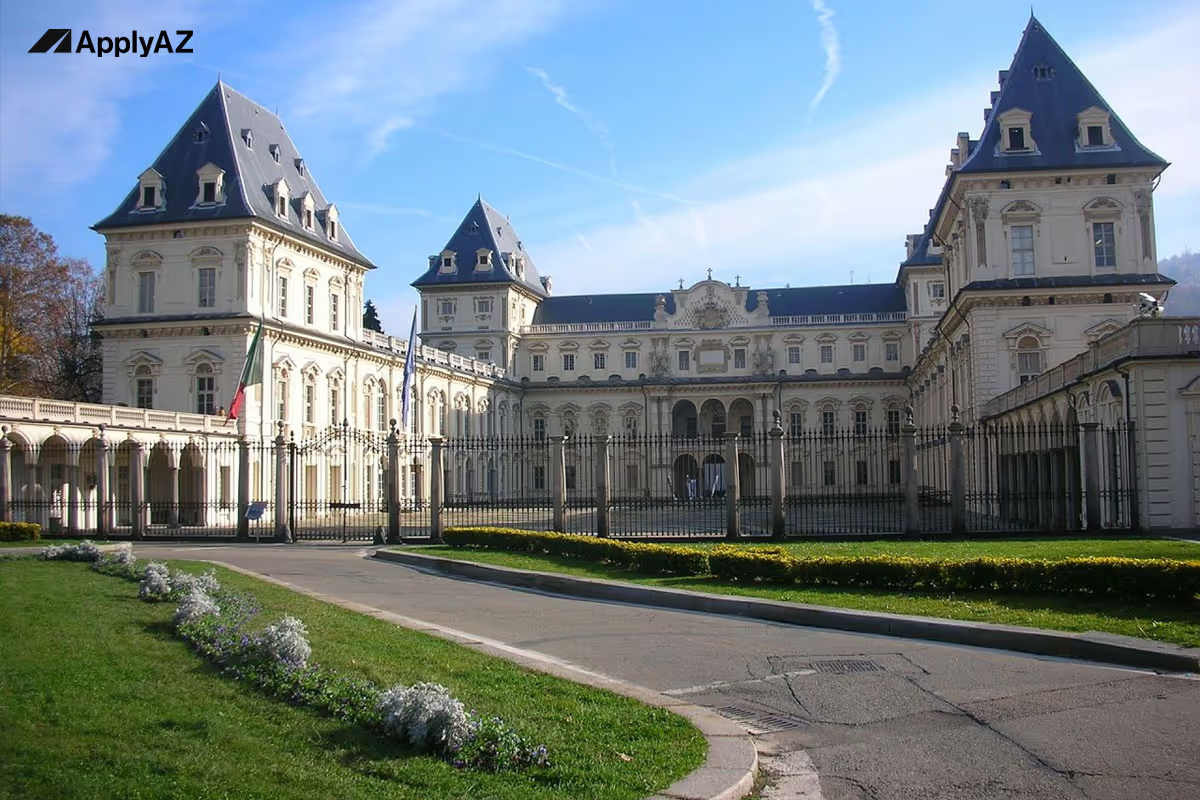
Architecture is a three-year, 180 ECTS bachelor's degree (class L-17) at Politecnico di Torino, taught entirely in English or entirely in Italian at the Castello del Valentino campus in Turin. Entry needs a school diploma after 12 years of schooling, a ranked place through the TIL-A test, as the SAT is not accepted, and English at B2 for the English stream. Places are capped.
Entry requirements
Detailed entry requirements
PoliTo's Architecture bachelor asks for a secondary school diploma after at least 12 years of schooling, a ranked place through the TIL-A admission test, as the SAT is not accepted, and, for the English-taught programme, an English certificate at CEFR B2 or above unless your qualification gives an exemption. Places are capped. Reviewed 8 October 2026. [1]
School-leaving requirement
You need a secondary school diploma awarded after at least 12 years of schooling. If your school system is shorter, one of these routes applies: [1]
- 11 years of schooling: plus all first-year university exams passed.
- 10 years of schooling: plus all first and second-year university exams passed.
- 10 or 11 years of schooling: plus a post-secondary qualification from a non-university institution in a field related to architecture, or a completed Foundation course on Politecnico's accepted list or a recognised foreign equivalent.
Some qualifications carry extra rules: [1]
- UK diplomas: at least three A levels in different subjects from the architecture list: Art and Design, Biology, Business, Chemistry, Classical Studies, Computer Science, Design and Technology, Digital Media and Design, Economics, Environmental Management, Information Technology, Mathematics, Further Mathematics, Media Studies and Physics.
- US high school diplomas: three Advanced Placement courses passed with a grade from 3 to 5: one in the arts, one in maths, computer science or science, and one more from either group.
- International Baccalaureate: at least 24 points in six subjects, 12 of them at Higher Level, plus a pass in Theory of Knowledge, CAS and the Extended Essay.
- National entrance exams: where a country regulates university entry with a national test, you also need proof that you passed it.
Non-EU applicants from school systems that allow a diploma before 18 must be 17 when they obtain the study visa. [1]
What this means for your school results
Places are ranked on the TIL-A score, not on school marks, but your school qualification must still meet the rule above. As a guide, based on the rule above:
- Usually a fit: Class 12 or Higher Secondary results after 12 years of schooling, such as CBSE, ISC or a state board in India, or the HSSC or HSC in Pakistan and Bangladesh.
- Check carefully: A levels from a British-curriculum school. You need three from the architecture list, so a mix that includes subjects outside it, such as Psychology or Sociology, can leave you short.
- Often short: a qualification after 10 or 11 years of schooling on its own, such as an SSC or O levels, unless you add passed university exams, a related post-secondary qualification or a Foundation course.
The call sets subject rules only for UK, Scottish, US and IB qualifications. The TIL-A still tests drawing, history, maths and physics, and a low physics and maths score brings extra first-year obligations. [1][2]
English
The English-taught programme needs an English certificate at CEFR B2 or above from Politecnico's accepted list. [1][2] Minimum results include IELTS Academic or General Training 5.5, TOEFL iBT 72 (or 4 for tests taken after 21 January 2026), PTE Academic 59 and a Cambridge English Scale score of 160 on exams from B1 Preliminary to C2 Proficiency. [7]
You are exempt if any of these applies: [1][3]
- An IB Diploma studied entirely in English, apart from foreign languages.
- A qualification from the United States, the United Kingdom, Ireland, Australia or New Zealand.
- A qualification earned after an English-medium path at a school or university in a listed country, which includes India, Pakistan, Bangladesh, Sri Lanka, Malaysia, Singapore, Nigeria, Ghana and Kenya. The proof is an official statement from your school that English was the medium of instruction.
For 2026/27, Architecture applicants with a non-Italian qualification had to enter their English certificate or exemption on Apply@polito by 15 July 2026 at 2 p.m., or lose the right to enrol. [1][3]
Selection: the TIL-A test
- Format: 50 multiple-choice questions in 100 minutes, in English or Italian, in five timed sections of 10 questions and 20 minutes each: reading comprehension, history (including history of art) and general knowledge, logical reasoning, drawing and representation, and physics and mathematics. [1]
- Scoring: 1 point for a correct answer, 0 for no answer and minus 0.25 for a wrong answer, out of 50. Each test is drawn at random with equivalent difficulty. [1]
- Where: in person in Politecnico di Torino's laboratories, with your passport as identification. [1]
- SAT: not valid for Architecture. [3]
- Maths support: a score below 3 out of 10 in physics and mathematics brings extra first-year obligations, cleared by passing the Year 1 mathematics exam or the final test of the online CIAO course. [1][2]
Places and ranking
For 2026/27, the programme had 500 places across the Italian and English streams: 415 for EU and equivalent applicants, of which up to 40 in the English-taught programme, and 85 for non-EU applicants living abroad who need a visa. [1]
Politecnico publishes separate ranking lists for the two groups, ordered by TIL-A score. Ties are broken by the logic, reading, drawing, physics and maths, and history sections in that order, then by age, younger first. Offers go down the list until all places are filled. [1]
2026/27 dates
These dates come from the 2026/27 call. The 2027/28 call is not yet published and will set the new dates. [1]
- TIL-A registration: 12 June to 15 July 2026 at 2 p.m., choosing the language of instruction.
- English certificate or exemption: by 15 July 2026 at 2 p.m. for applicants with a non-Italian qualification.
- Test: 21 or 22 July 2026.
- Ranking: published on 24 July 2026, with place reservation by 29 July 2026 at 2 p.m. Updates followed on 30 July, 1 September and 4 September 2026.
- Online enrolment: by 30 September 2026.
Politecnico validates a Universitaly pre-enrolment for Architecture once you have passed the TIL-A and reserved your place. Its indicative Universitaly date for 2026/27 was 30 June 2026, and the portal stayed open after it. [3]
Documents and non-EU steps
To enrol with a non-Italian qualification you present: [1][3]
- Your passport and type D study visa for university enrolment.
- An Italian tax code (codice fiscale).
- Your school diploma with an official Italian translation. Diplomas in English, French or Spanish need no translation.
- A declaration of value or a CIMEA statement of comparability for your diploma. An ARDI certificate of correspondence can replace the CIMEA statement, but Politecnico may ask for a CIMEA verification certificate.
- Your national entrance exam certificate, if your country has one, and your English certificate.
For 2026/27, these documents were uploaded by 30 September 2026 and checked before 11 November 2026. A missing declaration of value or CIMEA statement could follow by 30 June 2027 under conditional enrolment, and non-EU students had to upload their type D visa by 30 November 2026. [4]
You can register for the TIL-A in your final school year, as long as you get your diploma that summer. The TIL-A score is valid only for enrolment in the same academic year. [1]
Sources and verification
Checked by the ApplyAZ admissions team against the university's official documents listed below. Entry rules can change with each new call, and we re-check them before every application.
- Politecnico di Torino. Call for applications for admission to the bachelor's degree programme in Architettura-Architecture, for EU and equivalent applicants and non-EU applicants residing abroad and requiring a visa, academic year 2026/27 (Rector's decree no. 575/2026). Reviewed 8 October 2026.
- Politecnico di Torino, Department of Architecture and Design. Academic regulations, bachelor's degree programme in Architecture (class L-17), academic year 2026/27 (Rector's decree no. 525 of 28 May 2026). Reviewed 8 October 2026.
- Politecnico di Torino. Admissions to bachelor's degree programmes for applicants with a non-Italian qualification, academic year 2026/27. Reviewed 8 October 2026.
- Politecnico di Torino. Enrolment regulations for bachelor's degree programmes, academic year 2026/27. Reviewed 8 October 2026.
- Politecnico di Torino. Architecture bachelor's degree programme pages (overview, programme details and after graduation), academic year 2026/27. Reviewed 8 October 2026.
- Politecnico di Torino. Tuition fees page, academic year 2026/27. Reviewed 8 October 2026.
- Politecnico di Torino, Language Centre. Table of certificates and minimum requirements for B2 English, adopted 23 September 2019, updated January 2026. Reviewed 8 October 2026.
About the programme
Architecture is a three-year bachelor's degree in class L-17 at Politecnico di Torino, run by the Department of Architecture and Design and taught at the Castello del Valentino campus in Turin. [2][5]
The degree is taught either entirely in Italian or entirely in English: three Italian-taught streams run alongside one English-taught stream. Admission is capped, with a compulsory admission test, the TIL-A. [1][2]
The university presents architecture as a passion for planning and a desire to transform the environment to improve quality of life. The degree suits students who want to design buildings and spaces and who enjoy both drawing and technical problem solving.
What you will study
The course follows the whole architectural process, from the first idea to the built project and its supervision. According to the programme page, graduates learn to: [5]
- Design simple civic buildings using established methods
- Survey contemporary buildings
- Survey historical buildings
- Develop a project from the first concept
- Follow a project through construction and supervision, with an analytical approach at each phase
The 2026/27 regulations organise the six semesters into thematic rooms: [2]
- Instruct (Year 1): architectural design, building technology, drawing and survey, history of architecture, structural engineering, urban planning and mathematics.
- Place (semester 3): architecture and the territory, with urban studies and the history of the modern city.
- Build (semester 4): design in relation to the site, comfort, structural performance and construction.
- Enquire (semester 5): restoration and design theory, real estate valuation and the history of the city.
- Explore (semester 6): a related course and an interdisciplinary design atelier of your choice, to prepare for a master's.
The detailed course units and design studios for each year are published in the university's online course catalogue.
How the programme is taught
Teaching combines single-subject courses, drawing, survey and geomatics laboratories, and multidisciplinary design ateliers in every year. From Year 2 you choose one of six design ateliers each semester, and from the second semester of Year 2 you add free-choice credits, such as courses, workshops, research essays or student team work, as an alternative to a 300-hour internship. [2]
The degree ends with a final portfolio of your design and theoretical work, worth 3 credits and prepared in Italian or English. [2] Politecnico di Torino treats international study as a key part of its graduates' growth and offers short and long exchange periods with partner universities in Europe and beyond. [5]
Career paths
Graduates work as junior architects. The programme page lists professional design studios, public administration, engineering and architecture firms, companies in the sector and construction firms. [5] After passing the Italian State Examination, graduates can register as junior architects in section B of the Register of Architects. The regulations note that this title is specific to Italy and is not recognised across the EU, where the architect title needs at least four years of study. [2]
Graduates can continue to an LM-4 master's degree in architecture at Politecnico di Torino or at other universities in Italy or abroad. [2] Politecnico di Torino's own master's options include Architecture Construction City, Architecture for Sustainability and Architecture for Heritage.
Fees and scholarships
Politecnico di Torino sets tuition under its yearly Tuition Fee Regulations, and students can request a reduction based on family income through an ISEE or ISEE Parificato, so programmes can be tuition-free for eligible students. [1][6]
EDISU Piemonte, the regional right-to-study body, gives scholarships and accommodation to eligible students, international students included; with a family abroad, we help you send the income and asset documents so EDISU can calculate an equivalent ISEE.
How to apply from outside the EU
Architecture has its own call, Architettura-Architecture, issued once the Ministry of University and Research has set the national rules. For 2026/27, registrations opened on 12 June 2026. [1]
Applicants register on Apply@polito, choose the English-taught programme and take the TIL-A test, 50 questions in five sections including drawing and representation; SAT scores do not count. For 2026/27 the TIL-A was held on 21 or 22 July 2026, in person in Politecnico di Torino's laboratories, and 85 of the 500 places were reserved for non-EU applicants living abroad who need a visa. [1][3]
Admitted students reserve their place by paying the first instalment, complete Universitaly pre-enrolment, apply for a type D study visa and enrol online, uploading a declaration of value or CIMEA statement for their diploma. [1][3][4] The 2027/28 call is not yet published and will set the new dates.
How ApplyAZ helps
ApplyAZ is an Italy-based consultancy that works only with public universities. We can include this programme in a shortlist of 20 to 30 English-taught programmes that fit your profile, so your plan never rests on a single application.
For eligible students who start with us, a named person owns each stage, from A to Z:
- We check your school results against PoliTo's entry rules for this programme.
- We write your CV and a tailored statement of purpose.
- We prepare and submit your Apply@polito application, TIL-A registration, place reservation and Universitaly pre-enrolment.
- We help you declare your family income for reduced fees and file your EDISU Piemonte scholarship application at the right time and in the right format.
- We prepare your visa file.
With operations in all 20 Italian regions, we follow each region's scholarship rules and deadlines as they change. The university decides admission, the region decides the scholarship and the consulate decides the visa, so no one can promise an outcome. You pay in milestones, and every service you pay for is either delivered or its fee is refunded (terms apply).
Programmes at Italian public universities can be tuition-free for eligible students. Check if you are eligible and book a one-to-one consultation session with one of our Italy experts, or see how ApplyAZ works.
Questions and answers
What school qualification do I need for Architecture at PoliTo?
A secondary school diploma after at least 12 years of schooling. With 10 or 11 years, you also need passed university exams, a related post-secondary qualification or an accepted Foundation course. UK, US and IB qualifications have extra subject rules, and places then go by TIL-A score. [1]
Is there an entrance test? Can I use the SAT?
Yes, the TIL-A, and the SAT is not accepted for Architecture. The TIL-A has 50 questions in 100 minutes, 10 each on reading comprehension, history and general knowledge, logic, drawing and representation, and physics and maths. You can take it in English or Italian. [1][3]
How is the TIL-A scored?
A correct answer scores 1 point, an unanswered question 0 and a wrong answer loses 0.25, for a maximum of 50. Places go in score order. Below 3 out of 10 in physics and maths brings extra first-year obligations, cleared by passing the Year 1 maths exam or the CIAO course test. [1][2]
What English level is required? Do I need IELTS?
English at CEFR B2 or above for the English-taught programme, such as IELTS 5.5, TOEFL iBT 72, PTE Academic 59 or a Cambridge English Scale score of 160. You are exempt with an English-medium qualification from a listed country, including India, Pakistan, Bangladesh and Sri Lanka. [1][7]
When is the deadline for non-EU students?
For 2026/27, TIL-A registration ran from 12 June to 15 July 2026, with the English certificate due by 15 July and the test on 21 or 22 July. The ranking came out on 24 July, and places had to be reserved by 29 July. The 2027/28 call is not yet published. [1]
Can I take the TIL-A before I finish school?
Yes, if you get your diploma in the summer of the test year. The TIL-A score is valid only for enrolment in that academic year, so a 2026 score counted only for 2026/27. [1]
I did not study art or drawing at school. Can I still apply?
Yes. The call sets no subject list for Class 12 results, only the 12-year rule. But the TIL-A has 10 drawing and representation questions and 10 on history, including history of art, so preparing for those sections matters. UK, US and IB routes do have subject rules. [1]
What jobs can I do after this degree?
After the Italian State Examination you can work as a junior architect in design studios, public administration, engineering and architecture firms and construction companies. The junior architect title is specific to Italy, and the EU architect title needs at least four years of study, so you can continue to an LM-4 master's. [2][5]
Can someone handle my whole application to Architecture at PoliTo?
Yes. ApplyAZ, an Italy-based consultancy that works only with public universities, checks your school results against PoliTo's rules for this programme, handles the application and Universitaly pre-enrolment, helps you file the EDISU Piemonte scholarship application at the right time and in the right format, and prepares your visa file, for eligible students. Start by checking your eligibility.
I'm applying from India. What is the route into Architecture?
Indian Class 12 results from CBSE, ISC or a state board come after 12 years of schooling, which meets the school-length rule. Your place then depends on your TIL-A score, as the SAT is not accepted for Architecture, plus English at B2, with an exemption if your school taught in English. The steps are the Apply@polito application, the TIL-A, the ranking, place reservation and Universitaly pre-enrolment. [1] Indian students apply for the type D study visa at the Italian embassy or consulate that covers their state, such as New Delhi, Mumbai or Bengaluru.
Is the route different from Pakistan, Bangladesh or Sri Lanka?
No. The academic rules for Architecture are the same whatever your nationality. Applicants from Pakistan, Bangladesh and Sri Lanka follow the same steps as India: Apply@polito application, the TIL-A test, the ranking, place reservation and Universitaly pre-enrolment, then a type D study visa from the Italian mission for their country of residence. Read our guide for students in Dhaka.
I live in the UAE, Saudi Arabia, Qatar, Kuwait, Oman or Bahrain. Where do I apply for the visa?
At the Italian embassy or consulate responsible for the country where you legally live, after Universitaly pre-enrolment. The academic rules for Architecture are the same whatever your nationality, and Gulf residents follow the same steps: Apply@polito application, the TIL-A test, the ranking, place reservation and Universitaly pre-enrolment. Read our guides for Dubai, Riyadh and Doha.
I studied or live in London, New York, Toronto, Vancouver, Singapore or Kuala Lumpur. What is the route?
The academic rules for Architecture are the same whatever your nationality, and your school results are assessed like any other foreign qualification. Non-EU applicants who live abroad follow the same route: Apply@polito application, the TIL-A test, the ranking, place reservation and Universitaly pre-enrolment, then a type D study visa from the Italian mission for where they live. Read our guides for students in London, New York, Toronto, Vancouver, Singapore and Kuala Lumpur.
More English-taught programmes at this university
Other public universities in this city

They began right where you are

